Energy Bills
Average Electric Bill by State in 2026
Quick answer
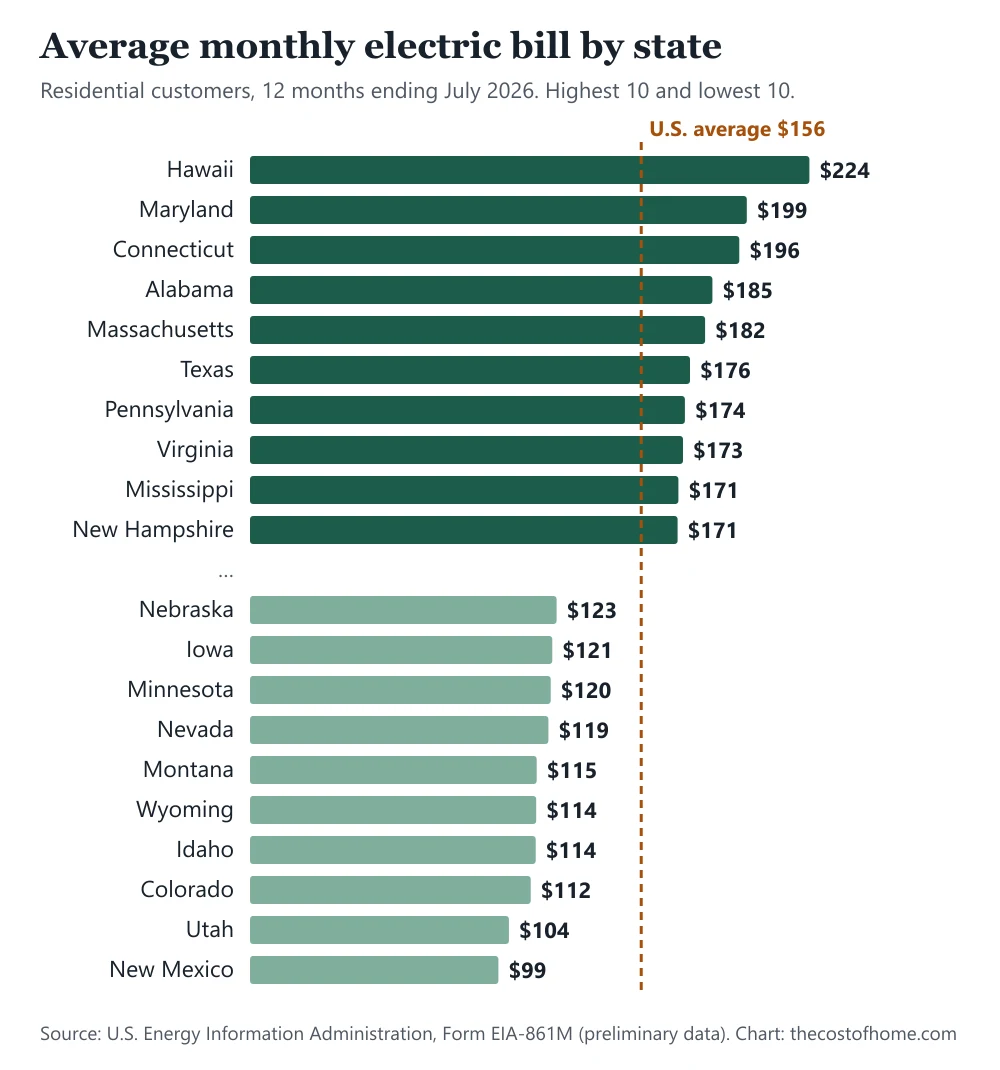
The average U.S. home paid about $156 a month for electricity in the 12 months ending July 2026, using roughly 870 kWh at 18 cents per kWh. Bills range from about $99 in New Mexico to $224 in Hawaii. Summer is the expensive season: the national average reached $212 in July 2026, against $128 in April.
On this page
- What is the average electric bill in each state?
- Which states have the highest electric bills?
- Which states have the cheapest electric bills?
- Why doesn't the price per kWh predict the bill?
- How much does the bill change from month to month?
- Is electricity getting more expensive?
- How do you compare your bill with your state's average?
- FAQ
- Sources
Your electric bill comes down to two numbers: how many kilowatt-hours (kWh) your home uses, and what you pay for each one. Both change a lot from state to state, which is why a $180 bill is normal in Alabama and high in Utah.
The figures below come from the U.S. Energy Information Administration (EIA), which collects monthly revenue, sales and customer counts from every electric utility and power supplier. The average bill is residential revenue divided by the number of residential customers, month by month, averaged over the 12 months from August 2025 to July 2026. The 2026 months are still marked preliminary by the EIA.
What is the average electric bill in each state?
Find your state below. The "monthly use" column shows how much electricity a typical home there buys, and the price column is the average paid per kWh over the same 12 months.
| State | Avg. monthly bill | Monthly use | Price per kWh | Rank |
|---|---|---|---|---|
| U.S. average | $156.49 | 870 kWh | 17.99¢ | – |
| Alabama | $184.97 | 1,125 kWh | 16.44¢ | 4 |
| Alaska | $157.58 | 587 kWh | 26.85¢ | 24 |
| Arizona | $161.99 | 1,052 kWh | 15.40¢ | 18 |
| Arkansas | $140.72 | 1,048 kWh | 13.43¢ | 32 |
| California | $160.65 | 487 kWh | 32.99¢ | 20 |
| Colorado | $112.27 | 677 kWh | 16.58¢ | 49 |
| Connecticut | $195.71 | 699 kWh | 27.99¢ | 3 |
| Delaware | $165.17 | 929 kWh | 17.79¢ | 14 |
| District of Columbia | $152.53 | 630 kWh | 24.20¢ | 28 |
| Florida | $169.13 | 1,099 kWh | 15.39¢ | 11 |
| Georgia | $161.60 | 1,069 kWh | 15.12¢ | 19 |
| Hawaii | $223.75 | 514 kWh | 43.51¢ | 1 |
| Idaho | $114.28 | 904 kWh | 12.65¢ | 48 |
| Illinois | $131.52 | 700 kWh | 18.79¢ | 40 |
| Indiana | $158.42 | 935 kWh | 16.94¢ | 21 |
| Iowa | $120.91 | 856 kWh | 14.13¢ | 43 |
| Kansas | $132.01 | 875 kWh | 15.09¢ | 37 |
| Kentucky | $154.19 | 1,107 kWh | 13.92¢ | 27 |
| Louisiana | $155.92 | 1,200 kWh | 12.99¢ | 26 |
| Maine | $156.02 | 532 kWh | 29.31¢ | 25 |
| Maryland | $198.72 | 945 kWh | 21.03¢ | 2 |
| Massachusetts | $182.03 | 598 kWh | 30.43¢ | 5 |
| Michigan | $132.68 | 630 kWh | 21.05¢ | 35 |
| Minnesota | $120.27 | 742 kWh | 16.22¢ | 44 |
| Mississippi | $171.38 | 1,160 kWh | 14.77¢ | 9 |
| Missouri | $145.28 | 1,041 kWh | 13.95¢ | 30 |
| Montana | $114.69 | 829 kWh | 13.84¢ | 46 |
| Nebraska | $122.65 | 954 kWh | 12.86¢ | 42 |
| Nevada | $119.37 | 894 kWh | 13.36¢ | 45 |
| New Hampshire | $171.02 | 641 kWh | 26.67¢ | 10 |
| New Jersey | $157.92 | 664 kWh | 23.78¢ | 23 |
| New Mexico | $99.37 | 649 kWh | 15.32¢ | 51 |
| New York | $166.72 | 587 kWh | 28.39¢ | 12 |
| North Carolina | $151.98 | 1,029 kWh | 14.77¢ | 29 |
| North Dakota | $132.42 | 1,075 kWh | 12.32¢ | 36 |
| Ohio | $158.12 | 866 kWh | 18.25¢ | 22 |
| Oklahoma | $144.15 | 1,052 kWh | 13.70¢ | 31 |
| Oregon | $131.63 | 849 kWh | 15.50¢ | 38 |
| Pennsylvania | $173.98 | 840 kWh | 20.70¢ | 7 |
| Rhode Island | $164.03 | 560 kWh | 29.27¢ | 15 |
| South Carolina | $165.28 | 1,057 kWh | 15.64¢ | 13 |
| South Dakota | $140.03 | 986 kWh | 14.20¢ | 34 |
| Tennessee | $162.48 | 1,198 kWh | 13.56¢ | 17 |
| Texas | $176.00 | 1,103 kWh | 15.96¢ | 6 |
| Utah | $103.57 | 778 kWh | 13.32¢ | 50 |
| Vermont | $140.60 | 591 kWh | 23.80¢ | 33 |
| Virginia | $173.19 | 1,051 kWh | 16.48¢ | 8 |
| Washington | $131.55 | 932 kWh | 14.12¢ | 39 |
| West Virginia | $163.06 | 1,053 kWh | 15.48¢ | 16 |
| Wisconsin | $124.47 | 664 kWh | 18.74¢ | 41 |
| Wyoming | $114.48 | 817 kWh | 14.01¢ | 47 |
Average for residential customers over the 12 months ending July 2026. Rank 1 = highest bill. Source: U.S. EIA, Form EIA-861M (preliminary).
Use these numbers as a yardstick, not a forecast. Your own bill depends on the size of your home, how it is heated and cooled, your utility's rate plan and the weather where you live.
Which states have the highest electric bills?
The five most expensive states for a monthly electric bill were:
- Hawaii ($224 a month, 514 kWh at 43.5¢)
- Maryland ($199 a month, 945 kWh at 21.0¢)
- Connecticut ($196 a month, 699 kWh at 28.0¢)
- Alabama ($185 a month, 1,125 kWh at 16.4¢)
- Massachusetts ($182 a month, 598 kWh at 30.4¢)
They get there in two different ways. Hawaii, Connecticut and Massachusetts have some of the highest prices per kWh in the country, but homes there use relatively little electricity. Alabama is the opposite: electricity there is cheaper than the national average, but a typical home buys 1,125 kWh a month, among the most in the country.
Which states have the cheapest electric bills?
The lowest average bills were in the Mountain West:
- New Mexico ($99 a month, 649 kWh at 15.3¢)
- Utah ($104 a month, 778 kWh at 13.3¢)
- Colorado ($112 a month, 677 kWh at 16.6¢)
- Idaho ($114 a month, 904 kWh at 12.7¢)
- Wyoming ($114 a month, 817 kWh at 14.0¢)
These states combine moderate prices with moderate use. Idaho stands out with one of the lowest prices in the country, 12.7¢ per kWh, which keeps the bill low even though homes there use more than the national average.
Why doesn't the price per kWh predict the bill?
Because use varies just as much as price. California has one of the highest prices, 33.0¢ per kWh, yet its average bill ($161) is close to the national average. California homes buy only 487 kWh a month, the lowest of any state. Louisiana shows the reverse: one of the cheapest prices, 13.0¢, and a bill of $156, because the average home there buys 1,200 kWh a month, the most in the country.
Rooftop solar also plays a part. The EIA notes that homes with net-metered solar panels buy less electricity from the grid, so in states with a lot of residential solar, like California and Hawaii, the average purchase understates how much electricity homes actually use. How long panels take to pay for themselves in each state is in solar panel payback period by state.
How much does the bill change from month to month?
A lot. Across the U.S., the average bill swung from $128 in April 2026 to $212 in July 2026, a difference of about $85. Air conditioning drives the summer peak, and electric heating causes a second, smaller peak in winter: January 2026 averaged $175.
| Month | Avg. bill | Avg. use |
|---|---|---|
| Aug 2025 | $189.77 | 1,078 kWh |
| Sep 2025 | $158.64 | 878 kWh |
| Oct 2025 | $132.99 | 740 kWh |
| Nov 2025 | $125.41 | 705 kWh |
| Dec 2025 | $153.78 | 892 kWh |
| Jan 2026 | $175.11 | 1,003 kWh |
| Feb 2026 | $156.82 | 888 kWh |
| Mar 2026 | $138.80 | 748 kWh |
| Apr 2026 | $127.71 | 678 kWh |
| May 2026 | $135.70 | 736 kWh |
| Jun 2026 | $170.65 | 930 kWh |
| Jul 2026 | $212.44 | 1,160 kWh |
U.S. average for residential customers, by month. Source: U.S. EIA, Form EIA-861M (preliminary).
If you're budgeting, plan around your state's summer months rather than the yearly average.
Is electricity getting more expensive?
Yes. The average residential price in the U.S. was 18.31¢ per kWh in July 2026, up from 17.45¢ in July 2025, an increase of about 4.9% in a year, according to the EIA's Electric Power Monthly. Prices rose in 45 of the 50 states and DC over that year, so the averages on this page will likely creep up as new months are added. This guide is updated when the EIA publishes new data.
How do you compare your bill with your state's average?
You need two numbers from your bill: the total amount and the kWh used in the billing period. Then:
- Find your price per kWh. Divide the total by the kWh. For example, $150 for 900 kWh works out to about 16.7¢ per kWh. This "all-in" price includes delivery charges and fees, which is how the EIA averages are calculated too. Our guide to how to read your electric bill explains each line.
- Compare your use. Put your monthly kWh next to the "monthly use" column for your state, keeping the season in mind: a July bill will be well above the yearly average.
- See which number is out of line. If your price is higher than your state's average, look at your rate plan and fixed charges. If your use is higher, heating, cooling and water heating are the usual places to look.
Electricity is not the only big yearly bill that changes by state. The average U.S. homeowners policy costs about as much as 11 months of electricity, and our guide to homeowners insurance cost by state sets the two side by side.
Frequently asked questions
What is the average electric bill in the U.S. in 2026?
About $156 a month, based on EIA data for the 12 months ending July 2026. The average home used 870 kWh a month at about 18 cents per kWh.
Which state has the highest electric bill?
Hawaii, at about $224 a month, because it has by far the highest price per kWh (43.5¢). Maryland ($199) and Connecticut ($196) come next.
Which state has the lowest electric bill?
New Mexico, at about $99 a month, followed by Utah ($104) and Colorado ($112).
Is a $200 electric bill high?
For a typical month, yes: it is above the national average of $156 and above the yearly average of every state except Hawaii. In summer it is closer to normal: the U.S. average reached $212 in July 2026, and several states averaged more than $240 that month.
How many kWh does an average home use per month?
About 870 kWh nationally. It ranges from 487 kWh in California to 1,200 kWh in Louisiana.
Why is my electric bill higher in summer?
Air conditioning. Across the U.S., average use jumped from 678 kWh in April 2026 to 1,160 kWh in July 2026, and the average bill went from $128 to $212.
Sources
- U.S. Energy Information Administration, Form EIA-861M: monthly sales, revenue and customers by state (accessed October 15, 2026)
- U.S. Energy Information Administration, Electric Power Monthly, Table 5.6.A: average price of electricity by state, July 2026 and 2025
- U.S. Energy Information Administration, "How much electricity does an American home use?"

Founder and editor, The Cost of Home
I lived in the United States for five years, and this site grew out of the question every household there keeps asking: what will this cost, and is it worth it? Every number here comes from a public source listed at the end of the article.