Energy Bills
How Much Does Charging an Electric Car at Home Add to Your Bill?
Quick answer
Charging an electric car at home adds about $49 a month to the average U.S. electric bill, or $582 a year. That assumes 10,787 miles a year, the federal average per vehicle, a car that uses 30 kWh per 100 miles, and the 17.99-cent national average price per kWh. It raises the average home's bill by about 31%, and the same miles in a 25 mpg gasoline car cost about $1,848.
On this page
- How much does it cost to charge an electric car at home?
- How many kWh does an EV add to your monthly bill?
- What does home charging cost in each state?
- Is charging at home cheaper than gasoline?
- Do you need a Level 2 charger at home, and what does it cost?
- Why can your real charging cost be higher than these estimates?
- How can you lower the cost of charging at home?
- How was this calculated?
- FAQ
- Sources
Charging at home is the part of owning an electric car that shows up on the electric bill instead of at a gas pump. Four numbers decide how much it adds: how many miles you drive, how many kilowatt-hours your car uses per mile, what your utility charges per kWh, and how much of your charging happens at home. The first three are easy to look up, and this guide multiplies them for you.
For the U.S. average driver in a typical electric SUV, the answer is about $49 a month. It runs from about $39 for an efficient sedan to $78 for a full-size electric pickup, and from about $33 in North Dakota to $117 in Hawaii. The prices come from the same federal data as our average electric bill by state guide.
How much does it cost to charge an electric car at home?
Cost = miles driven × (kWh per 100 miles ÷ 100) × price per kWh. The U.S. Environmental Protection Agency (EPA) rates every new electric vehicle in kWh per 100 miles, and its figures are measured at the wall outlet, so they already include the energy lost in the charging cable and the car's onboard charger. At the U.S. average price of 17.99 cents per kWh, a car rated at 30 kWh per 100 miles costs $5.40 per 100 miles, or about 5.4 cents a mile.
The rating depends on the car. The EPA's 2026 list of all-electric vehicles runs from 23 kWh per 100 miles for the Lucid Air Pure RWD to 66 for the Bugatti Rimac Nevera R, and the Department of Energy (DOE) says today's all-electric cars can drive 100 miles on 25 to 40 kWh. About two-thirds of the 321 versions on the 2026 list fall between 25 and 40, and heavier trucks and large SUVs sit above it. A compact SUV such as the Hyundai Ioniq 5 RWD, rated at 30, is the benchmark in the rest of this guide.
| Model | Type | kWh per 100 miles | Cost per 100 miles | Cost per month | Cost per year |
|---|---|---|---|---|---|
| Tesla Model 3 Standard RWD | Efficient sedan | 24 | $4.32 | $38.81 | $466 |
| Hyundai Ioniq 5 RWD | Compact SUV | 30 | $5.40 | $48.51 | $582 |
| Ford Mustang Mach-E AWD | Midsize SUV | 34 | $6.12 | $54.98 | $660 |
| Kia EV9 Long Range AWD | Three-row SUV | 40 | $7.20 | $64.69 | $776 |
| Chevrolet Silverado EV Extended Range WT | Full-size pickup | 48 | $8.64 | $77.62 | $931 |
Cost of charging at home for 2026 all-electric models, by efficiency, at the U.S. average price of 17.99 cents per kWh and 10,787 miles a year. Efficiency is the EPA combined rating in kWh per 100 miles.
For scale, the 10,787-mile year in the table is the Federal Highway Administration's (FHWA) 2024 average for a light-duty vehicle, or 899 miles a month and 30 miles a day. It is an average for all light-duty vehicles, not only electric ones, so use your own odometer when you can. Public fast charging is priced differently: the DOE's Fuel Economy site says some public chargers are free, while others charge a flat fee per session, a subscription, or a price by energy used or time plugged in, so none of this math applies to them.
How many kWh does an EV add to your monthly bill?
The same 899 miles a month at 30 kWh per 100 miles is about 270 kWh. The average U.S. home used about 870 kWh a month over the 12 months ending July 2026, so a typical electric car adds roughly 31% to the electricity a home uses. The household bill averaged $156.49 over the same months, and $48.51 on top of it is the +31% in the answer above. The DOE's Fuel Economy site gives its own example with the same method: a car that uses 35 kWh per 100 miles, driven 12,000 miles a year at 13 cents per kWh, would add $45.50 to the monthly bill.
Your own number depends on miles and efficiency, so here is the monthly cost for a range of both at the U.S. average price.
| Miles per year | 25 kWh/100 mi | 30 kWh/100 mi | 35 kWh/100 mi | 40 kWh/100 mi | 50 kWh/100 mi |
|---|---|---|---|---|---|
| 5,000 | $19 | $22 | $26 | $30 | $37 |
| 7,500 | $28 | $34 | $39 | $45 | $56 |
| 10,787 (U.S. average) | $40 | $49 | $57 | $65 | $81 |
| 15,000 | $56 | $67 | $79 | $90 | $112 |
| 20,000 | $75 | $90 | $105 | $120 | $150 |
Monthly cost of charging at home by miles driven per year and EV efficiency, at 17.99 cents per kWh. Efficiency is in kWh per 100 miles.
A driver who covers 5,000 miles a year in an efficient car adds about $19 a month. A high-mileage driver in a heavy pickup, at 20,000 miles and 50 kWh, adds $150. For context on what the rest of a home draws, the EIA's 2020 household survey found that homes that charged a vehicle at home used an average of 2,363 kWh a year for it; compare that with the other big loads in why is my electric bill so high.
What does home charging cost in each state?
Electricity prices differ far more than electric cars do, so the state you live in matters more than the model you buy. The table applies each state's average residential price over the 12 months ending July 2026 to the same 10,787 miles at 30 kWh per 100 miles. The last column compares the monthly charging cost with what the average home in that state pays now.
| State | Price per kWh | Cost per 100 miles | Cost per month | Cost per year | Added to the average bill |
|---|---|---|---|---|---|
| U.S. average | 17.99¢ | $5.40 | $48.51 | $582 | +31% |
| Alabama | 16.44¢ | $4.93 | $44.33 | $532 | +24% |
| Alaska | 26.85¢ | $8.05 | $72.41 | $869 | +46% |
| Arizona | 15.40¢ | $4.62 | $41.53 | $498 | +26% |
| Arkansas | 13.43¢ | $4.03 | $36.22 | $435 | +26% |
| California | 32.99¢ | $9.90 | $88.97 | $1,068 | +55% |
| Colorado | 16.58¢ | $4.97 | $44.71 | $537 | +40% |
| Connecticut | 27.99¢ | $8.40 | $75.48 | $906 | +39% |
| Delaware | 17.79¢ | $5.34 | $47.98 | $576 | +29% |
| District of Columbia | 24.20¢ | $7.26 | $65.26 | $783 | +43% |
| Florida | 15.39¢ | $4.62 | $41.50 | $498 | +25% |
| Georgia | 15.12¢ | $4.54 | $40.77 | $489 | +25% |
| Hawaii | 43.51¢ | $13.05 | $117.34 | $1,408 | +52% |
| Idaho | 12.65¢ | $3.79 | $34.11 | $409 | +30% |
| Illinois | 18.79¢ | $5.64 | $50.67 | $608 | +39% |
| Indiana | 16.94¢ | $5.08 | $45.68 | $548 | +29% |
| Iowa | 14.13¢ | $4.24 | $38.11 | $457 | +32% |
| Kansas | 15.09¢ | $4.53 | $40.69 | $488 | +31% |
| Kentucky | 13.92¢ | $4.18 | $37.54 | $450 | +24% |
| Louisiana | 12.99¢ | $3.90 | $35.03 | $420 | +22% |
| Maine | 29.31¢ | $8.79 | $79.04 | $949 | +51% |
| Maryland | 21.03¢ | $6.31 | $56.71 | $681 | +29% |
| Massachusetts | 30.43¢ | $9.13 | $82.06 | $985 | +45% |
| Michigan | 21.05¢ | $6.32 | $56.77 | $681 | +43% |
| Minnesota | 16.22¢ | $4.87 | $43.74 | $525 | +36% |
| Mississippi | 14.77¢ | $4.43 | $39.83 | $478 | +23% |
| Missouri | 13.95¢ | $4.18 | $37.62 | $451 | +26% |
| Montana | 13.84¢ | $4.15 | $37.32 | $448 | +33% |
| Nebraska | 12.86¢ | $3.86 | $34.68 | $416 | +28% |
| Nevada | 13.36¢ | $4.01 | $36.03 | $432 | +30% |
| New Hampshire | 26.67¢ | $8.00 | $71.92 | $863 | +42% |
| New Jersey | 23.78¢ | $7.13 | $64.13 | $770 | +41% |
| New Mexico | 15.32¢ | $4.60 | $41.31 | $496 | +42% |
| New York | 28.39¢ | $8.52 | $76.56 | $919 | +46% |
| North Carolina | 14.77¢ | $4.43 | $39.83 | $478 | +26% |
| North Dakota | 12.32¢ | $3.70 | $33.22 | $399 | +25% |
| Ohio | 18.25¢ | $5.47 | $49.22 | $591 | +31% |
| Oklahoma | 13.70¢ | $4.11 | $36.95 | $443 | +26% |
| Oregon | 15.50¢ | $4.65 | $41.80 | $502 | +32% |
| Pennsylvania | 20.70¢ | $6.21 | $55.82 | $670 | +32% |
| Rhode Island | 29.27¢ | $8.78 | $78.93 | $947 | +48% |
| South Carolina | 15.64¢ | $4.69 | $42.18 | $506 | +26% |
| South Dakota | 14.20¢ | $4.26 | $38.29 | $460 | +27% |
| Tennessee | 13.56¢ | $4.07 | $36.57 | $439 | +23% |
| Texas | 15.96¢ | $4.79 | $43.04 | $516 | +24% |
| Utah | 13.32¢ | $4.00 | $35.92 | $431 | +35% |
| Vermont | 23.80¢ | $7.14 | $64.18 | $770 | +46% |
| Virginia | 16.48¢ | $4.94 | $44.44 | $533 | +26% |
| Washington | 14.12¢ | $4.24 | $38.08 | $457 | +29% |
| West Virginia | 15.48¢ | $4.64 | $41.75 | $501 | +26% |
| Wisconsin | 18.74¢ | $5.62 | $50.54 | $606 | +41% |
| Wyoming | 14.01¢ | $4.20 | $37.78 | $453 | +33% |
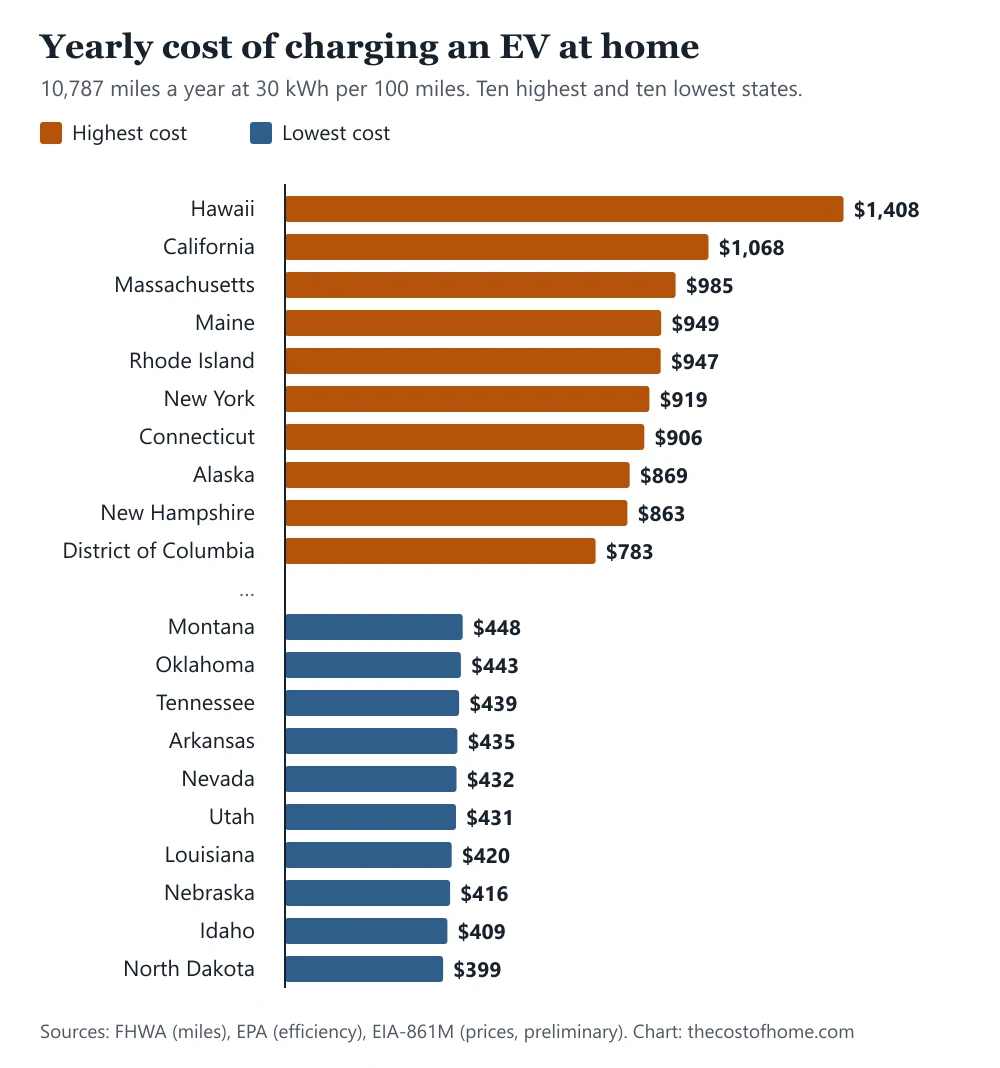
Estimated cost of charging an EV at home, by state: 10,787 miles a year at 30 kWh per 100 miles, at each state's average residential price over the 12 months ending July 2026 (preliminary). The last column compares the monthly charging cost with the state's average electric bill.
North Dakota has the cheapest power (12.32 cents per kWh), so a year of charging costs about $399 there. Hawaii is the most expensive at 43.51 cents, and the same driving costs about $1,408. California ($1,068 a year) and the Northeast, where Massachusetts ($985), Maine ($949) and Rhode Island ($947) lead, are the costly places to charge. The effect on the bill is largest where homes use little electricity: California comes first at +55%, because the average home there uses only 487 kWh a month, and Hawaii follows at +52%. In Louisiana ($420), Tennessee ($439) and Texas ($516) the car adds a smaller share.
Is charging at home cheaper than gasoline?
At today's prices, by a wide margin. The EIA's weekly survey put regular gasoline at $4.28 a gallon on October 19, 2026. A gasoline car that gets 25 mpg, a round figure we use as the comparison, burns 431 gallons over 10,787 miles, which is about $1,848 a year, or $154 a month. The same miles in an electric SUV at 30 kWh per 100 miles cost $582 a year at the national electricity price, $1,266 less.
The comparison also holds up in the costliest state. Gasoline at $4.28 and 25 mpg costs $17.14 per 100 miles, and electricity would have to reach about 57 cents per kWh to cost the same per mile as the electric SUV; Hawaii's 43.51 cents is well below that. Gasoline prices vary by region too, and the EIA reports a higher average on the West Coast than on the Gulf Coast, so check the price at your own station.
Do you need a Level 2 charger at home, and what does it cost?
Not necessarily, and the charger type does not change the price of a kWh. It changes how long a charge takes. The EPA says Level 1 charging, a standard 120-volt outlet and the cord that comes with the car, adds around 3 to 5 miles of range per hour. Level 2, a 240-volt charger, adds around 25 to 40 miles per hour. The average driver covers about 30 miles a day, which takes roughly 6 to 10 hours on Level 1 and about an hour on Level 2. The DOE notes that many owners meet their daily needs with Level 1 charging overnight at no added cost, if a dedicated outlet is near where the car is parked, and that Level 2 suits longer commutes, large batteries or irregular schedules.

If you add a Level 2 charger, the EPA puts the equipment at $400 to $1,000 and the installation at $300 to $2,000, depending on the home's setup, the distance from the electrical panel and any upgrades the panel needs. Safety-certified equipment, a certified electrician and a check on permits are recommended by the DOE. This is a one-time cost, separate from the monthly figures above, and some state and utility incentives may offset it.
Why can your real charging cost be higher than these estimates?
The tables use a national average for miles and an EPA rating, so your own year can differ. Four things move the number most:
- Winter. The EPA's cold-weather page says an electric car's fuel economy can drop roughly 39% and its range 41%, and that about two-thirds of the extra energy goes to heating the cabin. With the heater off, efficiency at 20°F is still 8% lower than at 75°F. Colder states will see more kWh per mile in winter than the table shows.
- Miles. A 20,000-mile year costs about 1.9 times the average year, as the table above shows.
- The vehicle. A full-size pickup at 48 kWh per 100 miles costs about 2 times as much per mile as an efficient sedan at 24.
- Your rate plan. The state averages blend every kind of customer. Your utility's tiers, delivery charges and any time-of-use schedule decide what the last kWh costs you; the price here includes delivery and fees because it is the bill divided by the kWh used.
Charging also lands on top of what your bill already does through the year. Our guides to the electric bill in winter vs summer and what central air costs to run show how much of the seasonal swing comes from heating and cooling.
How can you lower the cost of charging at home?
- Charge off-peak. The EPA points out that many chargers can schedule charging to take advantage of lower off-peak electricity rates, where available. Ask your utility whether it offers a time-of-use or EV rate.
- Preheat while plugged in. The EPA says preheating the cabin while the car is on the charger can extend range, and that seat warmers use less energy than the cabin heater.
- Pick efficiency when you shop. The kWh per 100 miles rating is on the label and at fueleconomy.gov. Going from 40 to 30 saves $194 a year at the U.S. average price and $356 in California.
- Offset it with solar. A rooftop system can cover part of the added load; see what solar panels cost in 2026 and how much sun each state gets. Hot water is the other large electric load that runs all year, covered in what a water heater costs to replace and run.
How was this calculated?
Yearly cost is miles × kWh per 100 miles ÷ 100 × price per kWh. Miles are the FHWA's 2024 average for all light-duty vehicles, 10,787. Efficiency figures are the EPA combined ratings published at fueleconomy.gov for 2026 models, which assume Level 2 charging and measure energy at the outlet. The base case of 30 kWh per 100 miles matches the compact SUVs on that list, such as the Hyundai Ioniq 5 RWD, Volkswagen ID.4 and Chevrolet Equinox EV FWD (30, 30 and 31).
The price is the U.S. residential average for the 12 months from August 2025 to July 2026 from the EIA's monthly utility survey (Form EIA-861M): residential revenue divided by kilowatt-hours sold, 17.99 cents. The state prices are calculated the same way. The EIA marks 2026 months as preliminary, so they may be revised. The gasoline comparison uses the EIA's weekly U.S. regular price for October 19, 2026 and a 25 mpg car, which is our assumption, not a survey result.
Three limits apply. The tables assume all charging happens at home at the average price, while public charging costs more or less depending on the network. They do not include the cost of a charger or of any electrical upgrade, or any incentive. And homes with rooftop solar or a special EV rate will pay differently. Our full approach is in how we research costs, and more guides on bills and rates are in the Energy Bills section.
Frequently asked questions
How much does it cost to charge an electric car at home per month?
About $49 a month at the U.S. average price of 17.99 cents per kWh, for 10,787 miles a year in a car that uses 30 kWh per 100 miles. The range is about $39 for an efficient sedan to $78 for a full-size electric pickup, and it varies by state from about $33 in North Dakota to $117 in Hawaii.
How much does it cost to fully charge an electric car at home?
It depends on the battery. Adding 200 miles of range takes about 60 kWh at 30 kWh per 100 miles, which costs $10.79 at the U.S. average price of 17.99 cents per kWh. Multiply the kWh your car adds by your own rate to get your cost.
How many kWh does an electric car use per mile?
The DOE says all-electric cars can drive 100 miles on 25 to 40 kWh, or 0.25 to 0.40 kWh per mile, and about two-thirds of the 2026 versions on the EPA list fall in that band. The list runs from 23 kWh per 100 miles for the Lucid Air Pure RWD to 66 for the Bugatti Rimac Nevera R. The figures include the energy lost while charging.
Does charging an electric car raise your electric bill a lot?
For the average driver it adds about 31% to the average home's bill, about $49 on $156. The share is larger in states where homes use little electricity, such as California (+55%), and smaller in states with high household use and low prices.
How much does it cost to charge a Tesla at home?
The 2026 Model Y is rated between 24 and 32 kWh per 100 miles and the Model 3 between 24 and 30, depending on version. At the U.S. average price and 10,787 miles a year, that is about $39 to $52 a month.
Is it cheaper to charge an electric car at home than at a public station?
Usually, yes. The EPA calls home charging typically the most time- and cost-effective method. Public chargers set their own prices, and the DOE says they may be free or billed per session, by subscription, per kWh or per minute, so the cost depends on the network and region.
Do I need a Level 2 charger to charge at home?
Not always. A standard 120-volt outlet adds around 3 to 5 miles of range per hour, according to the EPA, which can cover about 30 miles a day overnight. A Level 2 charger adds around 25 to 40 miles per hour and costs about $400 to $1,000 for the equipment plus $300 to $2,000 for installation.
Sources
- U.S. Energy Information Administration, Form EIA-861M: monthly sales, revenue and customers by state (accessed October 15, 2026)
- U.S. Department of Energy and EPA, fueleconomy.gov: Fuel Economy of 2026 All-Electric Vehicles (accessed October 21, 2026)
- U.S. Environmental Protection Agency, Fuel Economy and EV Range Testing (MPGe and kWh per 100 miles measured at the outlet)
- Federal Highway Administration, Highway Statistics 2024, Table VM-1: annual vehicle distance traveled in miles (accessed October 21, 2026)
- U.S. Energy Information Administration, Gasoline and Diesel Fuel Update: weekly U.S. regular retail price (week of October 19, 2026)
- U.S. Department of Energy, fueleconomy.gov: Charging an Electric Vehicle (Level 1 and Level 2 speeds, home and public charging costs)
- U.S. Environmental Protection Agency, Getting Started with Home EV Charging (charging speeds, equipment and installation costs, off-peak scheduling)
- U.S. Department of Energy, Alternative Fuels Data Center: Charging at Home (Level 1 and Level 2 equipment, installation guidance)
- U.S. Department of Energy, Alternative Fuels Data Center: Electric Vehicle Benefits and Considerations (25 to 40 kWh per 100 miles)
- U.S. Department of Energy and EPA, fueleconomy.gov: Fuel Economy in Cold Weather
- U.S. Energy Information Administration, 2020 Residential Energy Consumption Survey, table CE5.3a: averages per household using the end use (accessed October 21, 2026)

Founder and editor, The Cost of Home
I lived in the United States for five years, and this site grew out of the question every household there keeps asking: what will this cost, and is it worth it? Every number here comes from a public source listed at the end of the article.