Heating & Cooling
How Much Does It Cost to Run Central Air Conditioning?
Quick answer
A 3-ton central air conditioner rated 15.2 SEER2, the ENERGY STAR level, draws about 2.4 kW and costs roughly 43 cents an hour at July 2026's U.S. average price of 18.3 cents per kWh. Run it 8 hours a day for a month and that is about $104. The average U.S. home that uses air conditioning spends roughly $425 a year on it, and about $800 in Arizona.
On this page
- How much does central air conditioning cost per hour?
- How much does central air cost to run per month?
- How much does central air conditioning cost to run per year in each state?
- What does SEER2 mean, and how much does a higher rating save?
- Why can my air conditioning cost more than these estimates?
- How can you lower the cost of running central air?
- How was this calculated?
- FAQ
- Sources
What central air costs to run comes down to four numbers: the size of the system, how efficient it is, how many hours it actually runs, and what your utility charges for a kilowatt-hour. The first two are on the unit, the third depends on your weather and thermostat, and the fourth is on your bill. Multiply them and you have your own number.
This guide does that math for the whole range of systems, then adds a state-by-state estimate. About 88% of U.S. homes use air conditioning, and two-thirds use a central air conditioner or central heat pump as their main equipment, according to the U.S. Energy Information Administration (EIA). Air conditioning accounted for about 19% of all residential electricity use in 2020. The prices come from the EIA's monthly utility data, the same source as our average electric bill by state guide.
How much does central air conditioning cost per hour?
A ton of cooling is 12,000 Btu per hour, so a 3-ton system is rated at 36,000 Btu/h. The efficiency rating, SEER2, is the cooling the system delivers over a whole season divided by the electricity it uses over that season, according to the U.S. Department of Energy (DOE). Divide the size by the rating and you get the power draw: a 3-ton system at 15.2 SEER2 uses 36,000 ÷ 15.2 ÷ 1,000 = 2.37 kW. At 18.3 cents per kWh, the July 2026 U.S. average, that is $0.43 per hour.
| Size | 13.4 SEER2 | 14.3 SEER2 | 15.2 SEER2 | 17 SEER2 | 20 SEER2 |
|---|---|---|---|---|---|
| 2 tons (24,000 Btu/h) | $0.33 | $0.31 | $0.29 | $0.26 | $0.22 |
| 3 tons (36,000 Btu/h) | $0.49 | $0.46 | $0.43 | $0.39 | $0.33 |
| 4 tons (48,000 Btu/h) | $0.66 | $0.61 | $0.58 | $0.52 | $0.44 |
| 5 tons (60,000 Btu/h) | $0.82 | $0.77 | $0.72 | $0.65 | $0.55 |
Cost per hour of running a central air conditioner, by size and SEER2 rating, at the July 2026 U.S. average electricity price of 18.3 cents per kWh.
The cheapest case in the table, a small 2-ton system at 20 SEER2, costs $0.22 an hour. The costliest, a 5-ton system at the 13.4 minimum, costs $0.82. The price per kWh here includes delivery charges and fees, because it is the bill divided by the kilowatt-hours used. Your SEER2 rating is on the unit's yellow EnergyGuide label.
These are average-day figures. SEER2 is a seasonal average, and on the hottest afternoons a system works harder. The DOE measures that with a second rating, EER2, which is the efficiency at a 95°F outdoor temperature. ENERGY STAR requires at least 12.0 EER2 for split systems, and a 3-ton system at that rating draws 3.0 kW, or $0.55 an hour at the same price. Expect the hourly cost to sit above the table on peak days and below it in mild weather.
How much does central air cost to run per month?
Hours of use is the number that varies most. What counts is the time the compressor is actually running, not the time the thermostat is set to cool, because the system cycles on and off to hold the temperature and runs longer on hot days. The table shows a 3-ton system for a 30-day month.
| Run time per day | 13.4 SEER2 | 14.3 SEER2 | 15.2 SEER2 | 17 SEER2 | 20 SEER2 |
|---|---|---|---|---|---|
| 4 hours | $59 | $55 | $52 | $47 | $40 |
| 8 hours | $118 | $111 | $104 | $93 | $79 |
| 12 hours | $177 | $166 | $156 | $140 | $119 |
Cost of running a 3-ton central air conditioner for 30 days, by hours of compressor run time per day and SEER2 rating, at 18.3 cents per kWh.
At 8 hours a day, a 3-ton system at 15.2 SEER2 uses 568 kWh and costs $104. For scale, the 2020 EIA survey puts the average home that uses air conditioning at about 2,300 kWh a year, and that figure includes window and wall units. A system like this one running 8 hours a day for four months would use about 2,270 kWh, so 8 hours a day over a four-month season is a fair picture of an average home, and 12 hours a day is a hot-climate summer. For a sense of the total, the average U.S. home's electric bill was $212 in July 2026, $37 more than in January (see electric bill in winter vs summer by state).
How much does central air conditioning cost to run per year in each state?
Cooling needs and electricity prices both change from state to state, so the yearly cost does too. The table below multiplies two public numbers: the electricity the average home that uses air conditioning burned on it in 2020, from the EIA's Residential Energy Consumption Survey (RECS), and the state's average residential price in July 2026. Find your state; the hourly column applies the state's price to a 3-ton, 15.2 SEER2 system.
| State | Homes with central AC | AC use per year | Price per kWh | Estimated yearly cost | 3-ton cost per hour |
|---|---|---|---|---|---|
| U.S. average | 67% | 2,320 kWh | 18.3¢ | $425 | $0.43 |
| Alabama | 81% | 3,080 kWh | 16.4¢ | $505 | $0.39 |
| Alaska | Not reported | 230 kWh | 28.8¢ | $66 | $0.68 |
| Arizona | 86% | 5,160 kWh | 15.4¢ | $794 | $0.36 |
| Arkansas | 72% | 2,870 kWh | 14.3¢ | $411 | $0.34 |
| California | 54% | 1,640 kWh | 33.6¢ | $551 | $0.80 |
| Colorado | 57% | 1,320 kWh | 17.0¢ | $224 | $0.40 |
| Connecticut | 34% | 1,200 kWh | 24.2¢ | $290 | $0.57 |
| Delaware | 85% | 1,790 kWh | 18.5¢ | $331 | $0.44 |
| District of Columbia | 68% | 1,470 kWh | 25.2¢ | $371 | $0.60 |
| Florida | 90% | 4,370 kWh | 15.0¢ | $657 | $0.36 |
| Georgia | 86% | 3,020 kWh | 16.3¢ | $491 | $0.39 |
| Hawaii | 12% | 2,840 kWh | 48.0¢ | $1,364 | $1.14 |
| Idaho | 64% | 1,320 kWh | 13.7¢ | $181 | $0.33 |
| Illinois | 74% | 1,490 kWh | 19.2¢ | $286 | $0.45 |
| Indiana | 81% | 1,760 kWh | 16.7¢ | $294 | $0.40 |
| Iowa | 81% | 1,470 kWh | 16.0¢ | $235 | $0.38 |
| Kansas | 85% | 2,580 kWh | 15.3¢ | $394 | $0.36 |
| Kentucky | 84% | 2,290 kWh | 13.8¢ | $316 | $0.33 |
| Louisiana | 76% | 4,510 kWh | 12.7¢ | $574 | $0.30 |
| Maine | 10% | 760 kWh | 32.4¢ | $246 | $0.77 |
| Maryland | 80% | 1,900 kWh | 21.4¢ | $407 | $0.51 |
| Massachusetts | 32% | 1,230 kWh | 30.5¢ | $375 | $0.72 |
| Michigan | 66% | 1,230 kWh | 23.1¢ | $284 | $0.55 |
| Minnesota | 68% | 1,030 kWh | 17.4¢ | $180 | $0.41 |
| Mississippi | 79% | 3,690 kWh | 14.5¢ | $537 | $0.34 |
| Missouri | 83% | 2,290 kWh | 16.1¢ | $368 | $0.38 |
| Montana | 40% | 820 kWh | 15.0¢ | $123 | $0.36 |
| Nebraska | 86% | 1,670 kWh | 13.8¢ | $230 | $0.33 |
| Nevada | 78% | 3,690 kWh | 12.8¢ | $471 | $0.30 |
| New Hampshire | 21% | 1,000 kWh | 26.6¢ | $266 | $0.63 |
| New Jersey | 61% | 1,760 kWh | 25.2¢ | $443 | $0.60 |
| New Mexico | 53% | 1,820 kWh | 16.1¢ | $293 | $0.38 |
| New York | 29% | 1,290 kWh | 29.9¢ | $385 | $0.71 |
| North Carolina | 84% | 2,460 kWh | 15.2¢ | $373 | $0.36 |
| North Dakota | 58% | 850 kWh | 13.4¢ | $114 | $0.32 |
| Ohio | 74% | 1,520 kWh | 19.4¢ | $295 | $0.46 |
| Oklahoma | 83% | 3,170 kWh | 14.3¢ | $455 | $0.34 |
| Oregon | 49% | 1,030 kWh | 16.0¢ | $164 | $0.38 |
| Pennsylvania | 54% | 1,550 kWh | 21.7¢ | $337 | $0.51 |
| Rhode Island | 31% | 1,140 kWh | 28.3¢ | $323 | $0.67 |
| South Carolina | 86% | 3,050 kWh | 15.5¢ | $472 | $0.37 |
| South Dakota | 76% | 1,320 kWh | 15.4¢ | $203 | $0.36 |
| Tennessee | 86% | 2,610 kWh | 13.7¢ | $358 | $0.32 |
| Texas | 83% | 3,990 kWh | 15.9¢ | $634 | $0.38 |
| Utah | 79% | 1,850 kWh | 13.1¢ | $243 | $0.31 |
| Vermont | 7% | 700 kWh | 23.8¢ | $166 | $0.56 |
| Virginia | 83% | 2,230 kWh | 17.6¢ | $392 | $0.42 |
| Washington | 30% | 880 kWh | 14.7¢ | $129 | $0.35 |
| West Virginia | 64% | 1,730 kWh | 15.8¢ | $273 | $0.37 |
| Wisconsin | 67% | 970 kWh | 19.1¢ | $185 | $0.45 |
| Wyoming | 40% | 1,000 kWh | 14.3¢ | $144 | $0.34 |
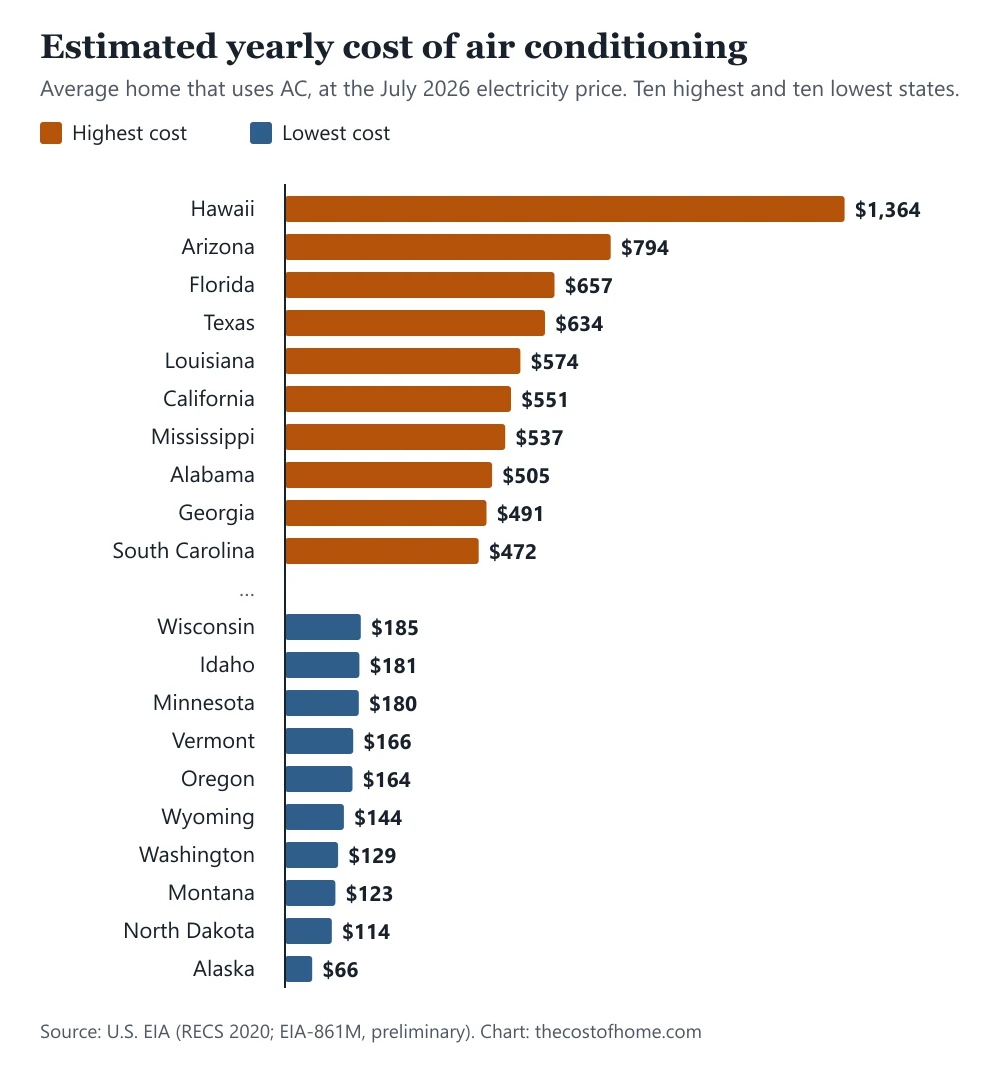
Estimated yearly cost of air conditioning in the average home that uses it, by state. Use is the 2020 EIA survey average for air conditioning of all types; price is the July 2026 residential average (preliminary); the hourly column is a 3-ton, 15.2 SEER2 central system.
These are estimates for the average home, not a forecast of your own bill. The survey counts every kind of air conditioner, including window units and mini-splits, so in states where central systems are less common, such as New York (29% of homes), Massachusetts (32%) and Hawaii (12%), a central system will usually cost more than the average shown.
Arizona has the highest cost on the mainland, $794 a year: homes use 5,160 kWh at 15.4 cents. Florida ($657), Texas ($634) and Louisiana ($574) follow. Hawaii comes first, at $1,364, because of price, not heat: its July average of 48.0 cents per kWh is more than three times Arizona's. Louisiana has the cheapest power (12.7 cents, so $0.30 an hour for the 3-ton system), while the same system costs $1.14 an hour in Hawaii. California's 33.6 cents makes cooling costly even though its homes use only 1,640 kWh.
What does SEER2 mean, and how much does a higher rating save?
The higher the SEER2, the less electricity the system needs for the same cooling. Since January 1, 2023, the DOE's minimum for a split-system air conditioner under 45,000 Btu/h (up to about 3.5 tons) is 13.4 SEER2 in the North and 14.3 SEER2 in the Southeast and Southwest. At 45,000 Btu/h and above, the South's minimum is 13.8. The Southwest is Arizona, California, Nevada and New Mexico; the Southeast is Alabama, Arkansas, Delaware, Florida, Georgia, Hawaii, Kentucky, Louisiana, Maryland, Mississippi, North Carolina, Oklahoma, South Carolina, Tennessee, Texas, Virginia and D.C. Everywhere else is the North. ENERGY STAR certification asks for 15.2 SEER2 and 12.0 EER2 in a split system, and the DOE lists 23.5 SEER2 as the most efficient ENERGY STAR model available.
Because power draw falls in proportion to the rating, the savings are easy to work out. For the same size and hours:
- 15.2 instead of 13.4 SEER2: about 12% less electricity. For a 3-ton system at 8 hours a day, that is $118 against $104 a month.
- 17 instead of 13.4: about 21% less, $93 a month.
- 20 instead of 13.4: about 33% less, $79 a month.
Over a four-month season, the step from 13.4 to 15.2 is worth about $56 at these assumptions, and 13.4 to 20 about $156. Whether a more efficient system pays for its higher price depends on how many hours you run it and what your power costs, so a high-use, high-price state such as Arizona or Texas gets more from it than a mild one. Heat pumps cool with the same equipment, and the DOE's minimum for a split-system heat pump is 14.3 SEER2; our heat pump vs gas furnace guide covers what one costs to run in winter.
Why can my air conditioning cost more than these estimates?
The tables assume a system that is the right size, correctly installed and well maintained. The DOE says installation problems such as oversizing, improper refrigerant charge and leaky ducts cause efficiency losses, along with discomfort and shorter equipment life. It also reports that households lose about 20% of their heated and cooled air through the duct system, and that a clogged filter restricts airflow and reduces efficiency. A home with poor attic or wall insulation, or air leaks, will also run its system longer than the average one.
The temperature gap matters too. The DOE notes that the smaller the difference between indoor and outdoor temperature, the lower the cooling bill, which is why a 105°F day in Phoenix costs more to cool than a 90°F day in Atlanta at the same thermostat setting.
How can you lower the cost of running central air?
The DOE's summer guidance points to a few changes that cost little:
- Raise the setting. Running air conditioning at 78°F instead of 72°F can save between 6% and 18% on the cooling bill. On a $104 month, that is $6 to $19.
- Use a ceiling fan. A ceiling fan lets you raise the thermostat about 4°F with no loss of comfort. Turn it off when you leave the room.
- Change the filter. A clogged filter lowers efficiency, so check it on a regular schedule.
- Seal and insulate the ducts. Have them inspected to make sure they are sealed properly and insulated if needed.
If cooling is the biggest part of your bill, rooftop solar produces the most when the air conditioner runs hardest; see what solar panels cost in 2026 and how much sun each state gives you. The other big electric use that runs all year is hot water: what a water heater costs to replace and run.
How was this calculated?
Power draw is the size in Btu per hour divided by the SEER2 rating and by 1,000, which gives kilowatts; cost is that figure times the hours and the price per kWh. The price is the U.S. residential average for July 2026 from the EIA's monthly utility survey (Form EIA-861M): residential revenue divided by kilowatt-hours sold, 18.3 cents. The EIA marks the 2026 months as preliminary, so they may be revised. The state prices are calculated the same way for each state.
The yearly figures use the EIA's 2020 Residential Energy Consumption Survey, which reports the electricity each state's homes that use air conditioning burn on it (in million Btu, converted at 293.07 kWh per million Btu), and apply July 2026 prices to it. Two limits follow. The survey covers all air-conditioning types, and it was taken before the DOE's 2023 efficiency standards, so a newly installed system should use somewhat less. Homes with rooftop solar buy less from the grid than they use. Our full approach is in how we research costs, and more guides on cooling and heating equipment are in the Heating & Cooling section.
Frequently asked questions
How much does it cost to run central air per hour?
A 3-ton system at 15.2 SEER2 costs about $0.43 an hour at the July 2026 U.S. average price of 18.3 cents per kWh. The range runs from $0.22 for a 2-ton, 20 SEER2 system to $0.82 for a 5-ton system at 13.4 SEER2.
How much does it cost to run central air for a month?
For a 3-ton system running 8 hours a day for 30 days, about $104 at 15.2 SEER2 and $118 at 13.4 SEER2. Across 4 to 12 hours a day and 13.4 to 20 SEER2, the 3-ton range is $40 to $177.
How many kWh does central air conditioning use?
A 3-ton system at 15.2 SEER2 draws about 2.4 kW, so 19 kWh in 8 hours, or about 568 kWh over a month at 8 hours a day. The average home that uses air conditioning of any type used about 2,300 kWh a year in 2020, according to the EIA.
What is a good SEER2 rating for central air?
Federal minimums are 13.4 SEER2 in the North and 14.3 SEER2 in the Southeast and Southwest for most home-size split systems. ENERGY STAR certification starts at 15.2 SEER2, and the DOE lists 23.5 SEER2 as the most efficient ENERGY STAR model available.
How much does central air cost to run in Texas, Florida and Arizona?
Estimated yearly costs for the average home that uses air conditioning are $634 in Texas, $657 in Florida and $794 in Arizona, from 2020 use and July 2026 prices. A 3-ton, 15.2 SEER2 system costs $0.38, $0.36 and $0.36 an hour in those states.
What thermostat setting saves the most on air conditioning?
The DOE says running air conditioning at 78°F instead of 72°F can save between 6% and 18% on the cooling bill, and a ceiling fan lets you raise the setting about 4°F with no loss of comfort.
Sources
- U.S. Energy Information Administration, Form EIA-861M: monthly sales, revenue and customers by state (accessed October 15, 2026)
- U.S. Energy Information Administration, 2020 Residential Energy Consumption Survey, table CE4.6.EL.ST: household electricity end-use consumption by state (accessed October 20, 2026)
- U.S. Energy Information Administration, 2020 Residential Energy Consumption Survey, "Highlights for air conditioning in U.S. homes by state" (accessed October 20, 2026)
- U.S. Energy Information Administration, Today in Energy: "Nearly 90% of U.S. households used air conditioning in 2020"
- U.S. Energy Information Administration, FAQ: How much electricity is used for air conditioning in the United States?
- U.S. Department of Energy, 2023 Central Air Conditioner Standards FAQ (SEER2, EER2 and regional minimums)
- ENERGY STAR, Version 6.2 Central Air Conditioner and Heat Pump Final Specification (Table 1 efficiency criteria)
- U.S. Department of Energy, Federal Energy Management Program: Purchasing Energy-Efficient Residential Central Air Conditioners
- U.S. Department of Energy, "Top 11 Things You Didn't Know About Saving Energy at Home: Summer Edition"
- U.S. Department of Energy, Energy Saver 101: Home Cooling

Founder and editor, The Cost of Home
I lived in the United States for five years, and this site grew out of the question every household there keeps asking: what will this cost, and is it worth it? Every number here comes from a public source listed at the end of the article.