Heating & Cooling
How Much Does a Heat Pump Cost to Buy, Install and Run?
Quick answer
A heat pump costs $5,000 to $15,000 installed for a typical home, with an $8,350 average, according to Fixr's 2026 guide. PickHVAC says $4,000 to $15,000 for central systems, while EnergySage's real quotes average $15,393. Mini-splits start near $1,200 a zone, and geothermal runs $15,000 to $45,000. The federal tax credit ended after 2025, so rebates are now the main way to cut the price.
On this page
- How much does a heat pump cost to install?
- How much does each type of heat pump cost?
- How much does a heat pump cost for your home size?
- What can add to the bill?
- How much does a heat pump cost to run?
- Is there a federal tax credit for a heat pump in 2026?
- What rebates can still lower the price?
- How can you pay less for a heat pump?
- Is a geothermal heat pump worth the extra cost?
- What does this guide leave out?
- FAQ
- Sources
A heat pump moves heat instead of making it, so one machine can warm a house in winter and cool it in summer. What it costs to buy is easy to ask and hard to answer. The 2026 cost guides we read put the price anywhere from about $1,200 for a single-zone mini-split to $45,000 for a geothermal system. This guide lines up three of them, adds what a heat pump costs to run from EIA prices, and checks what is left of the federal tax credit, using sources we read on October 27, 2026.
We did not find an official survey of what heat pumps cost to install. The prices below are ranges from two cost guides (PickHVAC and Fixr) and an average of real quotes (EnergySage), so we show them next to each other and say where they disagree. Running costs are our arithmetic from EIA prices, and the incentives come from the IRS and the Department of Energy (DOE). The method behind every number on this site is in how we research costs.
How much does a heat pump cost to install?
Fixr puts the installed price at $5,000 to $15,000, with a national average of $8,350. PickHVAC says most central air-source installs fall between $4,000 and $15,000, and that swapping a central air conditioner for a 3.5-ton heat pump in a 2,000-square-foot home runs $6,000 to $14,000, about $8,500 on average with mid-range equipment, standard labor and a simple electrical hookup.
| Source | What it measures | Price |
|---|---|---|
| Fixr | Installed price of a heat pump | $5,000 to $15,000; national average $8,350 |
| PickHVAC | Most central air-source installs | $4,000 to $15,000 |
| PickHVAC | Replacing a central air conditioner with a 3.5-ton heat pump, 2,000-square-foot home | $6,000 to $14,000; average about $8,500 |
| EnergySage | Average of real quotes on its marketplace, all heat pump types | $15,393 before incentives; $14,153 after all incentives |
What a heat pump costs to install, by source. Each source's own wording. Sources: Fixr (updated January 22, 2026); PickHVAC (May 24, 2026); EnergySage (updated March 19, 2026). Read October 27, 2026.
EnergySage's number is higher because it measures something different. It is the average of real quotes from its marketplace, for every type of heat pump, and the page notes that most of its quotes come from Massachusetts. A quote is also a price someone offered a specific home, not a national range, so the three figures answer slightly different questions. When you collect quotes, ask each installer to write down what the price includes, because the gaps between bids usually come from the extras covered below.
How much does each type of heat pump cost?
The type of system is the biggest lever on the price. A ducted system uses the ductwork already in the house, a ductless mini-split puts a small indoor unit in each room or zone, a hybrid pairs a heat pump with a furnace, and a geothermal system exchanges heat with the ground.
| Type | PickHVAC | Fixr | EnergySage average |
|---|---|---|---|
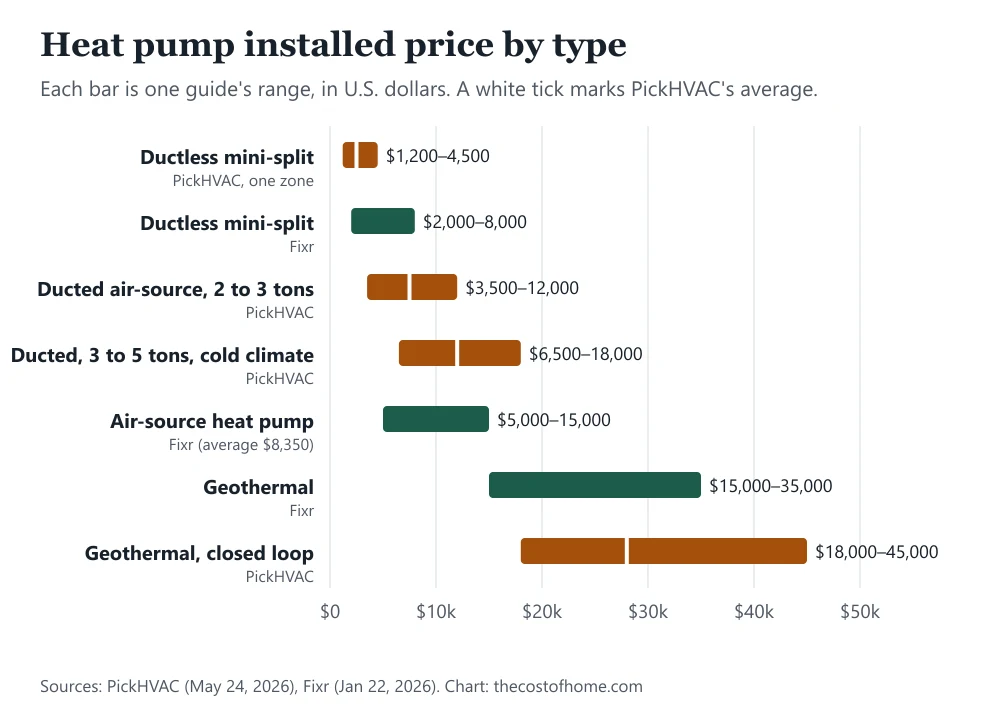
| Ducted air-source | $3,500 to $12,000 for 2 to 3 tons (average $7,500); $6,500 to $18,000 for 3 to 5 tons, cold climate (average $12,000) | $5,000 to $15,000 | $14,529 |
| Ductless mini-split | $1,200 to $4,500 for a single zone (average $2,500) | $2,000 to $8,000 | $25,957 |
| Hybrid (heat pump plus furnace) | Not given | Not given | $14,353; $10,695 after incentives |
| Geothermal | $18,000 to $45,000, closed loop, 3 to 5 tons (average $28,000) | $15,000 to $35,000 | Not given |
Heat pump price by type, installed, as each guide states it. PickHVAC gives low, average and high; Fixr gives a range; EnergySage gives the average of its marketplace quotes before incentives. "Not given" means the page has no figure. Sources: PickHVAC (May 24, 2026); Fixr (January 22, 2026); EnergySage (March 19, 2026).
- Ducted air-source. The usual whole-home choice when the house has ducts. PickHVAC prices a 2 to 3 ton system at an average of $7,500 and a whole-home cold-climate system of 3 to 5 tons at $12,000. EnergySage's ducted quotes average $14,529.
- Ductless mini-split. Cheapest for one room or an addition: $1,200 to $4,500 for a single zone at PickHVAC (its text says "about $1,500" for the low end, its table says $1,200) and $2,000 to $8,000 at Fixr. Whole-home ductless is another story: EnergySage's quotes average $25,957, and it says each extra indoor unit adds equipment and labor with no big discount. The same page also prints $25,393 for that average in its summary, so we show the table figure.
- Hybrid. A heat pump paired with a furnace. EnergySage's quotes average $14,353, or $10,695 after incentives. The other two guides do not price it.
- Geothermal. The most expensive: $15,000 to $35,000 at Fixr and $18,000 to $45,000 at PickHVAC for a closed-loop system. Digging or drilling for the ground loop is the extra cost.
How much does a heat pump cost for your home size?
A bigger home needs a bigger unit, and a bigger unit costs more. For a 2,000-square-foot home, Fixr says $8,000 to $20,000 with 3 to 4 tons. PickHVAC's figure for a 3.5-ton swap in the same size home is $6,000 to $14,000, lower at both ends. PickHVAC adds that each extra half-ton of capacity, at the same efficiency, adds roughly $800 to $2,000.
| Home size | Tonnage Fixr recommends | Typical cost |
|---|---|---|
| 1,000 square feet | 2 tons | $5,000 to $8,000 |
| 1,500 square feet | 2.5 to 3 tons | $6,700 to $14,000 |
| 1,800 square feet | 3 to 4 tons | $8,000 to $20,000 |
| 2,000 square feet | 3 to 4 tons | $8,000 to $20,000 |
| 2,500 square feet | 3.5 to 5 tons | $9,500 to $22,000 |
| 3,000 square feet | 4 to 6 tons | $15,000 to $25,000 |
What Fixr says a heat pump costs by home size, installed. Source: Fixr, "How Much Does a Heat Pump Cost? [2026 Data]" (updated January 22, 2026).
EnergySage gives a rough rule of thumb of about 1 ton per 600 square feet of living space, which lands in the same place as Fixr's table. Climate and insulation change the real number, so the installer's own calculation should decide the size, not the rule.
Efficiency moves the price too. Fixr says a higher SEER2 rating usually means paying more for the equipment, though it adds that this often means paying less in the long run through lower heating and cooling bills:
| SEER2 rating | Typical installed cost |
|---|---|
| 14 to 15 | $5,000 to $12,000 |
| 16 to 17 | $7,000 to $15,000 |
| 18 to 19 | $10,000 to $18,000 |
| 20 or more | $15,000 to $25,000 |
What Fixr says a heat pump costs by efficiency rating (SEER2, the cooling rating). A higher rating costs more up front. Source: Fixr (updated January 22, 2026).
What can add to the bill?
- Ductwork. PickHVAC says sealing or repairing ducts adds $300 to $1,200, and replacing them entirely adds $3,000 to $8,000. Fixr says changes to old ducts "will add significantly" to the upfront cost. A mini-split skips the ducts.
- Electrical work. PickHVAC puts a subpanel or service upgrade at $800 to $3,000.
- Labor and parts. PickHVAC lists labor at $600 to $3,500 and line sets (the refrigerant tubing) at $150 to $600, and says labor and overhead are 40% to 60% of the total. Fixr says installers charge about $75 to $125 an hour.
- Permits. Fixr says permits and inspection fees add $50 to $300.
- Where you live. PickHVAC says the Northeast and West run 10% to 25% above the Midwest and South.
Stack full duct replacement and a panel upgrade, our arithmetic from PickHVAC's ranges, and the job grows by $3,800 to $11,000. Few homes need both.
How much does a heat pump cost to run?
The DOE says modern air-source heat pumps can reduce electricity use by 50% compared with furnaces and baseboard heaters. To put dollars on it, we use the same example home as our heat pump vs gas furnace guide: one that needs 60 million Btu of heat over the winter. At the U.S. average electricity price of 17.8¢ per kWh, a typical heat pump (COP 2.5) delivers that heat for about $1,250, using about 7030 kWh. Electric resistance heat, with a COP of 1.0, would cost about $3,120, so the heat pump uses 60% less electricity for the same heat.
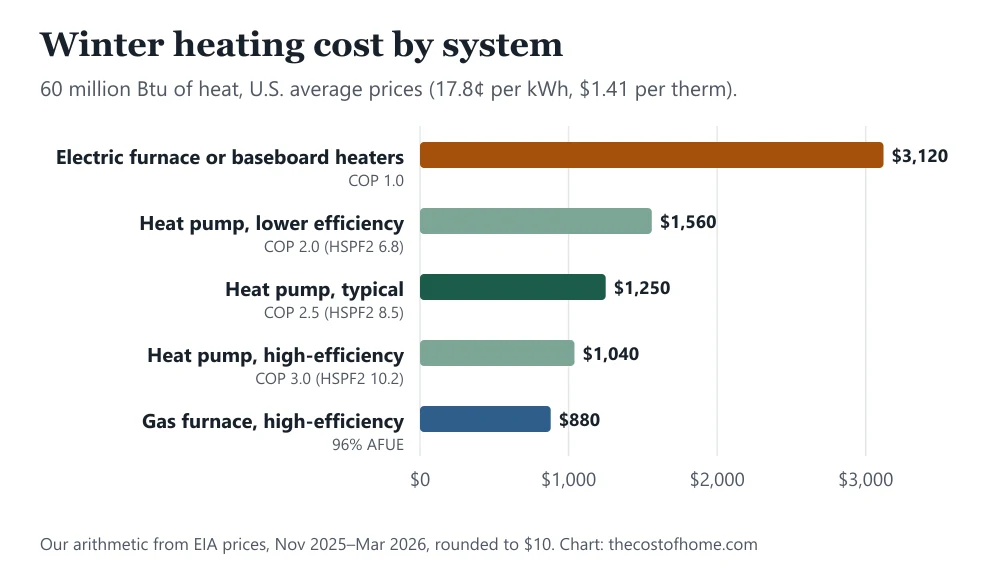
| Heating system | Efficiency | Winter cost |
|---|---|---|
| Electric furnace or baseboard heaters | COP 1.0 | $3,120 |
| Heat pump, lower efficiency | COP 2.0 (HSPF2 6.8) | $1,560 |
| Heat pump, typical | COP 2.5 (HSPF2 8.5) | $1,250 |
| Heat pump, high-efficiency | COP 3.0 (HSPF2 10.2) | $1,040 |
| Gas furnace, high-efficiency | 96% AFUE | $880 |
Winter cost of 60 million Btu of heat at U.S. average prices (17.8¢ per kWh, $1.41 per therm of gas), rounded to the nearest $10. Our arithmetic from EIA prices, November 2025 to March 2026. COP is the heat delivered per unit of electricity.
The gas furnace is still cheaper at national average prices, and it was cheaper in 40 of the 47 places in our comparison. Your price per kWh decides the rest. The same 60 million Btu from a COP 2.5 heat pump costs about $800 in North Dakota (11.4¢ per kWh) and about $2,290 in California (32.5¢). Our average electric bill by state guide shows where your state sits.
Two other estimates are worth knowing, with the caveat that they use different baselines. Fixr says heat pumps can lower utility bills by $300 to $650 a year, citing the National Renewable Energy Laboratory, and the DOE says savings can average over $500 a year depending on home size, climate and efficiency. Fixr's own example is an 1,800-square-foot home with a 5-ton, SEER2 18 heat pump running four hours a day, which costs about $1,200 a year to heat and cool at 17.47¢ per kWh. Its size table lists 3 to 4 tons for that home, so treat the example as an illustration.
Cold weather lowers a heat pump's efficiency. ENERGY STAR certifies cold-climate air-source models by testing them down to 5°F, says they keep working below that, and recommends asking your contractor for a certified cold-climate unit if winter temperatures regularly drop below freezing. It also says pairing a heat pump with a backup heat source heats a home most efficiently when it gets colder still.
Is there a federal tax credit for a heat pump in 2026?
No. The IRS says the Energy Efficient Home Improvement Credit (section 25C) "will not be allowed for any property placed in service after December 31, 2025," and that the Residential Clean Energy Credit (section 25D) "will not be allowed for any expenditures made after December 31, 2025." For section 25D, which covered items such as geothermal heat pumps, the IRS says an expenditure on an installed item counts as made when the original installation is completed, and it answers no to claiming the credit when you paid by the deadline but the item was installed after it. EnergySage says the 30% federal credit for heat pumps "expired after 2025."
Some pages have not caught up. ENERGY STAR's heat pump page still says certified air-source units are eligible for a federal credit of up to $2,000 for products installed through December 31, 2032, and the DOE's 2023 heat pump article describes a credit of up to 30%. We followed the IRS, which is the agency that sets the dates. A heat pump finished in 2026 does not qualify.
What rebates can still lower the price?
The main federal help left is not a tax credit but a rebate that your state runs. The DOE says an ENERGY STAR heat pump for heating and cooling may qualify for a High-Efficiency Electric Home Rebate of up to $8,000 or a Home Owner Managing Energy Savings (HOMES) rebate of up to $8,000, and that your state, territory or Tribe decides how it works. EnergySage reads the income rules this way:
- Households at or below 80% of area median income may get up to $8,000 toward a heat pump.
- Households from 80% to 150% of area median income may get up to $7,000.
- HOMES rebates are based on measured energy savings and vary by state and income.
Funding is limited and moves state by state. EnergySage says availability varies and some states have run out of money. In California, the TECH Clean California program says single-family rebates were fully reserved statewide as of February 24, 2026, with new requests going on a waitlist, and that a request is rejected if the equipment is installed before the reservation is issued. EnergySage lists Mass Save, in Massachusetts, at up to $9,000, and a $1,500 Colorado tax credit per air-source heat pump. ENERGY STAR says many utilities also offer incentives. The practical rule is to check your state energy office and your utility before you sign anything.
How can you pay less for a heat pump?
- Apply for the rebate first. The California rule above is common: a rebate can be refused if the work starts before approval.
- Compare written quotes. Ask what each includes for ductwork, electrical work, permits and removing the old unit, since those lines drive the gaps between bids.
- Book in spring or fall. PickHVAC says scheduling outside peak season may save about 5% to 15% on labor.
- Do not buy more capacity than you need. Each extra half-ton adds $800 to $2,000 at PickHVAC. A tighter, better-insulated home can use a smaller unit, and our attic insulation guide covers one of the cheaper ways to get there.
- Match the efficiency to your winters. A higher rating costs more up front. In a mild climate the basic rating may be enough, and in a hard-freeze climate ENERGY STAR points to the cold-climate label.
Is a geothermal heat pump worth the extra cost?
It costs the most to install, and the DOE says it is typically more expensive than an air-source system. In return, the DOE's consumer guide says geothermal systems can use 25% to 50% less energy than air-source heat pumps, that the extra cost can be recouped in energy savings in 5 to 10 years, and that the heat pump itself lasts 20 years or more while the underground loop lasts 25 to 50. That guide is from August 2021, and its cost figures ($2,500 per ton of capacity plus installation and drilling) are far below the 2026 guides above, so treat its payback as an older estimate. The DOE says horizontal loops, which need trenches at least four feet deep, are generally the most cost-effective for homes with enough land, while vertical loops cost more but need little land.
What does this guide leave out?
- It is not an official price survey. PickHVAC and Fixr publish ranges and do not show how they were built. EnergySage's average comes from its own marketplace quotes, mostly from one state, and does not give the number of quotes.
- The sources disagree on details. Fixr's 2,000-square-foot range of $8,000 to $20,000 is higher than PickHVAC's $6,000 to $14,000. EnergySage prints two numbers for the ductless average, $25,957 and $25,393, and PickHVAC prints two for the lowest mini-split. We show each source instead of picking one.
- The running costs are for heating only. They use last winter's EIA prices and an example home. Cooling is not included, and the $1,200 a year in Fixr's example is the only cooling-inclusive figure we cite.
- Incentives change. Rebate funds run out and state programs open and close. We read DOE and EnergySage pages, not each state's own program, so confirm yours.
- Not covered: heat pump water heaters and dryers, pool heat pumps, and a payback against the specific furnace or air conditioner you would replace.
A heat pump is one of the ways to change the bills this blog tracks. For what those bills look like, see the EIA's winter heating forecast, what a furnace costs to run per month and what central air costs to run. The other big gas appliance in many homes is covered in our water heater guide. More guides on keeping a home warm and cool are in the Heating & Cooling section.
Frequently asked questions
How much does a heat pump cost to install?
Fixr puts a typical installed price at $5,000 to $15,000, with a national average of $8,350. PickHVAC says most central air-source installs fall between $4,000 and $15,000. EnergySage's real quotes average $15,393 before incentives. Type, size, ductwork and electrical work move the price.
How much does a ductless mini-split heat pump cost?
PickHVAC says $1,200 to $4,500 for a single zone, with an average of $2,500. Fixr says $2,000 to $8,000. A whole-home system with several indoor units costs much more: EnergySage's quotes average $25,957.
How much does a geothermal heat pump cost?
Fixr says $15,000 to $35,000 and PickHVAC says $18,000 to $45,000 for a closed-loop system, with an average of $28,000. The ground loop is the main extra cost. The DOE says geothermal systems are typically more expensive than air-source ones.
Is there still a federal tax credit for heat pumps?
No. The IRS says section 25C does not apply to property placed in service after December 31, 2025, and section 25D does not apply to expenditures made after that date. For 25D, an expenditure counts as made when the installation is completed, even if you paid earlier. Some pages still list the old credit, but the IRS dates control.
What rebates are available for a heat pump?
The DOE says an ENERGY STAR heat pump may qualify for a state-run rebate of up to $8,000. EnergySage says households at or below 80% of area median income may get up to $8,000 and those from 80% to 150% up to $7,000. Funds are limited and some states have run out, so check your state energy office and utility before you install.
How much does it cost to run a heat pump?
In our example, a typical heat pump (COP 2.5) delivers 60 million Btu of winter heat for about $1,250 at U.S. average electricity prices. That compares with about $3,120 for electric resistance heat and $880 for a 96% gas furnace. Your electricity price decides the result: the same heat costs about $800 in North Dakota and $2,290 in California.
What size heat pump do I need?
Fixr lists 2 tons for a 1,000-square-foot home, 3 to 4 tons for 1,800 to 2,000 square feet and 4 to 6 tons for 3,000 square feet. EnergySage gives a rough rule of about 1 ton per 600 square feet. Climate and insulation change the answer, so let the installer calculate it.
Do heat pumps work in cold weather?
Yes, at lower efficiency. ENERGY STAR tests certified cold-climate air-source heat pumps down to 5°F and says they keep working below that. It recommends asking for a certified cold-climate unit if winter temperatures regularly drop below freezing, and a backup heat source heats most efficiently in even colder weather.
Sources
- Fixr, "How Much Does a Heat Pump Cost? [2026 Data]" by Dan Simms: average, range, cost by type, size and SEER2 rating, permits and the operating-cost example (updated January 22, 2026; accessed October 27, 2026)
- PickHVAC, "Heat Pump Cost and Installation Prices 2026" by Rene Langer: cost by type, labor, ductwork and electrical extras (May 24, 2026; accessed October 27, 2026)
- EnergySage, "How much does a heat pump cost in 2026?" by Liam McCabe and Casey McDevitt: average of marketplace quotes by type, incentives (updated March 19, 2026; accessed October 27, 2026)
- Internal Revenue Service, FAQs on the modification of sections 25C, 25D, 25E, 30C, 30D, 45L, 45W and 179D under Public Law 119-21 (FS-2025-05, August 21, 2025; accessed October 27, 2026)
- U.S. Department of Energy, "Home Upgrades": heat pump rebates up to $8,000 run by states, territories and Tribes (undated; accessed October 27, 2026)
- U.S. Department of Energy, "Pump Up Your Savings with Heat Pumps": 50% less electricity than furnaces and baseboard heaters (May 30, 2023; accessed October 27, 2026)
- U.S. Department of Energy, "Consumer Guide to Geothermal Heat Pumps" (DOE/EE-2469, August 2021; accessed October 27, 2026)
- U.S. Department of Energy, Geothermal Heat Pumps: loops buried vertically or horizontally, typically more expensive than air-source systems (undated; accessed October 27, 2026)
- ENERGY STAR, Air-Source Heat Pumps: cold-climate testing to 5°F, utility incentives and the credit wording (undated; accessed October 27, 2026)
- ENERGY STAR, Air-Source Heat Pumps: key product criteria (HSPF2 requirements)
- TECH Clean California, "HEEHRA Rebates for Single Family Homes in Northern California Fully Reserved as of February 24, 2026" (accessed October 27, 2026)
- U.S. Energy Information Administration, Electricity Data Browser: residential price by state, monthly (the winter 2025-26 prices behind our running-cost example)
- U.S. Energy Information Administration, Natural Gas Prices: average residential price by state, monthly (the winter 2025-26 prices behind our running-cost example)
- U.S. Energy Information Administration, British thermal units (Btu): 1 kilowatthour = 3,412 Btu; 1 therm = 100,000 Btu

Founder and editor, The Cost of Home
I lived in the United States for five years, and this site grew out of the question every household there keeps asking: what will this cost, and is it worth it? Every number here comes from a public source listed at the end of the article.