Energy Bills
Winter Heating Costs 2026-27: What the EIA Expects for Gas, Electric, Propane and Oil
Quick answer
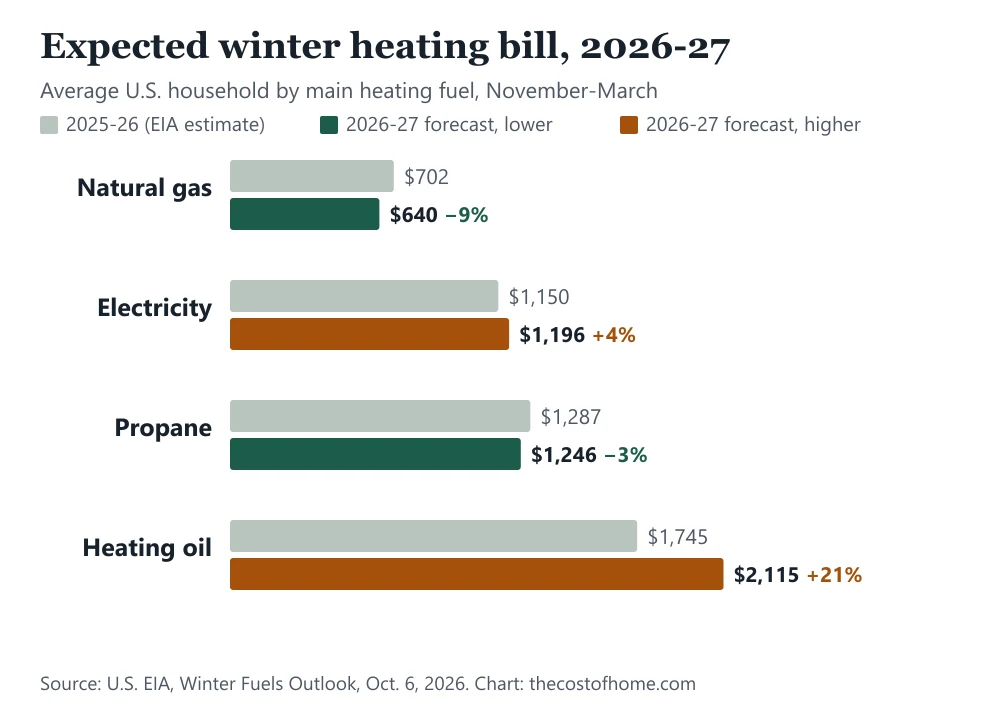
The EIA expects the average home to spend less on heating this winter if it uses natural gas ($640, down 9%) or propane ($1,246, down 3%), and more if it uses electricity ($1,196, up 4%) or heating oil ($2,115, up 21%). The forecast covers November to March and assumes a milder Northeast and a much colder West.
On this page
- How much will it cost to heat a home this winter?
- Will natural gas heating cost less this winter?
- Will electric heating cost more this winter?
- Will propane cost less this winter?
- Why is heating oil the big increase?
- Which parts of the country will see the biggest changes?
- What does the forecast assume about the weather?
- Which winter month costs the most?
- How accurate was last winter's forecast?
- Can you compare fuels using these numbers?
- How do you estimate your own winter bill?
- FAQ
- Sources
The U.S. Energy Information Administration (EIA) published its Winter Fuels Outlook for 2026-27 on October 6. It is the government's best guess at what a typical household will spend to heat its home from November through March, split by the fuel the home mainly uses. This guide goes through the numbers and what is behind them.
One thing to know before reading the tables: each figure is the average for homes that use that fuel as their main heating fuel, and it includes everything else the home runs on that fuel, such as water heating, cooking or lighting. It is a guide to how this winter compares with last winter, not a quote for your house.
How much will it cost to heat a home this winter?
It depends on the fuel, and the forecast splits in two. Homes that heat with natural gas or propane, about half of U.S. households, are expected to spend less than last winter. Homes that heat with electricity or heating oil are expected to spend more.
| Main heating fuel | Share of U.S. homes | Last winter | This winter | Change | Price this winter |
|---|---|---|---|---|---|
| Natural gas | 45% | $702 | $640 | -9% | $1.34 per ccf (-9%) |
| Electricity | 43% | $1,150 | $1,196 | +4% | 18.2¢ per kWh (+3%) |
| Propane | 5% | $1,287 | $1,246 | -3% | $2.52 per gallon (-2%) |
| Heating oil | 3% | $1,745 | $2,115 | +21% | $5.26 per gallon (+34%) |
Average household heating bill, November to March, for homes that use each fuel as their main heating fuel. Last winter is the EIA's current estimate. Prices are before taxes for propane and heating oil. ccf = 100 cubic feet. Source: U.S. EIA, Winter Fuels Outlook, Oct. 6, 2026.
The EIA counts about 61.0 million homes that mainly heat with natural gas, 57.9 million with electricity, 6.4 million with propane and 4.1 million with heating oil. The rest burn wood or have no main heating fuel.
Will natural gas heating cost less this winter?
Yes, on average. The EIA expects gas-heated homes to spend about $640, 9% less than last winter's estimate of $702. The main reason is price: the average residential gas price is forecast at $1.34 per ccf, down 9%, while the amount of gas a home uses stays almost the same at 476 ccf. The EIA also says natural gas inventories should enter the winter about 2% above the five-year average.
About 80% of the gas bill, or $510, is space heating. The rest, $131, is what a gas home spends on water heating, cooking and drying clothes in the same months. If you want to see what gas costs in your state in a normal year, see the average natural gas bill by state.
Will electric heating cost more this winter?
Slightly. All-electric homes are expected to pay about $1,196, up 4% from $1,150. The cause is the price of electricity: 18.2 cents per kWh against 17.7 last winter, a 3% increase. Use is expected to be about the same (6,562 kWh).
An electric bill in winter is not all heating. The EIA puts the heating part at about $542, or 45% of the total. The other $654 is lights, appliances, electronics and water heating, which cost the same in July. That is why a rise in the price per kWh moves the whole bill, while a milder winter helps less than it would for gas. For prices where you live, see the average electric bill by state.
Will propane cost less this winter?
A little. Propane homes are expected to spend about $1,246, 3% less than the $1,287 estimated for last winter. The U.S. average price is $2.52 per gallon, down 2%, and a home uses about 494 gallons over the winter.
The savings are not even. In the Northeast, where propane homes use less and pay less per gallon, the bill is forecast to fall 15%, to $1,687. In the Midwest it falls 4%, to $1,305, and in the South it is about flat at $1,164.
Why is heating oil the big increase?
Heating oil is the one fuel with a large jump. The EIA expects the average oil-heated home to spend about $2,115, up 21% from $1,745, even though the home uses about 9% less oil (402 gallons against 443). The reason is price: $5.26 per gallon, up 34%.
The EIA ties that to the global market for distillate, the fuel family that includes heating oil and diesel. Refining activity worldwide has dropped, import costs are up and U.S. stocks are low going into winter. In its release, the agency said East Coast distillate inventories were 32% below the five-year average in September and are expected to stay 20% to 30% below through the winter. Milder weather in the Northeast offsets part of the price rise, which is why the bill rises 21% even though the price rises 34%.
Only about 3% of U.S. homes heat mainly with oil, and about 82% of them are in the Northeast. If you are one of them, remember that the EIA assumes you pay the prevailing price when you buy. Many oil and propane customers fill up ahead of the winter or have a contracted price, and the EIA's calculation does not account for that.
Which parts of the country will see the biggest changes?
The West. The EIA's weather assumption is a milder winter in the Northeast, following a cold one last year, and a much colder winter in the West, following an unusually warm one. Heating degree days, the agency's measure of cold, are forecast 12% lower in the Northeast and 25% higher in the West. The Midwest and South are close to last winter.
| Region | Natural gas | Electricity | Propane | Colder or milder |
|---|---|---|---|---|
| Northeast | $879 (-14%) | $1,637 (-3%) | $1,687 (-15%) | -12% |
| Midwest | $613 (-10%) | $1,380 (+3%) | $1,305 (-4%) | -2% |
| South | $511 (-15%) | $1,079 (+3%) | $1,164 (0%) | +1% |
| West | $590 (+7%) | $1,151 (+9%) | – | +25% |
| U.S. average | $640 (-9%) | $1,196 (+4%) | $1,246 (-3%) | 0% |
Expected winter 2026-27 bill by Census region, with the change from last winter in parentheses. The last column is the change in heating degree days, the EIA's measure of how cold the winter is. The EIA does not forecast propane for the West, where few homes use it. Source: U.S. EIA, Winter Fuels Outlook, Oct. 6, 2026.
That is why the West is the one region where gas-heated homes are expected to spend more (+7%) even though the gas price is lower, and where electric heating rises the most (+9%). In the Northeast, a milder winter pushes gas down 14% and electricity down 3%, but the region still has the highest bills: $879 for gas and $1,637 for electricity. The South sees the largest gas drop, 15%, because gas prices there are forecast 16% lower.
What does the forecast assume about the weather?
That the whole country is about as cold as last winter on average, 3,155 heating degree days against 3,145. The EIA builds its base case from the previous 30 years of weather, and it warns that a strong El Niño, which the National Oceanic and Atmospheric Administration has identified for this winter, could move temperatures well away from the forecast.
Because weather is the biggest unknown, the EIA also runs two side cases in which every region is 10% colder or 10% warmer than its base forecast:
| Main heating fuel | 10% warmer | Base case | 10% colder |
|---|---|---|---|
| Natural gas | $620 (-12%) | $640 (-9%) | $685 (-2%) |
| Electricity | $1,164 (+1%) | $1,196 (+4%) | $1,243 (+8%) |
| Propane | $1,151 (-11%) | $1,246 (-3%) | $1,385 (+8%) |
| Heating oil | $1,974 (+13%) | $2,115 (+21%) | $2,332 (+34%) |
U.S. average winter bill in the EIA's base case and in two side cases where every region is 10% warmer or 10% colder than the base forecast. The percentages compare each case with last winter. Source: U.S. EIA, Winter Fuels Outlook, Oct. 6, 2026.
The cold case matters most for propane and heating oil, which would rise about 8% and 34% against last winter. Natural gas has more room: even in a winter 10% colder than the EIA expects, gas homes would spend $685, still 2% below last winter's estimate.
Which winter month costs the most?
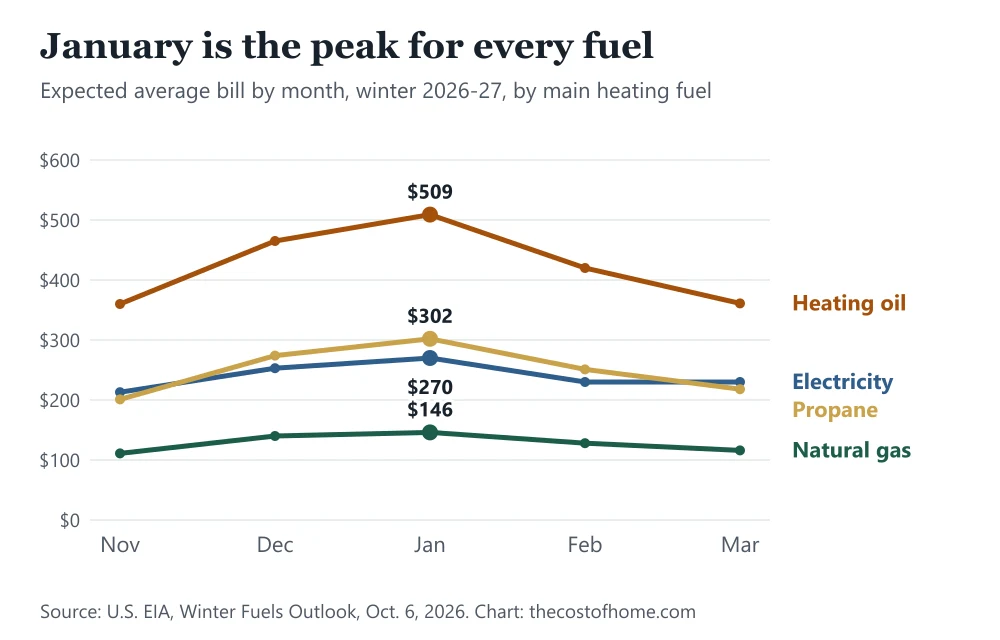
January, for every fuel. The EIA expects January to account for about 23% of a gas home's winter bill and 24% of an oil home's, with December and February close behind. November is the cheapest month for every fuel, with March just above it.
| Month | Natural gas | Electricity | Propane | Heating oil |
|---|---|---|---|---|
| Nov | $111 | $213 | $201 | $360 |
| Dec | $140 | $253 | $274 | $465 |
| Jan | $146 | $270 | $302 | $509 |
| Feb | $128 | $230 | $251 | $420 |
| Mar | $116 | $230 | $218 | $361 |
| Winter total | $640 | $1,196 | $1,246 | $2,115 |
Expected average bill by month, winter 2026-27, by main heating fuel. January is highlighted. Source: U.S. EIA, Winter Fuels Outlook, Oct. 6, 2026.
If you pay for heating on a budget plan, this is the pattern the plan smooths out: a gas home's average bill goes from $111 in November to $146 in January and back to $116 in March.
How accurate was last winter's forecast?
Close for electricity, further off for gas and propane, and farthest off for heating oil. Last October the EIA forecast the bills below for winter 2025-26. Its current estimate of what households actually spent is on the right.
| Main heating fuel | Forecast, Oct. 2025 | EIA estimate now | Difference |
|---|---|---|---|
| Natural gas | $642 | $702 | +9% |
| Electricity | $1,133 | $1,150 | +2% |
| Propane | $1,210 | $1,287 | +6% |
| Heating oil | $1,390 | $1,745 | +26% |
The EIA's October 2025 forecast for winter 2025-26 against its current estimate of what households spent. Source: U.S. EIA, Winter Fuels Outlook 2025-26 forecast tracker and 2026-27 outlook.
National weather does not explain the gap: the EIA had forecast 3,153 heating degree days for the winter and now estimates 3,145. So the gap is not a national weather miss. The EIA describes last winter as relatively cold in the Northeast and unusually warm in the West, and regional weather moves the bills of gas and electric homes differently. Heating oil was the farthest off, and it is also the fuel with the largest forecast increase this year, so treat its number as the least certain. The EIA says it will update the forecast with each Short-Term Energy Outlook through the winter.
Can you compare fuels using these numbers?
Not directly, and the EIA says so itself. The homes behind each average are different: oil homes are mostly in cold Northeastern states, electric homes are mostly in the South, and an all-electric home's bill includes every light and appliance. A gas home paying $640 and an oil home paying $2,115 do not tell you what switching would cost.
To compare the cost of making the same heat with gas or electricity, use the state-by-state calculation in heat pump vs gas furnace running costs, which holds the house and the amount of heat constant. For what a furnace costs per month and per hour, by state and fuel, see how much it costs to run a furnace per month.
How do you estimate your own winter bill?
Start from what you paid last winter and adjust it for your region and fuel. Add up your bills from November to March, then multiply by the change for your fuel and region in the table above. For example, a Northeast home that paid $1,000 for gas last winter would plan on about $860, and a Midwest home that paid $1,000 for electricity would plan on about $1,030.
For heating oil and propane you can be more exact, because you control the gallons: multiply the gallons you expect to use by the price per gallon your supplier quotes. A home that burns the EIA's average of 402 gallons of oil at $5.26 spends about $2,115; at a pre-purchased $4.00 per gallon it would spend $1,607. One caveat applies to any estimate: a home that is larger, older or less insulated than average uses more fuel than the EIA's average home. What insulating the attic costs, and what it saves, is in our attic insulation guide.
The method behind every number on this site is in how we research costs. More guides on household energy are in the Energy Bills section.
Frequently asked questions
How much will it cost to heat a home this winter?
The EIA forecasts an average of $640 for natural gas homes, $1,196 for electric homes, $1,246 for propane homes and $2,115 for heating oil homes for November to March 2026-27. Each figure is for homes that mainly use that fuel.
Will natural gas heating bills be lower this winter?
On average, yes. The EIA expects gas-heated homes to spend about 9% less than last winter because the residential gas price is lower. The exception is the West, where a much colder winter is expected to raise the bill 7%.
Will heating oil cost more this winter?
Yes. The EIA forecasts heating oil at $5.26 per gallon, 34% above last winter, which puts the average oil-heated home's bill at $2,115, up 21%. It cites tight global distillate supplies and low East Coast inventories.
Is electric heat more expensive this winter?
Slightly. The EIA expects an average increase of 4%, to $1,196, driven by a 3% rise in the retail electricity price. The West has the largest increase, 9%, because it is forecast to be much colder.
Which region will see the biggest change in heating costs?
The West. The EIA expects a winter much colder than last year's unusually warm one, with heating degree days up 25%. The Northeast, which had a cold winter last year, is expected to be 12% milder, and its bills fall.
Which month has the highest heating bill?
January. The EIA's monthly forecast peaks in January for every fuel, at about $146 for gas homes, $270 for electric homes, $302 for propane homes and $509 for heating oil homes.
How does the EIA make this forecast?
It starts from household consumption in the EIA's 2020 Residential Energy Consumption Survey, corrects it for actual and forecast heating degree days, and multiplies by the monthly retail price forecasts from its Short-Term Energy Outlook. It publishes a base case plus a 10% warmer and a 10% colder case.
Sources
- U.S. Energy Information Administration, Winter Fuels Outlook 2026-27, published October 6, 2026 with the October Short-Term Energy Outlook (accessed October 18, 2026)
- U.S. Energy Information Administration, Table WF01 and WF02: seasonal and monthly household consumption, prices and expenditures by heating fuel (accessed October 18, 2026)
- U.S. Energy Information Administration press release, "EIA expects a mixed picture for winter fuel costs this year," October 6, 2026
- U.S. Energy Information Administration, Short-Term Energy Outlook, October 2026 (monthly price forecasts behind the Winter Fuels Outlook)

Founder and editor, The Cost of Home
I lived in the United States for five years, and this site grew out of the question every household there keeps asking: what will this cost, and is it worth it? Every number here comes from a public source listed at the end of the article.