Home Repairs & Appliances
How Much Does Attic Insulation Cost, and What Does It Save?
Quick answer
Attic insulation costs $1,700 to $2,500 for a typical home, a $2,100 average in HomeAdvisor's 2026 data, or $1 to $3 per square foot installed. ENERGY STAR says air sealing plus insulation saves about 15% on heating and cooling. That is roughly $114 a year on the average U.S. bill, so payback is slow where bills are low and much faster where they are high.
On this page
- How much does attic insulation cost?
- How much does it cost for your attic size?
- What does each type of insulation cost?
- What can add to the bill?
- How much insulation does your attic need?
- What R-value does your state call for?
- How can you tell if your attic needs more insulation?
- How much does attic insulation save?
- How long does attic insulation take to pay for itself?
- Can you insulate your attic yourself?
- Is there a tax credit or rebate for attic insulation in 2026?
- What does this guide leave out?
- FAQ
- Sources
ENERGY STAR calls a well-sealed, properly insulated attic one of the most important things you can do for a home's energy use. What the work costs is easy to find. What it saves is harder, because the savings depend on your climate, your bills and how much insulation the attic already has. This guide puts the two side by side, using three 2026 cost guides and the figures from ENERGY STAR, the Department of Energy, the EIA and the IRS that we read in full on October 25, 2026.
We did not find an official survey of what attic insulation costs. The prices below are ranges published by cost guides, so we show them next to each other and say where they disagree. The savings come from the EPA's national model, and the spending figures come from the EIA's household survey. The method behind every number on this site is in how we research costs.
How much does attic insulation cost?
HomeAdvisor puts a typical job at $1,700 to $2,500, with an average of $2,100 and a full range from $1,500 to $3,500. That works out to about $1 to $3 per square foot. Block Renovation gives the same typical range and the same per-foot price. PickHVAC is a little wider at the low end: $1.25 to $2.75 per square foot for blown-in or roll insulation.
| Source | Typical project | Per square foot, installed |
|---|---|---|
| HomeAdvisor, attic insulation guide | $1,700 to $2,500; average $2,100; low to high $1,500 to $3,500 | $1.00 to $3.00 |
| Block Renovation (home renovation marketplace) | $1,700 to $2,500 | $1.00 to $3.00 |
| PickHVAC (HVAC and insulation cost guide) | $1,250 to $2,750 for a 1,000-square-foot attic | $1.25 to $2.75 (blown-in or roll) |
What a typical attic insulation job costs, by source. Each source's own wording. Sources: HomeAdvisor (updated June 20, 2026); Block Renovation (July 21, 2026); PickHVAC (May 15, 2026). Read October 25, 2026.
HomeAdvisor says its prices come from surveys of customers after their projects are finished. We found no method statement on the other two pages. When you collect quotes, ask each company to write down what the price includes, because the biggest gaps between bids are usually the extras covered below.
How much does it cost for your attic size?
Size is the first thing that moves the price. For a 1,000-square-foot attic, HomeAdvisor says $1,000 to $3,000 and Block says $1,500 to $3,000.
| Attic size | HomeAdvisor | Block Renovation |
|---|---|---|
| 300 square feet | $300 to $900 | Not given |
| 500 square feet | $500 to $1,500 | $800 to $1,500 |
| 800 square feet | $800 to $2,400 | Not given |
| 1,000 square feet | $1,000 to $3,000 | $1,500 to $3,000 |
| 1,500 square feet | $1,500 to $4,500 | $2,000 to $4,500 |
| 2,000 square feet | Not given | $3,000 to $7,000 |
What attic insulation costs by attic size, installed. HomeAdvisor's figures are $1 to $3 per square foot; Block says its figures assume a standard job with some air sealing included. Sources: HomeAdvisor (June 20, 2026); Block Renovation (July 21, 2026).
Access can matter as much as square footage. Block says a low attic packed with ductwork, wiring and roof angles takes far longer to insulate than one you can stand up in, and those hours land in the price. HomeAdvisor adds that the price can rise if an electrician has to check the wiring first. Ask the contractor to measure the attic floor instead of guessing from the footprint of the house.
What does each type of insulation cost?
The material is the other big lever. The three guides group it differently, so the chart shows each source's range as published.
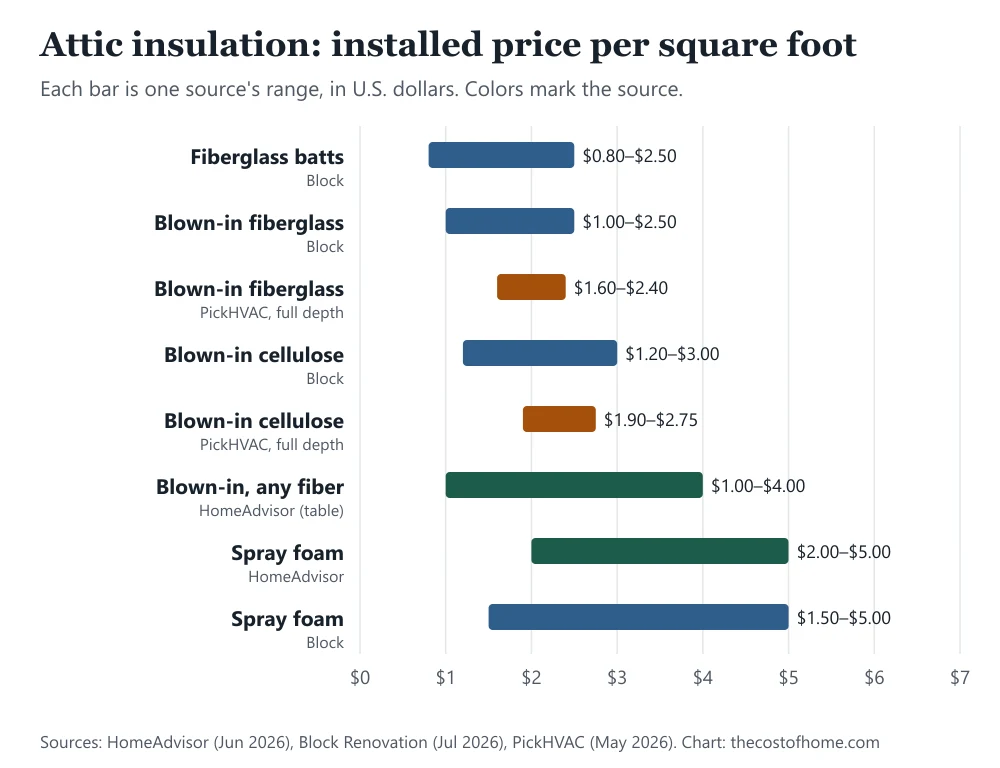
- Blown-in fiberglass or cellulose is the common choice for an attic floor. Block says a machine spreads it evenly and fills odd corners that rigid sheets miss.
- Batts cost the least in Block's table, but Block says they leave gaps wherever the framing is irregular. HomeAdvisor lists them at $2 to $4 and says they do not fill tight spaces well.
- Mineral wool runs $1.50 to $3.00 per square foot at Block and $1.75 to $2.65 at PickHVAC.
- Spray foam sits at the top of the range. Block says it needs trained installers and, in a vented attic, a contractor who understands ventilation and moisture control. PickHVAC's spray foam prices, $4 to $7, are for ceilings and walls, so they are not comparable with the rest.
If the attic already has some insulation in good shape, topping it off costs less per foot than starting from zero:
| Material | Full depth | Adding depth to what is there |
|---|---|---|
| Fiberglass | $1.60 to $2.40 | $1.25 to $1.75 |
| Rockwool (mineral wool) | $1.75 to $2.65 | $1.40 to $2.00 |
| Cellulose | $1.90 to $2.75 | $1.55 to $2.25 |
Installed price per square foot: a full-depth job versus adding to insulation that is already there. Source: PickHVAC, May 15, 2026.
What can add to the bill?
- Air sealing. HomeAdvisor prices it at $250 to $750 and says pros do it before the new material goes in. Block puts it at $200 to $1,500 depending on how many gaps there are. ENERGY STAR says contractors should seal air leaks in the attic floor before adding insulation. Block calls this the step that moves your energy bill the most, and warns that a crew can skip it without you noticing for months.
- Removing old insulation. HomeAdvisor says $1 to $1.50 per square foot; Block and PickHVAC say $1 to $2. Block says it is worth paying when the old layer is wet, moldy, pest-damaged or matted flat, and that dry, evenly spread insulation can simply be topped off.
- Problems found once the crew is in the attic. Block lists blocked soffit vents that need baffles, recessed lights and bathroom fans that vent into the attic, knob-and-tube wiring, which it says is a documented fire risk under insulation, and pests, moisture or mold. Each needs work before the insulation goes down.
Here is what those extras do to a 1,000-square-foot attic if you stack them:
| Line | Low to high |
|---|---|
| Insulation, installed ($1.00 to $3.00 per square foot) | $1,000 to $3,000 |
| Air sealing first | $250 to $750 |
| Removing old insulation ($1.00 to $1.50 per square foot) | $1,000 to $1,500 |
| All three together | $2,250 to $5,250 |
Our arithmetic for a 1,000-square-foot attic, using HomeAdvisor's per-foot prices and ranges (June 20, 2026). Few attics need all three lines.
One material needs a hard stop. Pebble-like gray-brown or silver-gold insulation, called vermiculite, may contain asbestos. The EPA says to assume it does, to leave it undisturbed and not to remove it yourself, and to hire a professional asbestos contractor for any work that would disturb it. A Libby, Montana mine supplied more than 70 percent of U.S. vermiculite from 1919 to 1990, and that ore was contaminated.
How much insulation does your attic need?
Insulation is rated by R-value, the measure of how well it resists heat flow. ENERGY STAR sets the amount to add by climate zone. For an attic with no insulation, it runs from R30 in the warmest zone to R60 in zone 4 and colder. If the attic already has 3 to 4 inches, you add less, from R25 to R49.
| Climate zone | Add to an attic with no insulation | About how deep | Add to an attic with 3 to 4 inches | About how deep |
|---|---|---|---|---|
| 1 | R30 | 9 to 10 in. | R25 | 7 to 8 in. |
| 2 | R49 | 14 to 16 in. | R38 | 11 to 13 in. |
| 3 | R49 | 14 to 16 in. | R38 | 11 to 13 in. |
| 4A and 4B | R60 | 17 to 20 in. | R49 | 14 to 16 in. |
| 4C, 5 and 6 | R60 | 17 to 20 in. | R49 | 14 to 16 in. |
| 7 and 8 | R60 | 17 to 20 in. | R49 | 14 to 16 in. |
The R-value ENERGY STAR recommends you add to an existing attic, by climate zone. The inches columns are our arithmetic, using ENERGY STAR's 3 to 3.5 R-value per inch for fiberglass, cellulose and mineral wool, and show roughly how deep the new layer is. Source: ENERGY STAR (based on the 2021 IECC).
The Department of Energy's 2021 consumer guide shows ranges instead of single numbers, for example R38 to R60 to add to an uninsulated attic in zones 2 and 3. We used ENERGY STAR's table because it names one number per zone and says it follows the 2021 International Energy Conservation Code. Local building codes can ask for more, so confirm the number with your contractor or building department.
What R-value does your state call for?
Climate zones follow county lines, so many states hold more than one. This table reads each state's zones from the Department of Energy's county list and applies ENERGY STAR's targets. Where a state shows a range, the lower number is for its warmer counties.
| State | Climate zones | Add to an attic with no insulation | Add to an attic with 3 to 4 inches |
|---|---|---|---|
| Alabama | 2 to 3 | R49 | R38 |
| Alaska | 7 to 8 | R60 | R49 |
| Arizona | 2 to 5 | R49 to R60 | R38 to R49 |
| Arkansas | 3 to 4 | R49 to R60 | R38 to R49 |
| California | 2 to 6 | R49 to R60 | R38 to R49 |
| Colorado | 4 to 7 | R60 | R49 |
| Connecticut | 5 | R60 | R49 |
| Delaware | 4 | R60 | R49 |
| District of Columbia | 4 | R60 | R49 |
| Florida | 1 to 2 | R30 to R49 | R25 to R38 |
| Georgia | 2 to 4 | R49 to R60 | R38 to R49 |
| Hawaii | 1 | R30 | R25 |
| Idaho | 5 to 6 | R60 | R49 |
| Illinois | 4 to 5 | R60 | R49 |
| Indiana | 4 to 5 | R60 | R49 |
| Iowa | 5 to 6 | R60 | R49 |
| Kansas | 4 to 5 | R60 | R49 |
| Kentucky | 4 | R60 | R49 |
| Louisiana | 2 to 3 | R49 | R38 |
| Maine | 6 | R60 | R49 |
| Maryland | 4 to 5 | R60 | R49 |
| Massachusetts | 5 | R60 | R49 |
| Michigan | 5 to 7 | R60 | R49 |
| Minnesota | 6 to 7 | R60 | R49 |
| Mississippi | 2 to 3 | R49 | R38 |
| Missouri | 4 to 5 | R60 | R49 |
| Montana | 6 | R60 | R49 |
| Nebraska | 5 | R60 | R49 |
| Nevada | 3 to 5 | R49 to R60 | R38 to R49 |
| New Hampshire | 5 to 6 | R60 | R49 |
| New Jersey | 4 to 5 | R60 | R49 |
| New Mexico | 3 to 5 | R49 to R60 | R38 to R49 |
| New York | 4 to 6 | R60 | R49 |
| North Carolina | 3 to 5 | R49 to R60 | R38 to R49 |
| North Dakota | 6 to 7 | R60 | R49 |
| Ohio | 4 to 5 | R60 | R49 |
| Oklahoma | 3 to 4 | R49 to R60 | R38 to R49 |
| Oregon | 4 to 5 | R60 | R49 |
| Pennsylvania | 4 to 6 | R60 | R49 |
| Rhode Island | 5 | R60 | R49 |
| South Carolina | 3 | R49 | R38 |
| South Dakota | 5 to 6 | R60 | R49 |
| Tennessee | 3 to 4 | R49 to R60 | R38 to R49 |
| Texas | 2 to 4 | R49 to R60 | R38 to R49 |
| Utah | 3 to 6 | R49 to R60 | R38 to R49 |
| Vermont | 6 | R60 | R49 |
| Virginia | 4 | R60 | R49 |
| Washington | 4 to 6 | R60 | R49 |
| West Virginia | 4 to 5 | R60 | R49 |
| Wisconsin | 6 to 7 | R60 | R49 |
| Wyoming | 5 to 7 | R60 | R49 |
The attic R-value ENERGY STAR recommends you add in each state, from the climate zone of its counties. A range means the state has counties in zones with different targets. Zones from the DOE county list (August 2015); targets from ENERGY STAR (2021 IECC).
The DOE county list is from August 2015 and ENERGY STAR's targets follow the 2021 code, so a few counties may sit in a different zone on ENERGY STAR's own map. Check your county there before you buy.
How can you tell if your attic needs more insulation?
ENERGY STAR gives a simple test: if the insulation is at or below the level of the floor joists in your attic, you probably need to add more. It also gives a way to estimate your R-value. Common types, such as fiberglass, cellulose and mineral wool, have an R-value of about 3 to 3.5 per inch, so the depth in inches times 3 is a rough guess of what you have. The table above tells you how much to add on top.
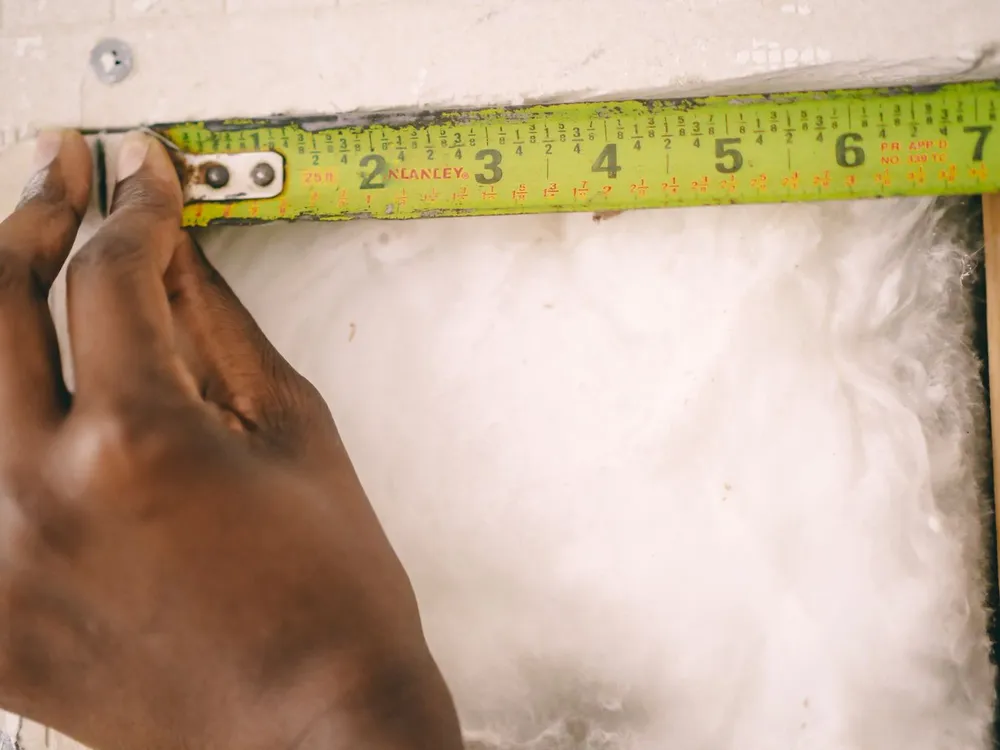
The EIA asks households how they rate the insulation in their homes. In the 2024 survey, about 20% of U.S. homes were rated poorly insulated or not insulated at all, and the share rises sharply with the age of the home. The EIA defines this rating as how respondents perceive the acceptability of the home's insulation, so it is an opinion about the whole house, not a measurement of the attic.
| Year built | Homes (millions) | Rated poorly insulated or not insulated |
|---|---|---|
| Before 1950 | 20.2 | 37% |
| 1950 to 1959 | 12.2 | 28% |
| 1960 to 1969 | 12.7 | 23% |
| 1970 to 1979 | 18.1 | 23% |
| 1980 to 1989 | 16.6 | 19% |
| 1990 to 1999 | 15.9 | 14% |
| 2000 to 2009 | 18.3 | 12% |
| 2010 to 2019 | 12.5 | 7% |
| All U.S. homes | 132.5 | 20% |
How U.S. households rate the insulation in their homes, by year built. These are the households' own answers, not measurements, and they cover the whole home, not only the attic. Source: EIA, RECS 2024 (preliminary data, March 2026), Table HC2.3. Share is our arithmetic.
By climate, the share ranged from 17% of homes in the hot-humid region to 25% in the mixed-dry and hot-dry regions. If your house was built before 1980, or if you see the joists, the attic is worth a look.
How much does attic insulation save?
The EPA estimates that homeowners save an average of 15% on heating and cooling costs, or 11% on total energy costs, by air sealing and adding insulation in the attic, in floors over crawl spaces and in accessible basement rim joists. The Department of Energy's consumer guide words it as "up to" 15% and 11%. Savings are larger in cold climates:
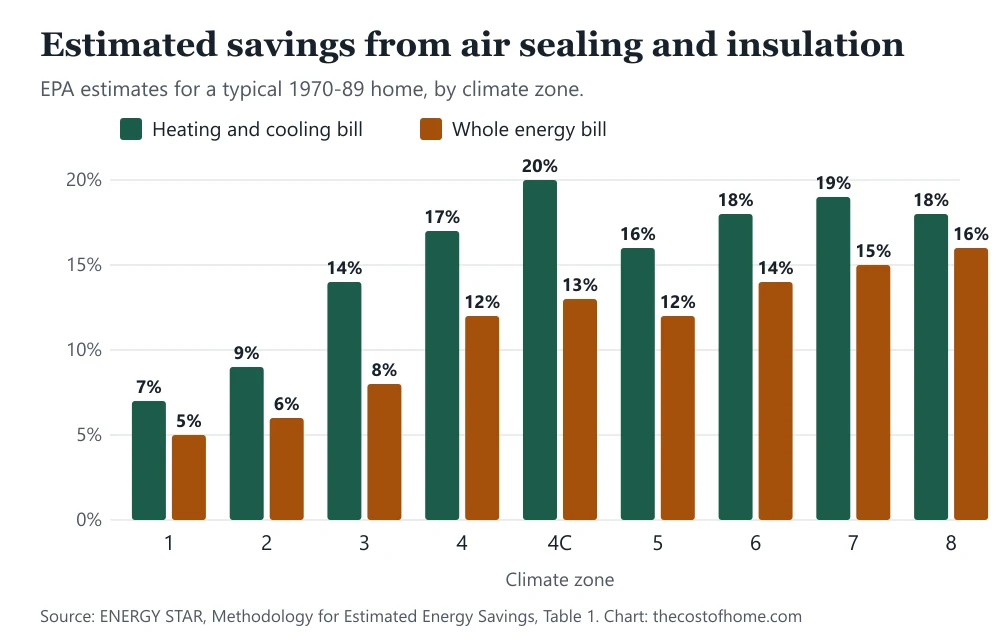
Read that figure with its limits in mind. It comes from an energy model of a typical 1,700-square-foot home built between 1970 and 1989. The model assumes a 25% cut in air leakage and insulation brought up to the 2012 energy code in attics, floors over unconditioned spaces and basement walls. That is more than an attic job alone, and none of the sources we read gives a savings number for the attic by itself. Block adds that homes that start with little insulation tend to see the biggest drop.
In dollars, the 15% depends on how much you spend. In 2020 the average U.S. household spent about $757 on space heating and air conditioning together, according to the EIA:
| Region | Heating and cooling spending per year | 15% of it |
|---|---|---|
| United States | $757 | $114 |
| Northeast | $978 | $147 |
| Midwest | $827 | $124 |
| South | $742 | $111 |
| West | $540 | $81 |
What 15% looks like in dollars. The first column is what the average household spent in 2020 on space heating plus air conditioning (total spending divided by all households in the region). Savings are our arithmetic: 15% of that spending. Source: EIA, RECS 2020, Tables CE3.6 to CE3.10 (2020 dollars).
Those are 2020 prices. If your own heating and cooling spending is higher today, scale from your own bill; the next table does that.
How long does attic insulation take to pay for itself?
Divide the cost of the job by what it saves each year. At the average U.S. bill and HomeAdvisor's $2,100 average job, the answer is about 18 years. In the Northeast, where the average bill is higher, it is about 14 years, and in the West about 26.
| Yearly heating and cooling bill | Saved per year at 15% | Payback on a $1,700 job | On a $2,100 job | On a $2,500 job |
|---|---|---|---|---|
| $540 | $81 | 21 years | 26 years | 31 years |
| $757 | $114 | 15 years | 18 years | 22 years |
| $978 | $147 | 12 years | 14 years | 17 years |
| $1,500 | $225 | 7.6 years | 9.3 years | 11 years |
| $2,000 | $300 | 5.7 years | 7.0 years | 8.3 years |
Our arithmetic: years for the savings to repay the job, at ENERGY STAR's 15% average. Simple payback only: it ignores later changes in energy prices, rebates, the cost of borrowing and the comfort you gain. The first three bills are the 2020 averages from the table above; the last two are examples. Job costs are HomeAdvisor's typical range and average.
The pattern is plain: the project pays back fastest in a house with a large heating and cooling bill, a cold climate and little insulation to begin with. Block says fiberglass and cellulose often last 20 years or more when they stay dry, so even the slower cases can pay back inside the life of the material. The comfort gain arrives the week the work is done, which a payback table cannot count. Block also says that if a new furnace or air conditioner is on your list, do the attic first, so the new system is sized for the house as it will be.
Can you insulate your attic yourself?
ENERGY STAR says you can save more by doing it yourself, and it recommends finishing the air sealing before you insulate. It also says contractors have the equipment and experience and often do the job much quicker, and that you should hire a professional for problems such as wet insulation, moldy rafters or knob-and-tube wiring. PickHVAC estimates that doing it yourself saves about 25% for foam and up to 50% for loose-fill insulation. HomeAdvisor calls a local pro the safest choice for most attics and says removing old insulation often takes special training, because old material can contain asbestos.
Is there a tax credit or rebate for attic insulation in 2026?
Not a federal tax credit. The IRS says the Energy Efficient Home Improvement Credit, section 25C, "will not be allowed for any property placed in service after December 31, 2025." Some pages still describe it: ENERGY STAR's attic page, which has no date, says the credit of up to 30% of the cost, not to exceed $1,200, applies through December 31, 2025. A job finished in 2026 does not qualify.
Utility and local rebates are a different story. ENERGY STAR says rebates for air sealing and insulation may be available depending on where you live, and HomeAdvisor suggests contacting your utility company and local government. Block says some programs require an approved contractor or sign-off before the job begins, so check before you sign. More ways to pay less:
- Get at least three quotes with the same scope, a tip from HomeAdvisor. Block suggests asking what the price includes for air sealing, whether the old insulation stays or goes, and what R-value the contractor is aiming for.
- Book off-season. HomeAdvisor says insulation pros are less busy in the spring months, which can mean discounts and better availability.
- Top off instead of removing when the old layer is dry and in good shape, which skips the removal cost.
What does this guide leave out?
- It is not an official price survey. HomeAdvisor connects homeowners with local pros and says its guide was updated with automation technology and reviewed by an editor. Block is a remodeling marketplace. PickHVAC is a cost guide for HVAC and insulation.
- The sources disagree on details. HomeAdvisor's table lists blown-in insulation at $1 to $4 per square foot, but its text says $2 to $4. Its labor-only figure, $1.50 to $3 per square foot, is as high as its total range of $1 to $3. Air sealing is $250 to $750 at HomeAdvisor and $200 to $1,500 at Block, and removal is $1 to $1.50 at one and $1 to $2 at two others. We show each source instead of picking one.
- The savings are a model. EPA's 15% and 11% are averages for a typical home and a package of work larger than the attic alone. Your house can land above or below them.
- The spending figures are from 2020. The EIA's 2024 household spending tables by end use are scheduled for spring 2027, so 2020 is the latest we could use. Use your own bill for a closer answer.
- The insulation ratings are opinions. The EIA's categories come from how households describe their homes, and the 2024 figures are preliminary.
- Not covered: finished attics and insulation between the rafters, radiant barriers, attic ventilation work and wall or basement insulation.
An insulated attic is one of the ways to lower the bills this blog tracks. For what those bills look like, see the EIA's winter heating forecast, what a furnace costs to run per month and what central air costs to run. If you are weighing a bigger change, read heat pump vs gas furnace cost, and for the reasons a bill climbs, why your electric bill is so high. More guides on the costly fixes are in the Home Repairs section.
Frequently asked questions
How much does attic insulation cost?
HomeAdvisor puts a typical job at $1,700 to $2,500, with an average of $2,100, or $1 to $3 per square foot installed. Block Renovation gives the same typical range, and PickHVAC says $1.25 to $2.75 per square foot for blown-in or roll insulation. Size, material and extras such as air sealing move the price.
How much does it cost to insulate a 1,000-square-foot attic?
HomeAdvisor says $1,000 to $3,000, Block Renovation says $1,500 to $3,000 and PickHVAC says $1,250 to $2,750. Air sealing and removing old insulation add to that.
What R-value do I need in my attic?
ENERGY STAR recommends adding R30 in zone 1, R49 in zones 2 and 3 and R60 in zones 4 to 8 to an attic with no insulation. With 3 to 4 inches already there, it recommends adding R25, R38 and R49. Use the state table in this guide to find your zone, and confirm with your local code.
How much will attic insulation save on my energy bill?
The EPA estimates an average of 15% on heating and cooling costs, or 11% on total energy costs, for air sealing plus insulation in attics, floors over crawl spaces and accessible basement rim joists. That is about $114 a year on the average 2020 U.S. heating and cooling spending of $757. Savings are larger in cold climates and in homes with little insulation.
How long does attic insulation take to pay for itself?
At the average U.S. bill and a $2,100 job, about 18 years by our arithmetic. With a $1,500 yearly heating and cooling bill it is about 9.3 years, and with $2,000 about 7.0. It is a simple payback that ignores rebates, energy price changes and comfort.
Is there a federal tax credit for attic insulation in 2026?
No. The IRS says the section 25C credit will not be allowed for property placed in service after December 31, 2025. Utility and local rebates may still exist, so ask your utility company before the work starts.
Should I remove the old insulation before adding new?
Not always. Block says dry, evenly spread insulation in good shape can be topped off, which skips the $1 to $2 per square foot removal cost. Wet, moldy, pest-damaged or matted insulation should come out first, and ENERGY STAR says to hire a professional for wet insulation and moldy rafters.
What is vermiculite insulation and is it dangerous?
It is a pebble-like, gray-brown or silver-gold pour-in insulation. The EPA says to assume it contains asbestos, to leave it undisturbed and to hire a professional asbestos contractor for any work that would disturb it. Do not remove it yourself.
Sources
- HomeAdvisor, "How Much Does Attic Insulation Cost in 2026?": typical range, average, costs by type and size, air sealing and removal (updated June 20, 2026; accessed October 25, 2026)
- Block Renovation, "Attic Insulation Cost: What You're Really Paying For in 2026" by Cheyenne Howard (July 21, 2026; accessed October 25, 2026)
- PickHVAC, "Attic Insulation Cost and Guide 2026" by Rene Langer (May 15, 2026; accessed October 25, 2026)
- ENERGY STAR, "Recommended Home Insulation R-Values": attic targets by climate zone, based on the 2021 IECC (undated; accessed October 25, 2026)
- ENERGY STAR, Attic Insulation: air sealing first, the joist test, R-value per inch, DIY versus contractor (undated; accessed October 25, 2026)
- ENERGY STAR, "Methodology for Estimated Energy Savings": the 15% and 11% estimates and Table 1 by climate zone (undated; accessed October 25, 2026)
- U.S. Department of Energy, "Consumer Guide to Home Insulation" (DOE/EE-2476, November 2021; accessed October 25, 2026)
- U.S. Department of Energy and PNNL, "Guide to Determining Climate Regions by County," Building America Best Practices Series Vol. 7.3 (August 2015; accessed October 25, 2026)
- U.S. Energy Information Administration, RECS 2024 (preliminary, March 2026), Table HC2.6 (by climate region) and Table HC2.3 (by year of construction); definition of "adequacy of insulation" on the RECS terminology page (accessed October 25, 2026)
- U.S. Energy Information Administration, RECS 2020, Tables CE3.6 to CE3.10: annual household end-use expenditures, U.S. and Census regions (2020 dollars; accessed October 25, 2026)
- Internal Revenue Service, FAQs on the modification of sections 25C, 25D, 25E, 30C, 30D, 45L, 45W and 179D under Public Law 119-21 (August 21, 2025; accessed October 25, 2026)
- U.S. Environmental Protection Agency, "Protect Your Family from Asbestos-Contaminated Vermiculite Insulation" (updated April 17, 2026; accessed October 25, 2026)

Founder and editor, The Cost of Home
I lived in the United States for five years, and this site grew out of the question every household there keeps asking: what will this cost, and is it worth it? Every number here comes from a public source listed at the end of the article.