Energy Bills
Why Is My Electric Bill So High? The Usual Causes, by the Numbers
Quick answer
A high electric bill means more kilowatt-hours, a higher price per kilowatt-hour, or both. Heating and cooling are the biggest users, about 38% of a home's electricity, with water heating next at 12%. Prices also rose about 5% in the year to July 2026. Size matters too: homes of 3,000 square feet or more use over twice the electricity of homes under 1,000.

On this page
- How is an electric bill figured, and what counts as a high one?
- Have electricity prices gone up?
- Where does the electricity in a home go?
- Which appliances add the most when you have them?
- Why is my bill higher than my neighbor's?
- Why does my bill jump in some months?
- How do I find what is driving my own bill?
- What can I do to lower it?
- How was this calculated?
- FAQ
- Sources
An electric bill has only two ingredients: how many kilowatt-hours (kWh) you used and what each one cost. When the total jumps, one of them moved, and the quickest way to find out which is to put your own numbers next to the national ones. This guide gives you those numbers: where a typical home's electricity goes, what each big use costs, and why a bill can run far above a neighbor's.
The figures come from the U.S. Energy Information Administration (EIA). Prices are from its monthly utility survey, the same data behind our average electric bill by state guide. Use by appliance is from its 2020 Residential Energy Consumption Survey (RECS), the latest edition, which counts what the average home used on each equipment type.
How is an electric bill figured, and what counts as a high one?
Your bill is the kWh you used times the price per kWh, with delivery charges and fees folded into that price when you divide the total by the kWh. The average U.S. home paid $156.49 a month over the 12 months ending July 2026: 870 kWh at 18.0 cents each, according to the EIA's Form EIA-861M (the 2026 months are preliminary).
So a bill is high for one of two reasons. Either you use more than the typical 870 kWh, or you pay more than 18.0 cents for each. The price part depends on where you live more than on anything you do, and it is wide: the same 870 kWh would cost about $379 in Hawaii and about $107 in North Dakota.
| State | Price per kWh | 870 kWh would cost |
|---|---|---|
| U.S. average | 18.0¢ | $156.49 |
| Hawaii | 43.5¢ | $379 |
| California | 33.0¢ | $287 |
| Massachusetts | 30.4¢ | $265 |
| Maine | 29.3¢ | $255 |
| Rhode Island | 29.3¢ | $255 |
| Utah | 13.3¢ | $116 |
| Louisiana | 13.0¢ | $113 |
| Nebraska | 12.9¢ | $112 |
| Idaho | 12.7¢ | $110 |
| North Dakota | 12.3¢ | $107 |
What the average U.S. home's 870 kWh a month would cost at each state's average price, 12 months ending July 2026. The five highest and five lowest prices of the 50 states and DC. Source: U.S. EIA, Form EIA-861M (preliminary).
That is why a bill compared with a friend's in another state tells you little. Compare your kWh with your state's average use, in the state-by-state table, and your price per kWh with your state's price. The 12-month average bill runs from $99 in New Mexico to $224 in Hawaii, the only state above $200.
Have electricity prices gone up?
Yes. The average residential price was 18.31 cents per kWh in July 2026, up from 17.45 cents in July 2025, a rise of about 4.9% in a year, according to the EIA's Electric Power Monthly. On July's average use of 1,160 kWh, that is about $10 more for the same electricity. If your use looks unchanged and the bill is higher than last year, the price per kWh is the first place to look: divide the total by the kWh on your bill and compare it with the year before.
Where does the electricity in a home go?
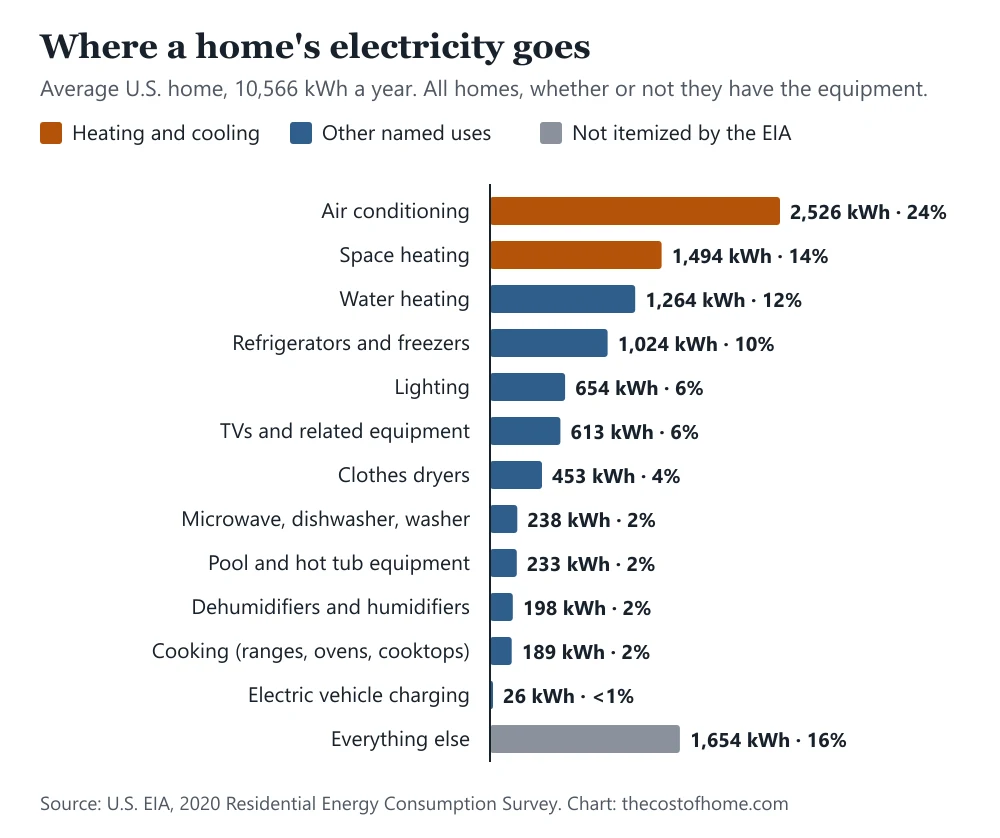
Heating and cooling come first. The EIA's survey puts the average home at 10,566 kWh a year, and 38% of it goes to air conditioning and space heating together (4,020 kWh, or about $723 a year at today's average price). Add water heating and the three account for 50% of the electricity a home buys. Refrigerators and freezers take about 10% (see what a refrigerator costs to run), and lighting and TVs about 6% each.
| Use | kWh per year | Share of total | Yearly cost |
|---|---|---|---|
| Air conditioning, with air handlers and ceiling fans | 2,526 | 23.9% | $454 |
| Space heating, with air handlers | 1,494 | 14.1% | $269 |
| Water heating | 1,264 | 12.0% | $227 |
| Refrigerators and freezers | 1,024 | 9.7% | $184 |
| Lighting | 654 | 6.2% | $118 |
| TVs and related equipment | 613 | 5.8% | $110 |
| Clothes dryers | 453 | 4.3% | $81 |
| Microwaves, dishwashers and clothes washers | 238 | 2.3% | $43 |
| Pool and hot tub equipment | 233 | 2.2% | $42 |
| Dehumidifiers and humidifiers | 198 | 1.9% | $36 |
| Cooking (ranges, ovens, cooktops) | 189 | 1.8% | $34 |
| Electric vehicle charging | 26 | <1% | $5 |
| Everything else | 1,654 | 15.7% | $298 |
| Total | 10,566 | 100% | $1,901 |
Where the electricity goes in the average U.S. home, from the EIA's 2020 survey. Averages cover all homes, including those without the equipment. Yearly cost uses the 18.0 cents per kWh U.S. average for the 12 months ending July 2026.
Two things about this table. First, the numbers are averages over all homes, including the ones without the equipment, so a home that has electric heat or a pool pump uses much more than the line shows (the next section has those figures). Second, the survey was taken in 2020, and it is the latest one the EIA has published. The last row is the electricity the EIA does not itemize in these tables, which includes small appliances and electronics such as computers.
Which appliances add the most when you have them?
A few items each add $400 or more a year when a home has them. The table below shows the average for homes that have the equipment, so it is the number to add to your bill if you do.
| If you have it | kWh per year | Yearly cost | Per month |
|---|---|---|---|
| Electric water heating | 2,706 | $487 | $41 |
| Electric space heating (main or secondary) | 2,484 | $447 | $37 |
| Pool pump | 2,384 | $429 | $36 |
| Electric vehicle charging at home | 2,363 | $425 | $35 |
| Air conditioning | 2,318 | $417 | $35 |
| Hot tub heater | 1,479 | $266 | $22 |
| Dehumidifier | 999 | $180 | $15 |
| Refrigerator(s), all in the home | 839 | $151 | $13 |
| Clothes dryer | 680 | $122 | $10 |
| Lighting | 654 | $118 | $10 |
| TVs and related equipment | 632 | $114 | $9 |
| Separate freezer | 570 | $103 | $9 |
| Second refrigerator | 494 | $89 | $7 |
What each use adds in a home that has it, from the EIA's 2020 survey. Yearly cost uses 18.0 cents per kWh.
An electric water heater (2,706 kWh) and electric heat (2,484 kWh) lead the list, and a pool pump and home charging for an electric vehicle are close behind. A home with two or three of these has a baseline bill well above the average one, and nothing is wrong with it. A second refrigerator ($89 a year) and a separate freezer ($103) are smaller, but they run all year. For a closer look at the two biggest items, see what a water heater costs to replace and run and what central air costs to run.
Why is my bill higher than my neighbor's?
Often because of the house itself. The same survey sorts homes by size, type, main heating fuel and number of people, and the spread is large.
| Type of home | Electricity per year | About per month |
|---|---|---|
| All U.S. homes | 10,566 kWh | $158 |
| By home size | ||
| Under 1,000 sq ft | 6,802 kWh | $102 |
| 1,000 to 1,499 sq ft | 9,407 kWh | $141 |
| 1,500 to 1,999 sq ft | 11,009 kWh | $165 |
| 2,000 to 2,499 sq ft | 12,173 kWh | $182 |
| 2,500 to 2,999 sq ft | 13,031 kWh | $195 |
| 3,000 sq ft or more | 15,489 kWh | $232 |
| By home type | ||
| Single-family detached house | 12,402 kWh | $186 |
| Single-family attached (townhouse) | 8,443 kWh | $127 |
| Apartment in a 2-4 unit building | 6,665 kWh | $100 |
| Apartment in a 5+ unit building | 6,093 kWh | $91 |
| Mobile home | 12,456 kWh | $187 |
| By main heating fuel | ||
| Natural gas | 9,035 kWh | $135 |
| Electricity | 13,073 kWh | $196 |
| Propane | 11,142 kWh | $167 |
| Fuel oil or kerosene | 9,025 kWh | $135 |
| By number of people | ||
| 1 person | 7,184 kWh | $108 |
| 2 people | 10,648 kWh | $160 |
| 3 people | 12,120 kWh | $182 |
| 4 people | 13,072 kWh | $196 |
| 5 people | 14,336 kWh | $215 |
| 6 or more people | 14,730 kWh | $221 |
Electricity used per home per year in 2020, by home size, type, main heating fuel and household size. The monthly figure applies 18.0 cents per kWh. Source: U.S. EIA, 2020 Residential Energy Consumption Survey, table CE4.6.
- Size. Homes of 3,000 square feet or more use 15,489 kWh a year, 2.3 times the 6,802 kWh of homes under 1,000 square feet. At today's average price that is about $130 more a month.
- Type of home. A detached house uses 12,402 kWh a year, about double the 6,093 kWh of an apartment in a larger building.
- Heating fuel. Homes that heat with electricity use 13,073 kWh a year, 4,038 kWh more than the 9,035 kWh of homes that heat with natural gas, roughly $61 a month on the electric bill. A gas home has a gas bill that makes up some of that difference; see the average natural gas bill by state.
- People at home. One-person households use 7,184 kWh a year and households of six or more use 14,730 kWh, about double.
If your bill is above your neighbor's and your house is bigger, older or heated with electricity, the gap is probably the house. If the two homes are alike and the bills are not, the next sections help you find what differs.
Why does my bill jump in some months?
Because heating and cooling follow the weather. The average U.S. bill was $127.71 in April 2026, a mild month in much of the country, and $212.44 in July, 66% higher, on 678 and 1,160 kWh. January's $175.11 is the winter peak for the country as a whole, and which month runs highest depends on the state.
| Month | Avg. bill | Avg. use |
|---|---|---|
| Aug 2025 | $189.77 | 1,078 kWh |
| Jan 2026 | $175.11 | 1,003 kWh |
| Apr 2026 | $127.71 | 678 kWh |
| Jul 2026 | $212.44 | 1,160 kWh |
Average U.S. residential bill and use by month, August 2025 to July 2026. Source: U.S. EIA, Form EIA-861M (preliminary).
So compare a bill with the same month last year, not with last month. A July bill is high next to an April bill in nearly every home. In 29 states the average July bill was $200 or more. Our guide to the electric bill in winter vs summer by state shows which months run highest where you live.
How do I find what is driving my own bill?
Four checks, in this order, with a recent bill and last year's:
- Find the kWh. It is in the usage section of the bill. Compare it with the same month last year and with the average for your state in our state table.
- Work out the price. Divide the total by the kWh. If the kWh is flat and the price is up, the rate is the cause, not the house.
- Match the extra kWh to the equipment. Look at the "if you have it" table above. A jump in summer points to cooling; the same jump in winter points to electric heat; a steady rise all year points to something that runs every day, like a water heater, a pool pump or a new vehicle charger.
- Consider a home energy assessment. The U.S. Department of Energy (DOE) says a simple audit takes about an hour, and a more thorough one takes about four hours and uses diagnostic tests such as a duct air-leakage test or an infrared scan to find leaks.
What can I do to lower it?
The DOE's home energy guide gives savings for the biggest uses. The dollar figures here apply its percentages to the average home in this article, so treat them as an order of magnitude, not a promise.
- Thermostat. Turning it down 7° to 10°F for 8 hours a day in fall and winter, and up in spring and summer, can save as much as 10% a year on heating and cooling, up to about $72 on the $723 the average home spends. Homes with heat pumps need a thermostat designed for them.
- Air leaks and ducts. Sealing cracks and openings to the outside can save 10% to 20% on heating and cooling bills, and the DOE says ducts that leak into an attic or crawl space can add hundreds of dollars a year.
- Water heater. Set it to 120°F, which the DOE calls safe for most people, and insulate the tank if it is warm to the touch, which can save 7% to 16% a year in water heating costs, about $16 to $36 a year on the average $227.
- Lighting. An ENERGY STAR certified LED bulb uses up to 90% less energy than an old incandescent bulb, and the average home has about 70 bulbs.
- Standby power. Many electronics keep drawing power when switched off, which the DOE says can add 5% to 10% to the monthly bill, about $8 to $16 on the national average. Advanced power strips cut it, and a TV set to its "home" or standard picture setting uses 18% to 30% less.

If most of the bill is heating, a heat pump uses less electricity than resistance heat; our heat pump vs gas furnace guide has the winter costs. For the bills that remain after you trim use, what solar panels cost in 2026 shows how much power a system makes in each state.
How was this calculated?
Prices and monthly bills come from the EIA's Form EIA-861M: residential revenue divided by kilowatt-hours sold (for price) or by residential customers (for the bill), averaged over August 2025 to July 2026. The EIA marks the 2026 months as preliminary, so they may be revised. The July 2025 and July 2026 prices are from its Electric Power Monthly, Table 5.6.A. The price used for every dollar figure in the tables, 18.0 cents per kWh, is the U.S. 12-month average.
Use by equipment is from the 2020 RECS. The total for each use (in billions of kWh, EIA tables CE5.1a and CE5.1b) is divided by the 123.53 million occupied U.S. homes to get the average home, and the "if you have it" figures are the EIA's own averages for homes that use the equipment (tables CE5.3a and CE5.3b). Heating and cooling include the air handlers and fans that move the air; ceiling fans are counted with cooling. Home-type averages are from table CE4.6. The survey predates the DOE's 2023 efficiency standards, so a newly installed system should use somewhat less. Homes with rooftop solar buy less from the grid than they use. To see what each line of your own bill means, read how to read your electric bill. Our full approach is in how we research costs, and more bill guides are in the Energy Bills section.
Frequently asked questions
Why is my electric bill so high all of a sudden?
Usually one of four things: weather (the average U.S. bill was $127.71 in April and $212.44 in July), a higher price per kWh (up about 4.9% from July 2025 to July 2026), new equipment such as electric heat, a pool pump or a vehicle charger, or more people at home. Compare the kWh on your bill with the same month last year to see which one it is.
What uses the most electricity in a house?
Air conditioning and heating. In the EIA's 2020 survey, air conditioning was about 24% of the average home's electricity and space heating about 14%, followed by water heating (12%) and refrigerators and freezers (10%).
How much electricity does the average home use?
About 870 kWh a month in the 12 months ending July 2026, according to the EIA's utility data, or $156.49 a month at 18.0 cents per kWh. The EIA's 2020 household survey found 10,566 kWh a year per home.
Is a $200 electric bill high?
Next to the 12-month national average of $156.49, yes: $200 is above the 12-month average bill in every state except Hawaii ($223.75). In July 2026, though, the average bill reached $200 or more in 29 states, so $200 is common in a hot summer month.
Why is my electric bill higher than my neighbor's?
Home size, type and heating fuel explain most of it. In the EIA's 2020 survey, homes of 3,000 square feet or more used 15,489 kWh a year against 6,802 for homes under 1,000, and homes heated with electricity used 13,073 kWh against 9,035 for natural gas homes.
How can I lower my electric bill?
The DOE's biggest savings come from heating and cooling: setting the thermostat back 7° to 10°F for 8 hours a day can save up to 10% a year, and sealing air leaks can save 10% to 20% on heating and cooling bills. Setting the water heater to 120°F and switching to LED bulbs, which use up to 90% less energy than incandescents, help too.
Sources
- U.S. Energy Information Administration, Form EIA-861M: monthly sales, revenue and customers by state (accessed October 15, 2026)
- U.S. Energy Information Administration, Electric Power Monthly, Table 5.6.A: average price of electricity by state, July 2026 and 2025
- U.S. Energy Information Administration, 2020 Residential Energy Consumption Survey, table CE5.1a: detailed household site electricity end-use consumption, part 1, totals (accessed October 21, 2026)
- U.S. Energy Information Administration, 2020 Residential Energy Consumption Survey, table CE5.1b: part 2, totals (accessed October 21, 2026)
- U.S. Energy Information Administration, 2020 Residential Energy Consumption Survey, table CE5.3a: part 1, averages per household using the end use (accessed October 21, 2026)
- U.S. Energy Information Administration, 2020 Residential Energy Consumption Survey, table CE5.3b: part 2, averages per household using the end use (accessed October 21, 2026)
- U.S. Energy Information Administration, 2020 Residential Energy Consumption Survey, table CE4.6: household end-use consumption by fuel, averages (home size, type, heating fuel and household size)
- U.S. Department of Energy, Tips on Saving Money and Energy in Your Home (2022 edition; accessed October 21, 2026)

Founder and editor, The Cost of Home
I lived in the United States for five years, and this site grew out of the question every household there keeps asking: what will this cost, and is it worth it? Every number here comes from a public source listed at the end of the article.