Home Repairs & Appliances
How Much Does It Cost to Run a Refrigerator?
Quick answer
A typical refrigerator costs about $112 a year to run, roughly $9 a month, at the U.S. average of 18.0 cents per kWh. That is the EIA's average of 620 kWh for a home's most-used refrigerator. A new ENERGY STAR top-freezer model uses about 360 kWh, or $65 a year. All the refrigerators in the average home cost about $151, from $105 in North Dakota to $396 in Hawaii.
On this page
- How much does it cost to run a refrigerator per year?
- How much does a new refrigerator cost to run?
- How much does it cost to run a refrigerator in each state?
- How much more does an old refrigerator cost to run?
- What does a second refrigerator or freezer cost?
- How can you lower the cost of running your refrigerator?
- How was this calculated?
- FAQ
- Sources
A refrigerator runs around the clock, so what it costs to run is simple arithmetic: the electricity it uses in a year, multiplied by what your utility charges for a kilowatt-hour (kWh). The first number is on the appliance's yellow EnergyGuide label, or in the survey averages below. The second is on your bill. Refrigerators are about 8% of the electricity used in U.S. homes, according to the U.S. Energy Information Administration (EIA), and separate freezers add about 2% more.
This guide works out the cost for a typical refrigerator, for new ENERGY STAR models by style, for a second refrigerator or freezer, and for the average home in every state. The prices come from the EIA's monthly utility data, the same source as our average electric bill by state guide.
How much does it cost to run a refrigerator per year?
The EIA's 2020 Residential Energy Consumption Survey (RECS) estimates what refrigerators and freezers use in a typical home. The most-used refrigerator, the one you open every day, uses about 620 kWh a year. That is 1.7 kWh a day, or an average draw of about 71 watts around the clock. At 18.0 cents per kWh, the 12-month U.S. average, it costs $112 a year.
| Appliance | Homes that use it | Average use per year | Cost per year | Cost per month | Cost per day |
|---|---|---|---|---|---|
| Most-used refrigerator | 122.9 million | 620 kWh | $112 | $9.29 | $0.31 |
| Second refrigerator | 42.5 million | 490 kWh | $88 | $7.35 | $0.24 |
| Separate freezer | 41.1 million | 570 kWh | $103 | $8.55 | $0.28 |
| All the refrigerators in the home (one or more) | 122.9 million | 840 kWh | $151 | $12.59 | $0.41 |
What refrigerators and freezers cost to run in U.S. homes that have them, from the EIA's 2020 survey, at the 12-month U.S. average electricity price of 18.0 cents per kWh (August 2025 to July 2026).
104 million of the 122.9 million U.S. homes with a refrigerator use a two-door model (top freezer, side-by-side or bottom freezer), and 48.1 million have through-the-door ice service. About 42.5 million homes run a second refrigerator, and 41.1 million have a separate freezer. Add them all up and the average home with a refrigerator spends about $151 a year on them, or $0.41 a day. The price per kWh here includes delivery charges and fees, because it is the bill divided by the kilowatt-hours used.
The survey figures are estimates for the average home. Your own cost depends on the model, its age, its size and where it sits, but you can put your own numbers in the table below: find your yearly use (the EnergyGuide label gives it for a new model) and your price per kWh from your bill.
| Yearly use | 13.0¢ | 18.0¢ | 25.0¢ | 33.0¢ | 43.5¢ |
|---|---|---|---|---|---|
| 246 kWh | $32 | $44 | $62 | $81 | $107 |
| 360 kWh | $47 | $65 | $90 | $119 | $157 |
| 615 kWh | $80 | $111 | $154 | $203 | $268 |
| 620 kWh | $81 | $112 | $155 | $205 | $270 |
| 840 kWh | $109 | $151 | $210 | $277 | $365 |
Yearly cost of a refrigerator by its yearly energy use and your price per kWh. The 18.0-cent column is the 12-month U.S. average; the last column is Hawaii's.
How much does a new refrigerator cost to run?
A new refrigerator uses less than the survey average, which covers every age, size and style. ENERGY STAR publishes the yearly energy use of every certified model. We took the 4,889 refrigerators on that list from 262 brands and worked out the median for each style. ENERGY STAR certification now requires 10% less energy than the federal minimum, and the median model on the list is 10% below it.
| Style | Typical size | Median use per year | Federal minimum for these models | Cost per year | Cost per month |
|---|---|---|---|---|---|
| Single door, no freezer | 15.5 cu ft | 270 kWh | 311 kWh | $49 | $4.05 |
| Top freezer, no ice maker | 17.6 cu ft | 360 kWh | 403 kWh | $65 | $5.40 |
| Top freezer, with ice maker | 18.2 cu ft | 450 kWh | 493 kWh | $81 | $6.75 |
| Bottom freezer, no ice maker | 17.3 cu ft | 442 kWh | 504 kWh | $80 | $6.63 |
| Bottom freezer, with ice maker | 22.5 cu ft | 615 kWh | 669 kWh | $111 | $9.22 |
| Side-by-side, with ice maker | 23.6 cu ft | 625 kWh | 686 kWh | $112 | $9.37 |
| Compact (no ice maker) | 3.3 cu ft | 246 kWh | 289 kWh | $44 | $3.69 |
Typical yearly energy use and cost of a new ENERGY STAR certified refrigerator, by style: the median of the models on the ENERGY STAR list (October 23, 2026), at 18.0 cents per kWh. Built-in models are not included.
A 17.6 cubic foot top-freezer model with no ice maker is the cheapest full-size style to run, at 360 kWh and $65 a year. A side-by-side model with an ice maker is the most expensive at 625 kWh and $112, about 74% more. That matches the advice from the DOE and ENERGY STAR that top-freezer models use the least energy, that the most efficient sizes are usually 16 to 20 cubic feet, and that models without an ice maker or water dispenser use less.
The ice maker adds a lot. Top-freezer models of nearly the same size use 90 kWh more with one (360 against 450, up 25%), about $16 a year. Bottom-freezer models show a 173 kWh gap, but those with ice makers are also bigger (22.5 cubic feet against 17.3), so size and the ice maker both play a part. In every style, the median certified model uses 8% to 15% less than the federal minimum for its class, which is what the "federal minimum" column shows.
How much does it cost to run a refrigerator in each state?
The yearly cost changes with the price of electricity much more than with the refrigerator. The table below multiplies two public numbers: the electricity the average home with a refrigerator used on all its refrigerators in 2020 (RECS), and the state's average residential price over the last 12 months. Find your state.
| State | Refrigerator use per year | Price per kWh | Cost per year | Cost per month |
|---|---|---|---|---|
| U.S. average | 840 kWh | 18.0¢ | $151 | $12.59 |
| Alabama | 910 kWh | 16.4¢ | $150 | $12.47 |
| Alaska | 760 kWh | 26.9¢ | $204 | $17.00 |
| Arizona | 940 kWh | 15.4¢ | $145 | $12.06 |
| Arkansas | 820 kWh | 13.4¢ | $110 | $9.18 |
| California | 820 kWh | 33.0¢ | $271 | $22.54 |
| Colorado | 850 kWh | 16.6¢ | $141 | $11.74 |
| Connecticut | 700 kWh | 28.0¢ | $196 | $16.33 |
| Delaware | 790 kWh | 17.8¢ | $141 | $11.71 |
| District of Columbia | 620 kWh | 24.2¢ | $150 | $12.50 |
| Florida | 940 kWh | 15.4¢ | $145 | $12.06 |
| Georgia | 940 kWh | 15.1¢ | $142 | $11.84 |
| Hawaii | 910 kWh | 43.5¢ | $396 | $33.00 |
| Idaho | 880 kWh | 12.7¢ | $111 | $9.28 |
| Illinois | 820 kWh | 18.8¢ | $154 | $12.84 |
| Indiana | 880 kWh | 16.9¢ | $149 | $12.42 |
| Iowa | 880 kWh | 14.1¢ | $124 | $10.36 |
| Kansas | 880 kWh | 15.1¢ | $133 | $11.07 |
| Kentucky | 850 kWh | 13.9¢ | $118 | $9.86 |
| Louisiana | 910 kWh | 13.0¢ | $118 | $9.85 |
| Maine | 670 kWh | 29.3¢ | $196 | $16.36 |
| Maryland | 850 kWh | 21.0¢ | $179 | $14.90 |
| Massachusetts | 700 kWh | 30.4¢ | $213 | $17.75 |
| Michigan | 790 kWh | 21.1¢ | $166 | $13.86 |
| Minnesota | 790 kWh | 16.2¢ | $128 | $10.68 |
| Mississippi | 940 kWh | 14.8¢ | $139 | $11.57 |
| Missouri | 910 kWh | 13.9¢ | $127 | $10.58 |
| Montana | 760 kWh | 13.8¢ | $105 | $8.77 |
| Nebraska | 940 kWh | 12.9¢ | $121 | $10.07 |
| Nevada | 910 kWh | 13.4¢ | $122 | $10.13 |
| New Hampshire | 760 kWh | 26.7¢ | $203 | $16.89 |
| New Jersey | 820 kWh | 23.8¢ | $195 | $16.25 |
| New Mexico | 820 kWh | 15.3¢ | $126 | $10.47 |
| New York | 670 kWh | 28.4¢ | $190 | $15.85 |
| North Carolina | 850 kWh | 14.8¢ | $126 | $10.46 |
| North Dakota | 850 kWh | 12.3¢ | $105 | $8.73 |
| Ohio | 820 kWh | 18.3¢ | $150 | $12.47 |
| Oklahoma | 880 kWh | 13.7¢ | $121 | $10.05 |
| Oregon | 820 kWh | 15.5¢ | $127 | $10.59 |
| Pennsylvania | 820 kWh | 20.7¢ | $170 | $14.15 |
| Rhode Island | 730 kWh | 29.3¢ | $214 | $17.81 |
| South Carolina | 850 kWh | 15.6¢ | $133 | $11.08 |
| South Dakota | 850 kWh | 14.2¢ | $121 | $10.06 |
| Tennessee | 850 kWh | 13.6¢ | $115 | $9.61 |
| Texas | 910 kWh | 16.0¢ | $145 | $12.10 |
| Utah | 880 kWh | 13.3¢ | $117 | $9.77 |
| Vermont | 730 kWh | 23.8¢ | $174 | $14.48 |
| Virginia | 880 kWh | 16.5¢ | $145 | $12.09 |
| Washington | 760 kWh | 14.1¢ | $107 | $8.94 |
| West Virginia | 790 kWh | 15.5¢ | $122 | $10.19 |
| Wisconsin | 820 kWh | 18.7¢ | $154 | $12.81 |
| Wyoming | 820 kWh | 14.0¢ | $115 | $9.57 |
Estimated yearly cost of all the refrigerators in the average home that has one, by state. Use is the 2020 EIA survey average; price is the state's 12-month average residential price, August 2025 to July 2026 (preliminary).
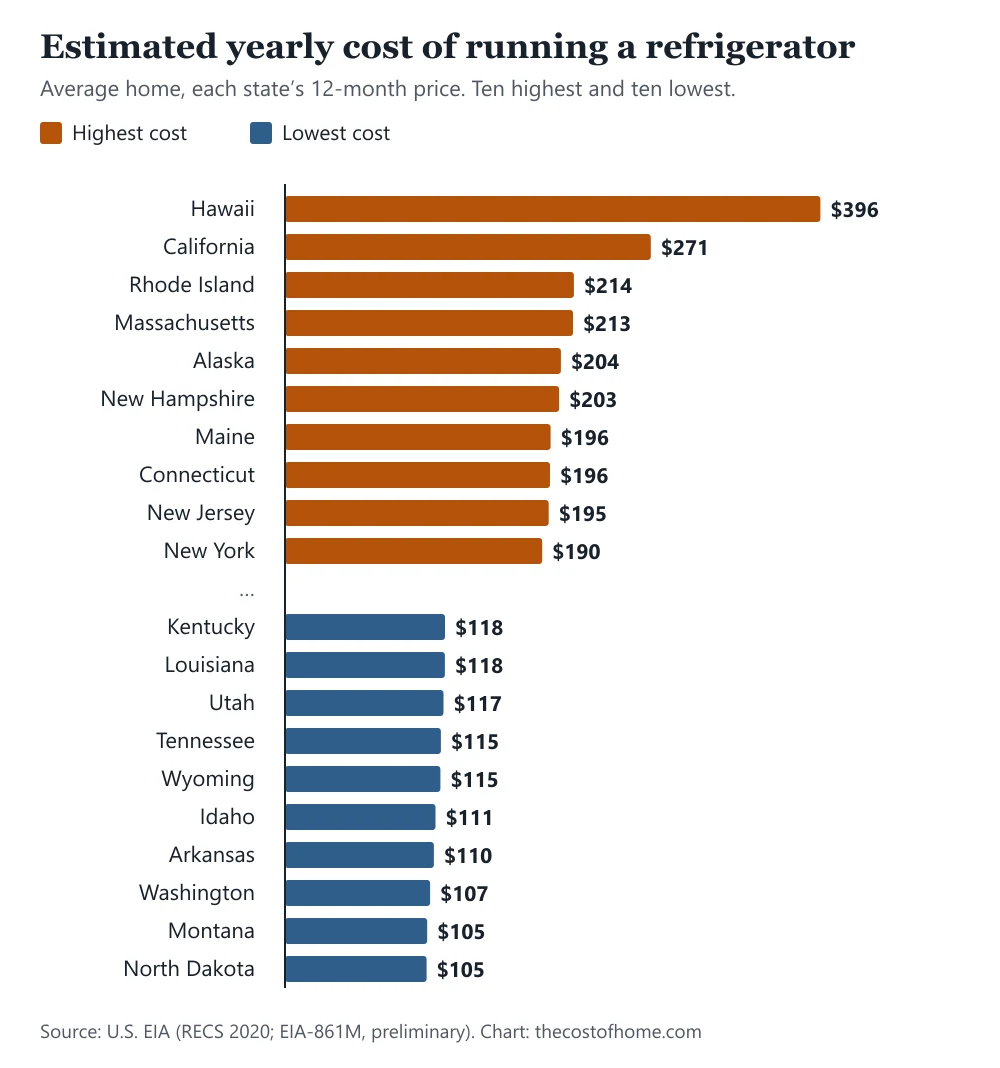
The cost runs from $105 a year in Montana and North Dakota to $396 in Hawaii. Hawaii's price of 43.5 cents per kWh is more than three times that of the cheapest mainland states, and California's 33.0 cents puts it second at $271. Six Northeastern states (Rhode Island, Massachusetts, New Hampshire, Maine, Connecticut and New Jersey) and Alaska are all between $195 and $214. Use differs far less than cost: the survey puts homes in Arizona, Florida, Georgia, Mississippi and Nebraska at 940 kWh, the highest, and homes in Maine and New York at 670 kWh, the lowest among the states (D.C. is lower, at 620 kWh). Survey estimates for single states have a margin of error, so treat differences of a few dozen kWh between neighbors as noise.
How much more does an old refrigerator cost to run?
Refrigerators last a long time, and many in use are not new. The 2020 survey counts 39.8 million homes whose most-used refrigerator is 5 to 9 years old, the biggest group, and 35.1 million (29%) where it is 10 years old or more. Of those, 14.3 million homes (12%) have one that is 15 years or older, including 5.5 million with a refrigerator 20 years old or more.
ENERGY STAR says that, on average, an old refrigerator uses about 20% more energy than an ENERGY STAR model, and that a refrigerator over 15 years old can cost about $95 more per year to run. It also puts the saving from replacing an old refrigerator with an ENERGY STAR model and recycling the old one at about $150 over the new refrigerator's 12-year life. Whether a replacement pays depends on what you pay for it, so compare the new model's EnergyGuide cost with your current appliance, and check for utility rebates for recycling the old one, which the DOE says many utilities offer.
Door seals matter more as a refrigerator ages. The DOE suggests closing the door over a dollar bill, half in and half out: if the bill pulls out easily, the latch may need adjusting or the seal may need replacing.
What does a second refrigerator or freezer cost?
A second refrigerator uses about 490 kWh a year, which is $88 at the U.S. average price. A separate freezer uses about 570 kWh, or $103. That is a steady cost for something often used for overflow: the survey counts 42.5 million homes with a second refrigerator, 16.3 million of them in a garage, 9.7 million in a basement and 2.9 million outside. Of those second refrigerators, 9.7 million (23%) are 15 years old or older.
The DOE's advice is direct: if you have an old second refrigerator or freezer, recycle it, particularly if you do not store much in it or if it sits in unconditioned space. ENERGY STAR says that if you do need a second refrigerator year-round, an ENERGY STAR model is the one to buy. A compact ENERGY STAR refrigerator uses a median of 246 kWh, or $44 a year.
How can you lower the cost of running your refrigerator?
The DOE and ENERGY STAR list a handful of habits that cost nothing:
- Check the temperature. Set the refrigerator to 35°F to 38°F, and a stand-alone freezer to 0°F for long-term storage.
- Keep the door closed as much as possible, and cover liquids and wrap food: uncovered food releases moisture and makes the compressor work harder.
- Mind the location. Keep it away from the oven, the dishwasher and direct sunlight, and leave a few inches between the wall and the refrigerator.
- Clean the coils. On older models, keep the condenser coils clean; the user's manual shows where they are.
- Test the seals. Close the door on a dollar bill; if it slides out easily, the seal may be worn.

When you buy, the DOE and ENERGY STAR both point to the same things: look for the ENERGY STAR and EnergyGuide labels, choose the size you need (the most efficient are usually 16 to 20 cubic feet), and consider a top-freezer model without an ice maker or water dispenser. Fewer doors also mean less air leaking out. For where the rest of your electricity goes, see why your electric bill is so high; the biggest items in most homes are heating, cooling and hot water: what a water heater costs to replace and run and what central air costs to run.
How was this calculated?
Yearly cost is yearly kWh times the price per kWh. The prices are the EIA's residential averages for the 12 months from August 2025 to July 2026 (Form EIA-861M, preliminary): residential revenue divided by kilowatt-hours sold, 18.0 cents for the U.S. A refrigerator runs all year, so the 12-month average is used, not a single month. The state prices are calculated the same way for each state.
The use figures come from the EIA's 2020 Residential Energy Consumption Survey. Tables CE5.3b (average use per home that has the appliance) and CE4.6.EL.ST (use by state) give electricity in million Btu, converted at 293.07 kWh per million Btu and rounded to the nearest 10 kWh. Two limits follow. The survey is from 2020, and refrigerators bought since then use somewhat less. The state figures are rounded to 0.1 million Btu, about 29 kWh. The new-model medians use the yearly kWh that manufacturers report for the 4,889 models on the ENERGY STAR list, where each variant of a model is listed on its own, so a style with many variants counts more in its median. Homes with rooftop solar buy less from the grid than they use. Our full approach is in how we research costs, and more guides are in the Home Repairs & Appliances section.
Frequently asked questions
How much does it cost to run a refrigerator per month?
About $9.29 for a typical refrigerator at the 12-month U.S. average of 18.0 cents per kWh, and about $12.59 for all the refrigerators in the average home. A new ENERGY STAR top-freezer model costs about $5.40.
How many kWh does a refrigerator use per day?
A typical refrigerator uses about 1.7 kWh a day (620 kWh a year), according to the EIA's 2020 survey. A new ENERGY STAR top-freezer model uses a median of 1.0 kWh a day.
How much does a new ENERGY STAR refrigerator cost to run?
By style, the median certified model costs from $49 a year for a single-door refrigerator to $112 for a side-by-side with an ice maker, at 18.0 cents per kWh. A top freezer with no ice maker is 360 kWh, or $65.
Do refrigerators use a lot of electricity?
Refrigerators are about 8% of the electricity used in U.S. homes, and separate freezers about 2% more, per the EIA's 2020 survey. Because they run all day, they are one of the larger fixed costs in a bill, at roughly $151 a year for the average home.
How much more does an old refrigerator cost to run?
ENERGY STAR says an old refrigerator uses about 20% more energy than an ENERGY STAR model on average, and one over 15 years old can cost about $95 more per year to run. About 12% of U.S. homes have a most-used refrigerator that old, per the EIA.
Is it worth keeping a second refrigerator in the garage?
A second refrigerator uses about 490 kWh a year, or $88 at the U.S. average price. The DOE advises recycling an old second refrigerator or freezer, particularly if you do not store much in it or it sits in unconditioned space.
What temperature should a refrigerator be set to?
The DOE and ENERGY STAR both recommend 35°F to 38°F for the refrigerator and 0°F for a stand-alone freezer used for long-term storage.
Sources
- U.S. Energy Information Administration, Form EIA-861M: monthly sales, revenue and customers by state (August 2025 to July 2026, accessed October 15, 2026)
- U.S. Energy Information Administration, 2020 Residential Energy Consumption Survey, table CE5.3b: detailed household electricity end-use consumption, averages (accessed October 23, 2026)
- U.S. Energy Information Administration, 2020 Residential Energy Consumption Survey, table CE5.1b: detailed household electricity end-use consumption, totals (accessed October 21, 2026)
- U.S. Energy Information Administration, 2020 Residential Energy Consumption Survey, table CE4.6.EL.ST: household electricity end-use consumption by state (accessed October 20, 2026)
- U.S. Energy Information Administration, 2020 Residential Energy Consumption Survey, table HC3.1: appliances in U.S. homes, by housing unit type (refrigerator count, type, age and location; accessed October 23, 2026)
- ENERGY STAR, Certified Residential Refrigerators: product list with annual energy use and federal standard by model (downloaded October 23, 2026)
- ENERGY STAR, Refrigerators: efficiency, savings and buying advice (accessed October 23, 2026)
- ENERGY STAR, Refrigerators: key product criteria (10% below the federal minimum; accessed October 23, 2026)
- U.S. Department of Energy, Tips on Saving Money and Energy in Your Home (2022 edition; refrigerators and freezers; accessed October 23, 2026)

Founder and editor, The Cost of Home
I lived in the United States for five years, and this site grew out of the question every household there keeps asking: what will this cost, and is it worth it? Every number here comes from a public source listed at the end of the article.