Home Repairs & Appliances
How Much Does a Sewer Line Camera Inspection Cost?
Quick answer
A sewer line camera inspection costs $271 to $1,725 for most homes, with a national average of $995 in HomeAdvisor's data. A plumbing company puts the typical price at $250 to $1,200, closer to $300 to $700 on average. Line length and access drive the price. It is worth paying before you buy an older home, after repeated clogs, or when large trees grow near the line.
On this page
- How much does a sewer line camera inspection cost?
- What makes the price go up or down?
- How much does a sewer camera inspection cost in different cities?
- What do you get for the money?
- When is a sewer camera inspection worth paying for?
- How much does it cost to fix what the camera finds?
- Who pays for the sewer line: you, the city or your insurance?
- How can you pay less for an inspection?
- What does this comparison leave out?
- FAQ
- Sources
The pipe that carries wastewater from your house to the public sewer or a septic tank is buried, and most owners never see it until something goes wrong. A camera inspection, also called a sewer scope, is how a plumber or inspector looks inside it. This guide puts the price of that look next to the repairs it can lead to, using eight sources we read in full on October 23, 2026.
We did not find an official government survey of what this service costs. The prices below are ranges published by a cost-guide site and a plumbing company, so we show them side by side and say where they disagree. The method behind every number on this site is in how we research costs.
How much does a sewer line camera inspection cost?
HomeAdvisor puts the national average at $995, with most homeowners paying between $271 and $1,725. Its full range runs from $100 to $6,000. Balkan, a New York City sewer and water main company, says inspections typically cost $250 to $1,200, with a national average closer to $300 to $700.
| Source | Typical range | Average | Lowest to highest |
|---|---|---|---|
| HomeAdvisor, sewer inspection guide | $271 to $1,725 | $995 | $100 to $6,000 |
| Balkan Sewer and Water Main (New York City plumbing company) | $250 to $1,200 | $300 to $700 | Up to $6,000 in rare cases |
| HomeAdvisor, sewer replacement guide (the video that starts a repair project) | $100 to $500 | Not given | Not given |
What a sewer line camera inspection costs, by source. Each source's own wording: HomeAdvisor's "normal range" and average, Balkan's typical range and "national average closer to". Sources: HomeAdvisor (updated June 19, 2026); Balkan Sewer and Water Main (June 6, 2025). Read October 23, 2026.
The two averages are far apart, and neither source fully explains the gap. Balkan says the cases that reach $6,000 usually involve extra work such as clearing the pipe or repairs, or the inspection of a public sewer, not the camera visit itself. Both guides say the price drops when the plumber can work through an existing cleanout instead of pulling a toilet. When you collect quotes, ask each company to write down what is included.
What makes the price go up or down?
- Length of the line. The farther the camera has to travel, the more you pay. HomeAdvisor notes that most owners do not know how many feet of pipe run under the house, so the final bill can come in above the estimate. Standard cameras reach roughly 330 to 350 feet, and longer runs need specialized equipment or a second entry point.
- Access. A cleanout, the capped pipe that gives direct access to the line, keeps the price down. Without one, the plumber may have to remove a toilet or a vent stack.
- What is in the way. HomeAdvisor says the quote climbs if the technician has to get through a hard-to-reach section, clear tree roots or create a new access point. Balkan adds that some lines have to be snaked before the camera can go in, and prices drain cleaning at $150 to $350.
- Packages. Some companies bundle the inspection with cleaning and minor repairs, which can lower the total even when the up-front price is higher.
- Where you live. Labor costs differ from place to place, and Balkan says remote areas can cost more because of travel time.
Labor is most of the bill. HomeAdvisor says nearly the entire average goes to labor and that most pros finish in about an hour, while Balkan says a typical job takes 30 minutes to 2 hours.
How much does a sewer camera inspection cost in different cities?
HomeAdvisor lists averages for eight metro areas, from $315 in Orlando to $2,315 in Pittsburgh.
| City | Average cost |
|---|---|
| Orlando, FL | $315 |
| Hartford, CT | $380 |
| Houston, TX | $420 |
| Salt Lake City, UT | $460 |
| New York City, NY | $510 |
| Seattle, WA | $1,535 |
| Los Angeles, CA | $1,600 |
| Pittsburgh, PA | $2,315 |
Average cost of a sewer line camera inspection in eight U.S. cities, as listed by HomeAdvisor (updated June 19, 2026). The guide does not say how each city's figure was built.
The guide does not say why Pittsburgh costs about seven times what Orlando does, so read the table as a reason to get two or three quotes, not as a forecast for your city. Balkan also advises asking several contractors for quotes and says the difference can be large.
What do you get for the money?
HomeAdvisor lists what a local inspector will likely do: reach the line through an existing cleanout or fixture, run the camera through the pipe to spot cracks, clogs and other red flags, write a report, hand over the video file, and walk you through the findings, the costs and the next steps. Balkan says modern cameras record HD video and images, and describes the inspection as preventive maintenance, like a yearly health checkup.
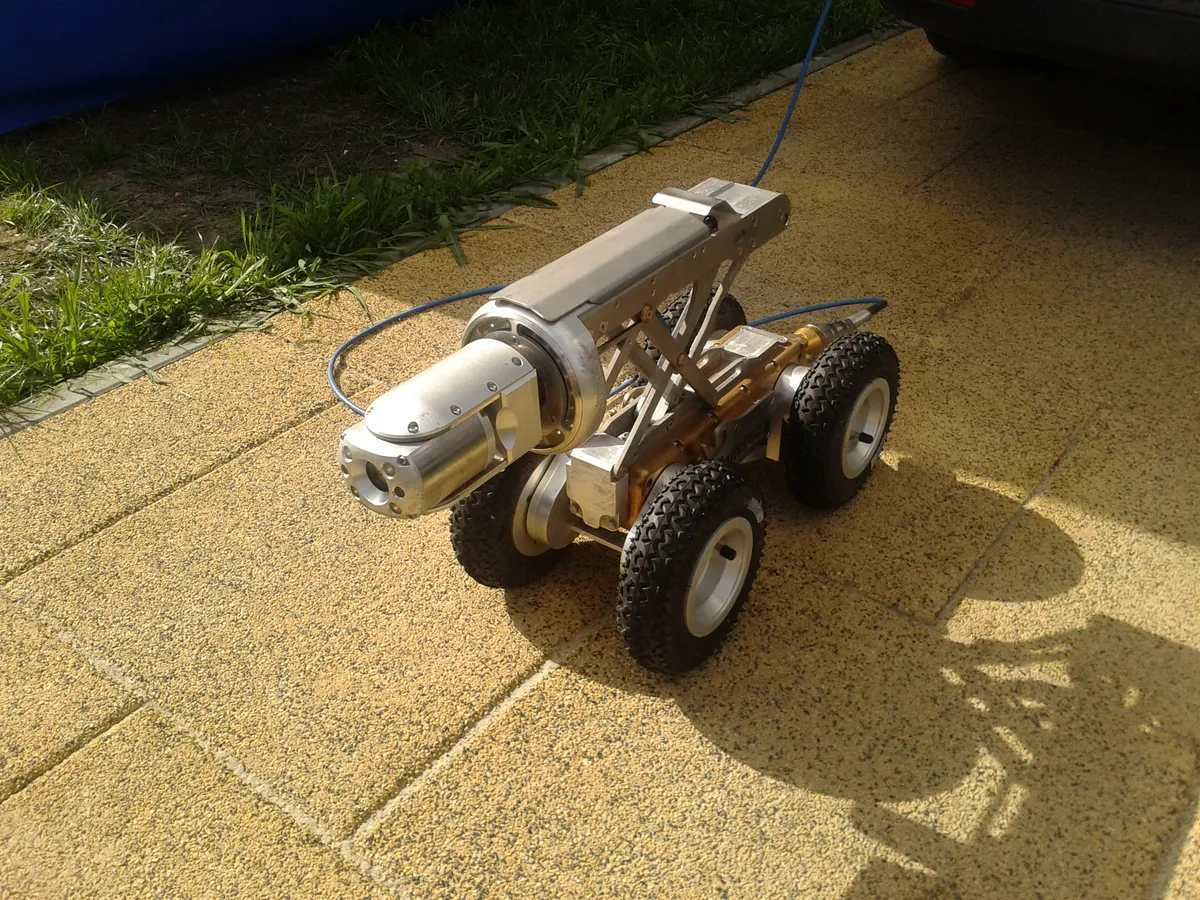
HomeAdvisor lists several camera types. A common one is a small camera on a thin cable that the plumber feeds into the pipe; the crawler at the top of this page is a larger unit of the kind city sewer services use. Either way, the technician watches the live picture on a monitor while the camera moves through the pipe, and you can usually watch along. This is what a screen looks like during a sewer survey: the view runs down the pipe, and the text on the screen logs where the camera is and what pipe it is in.
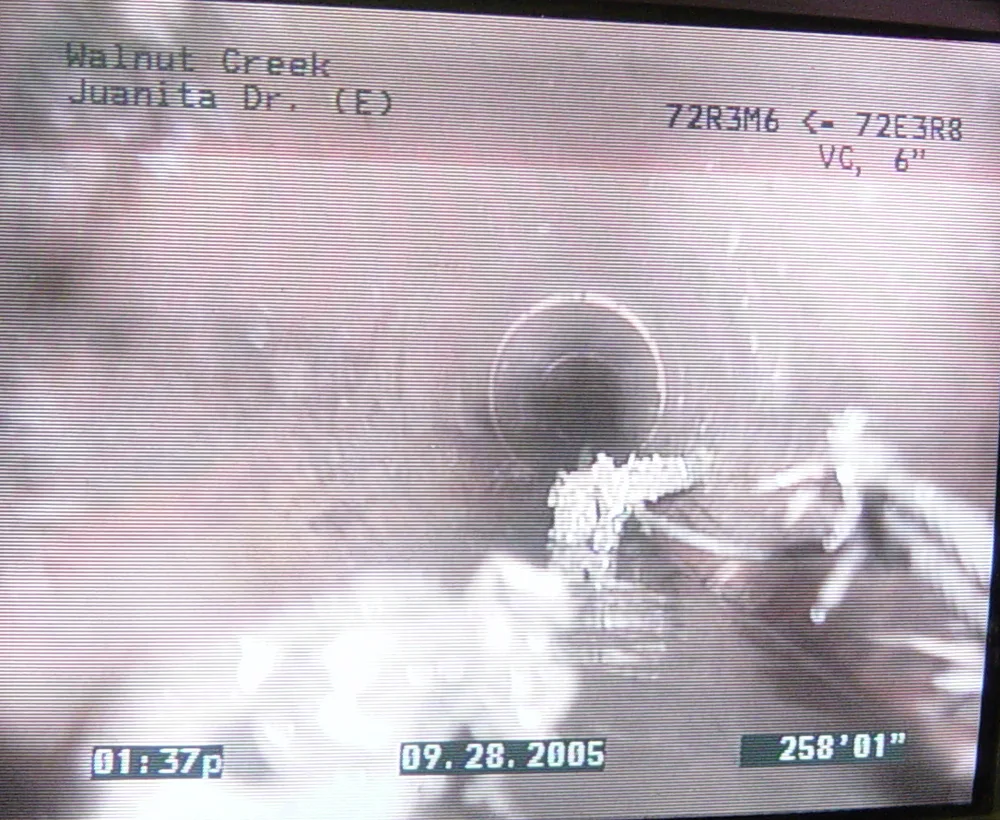
A camera can only show what it can reach. HomeAdvisor says standard cameras travel roughly 330 to 350 feet, and a line that is longer than that needs another entry point.
When is a sewer camera inspection worth paying for?
The clearest case is a house you are about to buy. HomeAdvisor says to always get a sewer line inspection before purchasing a home, and Balkan puts it more bluntly: once you buy the home, you also buy the sewer problem. Both guides also list these situations:
- An older house. HomeAdvisor says old clay or cast iron pipes are more prone to deterioration, cracks and root intrusion. Balkan says clay pipes in homes built before 1970 are easy to damage.
- Large trees near the line. Tree roots can grow into the pipe and block it, according to Balkan.
- Symptoms. Slow drains in several fixtures, frequent clogs, gurgling from drains or toilets, sewage smells, wet spots or unusually lush grass in the yard and rodents. Balkan adds water backing up in almost every bathroom fixture.
- After a big renovation. HomeAdvisor suggests an inspection after major plumbing work to check that nothing was damaged by accident.
- Before and after a cleaning. Balkan notes a scope is a way to check how well a snaking worked.
In some places the old pipe is a specific material. Orangeburg pipe is made of paper with a tar coating and was used to connect homes to the city sewer between 1940 and 1970. When KJZZ reported on Tempe, Arizona, in 2022, it said the pipe's average lifespan was about 50 years but that it is known to fail in as little as 10, and that the city had no record of where it was installed. An engineering professor quoted in the story described the two ways it fails: a crack that leaks sewage into the yard, or a collapse that causes backups in the house.
How often should you do it?
HomeAdvisor says many plumbing experts recommend a sewer camera inspection every one to two years, even without problems, and every two to three years for newer homes with no plumbing issues. Do the math before you commit to that: one scope every two years for 20 years is 10 inspections, or $3,000 to $7,000 at Balkan's $300 to $700, about the price of one average replacement ($3,319). That is our arithmetic, not a recommendation from either source. A scope when you buy and another when a symptom appears costs a fraction of that.
How much does it cost to fix what the camera finds?
The camera is usually the first step. This Old House says most sewer line projects begin with a camera inspection to find blockages, cracks or collapsed sections and to decide on the repair, and HomeAdvisor says a video inspection can save thousands by making sure the diagnosis is right. What comes next depends on the problem.
| Problem or method | Typical cost |
|---|---|
| Clear a clogged sewer line | $200 to $300 (up to $1,000 or more for severe or hard-to-reach clogs) |
| Remove tree roots from the line | $100 to $600 (Balkan: about $600) |
| Repair a broken or cracked pipe | $600 to $1,050 |
| Spot repair of a defect (Balkan) | $1,300 to $15,000 |
| Replace part of the line | $50 to $250 per foot |
| Replace the whole line (average $3,319) | $1,388 to $5,323, or $60 to $250 per foot |
| Trenchless: pipe lining (CIPP) | $90 to $250 per foot |
| Trenchless: pipe bursting | $60 to $200 per foot |
| Extra to dig under a concrete slab | $300 to $350 more per foot |
What common sewer line problems cost to fix. Figures are HomeAdvisor's unless marked; per-foot prices cover materials and labor. Sources: HomeAdvisor sewer replacement guide (updated June 19, 2026); Balkan Sewer and Water Main (2025).
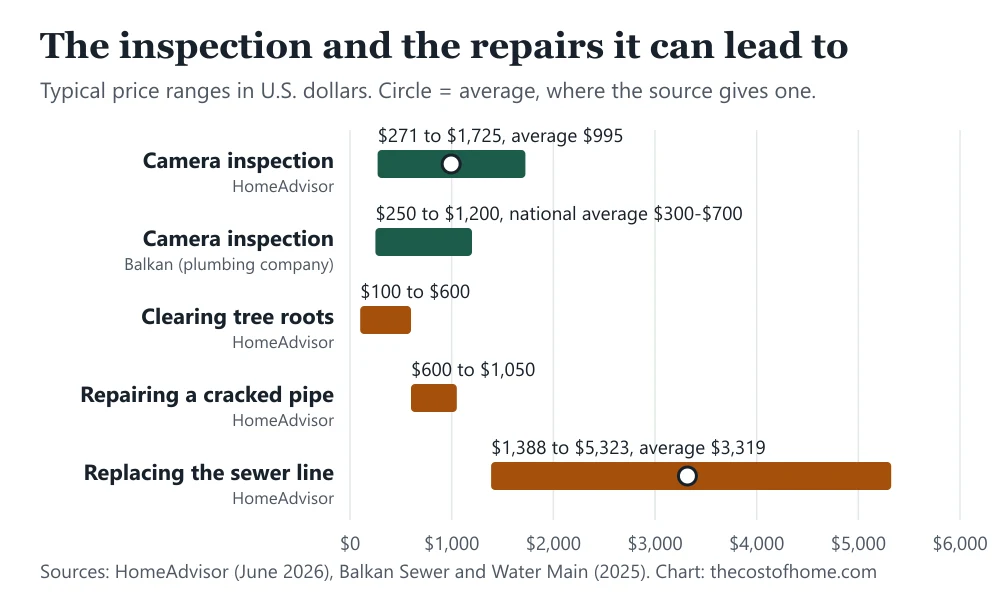
A typical scope at Balkan's $300 to $700 is about 9% to 21% of an average replacement bill of $3,319, and HomeAdvisor's $995 average is about 30% of it. The cost of a replacement depends on length, so here is the per-foot pricing applied to three line lengths:
| Line length | Replace (open trench) | Pipe lining (CIPP) | Pipe bursting |
|---|---|---|---|
| 30 feet | $1,800 to $7,500 | $2,700 to $7,500 | $1,800 to $6,000 |
| 50 feet | $3,000 to $12,500 | $4,500 to $12,500 | $3,000 to $10,000 |
| 100 feet | $6,000 to $25,000 | $9,000 to $25,000 | $6,000 to $20,000 |
Our arithmetic: the per-foot prices above times the length of the line, rounded as shown. Pipe, materials and labor only. Digging, permits, fixing the yard or driveway and the camera inspection are not included. Source of the per-foot prices: HomeAdvisor, June 2026.
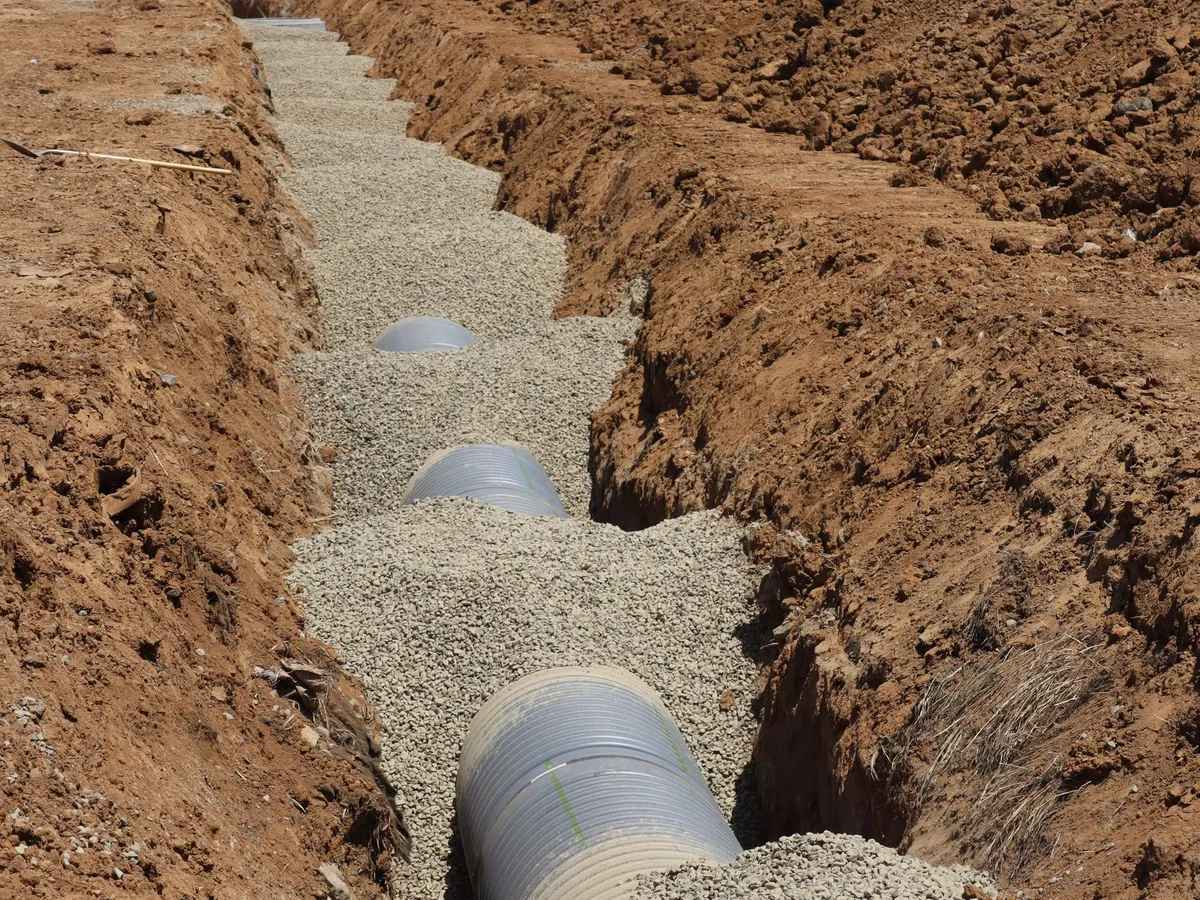
Digging explains much of the gap between methods. HomeAdvisor says a large part of the cost of a replacement is trenching, which it prices at $4 to $12 per linear foot, and fixing the yard or driveway afterward adds more: landscaping runs $4.50 to $12 per square foot and a concrete driveway repair $1 to $25. Trenchless methods, lining and bursting, need less digging and can save on that restoration, but they are not always possible: HomeAdvisor says they are sometimes unavailable when the pipe has completely collapsed. This Old House puts open-trench replacement at $50 to $200 per foot and trenchless at $60 to $250.
Who pays for the sewer line: you, the city or your insurance?
Usually you do, at least for the pipe on your property, though the rules differ by city. Los Angeles County Public Works says its sewer laterals are entirely owned by the property owner they serve, and that the owner is responsible for the entire length, including the part under the street. It also notes that laterals are often not maintained until a disaster strikes. We read only that county's page, so check with your own city or sewer district.
In some places an inspection is not optional. In the area served by the East Bay Municipal Utility District in California, a Compliance Certificate showing the private sewer lateral is leak-free is required to close escrow when you buy or sell a property, for a remodel over $100,000 and when a water meter changes size. If the pipe has not passed by the time of the sale, the parties can get a Time Extension Certificate, which requires a $4,500 refundable deposit and gives 180 days to do the work.
Standard homeowners insurance leaves gaps here. Policygenius says water that backs up through a sewer or drain is excluded unless you add a water backup endorsement, which it says costs as little as $30 a year, typically $30 to $70 a year for $5,000 of coverage, and does not cover wear and tear or maintenance problems. None of the sources we read says a standard policy pays for an inspection or for replacing a worn pipe. HomeAdvisor and Balkan both suggest checking whether a home warranty covers the inspection or the repair. Some cities also partner with service line plans: KJZZ reported that Tempe's program covered repairs up to $8,500 for $9.88 a month in the first year, as of 2022.
How can you pay less for an inspection?
- Get two or three quotes and compare what each includes. Balkan says the price difference can be eye-opening.
- Bundle it with drain cleaning, pipe clearing or a repair. HomeAdvisor and Balkan both say bundling can lower the total.
- Book an off-peak day, if you can, and keep records of earlier repairs so the plumber does not spend your money rediscovering them. Both tips are HomeAdvisor's.
- Check a home warranty. Both guides say it may cover the inspection.
Doing it yourself is possible but limited. HomeAdvisor says consumer snake cameras reach only about 20 feet, enough to find an obstruction near a fixture but not to diagnose the main line. Balkan says renting a sewer camera costs $100 to $300 a day and buying one $200 to $10,000, and warns that a beginner can miss a hairline crack or hidden root growth, or mistake a minor issue for a major one.
What does this comparison leave out?
- It is not an official statistic. Both main sources sell something: HomeAdvisor connects homeowners with local pros, and Balkan repairs and replaces sewer lines. HomeAdvisor says its guides were produced with automation technology and reviewed by an editor, and that its prices come from surveys of customers.
- The two guides disagree. HomeAdvisor's own pages even give two ranges for a video inspection: $271 to $1,725 in the inspection guide and $100 to $500 in the replacement guide. That is why we show every range instead of picking one.
- Repair prices are for the pipe. They leave out permits and the yard, driveway or patio restoration, which can add thousands.
- Your local rules. Who owns the pipe, and whether the sale of a home triggers an inspection, depends on your city or sewer district.
- Prices change. HomeAdvisor updated both guides on June 19, 2026, and Balkan published its guide in June 2025.
A sewer line is one of the repairs that hides until it is expensive. For two other big-ticket items in the same budget, see what a new water heater costs and heat pump vs gas furnace cost, and for what the house costs to keep warm, what a furnace costs to run per month. More guides on the costly fixes are in the Home Repairs section.
Frequently asked questions
How much does a sewer line camera inspection cost?
HomeAdvisor puts the national average at $995, with most homeowners paying $271 to $1,725. Balkan, a plumbing company, says $250 to $1,200 is typical and the national average is closer to $300 to $700. Length of the line and access to it move the price.
How long does a sewer camera inspection take?
HomeAdvisor says most pros finish in roughly an hour, and Balkan says 30 minutes to 2 hours for most homes. Cleaning the line first, or having no cleanout, adds time and cost.
Is a sewer camera inspection worth it when buying a house?
Both guides say yes. HomeAdvisor recommends always getting one before purchasing a home, and Balkan says that once you buy the house you also buy the sewer problem. An inspection costs a fraction of the $3,319 average replacement bill.
How often should you have your sewer line inspected?
HomeAdvisor says many plumbing experts recommend every one to two years, and every two to three years for newer homes with no plumbing issues. Older homes, large trees near the line and repeated clogs are reasons to scope sooner.
How much does it cost to fix a sewer line after the camera inspection?
It depends on the problem. HomeAdvisor lists $100 to $600 to remove tree roots, $600 to $1,050 to repair a cracked pipe and $1,388 to $5,323 to replace the line, with an average of $3,319. Trenchless lining runs $90 to $250 per foot.
Does homeowners insurance cover a sewer line inspection or repair?
A standard policy generally excludes water that backs up through a sewer or drain unless you add a water backup endorsement, which Policygenius says costs as little as $30 a year. It does not cover wear and tear or maintenance problems. None of the sources we read says a standard policy pays for an inspection, so ask your insurer and check whether a home warranty applies.
Can I inspect my own sewer line with a camera?
You can, but it is limited. HomeAdvisor says consumer snake cameras reach only about 20 feet. Balkan says renting a sewer camera costs $100 to $300 a day and warns that an inexperienced user can miss small cracks or hidden roots, or mistake a minor issue for a major one.
Who is responsible for the sewer line, the homeowner or the city?
It depends on where you live. Los Angeles County says the property owner owns and maintains the entire lateral, including the part under the street. Other cities split the responsibility at the property line, so check with your city or sewer district.
Sources
- HomeAdvisor, "How Much Does a Sewer Line Camera Inspection Cost in 2026?": average, normal range, cost factors and city averages (updated June 19, 2026; accessed October 23, 2026)
- HomeAdvisor, "How Much Does Sewer Line Replacement Cost in 2026?": replacement, repair and trenchless prices (updated June 19, 2026; accessed October 23, 2026)
- Balkan Sewer and Water Main, "How Much Does A Sewer Scope Inspection Cost" by David Balkan (June 6, 2025; accessed October 23, 2026)
- This Old House, "How Much Does Sewer Line Replacement Cost? (2026 Pricing)" (updated March 30, 2026; cost data from Angi; accessed October 23, 2026)
- KJZZ, "Officials: Tempe plagued with deteriorating sewage pipes" (June 4, 2022; accessed October 23, 2026)
- Los Angeles County Public Works, Sewer Maintenance Division: homeowner responsibility for the sewer lateral (accessed October 23, 2026)
- East Bay Municipal Utility District, Private Sewer Laterals: Compliance Certificate and Time Extension Certificate (accessed October 23, 2026)
- Policygenius, "What Is Water Backup Coverage?": exclusions and endorsement prices (accessed October 23, 2026)

Founder and editor, The Cost of Home
I lived in the United States for five years, and this site grew out of the question every household there keeps asking: what will this cost, and is it worth it? Every number here comes from a public source listed at the end of the article.