Heating & Cooling
Heat Pump vs Gas Furnace: Which Costs Less to Run This Winter?
Quick answer
At last winter's prices, a high-efficiency gas furnace costs less to run than a heat pump in most of the country: 40 of 47 places. The heat pump comes out ahead where electricity is cheap and gas is not, such as Arkansas, North Carolina and Texas. At national average prices, a heat pump needs a seasonal efficiency (COP) of about 3.5 to match a 96% furnace.
On this page
- How much does a furnace or a heat pump cost to run in winter?
- Which costs less to run in your state?
- Why does the answer change so much from state to state?
- What efficiency does a heat pump need to beat a gas furnace?
- Do heat pumps still save money in cold weather?
- How do you work out the cost for your own home?
- What does this comparison leave out?
- FAQ
- Sources
A furnace burns gas you buy by the therm. A heat pump runs on electricity you buy by the kilowatt-hour. Both put the same heat into your home, so which one is cheaper to run comes down to how those two prices compare where you live.
To compare them fairly, this guide prices the same job in every state: delivering 60 million Btu of heat to a home over the winter. That is an example size, so the dollar figures scale up or down with your own home. The prices are the U.S. Energy Information Administration (EIA) averages paid by residential customers from November 2025 to March 2026, weighted by how much each state used, so they include delivery charges and fees. Our average electric bill by state guide is built from the same EIA data.
How much does a furnace or a heat pump cost to run in winter?
At national average prices, the 96% gas furnace costs about $880 to deliver the example winter's heat. The typical heat pump costs about $1,250, roughly 41% more. A very efficient heat pump (COP 3.0) lands at $1,040, close to the $1,060 a standard 80% furnace would cost.
| Heating system | Efficiency | Winter cost |
|---|---|---|
| Gas furnace, standard | 80% AFUE | $1,060 |
| Gas furnace, high-efficiency | 96% AFUE | $880 |
| Heat pump, lower efficiency | COP 2.0 (HSPF2 6.8) | $1,560 |
| Heat pump, typical | COP 2.5 (HSPF2 8.5) | $1,250 |
| Heat pump, high-efficiency | COP 3.0 (HSPF2 10.2) | $1,040 |
Winter cost of 60 million Btu of heat at U.S. average prices ($1.41 per therm of gas, 17.8¢ per kWh), rounded to the nearest $10. Source: U.S. EIA prices, Nov 2025-Mar 2026.
The national average hides a wide spread. Gas costs $1.98 per therm in Arkansas and $0.68 in Idaho, and electricity runs from 12.4¢ in Missouri to 32.5¢ in California. The next table shows what that does to each state.
Which costs less to run in your state?
The gas furnace was at least 5% cheaper in 40 of the 47 places in the table. The heat pump was clearly cheaper in Arkansas, North Carolina and Texas, and the two were about even in Arizona, Georgia, Missouri and Washington.
| State | Electricity | Gas | Furnace | Heat pump | Cheaper | Break-even COP |
|---|---|---|---|---|---|---|
| U.S. average | 17.8¢ | $1.41 | $880 | $1,250 | Furnace | 3.5 |
| Alabama | 16.3¢ | $1.64 | $1,020 | $1,140 | Furnace | 2.8 |
| Alaska | 26.0¢ | $1.25 | $780 | $1,830 | Furnace | 5.8 |
| Arizona | 15.7¢ | $1.75 | $1,100 | $1,100 | About even | 2.5 |
| Arkansas | 12.8¢ | $1.98 | $1,240 | $900 | Heat pump | 1.8 |
| California | 32.5¢ | $2.18 | $1,360 | $2,290 | Furnace | 4.2 |
| Colorado | 16.5¢ | $1.04 | $650 | $1,160 | Furnace | 4.4 |
| Connecticut | 28.3¢ | $1.68 | $1,050 | $1,990 | Furnace | 4.7 |
| Delaware | 17.1¢ | $1.62 | $1,010 | $1,200 | Furnace | 3.0 |
| District of Columbia | 23.9¢ | $1.56 | $970 | $1,680 | Furnace | 4.3 |
| Georgia | 14.3¢ | $1.59 | $990 | $1,010 | About even | 2.5 |
| Idaho | 12.3¢ | $0.68 | $430 | $870 | Furnace | 5.1 |
| Illinois | 17.6¢ | $1.00 | $630 | $1,240 | Furnace | 4.9 |
| Indiana | 16.6¢ | $1.04 | $650 | $1,160 | Furnace | 4.5 |
| Iowa | 13.0¢ | $0.98 | $610 | $910 | Furnace | 3.7 |
| Kansas | 14.8¢ | $1.30 | $810 | $1,040 | Furnace | 3.2 |
| Kentucky | 13.9¢ | $1.34 | $840 | $970 | Furnace | 2.9 |
| Maryland | 22.9¢ | $1.58 | $990 | $1,610 | Furnace | 4.1 |
| Massachusetts | 30.8¢ | $2.47 | $1,540 | $2,160 | Furnace | 3.5 |
| Michigan | 20.0¢ | $1.02 | $640 | $1,410 | Furnace | 5.5 |
| Minnesota | 15.2¢ | $1.05 | $660 | $1,070 | Furnace | 4.1 |
| Mississippi | 14.8¢ | $1.42 | $890 | $1,040 | Furnace | 2.9 |
| Missouri | 12.4¢ | $1.44 | $900 | $870 | About even | 2.4 |
| Montana | 13.1¢ | $0.84 | $530 | $920 | Furnace | 4.4 |
| Nebraska | 12.1¢ | $1.07 | $670 | $850 | Furnace | 3.2 |
| Nevada | 13.9¢ | $0.95 | $600 | $980 | Furnace | 4.1 |
| New Hampshire | 26.6¢ | $1.86 | $1,160 | $1,870 | Furnace | 4.0 |
| New Jersey | 23.1¢ | $1.37 | $860 | $1,620 | Furnace | 4.7 |
| New Mexico | 14.9¢ | $1.01 | $630 | $1,050 | Furnace | 4.1 |
| New York | 28.3¢ | $1.62 | $1,010 | $1,990 | Furnace | 4.9 |
| North Carolina | 14.3¢ | $1.76 | $1,100 | $1,010 | Heat pump | 2.3 |
| North Dakota | 11.4¢ | $0.84 | $520 | $800 | Furnace | 3.8 |
| Ohio | 17.7¢ | $1.17 | $730 | $1,250 | Furnace | 4.3 |
| Oklahoma | 12.9¢ | $1.29 | $810 | $910 | Furnace | 2.8 |
| Oregon | 14.9¢ | $1.58 | $990 | $1,050 | Furnace | 2.7 |
| Pennsylvania | 20.3¢ | $1.41 | $880 | $1,430 | Furnace | 4.0 |
| Rhode Island | 30.3¢ | $2.02 | $1,270 | $2,130 | Furnace | 4.2 |
| South Carolina | 15.6¢ | $1.62 | $1,010 | $1,100 | Furnace | 2.7 |
| South Dakota | 13.4¢ | $0.95 | $590 | $950 | Furnace | 4.0 |
| Tennessee | 13.3¢ | $1.19 | $740 | $940 | Furnace | 3.2 |
| Texas | 15.9¢ | $1.88 | $1,180 | $1,120 | Heat pump | 2.4 |
| Utah | 13.1¢ | $1.05 | $660 | $920 | Furnace | 3.5 |
| Vermont | 23.6¢ | $1.60 | $1,000 | $1,660 | Furnace | 4.1 |
| Virginia | 15.9¢ | $1.59 | $990 | $1,120 | Furnace | 2.8 |
| Washington | 13.9¢ | $1.61 | $1,010 | $980 | About even | 2.4 |
| West Virginia | 15.0¢ | $1.28 | $800 | $1,060 | Furnace | 3.3 |
| Wisconsin | 18.4¢ | $1.11 | $690 | $1,290 | Furnace | 4.7 |
| Wyoming | 13.2¢ | $1.04 | $650 | $930 | Furnace | 3.6 |
Winter cost of 60 million Btu of heat, rounded to the nearest $10. Electricity in cents per kWh, gas in dollars per therm. Gas furnace at 96% AFUE, heat pump at COP 2.5. "About even" means within 5%. Break-even COP is the seasonal efficiency at which a heat pump costs the same as the furnace. Source: U.S. EIA prices, Nov 2025-Mar 2026.
The table covers 46 states and D.C. Florida, Hawaii, Louisiana and Maine are left out because the EIA's winter gas prices were missing for several months, or almost no homes there use gas.
Why does the answer change so much from state to state?
A heat pump wins when electricity costs less than its COP times what gas costs for the same amount of heat. The break-even COP in the table is that comparison as a single number. In Arkansas it is 1.8, so even a basic heat pump saves money. In Michigan it is 5.5, because gas there costs only $1.02 per therm while electricity runs 20.0¢.
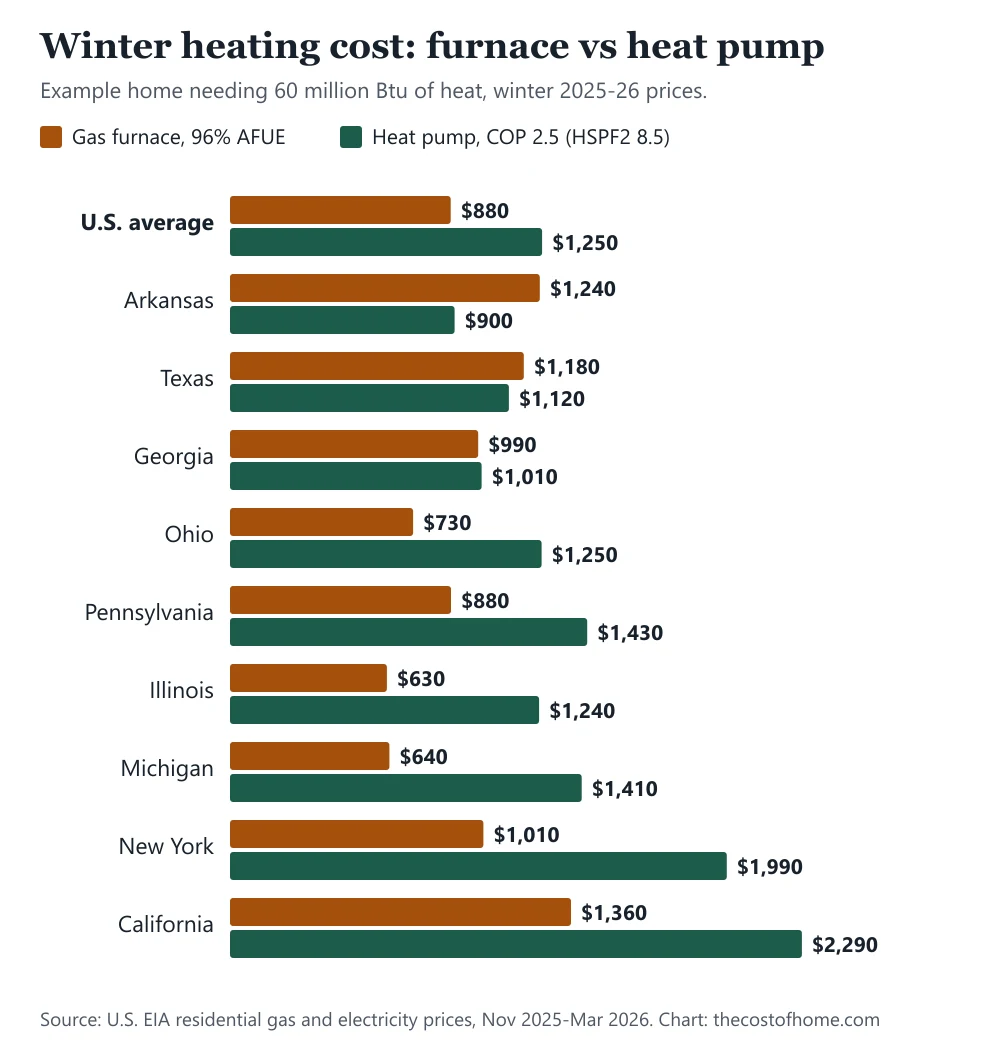
High prices on both sides, as in California and New York, leave the furnace ahead because electricity costs far more than gas for the same heat: 32.5¢ per kWh against $2.18 per therm in California.
What efficiency does a heat pump need to beat a gas furnace?
Take the break-even COP for your state from the table and compare it with your heat pump's rating. HSPF2 divided by 3.412 gives the seasonal COP, so a unit rated HSPF2 10.2 averages about 3.0. ENERGY STAR sets the bar at HSPF2 7.8 for split-system heat pumps (a COP of about 2.3) and at 8.1 to 8.5 for its cold-climate label (about 2.4 to 2.5).
The comparison depends on the furnace you are replacing. Against a standard 80% furnace, the heat pump at COP 2.5 costs less in 15 of the 47 places, and at COP 3.0 in 22. If your furnace is old, the heat pump's case is stronger than the table suggests.
A quick check with your own bill: a COP 2.5 heat pump matches a 96% furnace when the price of a kWh, in cents, is about 8.9 times the price of a therm of gas, in dollars. At $1.50 per therm, that is 13.3¢ per kWh. Pay less than that for electricity and the heat pump is the cheaper one to run.
Do heat pumps still save money in cold weather?
Heat pumps lose efficiency as the outdoor temperature falls. ENERGY STAR's cold-climate label requires a COP of at least 1.75 at 5°F and at least 70% of the unit's 47°F heating capacity at 5°F, so even in a hard freeze a qualifying unit still delivers more heat per kWh than a plain electric heater (COP 1.0). In a cold state, the season's average COP can sit below the 2.5 used here, which is why the break-even column matters more than the single comparison.
Where winters are mild and electricity is reasonably priced, such as North Carolina (break-even 2.3) and Texas (2.4), the heat pump holds up well. In the northern states with cheap gas, the break-even is much higher: Minnesota needs 4.1 and Michigan needs 5.5, which would take an HSPF2 of about 19, far above the 8.1 to 8.5 ENERGY STAR sets for its cold-climate label.
How do you work out the cost for your own home?
You need the therms of gas your furnace uses in a winter and the price per therm on your bill.
- Find the gas used for heating. Take a January bill and subtract the therms you use in a summer month for water heating and cooking. Some bills show CCF instead of therms; 1 CCF is about 1.04 therms.
- Price it. Divide the total on your gas bill by the therms to get your all-in price per therm, then multiply by the heating therms.
- Price the heat pump. Multiply the heating therms by 100,000 Btu, then by your furnace's AFUE, divide by 3,412 Btu per kWh and by the heat pump's COP. Multiply the kWh by your price per kWh.
For example, a home that burns 500 therms a winter at $1.41 per therm in a 96% furnace pays about $710. The same heat from a COP 2.5 heat pump takes about 5,627 kWh, or $1,000 at 17.8¢ per kWh. Your price per kWh is on your electric bill, and our guide to the average electric bill by state shows how it compares with your state's average.
What does this comparison leave out?
It covers the cost of running the equipment, and our guide to what a furnace costs to run per month prices the furnace by state, size and fuel. A few other things also decide the full picture:
- Equipment and installation. A heat pump and a furnace are priced differently, and a heat pump also cools your home in summer, which can replace a central air conditioner. Our heat pump cost guide covers the price to buy and install one.
- Your gas bill's fixed charge. If you keep gas for the water heater or stove, the monthly customer charge on your gas bill stays. If you drop gas entirely, it goes away.
- Your rate plan. Tiered and time-of-use electricity rates, or a utility's special heat pump rate, can move the numbers in either direction.
- Backup heat. Some heat pumps switch to electric resistance heat in extreme cold, which runs at COP 1.0.
- Next winter's prices. These are last winter's actual averages. Gas and electricity prices change every year, so the ranking can shift.
The method behind every number on this site is in how we research costs. More guides on the cost of keeping a home warm are in the Heating & Cooling and Energy Bills sections.
Frequently asked questions
Is a heat pump cheaper to run than a gas furnace?
In most states, no: a 96% gas furnace was at least 5% cheaper in 40 of 47 places at last winter's prices. At national average prices the example winter's heat costs about $880 with the furnace and $1,250 with a typical heat pump. The heat pump was clearly cheaper in Arkansas, North Carolina and Texas.
Is a heat pump cheaper to run than an electric furnace?
Yes. A plain electric furnace turns each kWh into 3,412 Btu of heat (COP 1.0), while a COP 2.5 heat pump turns it into 8,530 Btu, so it uses 60% less electricity for the same heat. At the national average price, the example winter's heat costs about $3,120 with an electric furnace and $1,250 with the heat pump.
What is a good HSPF2 rating for a heat pump?
ENERGY STAR sets 7.8 as the minimum for split-system heat pumps and 8.1 (ducted) to 8.5 (ductless) for its cold-climate label. Divide HSPF2 by 3.412 to get the seasonal COP: 8.5 is about 2.5, and 10.2 is about 3.0.
Do heat pumps work below freezing?
Yes, with lower efficiency. ENERGY STAR cold-climate heat pumps must deliver a COP of at least 1.75 at 5°F and keep at least 70% of their 47°F heating capacity, so they still beat plain electric heat (COP 1.0) in a hard freeze.
Does a heat pump cost less to run than an old 80% furnace?
More often than against a new furnace. A COP 2.5 heat pump was cheaper than an 80% furnace in 15 of the 47 places, and a COP 3.0 heat pump in 22. At national average prices, the 80% furnace costs about $1,060 for the example winter's heat, against $1,250 for the COP 2.5 heat pump and $1,040 at COP 3.0.
How do I find the price per therm on my gas bill?
Divide the total amount by the therms used. If your bill shows CCF (100 cubic feet), multiply by about 1.04 to get therms. The U.S. average over the winter was about $1.41 per therm, including delivery charges and fees.
Sources
- U.S. Energy Information Administration, Natural Gas Prices: average residential price by state, monthly (accessed October 16, 2026)
- U.S. Energy Information Administration, Natural Gas Consumption by End Use: residential volumes by state, monthly (accessed October 16, 2026)
- U.S. Energy Information Administration, Electricity Data Browser: residential retail sales and average price by state, monthly (accessed October 16, 2026)
- U.S. Energy Information Administration, "How do I convert natural gas prices in dollars per cubic feet to dollars per British thermal unit or therm?" (average heat content of natural gas, 1,037 Btu per cubic foot in 2025)
- U.S. Energy Information Administration, British thermal units (Btu): 1 kilowatthour = 3,412 Btu; 1 therm = 100,000 Btu
- ENERGY STAR, Air-Source Heat Pumps: key product criteria (HSPF2 and cold-climate requirements)
- ENERGY STAR, Furnaces: key product criteria (AFUE requirements)

Founder and editor, The Cost of Home
I lived in the United States for five years, and this site grew out of the question every household there keeps asking: what will this cost, and is it worth it? Every number here comes from a public source listed at the end of the article.