Heating & Cooling
How Much Does It Cost to Run a Furnace per Month?
Quick answer
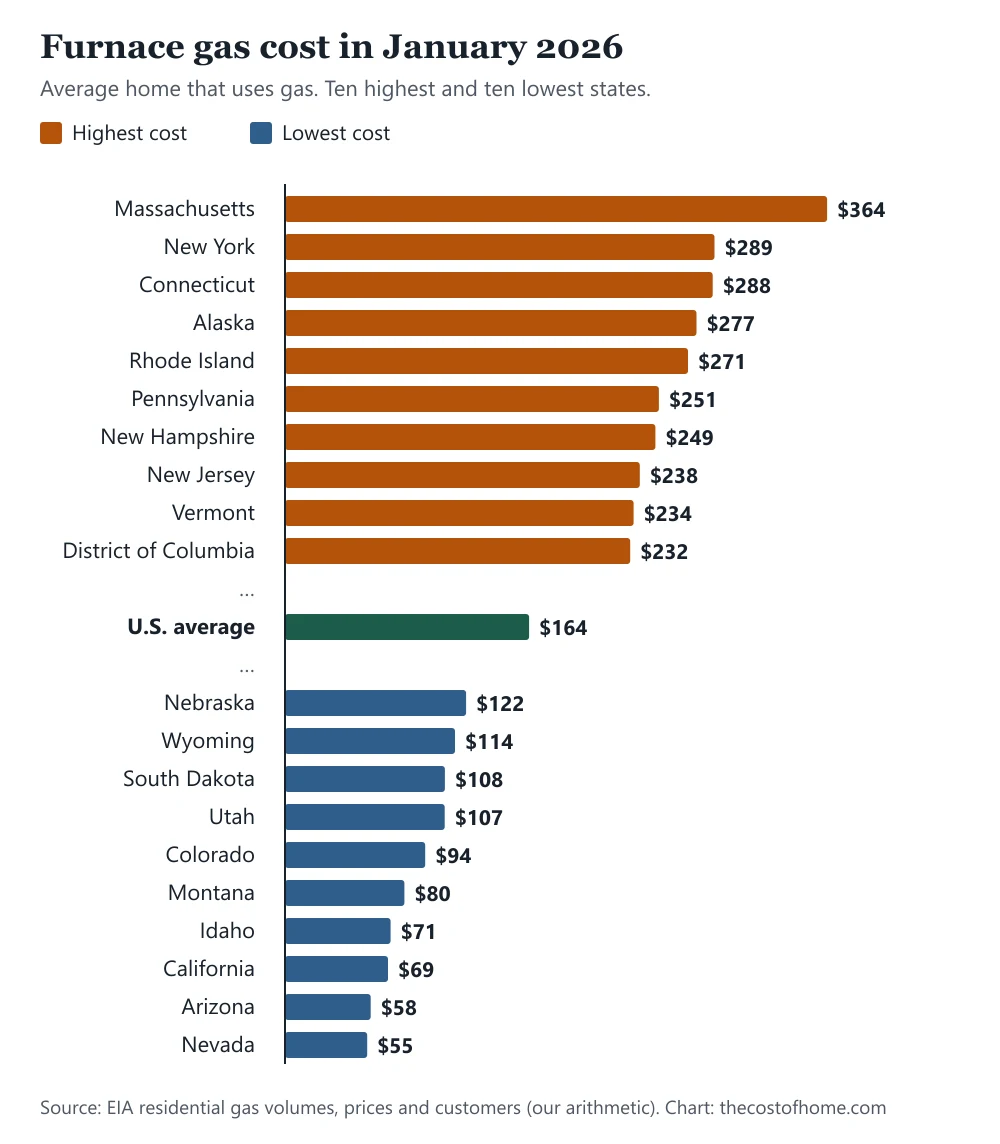
Running a gas furnace costs the average U.S. home about $116 a month from November through March, and about $164 in January, when it works hardest. That is based on last winter's EIA gas bills. January runs from about $55 in Nevada to $364 in Massachusetts. An electric furnace costs about 4 times as much per unit of heat.

On this page
- How much does it cost to run a furnace per month?
- What does a furnace cost per month in each state?
- How much does a furnace cost to run per hour?
- Is a gas, electric, oil or propane furnace cheapest to run?
- Will running a furnace cost more this winter?
- How much does furnace heating cost in your climate?
- Why can your furnace cost more than the average?
- How can you lower what your furnace costs per month?
- How was this calculated?
- FAQ
- Sources
A furnace has no price tag of its own on the monthly bill. What you pay is the fuel it burns or the electricity it draws, so the cost depends on how much heat your home loses, how cold the month is, how efficient the furnace is and what your utility charges per unit. Most furnaces burn natural gas; the U.S. Department of Energy says others use electricity, oil or propane. This guide prices all four.
For the average home that uses gas, the answer is about $116 a month over the five heating months, $164 in January and $582 for the season. By state, January runs from about $55 in Nevada to $364 in Massachusetts. The prices come from the same federal data as our average natural gas bill by state guide.
How much does it cost to run a furnace per month?
The Energy Information Administration (EIA) publishes how much gas residential customers use and pay for each month, by state. A furnace shows up in that data as the winter jump above the summer baseline, when gas only runs the water heater and the stove. We took the average gas use per customer in July and August 2025 as that baseline, subtracted it from each month from November 2025 to March 2026, and priced the extra gas at each month's residential price.
For the U.S. as a whole, the extra gas in January was 11.8 thousand cubic feet per customer, or about 12 million Btu, at $13.96 per thousand cubic feet. That is $164. The five months added up to $582, an average of $116 a month. A second source points the same way. The EIA's 2020 household survey found that the average home heating with gas used 44.9 million Btu a year for space heating, about 43 thousand cubic feet, against the 40 thousand our monthly method finds for last winter. The two are within about 9% of each other.
To picture it, $164 in January equals an 80,000-Btu-per-hour furnace firing about 5 hours a day all month, our arithmetic from the same data. A furnace does not fire around the clock; it cycles on and off to hold the thermostat setting.
What does a furnace cost per month in each state?
Gas prices differ far more than winters do. The table shows what the average gas customer's furnace cost in January, in an average month of the season, and for the season as a whole. A state with a mild winter and cheap gas can cost a small fraction of a cold state with expensive gas.
| State | Gas price in January (per therm) | January | Average month, Nov-Mar | Whole season, Nov-Mar |
|---|---|---|---|---|
| U.S. average | $1.35 | $164 | $116 | $582 |
| Alabama | $1.60 | $137 | $82 | $411 |
| Alaska | $1.25 | $277 | $235 | $1,175 |
| Arizona | $1.66 | $58 | $40 | $198 |
| Arkansas | $2.04 | $172 | $118 | $588 |
| California | $2.21 | $69 | $47 | $235 |
| Colorado | $1.02 | $94 | $69 | $343 |
| Connecticut | $1.71 | $288 | $213 | $1,064 |
| Delaware | $1.56 | $227 | $170 | $848 |
| District of Columbia | $1.51 | $232 | $167 | $835 |
| Georgia | $1.51 | $181 | $117 | $583 |
| Idaho | $0.65 | $71 | $51 | $256 |
| Illinois | $0.93 | $186 | $134 | $669 |
| Indiana | $0.97 | $155 | $111 | $556 |
| Iowa | $0.92 | $125 | $88 | $440 |
| Kansas | $1.22 | $161 | $104 | $519 |
| Kentucky | $1.23 | $182 | $120 | $602 |
| Massachusetts | $2.49 | $364 | $272 | $1,360 |
| Michigan | $0.97 | $188 | $138 | $691 |
| Minnesota | $1.08 | $181 | $121 | $604 |
| Mississippi | $1.23 | $135 | $87 | $435 |
| Missouri | $1.40 | $211 | $132 | $660 |
| Montana | $0.84 | $80 | $58 | $290 |
| Nebraska | $1.00 | $122 | $84 | $421 |
| Nevada | $0.90 | $55 | $39 | $195 |
| New Hampshire | $1.83 | $249 | $188 | $939 |
| New Jersey | $1.37 | $238 | $176 | $881 |
| New York | $1.54 | $289 | $223 | $1,114 |
| North Dakota | $0.81 | $126 | $91 | $453 |
| Ohio | $1.06 | $186 | $144 | $719 |
| Oregon | $1.48 | $122 | $93 | $466 |
| Pennsylvania | $1.37 | $251 | $180 | $900 |
| Rhode Island | $1.87 | $271 | $215 | $1,073 |
| South Dakota | $0.91 | $108 | $78 | $391 |
| Tennessee | $1.08 | $154 | $101 | $504 |
| Texas | $1.59 | $124 | $74 | $369 |
| Utah | $1.09 | $107 | $67 | $335 |
| Vermont | $1.56 | $234 | $177 | $883 |
| Virginia | $1.58 | $222 | $158 | $788 |
| West Virginia | $1.17 | $190 | $141 | $705 |
| Wisconsin | $1.08 | $165 | $115 | $575 |
| Wyoming | $1.00 | $114 | $89 | $445 |
Estimated cost of the gas a furnace burns in a home that uses gas, by state, from the November 2025 to March 2026 heating season. The gas price is the state's average residential price in January 2026. Estimated from EIA residential gas volumes, prices and customers; 40 states and Washington, D.C.
Massachusetts is the most expensive place to run a gas furnace: $364 in January, with gas at $2.49 per therm. Michigan customers burned more gas than Massachusetts customers that month (19 against 14 thousand cubic feet above the summer baseline), yet paid $188, because gas cost $0.97 per therm. Idaho is a cold state too, and its $71 January reflects gas at $0.65 per therm. At the bottom of the table, Nevada ($55) and Arizona ($58) have mild winters, and California ($69) shows the smallest winter jump in gas use in the table, about 10 thousand cubic feet per customer above the summer baseline over the whole season.
The table leaves out ten places. The EIA did not publish all the months needed for Florida, Louisiana, Maryland, Maine, North Carolina, New Mexico, Oklahoma, South Carolina and Washington, and Hawaii has almost no piped natural gas. Each state's figure is an average across customers, so a larger home or an older furnace will cost more, and a small apartment will cost less.
How much does a furnace cost to run per hour?
You can price your own furnace if you know its input rating, which is on the nameplate. A gas furnace's input is in Btu per hour, and one therm of gas is 100,000 Btu. Cost per hour = input ÷ 100,000 × price per therm. At this winter's forecast U.S. average of $1.30 per therm, an 80,000-Btu furnace costs $1.04 for each hour the burner is on. An electric furnace is rated in kilowatts. Cost per hour = kilowatts × price per kWh, so a 15 kW unit costs $2.73 an hour at 18.2 cents.
| Furnace | Cost per hour | 4 hours a day | 8 hours a day | 12 hours a day |
|---|---|---|---|---|
| Gas furnace, 60,000 Btu/h input | $0.78 | $93 | $187 | $280 |
| Gas furnace, 80,000 Btu/h input | $1.04 | $124 | $249 | $373 |
| Gas furnace, 100,000 Btu/h input | $1.30 | $156 | $311 | $467 |
| Electric furnace, 10 kW | $1.82 | $219 | $437 | $656 |
| Electric furnace, 15 kW | $2.73 | $328 | $656 | $984 |
| Electric furnace, 20 kW | $3.65 | $437 | $875 | $1,312 |
Cost of running a furnace by size, at this winter's forecast U.S. average prices: $1.30 per therm of natural gas ($13.44 per thousand cubic feet) and 18.2 cents per kWh. The monthly columns assume the furnace is firing that many hours a day for 30 days. Fan electricity for gas furnaces is not included.
Sizes in the table are examples, not a recommendation for any home. How long a furnace runs depends on the weather, the house and the thermostat. For reference, the January average above works out to the equivalent of about 5 hours a day for the 80,000-Btu furnace. A gas furnace also uses some electricity for its fan, which shows up on the electric bill and is not in the table; our guide to why your electric bill is so high shows where the rest of a home's power goes.
Is a gas, electric, oil or propane furnace cheapest to run?
Gas, by a wide margin. The fairest comparison is the cost of the same amount of heat delivered to the house, which divides each fuel's price by its energy content and by the furnace's efficiency. The efficiency measure for furnaces is the annual fuel utilization efficiency, or AFUE, and the Department of Energy tells buyers to look for a high AFUE. The Btu per unit come from the EIA: 100,000 per therm of gas, 91,452 per gallon of propane, 138,500 per gallon of heating oil and 3,412 per kilowatt-hour.
| Furnace fuel | Price | Efficiency assumed | Cost per 100,000 Btu of heat | Cost of a 12 million Btu month |
|---|---|---|---|---|
| Natural gas, high-efficiency | $13.44 per 1,000 cu ft | 96% | $1.35 | $160 |
| Natural gas, standard | $13.44 per 1,000 cu ft | 80% | $1.62 | $190 |
| Propane | $2.52 per gallon | 96% | $2.87 | $340 |
| Heating oil | $5.26 per gallon | 87% | $4.37 | $520 |
| Electric furnace | 18.2 cents per kWh | 100% | $5.34 | $640 |
Cost of the same heat from each furnace fuel, at the EIA's forecast U.S. average residential prices for winter 2026-27. The last column is the cost of delivering 12 million Btu of heat in one cold month, rounded to the nearest $10. Efficiency is an assumption: ENERGY STAR's 87% floor for oil furnaces, 96% for a high-efficiency gas or propane furnace, 80% for a standard gas furnace, and 100% for electric resistance.
On the EIA's forecast prices, 100,000 Btu of heat costs $1.35 from a high-efficiency gas furnace and $5.34 from an electric one, about 4.0 times as much. In a cold month that needs 12 million Btu of heat, close to what the average gas customer's furnace burns in a U.S. January, the gap is $160 for gas and $640 for electric resistance. Propane lands at $340 and oil at $520. The Department of Energy's consumer guide agrees on the direction: it says electric heat can be more expensive than other fuel options, and that a heat pump is preferable in most climates if electricity is the only choice. Our heat pump vs gas furnace guide runs that comparison state by state.
Will running a furnace cost more this winter?
It depends on the fuel. The EIA's Winter Fuels Outlook of October 6, 2026 expects the average U.S. household's whole-winter bill, from November through March, to move this way compared with last winter: natural gas -9% to $640, electricity +4% to $1,196, propane -3% to $1,246, and heating oil +21% to $2,115. Those figures are for each fuel's whole-winter use in the homes that heat with it, and they depend on the weather the EIA assumes, so a colder winter would raise them. Our winter heating costs 2026-27 guide has the details by region.
How much does furnace heating cost in your climate?
The EIA's 2020 household survey measured how much energy homes used for space heating, by climate region. The table prices that use at this winter's forecast prices. Gas heating costs about $788 a year in very cold and cold climates and about $246 in mixed-dry and hot-dry ones. Divided over a five-month season, that is about $158 and $49 a month.
| Climate region | Gas heating, million Btu a year | Gas heating cost a year | Gas, per month over five months | Electric heating, kWh a year | Electric heating cost a year |
|---|---|---|---|---|---|
| U.S. average | 44.9 | $582 | $116 | 2,491 | $454 |
| Very cold and Cold | 60.8 | $788 | $158 | 2,872 | $523 |
| Mixed-humid | 44 | $570 | $114 | 2,989 | $545 |
| Marine | 30.2 | $391 | $78 | 2,696 | $491 |
| Hot-humid | 20.8 | $270 | $54 | 1,905 | $347 |
| Mixed-dry and Hot-dry | 19 | $246 | $49 | 938 | $171 |
Space-heating energy used by the average household that heats with each fuel, by climate region (EIA 2020 Residential Energy Consumption Survey), priced at the EIA's forecast U.S. average prices for winter 2026-27: $13.44 per 1,000 cubic feet of gas and 18.2 cents per kWh. Electric heating includes heat pumps and baseboard heaters as well as electric furnaces. The monthly column spreads the gas cost over a five-month heating season.
The electric column is not an electric furnace. The survey counts every home that heats with electricity, and many of those use heat pumps, which deliver more heat per kWh than a furnace, or heat only part of the home. An electric furnace in a cold climate will cost more than the table shows. For that comparison, use the dollars per 100,000 Btu above.
Why can your furnace cost more than the average?
The averages blend every kind of home. Five things move your own number most:
- Furnace efficiency. A standard furnace at 80% AFUE costs about 20% more for the same heat than a 96% one. ENERGY STAR says certified gas furnaces are up to 16% more efficient than standard models in the South and up to 18% more efficient in the North, and certified oil furnaces up to 4%.
- Ducts. The Department of Energy says ducts that leak air into an attic or crawl space can add hundreds of dollars a year to heating and cooling bills.
- Your thermostat. A furnace works as hard as the setting you give it. The Department of Energy says turning the thermostat down 7°F to 10°F for 8 hours a day can save as much as 10% a year on heating and cooling.
- Insulation. The EPA estimates that air sealing and adding insulation saves an average of 15% on heating and cooling costs. Our guide to attic insulation cost and savings shows what the work costs and how long it takes to pay back.
- Price and price plan. The state averages blend every utility. Your rate, delivery charge and any monthly fee decide your bill, and propane and heating oil are sold by the gallon, so your local price may differ from the national average.
Your own gas bill shows the same method at home. Compare a January bill with a July bill: the difference in therms is close to what your furnace burned, and the therms times the per-therm price on the bill is the cost. Our guide to the electric bill in winter vs summer does the same for electricity.
How can you lower what your furnace costs per month?
- Change the filter. The Department of Energy says to clean or replace furnace filters once a month or as recommended, which keeps the system running efficiently.
- Turn the thermostat back while you sleep or are out. The 7°F to 10°F for 8 hours a day setback above is the Department of Energy's example; if you have a heat pump, it advises a thermostat designed for heat pumps.
- Seal and insulate the ducts. Insulating and sealing ducts in unconditioned spaces is usually very cost effective, according to the Department of Energy, and it asks for a qualified professional to do the repairs and test the sealing.
- Think about replacement at 15 years. The Department of Energy lists a furnace or boiler more than 15 years old, or one that needs frequent repairs while bills rise, as reasons to consider replacing it. It also says new efficient equipment alone can cut energy use by 20% or more. ENERGY STAR puts the average savings of a certified gas furnace at $60 a year in the South and $160 in the North, and about $90 for an oil furnace.
- Compare against a heat pump. The Department of Energy says a heat pump can cut electricity use for heating by about 50% compared with an electric furnace or baseboard heaters, and in a few states it costs less to run than gas. See the state-by-state comparison, what a heat pump costs in our heat pump cost guide, and our water heater guide for the other large gas appliance in many homes.
How was this calculated?
The state figures use the EIA's monthly natural gas data: residential volume and residential price by state for November 2025 to March 2026, and residential customers for 2024, the latest year published. Gas per customer is volume divided by customers. The summer baseline is the average of July and August 2025. The furnace share of each winter month is the gas per customer above that baseline, and the cost is that extra gas times the month's residential price, which includes delivery charges because the EIA reports what customers pay. A state needs all seven months to appear in the table.
Two limits apply. The baseline is a simplification: water heating uses somewhat more gas in winter because the incoming water is colder, so a little of the furnace figure is really water heating, and some customers heat with a boiler or do not use gas for heat. The figures are also an average of the whole state, not a forecast for your home. The prices in the hourly, fuel and climate tables are the EIA's forecasts for this winter from the Winter Fuels Outlook, not what a particular utility will charge. For climate use we relied on the 2020 Residential Energy Consumption Survey, the latest edition. The efficiencies are our assumptions, except the 87% oil furnace floor and the 95% to 97% gas range that ENERGY STAR requires. Our full approach is in how we research costs, and more guides on heating and cooling are in the Heating & Cooling section.
Frequently asked questions
How much does it cost to run a furnace per month?
For the average U.S. home that heats with gas, about $116 a month from November through March and $164 in January, from the EIA's gas data for last winter. By state, January runs from about $55 in Nevada to $364 in Massachusetts.
How much does it cost to run a gas furnace per hour?
An 80,000-Btu-per-hour gas furnace uses 0.8 therm for each hour the burner is on, which costs about $1.04 at the EIA's forecast U.S. average of $1.30 per therm. Multiply the input rating on the nameplate by the hours it fires and your price per therm. The fan's electricity is separate.
How much does it cost to run an electric furnace per month?
A 15 kW electric furnace costs about $2.73 per hour at 18.2 cents per kWh, or about $328 a month at 4 hours a day and $656 at 8 hours a day. Electric resistance heat costs about 4.0 times as much as a high-efficiency gas furnace for the same heat.
Is it cheaper to run a gas furnace or an electric furnace?
Gas, at the EIA's forecast prices for this winter. A high-efficiency gas furnace delivers 100,000 Btu of heat for about $1.35, an electric furnace for about $5.34. The Department of Energy also says electric heat can be more expensive than other fuels and that a heat pump is preferable in most climates if electricity is the only choice.
How much does it cost to run an oil or propane furnace per month?
For 12 million Btu of heat in a cold month, about $520 for heating oil at $5.26 per gallon and $340 for propane at $2.52 per gallon, against $160 for high-efficiency natural gas. Oil and propane are sold by the gallon, so your local price may differ.
Does turning down the thermostat save money on furnace costs?
Yes. The Department of Energy says you can save as much as 10% a year on heating and cooling by turning your thermostat down 7°F to 10°F for 8 hours a day in the fall and winter. If you have a heat pump, it recommends a smart or programmable thermostat designed for heat pumps.
When should you replace a furnace?
The Department of Energy lists a furnace or boiler more than 15 years old, frequent repairs with rising energy bills, rooms that are too hot or too cold and a noisy system among the reasons to consider replacing it. ENERGY STAR says certified gas furnaces save an average of $60 a year in the South and $160 a year in the North.
Sources
- U.S. Energy Information Administration, Natural Gas Consumption by End Use: residential volumes by state, monthly (data for July 2025 to March 2026, accessed October 17, 2026)
- U.S. Energy Information Administration, Natural Gas Prices: average residential price by state, monthly (accessed October 17, 2026)
- U.S. Energy Information Administration, Number of Natural Gas Consumers: residential customers by state, annual (2024; accessed October 17, 2026)
- U.S. Energy Information Administration, Winter Fuels Outlook 2026-27, published October 6, 2026 (accessed October 18, 2026)
- U.S. Energy Information Administration, Table WF01: seasonal household consumption, prices and expenditures by heating fuel, winter 2026-27 forecast (accessed October 18, 2026)
- U.S. Energy Information Administration, 2020 Residential Energy Consumption Survey, table CE4.6: household end-use consumption by fuel, averages, including climate regions (accessed October 22, 2026)
- U.S. Energy Information Administration, British thermal units (Btu): 1 therm = 100,000 Btu; propane 91,452 Btu per gallon; heating oil 138,500 Btu per gallon; 1 kilowatt-hour = 3,412 Btu (accessed October 22, 2026)
- U.S. Energy Information Administration, "How do I convert natural gas prices in dollars per cubic feet to dollars per British thermal unit or therm?" (1,037 Btu per cubic foot in 2025)
- U.S. Department of Energy, Tips on Saving Money and Energy in Your Home (2022 edition; thermostats, air ducts, buying heating systems, heating tips; accessed October 22, 2026)
- ENERGY STAR, Furnaces: efficiency and savings of certified gas and oil furnaces (accessed October 22, 2026)
- ENERGY STAR, Furnaces: key product criteria (AFUE requirements: 95% South and 97% North for gas, 87% for oil; accessed October 22, 2026)

Founder and editor, The Cost of Home
I lived in the United States for five years, and this site grew out of the question every household there keeps asking: what will this cost, and is it worth it? Every number here comes from a public source listed at the end of the article.