Home Repairs & Appliances
How Much Does a New Water Heater Cost in 2026?
Quick answer
A new water heater costs about $950 for a gas tank, $1,000 for an electric tank, $1,350 for a gas tankless unit and $3,500 for a heat pump model, all installed, in 2026 dollars. A heat pump that needs a new electrical panel runs about $6,000. The heat pump costs the most up front, and its yearly energy bill is a fraction of a standard electric tank's.
On this page
- How much does a water heater cost installed?
- Why does a heat pump water heater cost so much more?
- How much does it cost to run each type of water heater?
- Which water heater is cheapest to run in your state?
- Is a heat pump water heater worth the higher price?
- What makes a water heater replacement cost more or less?
- What does this comparison leave out?
- FAQ
- Sources
A water heater quote has two parts: the unit and the labor to swap it in. The sticker price also leaves out what you pay every month: the energy to heat the water. This guide puts the pieces together for each type of water heater: what it costs installed, what it costs to run in your state, and what the two add up to over a typical 15-year life.
The installed prices come from a 2024 study by Energy Solutions for the Ozone Transport Commission and NESCAUM, two groups of Northeast and Mid-Atlantic state air-quality agencies. It is built on the U.S. Department of Energy's (DOE) cost data for water heaters and on California's technical reference manual for heat pumps. The study states its figures in 2023 dollars and notes that they do not fully reflect the 2021-2023 jump in prices, so we added 11% for consumer price inflation since then (our estimate, from the Bureau of Labor Statistics). Treat the 2026 column as a starting point, since your own quote may come in higher or lower.
How much does a water heater cost installed?
The cheapest options to install are the two tanks. A gas tank averages about $950 and an electric tank about $1,000, in 2026 dollars. A gas tankless unit averages about $1,350. A 240-volt heat pump water heater averages about $3,500, which the study puts at three to four times the cost of an electric or gas tank.
| Water heater type | Equipment | Labor | Installed, as published | Installed, 2026 estimate |
|---|---|---|---|---|
| Gas storage tank, 40-50 gal | $504 | $361 | $865 | $950 |
| Electric storage tank, 40-50 gal | $574 | $308 | $882 | $1,000 |
| Gas tankless | $639 | $564 | $1,204 | $1,350 |
| Heat pump, 240-volt, 45-55 gal | $1,837 | $1,314 | $3,152 | $3,500 |
| Heat pump, 120-volt plug-in, 65 gal | $2,630 | $762 | $3,392 | $3,750 |
| Heat pump, 240-volt, with a new electrical panel | $1,837 | $3,589 | $5,427 | $6,000 |
Average cost to replace a water heater, by type. "As published" is the study's figure in 2023 dollars; "2026 estimate" adds 11% for consumer price inflation since 2023 (BLS CPI-U) and rounds to the nearest $50. Sources: Energy Solutions for OTC/NESCAUM, 2024; U.S. BLS.
Equipment and labor are listed apart because they move for different reasons. The tank is a fixed price at the store. Labor changes with where you live, how hard the old unit is to reach and how much new piping, venting or wiring the job needs.
Why does a heat pump water heater cost so much more?
Two things: the unit and the job. The equipment alone is about $1,837, against $574 for an electric tank, and the labor is about $1,314 against $308. DOE's labor estimate for a heat pump includes a condensate drain, an insulation jacket, permits and some minor electrical work that a standard tank does not need, and it assumes about 7 hours of labor.
The biggest swing is the electrical panel. The 240-volt heat pump is the one that sometimes forces an upgrade, especially in older homes. For that case the study adds about $2,275 for an upgrade, which lifts the average to $6,000. In the California data it used, only 8% of homes that got a heat pump incentive needed a panel upgrade, and homes older than 50 years were twice as likely to need one.
A 120-volt plug-in model avoids that risk. It runs on a standard 120-volt circuit, and two installers in a field study the report cites took 4 to 7 hours to put one in. The unit costs more ($2,630), and ENERGY STAR sets its minimum efficiency lower (a UEF of 2.2, against 3.3 for the 240-volt type).
ENERGY STAR's estimate of the extra cost of a heat pump over a standard electric tank is $1,503. The federal tax credit for heat pump water heaters ended on December 31, 2025, so it no longer applies. Many utilities and states still pay rebates, which you can look up by ZIP code in the ENERGY STAR Rebate Finder. In 2023 the study found that stacking federal, state and utility incentives could bring a heat pump down to the price of a gas or electric tank. The federal part is gone, but state and utility rebates may still apply.
How much does it cost to run each type of water heater?
At national average prices, an electric tank costs about $620 a year to run. A gas tank costs about $290, a gas tankless unit about $200, and a 240-volt heat pump about $170. The heat pump uses about 996 kWh a year, against 3,574 kWh for the electric tank, because it moves heat from the surrounding air into the water instead of making heat from electricity.
| Water heater type | Efficiency (UEF) | Energy per year | Cost per year |
|---|---|---|---|
| Electric storage tank | 0.92 | 3,574 kWh | $620 |
| Gas storage tank | 0.58 | 193 therms | $290 |
| Gas tankless | 0.81 | 138 therms | $200 |
| Heat pump, 120-volt plug-in | 2.20 | 1,494 kWh | $260 |
| Heat pump, 240-volt | 3.30 | 996 kWh | $170 |
Yearly energy cost for 55 gallons of hot water a day at U.S. average 2025 prices (17.3¢ per kWh, $1.48 per therm of gas), rounded to the nearest $10. UEF is the efficiency rating: the higher, the less energy for the same hot water. Sources: U.S. EIA prices; DOE test procedure; ENERGY STAR.
That puts the heat pump about $450 a year below an electric tank, a drop of 72%. ENERGY STAR puts the saving for a certified heat pump at about $270 a year for a household of two, $410 for three and $550 for four, at 14.6¢ per kWh. These estimates use 55 gallons a day, so a bigger household saves more and a smaller one saves less. Our average electric bill by state guide shows what a kilowatt-hour costs where you live, and the average natural gas bill by state guide does the same for gas.
Which water heater is cheapest to run in your state?
The 240-volt heat pump was the cheapest of the four types to run in 34 of the 51 places in the table, and gas tankless units in the other 17. The heat pump beat a gas tank in 50 of 51, losing only in Alaska. It ran from $120 a year in North Dakota to $400 in Hawaii, where electricity is the most expensive in the country.
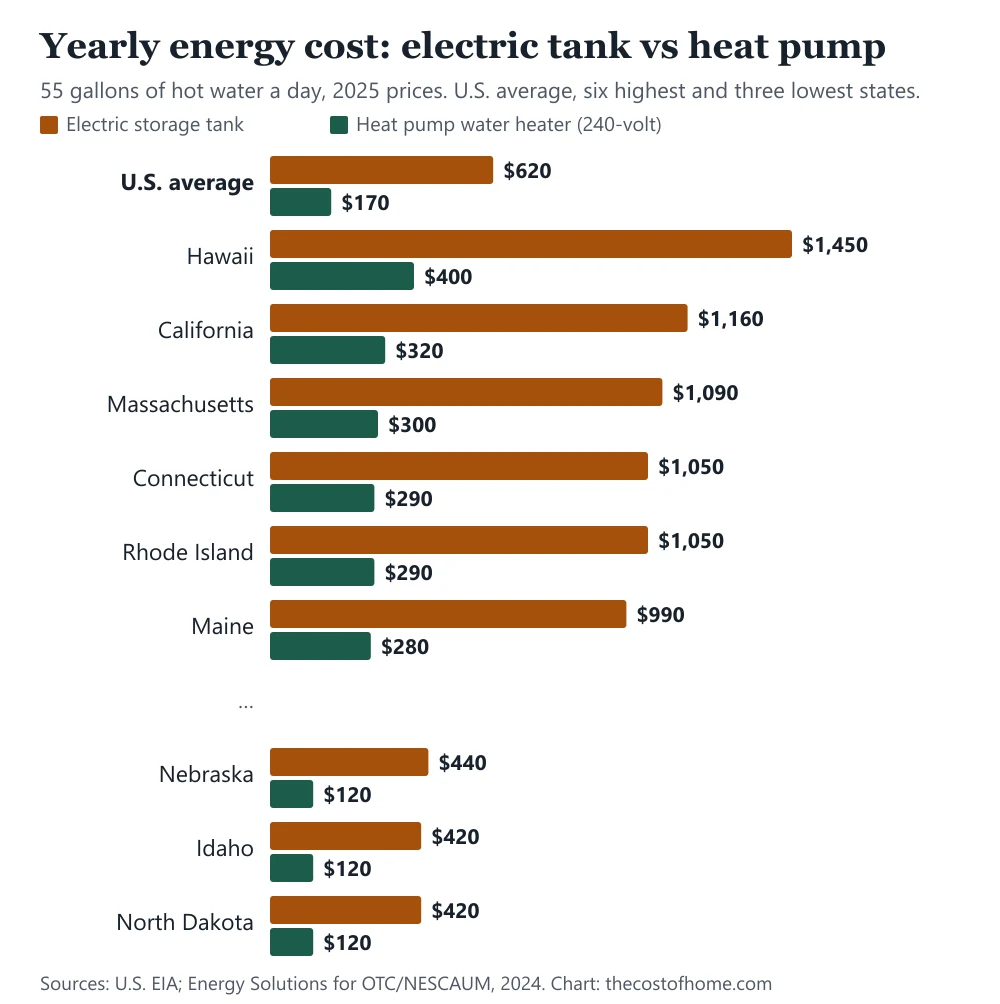
| State | Electricity | Gas | Electric tank | Heat pump | Gas tank | Gas tankless | Cheapest | Payback |
|---|---|---|---|---|---|---|---|---|
| U.S. average | 17.3¢ | $1.48 | $620 | $170 | $290 | $200 | Heat pump | 5.6 yrs |
| Alabama | 16.1¢ | $1.69 | $580 | $160 | $330 | $230 | Heat pump | 6.0 yrs |
| Alaska | 26.1¢ | $1.25 | $930 | $260 | $240 | $170 | Gas tankless | 3.7 yrs |
| Arizona | 15.3¢ | $1.79 | $550 | $150 | $350 | $250 | Heat pump | 6.3 yrs |
| Arkansas | 12.8¢ | $1.86 | $460 | $130 | $360 | $260 | Heat pump | 7.6 yrs |
| California | 32.5¢ | $2.12 | $1,160 | $320 | $410 | $290 | Gas tankless | 3.0 yrs |
| Colorado | 15.8¢ | $1.08 | $570 | $160 | $210 | $150 | Gas tankless | 6.1 yrs |
| Connecticut* | 29.4¢ | $1.63 | $1,050 | $290 | $310 | $230 | Gas tankless | 3.3 yrs |
| Delaware | 17.1¢ | $1.54 | $610 | $170 | $300 | $210 | Heat pump | 5.7 yrs |
| District of Columbia | 21.9¢ | $1.61 | $780 | $220 | $310 | $220 | Heat pump | 4.4 yrs |
| Florida | 15.2¢ | $2.46 | $540 | $150 | $480 | $340 | Heat pump | 6.4 yrs |
| Georgia | 14.7¢ | $1.97 | $530 | $150 | $380 | $270 | Heat pump | 6.6 yrs |
| Hawaii | 40.6¢ | $5.05 | $1,450 | $400 | $980 | $700 | Heat pump | 2.4 yrs |
| Idaho | 11.8¢ | $0.74 | $420 | $120 | $140 | $100 | Gas tankless | 8.2 yrs |
| Illinois | 17.7¢ | $1.08 | $630 | $180 | $210 | $150 | Gas tankless | 5.5 yrs |
| Indiana | 16.2¢ | $1.11 | $580 | $160 | $210 | $150 | Gas tankless | 6.0 yrs |
| Iowa | 13.7¢ | $1.02 | $490 | $140 | $200 | $140 | Heat pump | 7.1 yrs |
| Kansas | 14.6¢ | $1.43 | $520 | $150 | $280 | $200 | Heat pump | 6.7 yrs |
| Kentucky | 13.2¢ | $1.37 | $470 | $130 | $270 | $190 | Heat pump | 7.3 yrs |
| Louisiana | 12.6¢ | $1.68 | $450 | $130 | $320 | $230 | Heat pump | 7.7 yrs |
| Maine* | 27.8¢ | $1.93 | $990 | $280 | $370 | $270 | Gas tankless | 3.5 yrs |
| Maryland* | 19.5¢ | $1.63 | $700 | $190 | $310 | $230 | Heat pump | 5.0 yrs |
| Massachusetts | 30.5¢ | $2.42 | $1,090 | $300 | $470 | $330 | Heat pump | 3.2 yrs |
| Michigan | 20.0¢ | $1.05 | $720 | $200 | $200 | $150 | Gas tankless | 4.8 yrs |
| Minnesota | 15.8¢ | $1.06 | $570 | $160 | $200 | $150 | Gas tankless | 6.1 yrs |
| Mississippi | 14.0¢ | $1.61 | $500 | $140 | $310 | $220 | Heat pump | 6.9 yrs |
| Missouri | 13.5¢ | $1.44 | $480 | $130 | $280 | $200 | Heat pump | 7.2 yrs |
| Montana | 13.0¢ | $0.87 | $460 | $130 | $170 | $120 | Gas tankless | 7.5 yrs |
| Nebraska | 12.3¢ | $1.10 | $440 | $120 | $210 | $150 | Heat pump | 7.9 yrs |
| Nevada | 13.2¢ | $1.27 | $470 | $130 | $250 | $180 | Heat pump | 7.4 yrs |
| New Hampshire | 24.6¢ | $1.79 | $880 | $240 | $350 | $250 | Heat pump | 3.9 yrs |
| New Jersey | 22.6¢ | $1.37 | $810 | $230 | $270 | $190 | Gas tankless | 4.3 yrs |
| New Mexico | 15.1¢ | $0.95 | $540 | $150 | $180 | $130 | Gas tankless | 6.4 yrs |
| New York | 26.4¢ | $1.70 | $940 | $260 | $330 | $230 | Gas tankless | 3.7 yrs |
| North Carolina* | 14.0¢ | $1.76 | $500 | $140 | $340 | $240 | Heat pump | 6.9 yrs |
| North Dakota | 11.8¢ | $0.92 | $420 | $120 | $180 | $130 | Heat pump | 8.2 yrs |
| Ohio | 17.0¢ | $1.34 | $610 | $170 | $260 | $180 | Heat pump | 5.7 yrs |
| Oklahoma | 13.1¢ | $1.39 | $470 | $130 | $270 | $190 | Heat pump | 7.4 yrs |
| Oregon | 15.4¢ | $1.61 | $550 | $150 | $310 | $220 | Heat pump | 6.3 yrs |
| Pennsylvania | 19.3¢ | $1.45 | $690 | $190 | $280 | $200 | Heat pump | 5.0 yrs |
| Rhode Island* | 29.5¢ | $2.08 | $1,050 | $290 | $400 | $290 | Gas tankless | 3.3 yrs |
| South Carolina* | 15.0¢ | $1.65 | $530 | $150 | $320 | $230 | Heat pump | 6.5 yrs |
| South Dakota | 13.4¢ | $0.95 | $480 | $130 | $180 | $130 | Gas tankless | 7.2 yrs |
| Tennessee | 13.2¢ | $1.14 | $470 | $130 | $220 | $160 | Heat pump | 7.4 yrs |
| Texas | 15.5¢ | $1.87 | $550 | $150 | $360 | $260 | Heat pump | 6.3 yrs |
| Utah | 13.1¢ | $0.98 | $470 | $130 | $190 | $140 | Heat pump | 7.4 yrs |
| Vermont | 22.9¢ | $1.74 | $820 | $230 | $340 | $240 | Heat pump | 4.2 yrs |
| Virginia | 15.3¢ | $1.62 | $550 | $150 | $310 | $220 | Heat pump | 6.3 yrs |
| Washington | 13.1¢ | $1.70 | $470 | $130 | $330 | $240 | Heat pump | 7.4 yrs |
| West Virginia | 15.4¢ | $1.33 | $550 | $150 | $260 | $180 | Heat pump | 6.3 yrs |
| Wisconsin | 18.2¢ | $1.04 | $650 | $180 | $200 | $140 | Gas tankless | 5.3 yrs |
| Wyoming | 13.4¢ | $1.13 | $480 | $130 | $220 | $160 | Heat pump | 7.2 yrs |
Yearly energy cost of a water heater for 55 gallons of hot water a day, by state, rounded to the nearest $10. Electricity in cents per kWh and gas in dollars per therm, 2025 averages. Heat pump is the 240-volt model. "Cheapest" compares the four types in the table. Payback is the extra installed price of a heat pump over an electric tank, divided by the yearly saving. * Gas price estimated from the months EIA published for 2025. Sources: U.S. EIA; Energy Solutions for OTC/NESCAUM, 2024.
The table assumes you can choose either fuel. If your home has no gas line, the comparison that matters is the electric tank against the heat pump, which is what the payback column shows.
Is a heat pump water heater worth the higher price?
Against an electric tank, yes in every state we checked. The heat pump costs about $2,500 more installed and saves about $450 a year at national prices, so it pays back in about 5.6 years, well inside a 15-year life. The payback runs from 2.4 years in Hawaii to 8.2 years in North Dakota, and it is under 5 years in 14 states. With a panel upgrade, the national payback stretches to about 11.2 years. ENERGY STAR's own table, which assumes a smaller $1,503 extra cost, shows paybacks of 5.5, 3.7 and 2.7 years for households of two, three and four.
Against gas, the picture is different. Gas fuel is cheap in most states, so a gas tank or tankless unit costs less up front and often less over time. Adding the installed price to 15 years of energy at 2025 prices, a gas tankless unit comes to about $4,420 and a gas tank about $5,240, against $6,090 for a 240-volt heat pump and $8,590 when it needs a new panel. An electric tank comes to $10,270.
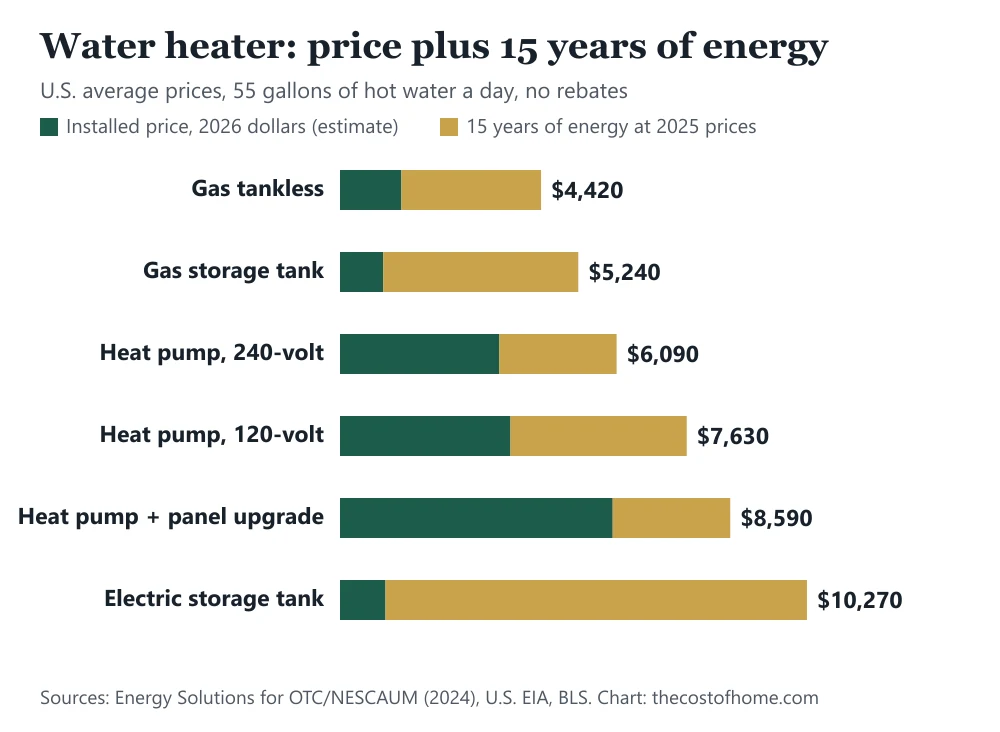
The heat pump wins on total cost over a gas tank in Arkansas, Arizona, Florida, Georgia, Hawaii, Louisiana, Mississippi, North Carolina, Texas and Washington, and over a gas tankless unit in Florida and Hawaii. Those are the places where electricity is cheap, gas is expensive, or both. Everywhere else, a heat pump is the right call mostly when you are replacing an electric tank, have no gas line, or can get a rebate that closes the price gap.
What makes a water heater replacement cost more or less?
- Fuel and venting. Gas installs run higher than electric ones. EIA's equipment cost report puts the typical gas install at $600 to $1,200, partly because it takes about 1.5 more hours of labor from two plumbers. High-efficiency condensing gas units vent through PVC instead of stainless steel and use an electrical connection, and some building codes require a condensate neutralizer filter.
- Switching types. The study notes that its $564 labor figure for a gas tankless unit would be higher when you convert from a storage tank.
- What the labor covers. In the study's breakdown, labor includes the contractor's hours, the trip to your home, removing the old water heater, installing the new one and materials such as gas and water piping, a drain pan and temperature and pressure valves.
- Where it goes. ENERGY STAR says a heat pump belongs in a space that stays between 40° and 90°F all year, with about 1,000 cubic feet of air around it. It works less efficiently in colder spaces and can cool the room it sits in, which can help in hot, humid weather.
- Size. ENERGY STAR suggests using your current tank's capacity as the starting point and going larger if you have added people or a new shower. The study's prices are for 40-50 gallon tanks and 45-55 gallon heat pumps.
- Your state. The study scales its averages by regional cost indexes. Across the 12 states and D.C. it covers, the same 240-volt heat pump ranged from $2,756 in Virginia to $3,904 in New York in 2023 dollars, and from $4,375 to $7,533 when a panel upgrade was needed.
What does this comparison leave out?
- Maintenance. EIA's equipment cost report assumes about $20 a year for tanks (it says only about 10% of households do the recommended annual flushing) and $90 a year for gas tankless units, which includes deliming the heat exchanger. ENERGY STAR notes that heat pumps may need an annual filter change.
- Lifespan. EIA's report assumes average lives of 14.5 years for a gas tank, 15.1 years for an electric tank or heat pump, and 20 years for a gas tankless unit. A longer life gives tankless units an edge that our 15-year comparison does not count.
- Propane and oil. The tables cover natural gas and electricity. Homes on propane or heating oil pay more for fuel, which strengthens the case for a heat pump.
- Prices change. These are 2025 averages. The electricity price in your state moves every year, and the ranking above can shift with it.
- New standards. DOE's final rule of May 6, 2024 sets higher efficiency standards for consumer water heaters made on and after May 6, 2029. The Energy Solutions study expects it to move much of the electric tank market toward heat pumps.
When the water heater is still working, ENERGY STAR advises planning the replacement ahead, because an installer may need time to order the right model and a heat pump can take longer to install than a standard tank. The method behind every number on this site is in how we research costs. For the same kind of comparison on heating the house, see heat pump vs gas furnace cost, and for the season's bills, winter heating costs 2026-27. More guides on the cost of keeping a home running are in the Home Repairs and Energy Bills sections, and for the other appliance that never stops running, see what a refrigerator costs to run.
Frequently asked questions
How much does it cost to replace a water heater?
About $950 for a gas tank, $1,000 for an electric tank, $1,350 for a gas tankless unit and $3,500 for a 240-volt heat pump water heater, all installed, in 2026 dollars (our inflation adjustment of a 2024 Energy Solutions study). A heat pump that needs a new electrical panel averages about $6,000.
How much does a heat pump water heater cost?
About $3,500 installed for a 240-volt model, or $3,750 for a 120-volt plug-in model, before rebates. If your electrical panel needs an upgrade, the average rises to about $6,000. The federal tax credit for these units ended on December 31, 2025, but many utilities and states still offer rebates.
Is a tankless water heater cheaper than a tank?
It costs more to install (about $1,350 against $950 for a gas tank) and less to run: about $200 a year against $290 at national gas prices. EIA's report assumes a 20-year life for a gas tankless unit, against 14.5 years for a gas tank.
How long does a water heater last?
EIA's equipment cost report assumes an average life of 14.5 years for a gas tank, 15.1 years for an electric tank or heat pump water heater, and 20 years for a gas tankless unit. DOE's own estimate for storage water heaters is about 15 years.
Is the federal tax credit for heat pump water heaters still available?
No. The federal credit for heat pump water heaters covered property placed in service through December 31, 2025. State and utility rebates may still apply, and the ENERGY STAR Rebate Finder lists them by ZIP code.
Which water heater is cheapest to run?
At national average prices, a 240-volt heat pump (about $170 a year) is cheapest, followed by a gas tankless unit ($200), a gas tank ($290) and an electric tank ($620). In 17 of 51 places, where gas is cheap and electricity is not, gas tankless comes out ahead.
How much does it cost to run a water heater per month?
For 55 gallons of hot water a day at national average prices, about $52 a month for an electric tank, $24 for a gas tank, $17 for a gas tankless unit and $14 for a 240-volt heat pump.
Sources
- ENERGY STAR, Rebate Finder: rebates on certified water heaters by ZIP code (accessed October 19, 2026)
- Energy Solutions for the Ozone Transport Commission and NESCAUM, "Heat Pump Water Heaters in the Northeast and Mid-Atlantic: Costs and Market Trends" (June 17, 2024; Tables 12, 14, 17 and 18, accessed October 19, 2026)
- U.S. Energy Information Administration, "Updated Buildings Sector Appliance and Equipment Costs and Efficiencies" (March 2023): residential water heater lifespans, maintenance costs and installation notes (accessed October 19, 2026)
- ENERGY STAR, Heat Pump Water Heaters: savings and paybacks (accessed October 19, 2026)
- ENERGY STAR, Heat Pump Water Heaters: buying guidance and installation space (accessed October 19, 2026)
- ENERGY STAR, Water Heater Key Product Criteria (UEF requirements, accessed October 19, 2026)
- Internal Revenue Service, Energy Efficient Home Improvement Credit (page last reviewed April 28, 2026; credit available for improvements made through December 31, 2025)
- U.S. Department of Energy, 10 CFR Part 430, Subpart B, Appendix E: uniform test method for water heaters (medium-usage draw pattern of 55 gallons a day; supply water at 58°F, delivered at 125°F; accessed October 19, 2026)
- U.S. Department of Energy, "Energy Conservation Program: Energy Conservation Standards for Consumer Water Heaters," final rule, 89 FR 37778 (May 6, 2024)
- U.S. Energy Information Administration, Electricity Data: average residential price by state, annual 2025 (accessed October 19, 2026)
- U.S. Energy Information Administration, Natural Gas Prices: average residential price by state, annual and monthly 2025 (accessed October 17, 2026)
- U.S. Energy Information Administration, "How do I convert natural gas prices in dollars per cubic feet to dollars per British thermal unit or therm?" (1,037 Btu per cubic foot in 2025; accessed October 19, 2026)
- U.S. Bureau of Labor Statistics, Consumer Price Index for All Urban Consumers (CPI-U), U.S. city average, all items: 2023 annual average 304.702, September 2026 336.940 (accessed October 19, 2026)

Founder and editor, The Cost of Home
I lived in the United States for five years, and this site grew out of the question every household there keeps asking: what will this cost, and is it worth it? Every number here comes from a public source listed at the end of the article.