Energy Bills
Average Natural Gas Bill by State in 2026
Quick answer
The average U.S. home with natural gas service paid about $84 a month in 2025, the latest full year of EIA data, using roughly 55 ccf at $1.53 per ccf. Bills ranged from about $42 in Idaho to $162 in Massachusetts. Gas is a winter bill: the national average reached $175 in January 2025 and fell to about $37 in August.
On this page
- What is the average natural gas bill in each state?
- Which states have the highest natural gas bills?
- Which states have the cheapest natural gas bills?
- Why doesn't the price per ccf predict the bill?
- How much does the gas bill change from month to month?
- Is natural gas getting more expensive?
- How do you compare your bill with your state's average?
- What does this average leave out?
- FAQ
- Sources
A natural gas bill comes down to two numbers: how much gas your home burns, and what you pay for each unit. Gas is sold by the ccf (100 cubic feet) or by the therm, and both change a lot from state to state, which is why a $100 bill is routine in Pennsylvania and very high in Arizona.
The figures below come from the U.S. Energy Information Administration (EIA). The average bill is the residential price the EIA reports multiplied by the volume of gas delivered, divided by the state's number of residential gas customers and by 12 months. It covers 2025, the latest calendar year for which the EIA has published complete data for every state. Monthly figures for 2026 are still missing for several states, so we will update this guide when they are in. Homes without gas service are not part of the average.
What is the average natural gas bill in each state?
Find your state below. The "monthly use" column shows how much gas a typical customer there buys in a month, and the price column is the average paid per ccf over the year, including delivery charges, taxes and fees. Your bill may show therms instead: 1 ccf is about 1.04 therms.
| State | Avg. monthly bill | Monthly use | Price per ccf | Rank |
|---|---|---|---|---|
| U.S. average | $83.97 | 55 ccf | $1.53 | – |
| Alabama | $56.80 | 32 ccf | $1.76 | 41 |
| Alaska | $152.20 | 117 ccf | $1.30 | 2 |
| Arizona | $42.50 | 23 ccf | $1.86 | 50 |
| Arkansas | $80.02 | 42 ccf | $1.93 | 24 |
| California | $65.55 | 30 ccf | $2.20 | 35 |
| Colorado | $61.68 | 55 ccf | $1.12 | 38 |
| Connecticut | $125.00 | 74 ccf | $1.69* | 6 |
| Delaware | $88.02 | 55 ccf | $1.60 | 20 |
| District of Columbia | $105.21 | 63 ccf | $1.67 | 12 |
| Florida | $46.63 | 18 ccf | $2.55 | 48 |
| Georgia | $124.86 | 61 ccf | $2.04 | 7 |
| Hawaii | $90.28 | 17 ccf | $5.24 | 18 |
| Idaho | $42.42 | 55 ccf | $0.77 | 51 |
| Illinois | $93.11 | 83 ccf | $1.13 | 17 |
| Indiana | $72.21 | 63 ccf | $1.15 | 31 |
| Iowa | $56.22 | 53 ccf | $1.06 | 42 |
| Kansas | $83.45 | 56 ccf | $1.48 | 23 |
| Kentucky | $73.43 | 52 ccf | $1.42 | 29 |
| Louisiana | $48.80 | 28 ccf | $1.74 | 46 |
| Maine | $129.29 | 65 ccf | $2.00* | 5 |
| Maryland | $97.69 | 58 ccf | $1.69* | 14 |
| Massachusetts | $161.53 | 64 ccf | $2.51 | 1 |
| Michigan | $87.52 | 80 ccf | $1.09 | 21 |
| Minnesota | $77.26 | 70 ccf | $1.10 | 27 |
| Mississippi | $67.53 | 41 ccf | $1.66 | 32 |
| Missouri | $88.72 | 59 ccf | $1.49 | 19 |
| Montana | $50.23 | 56 ccf | $0.90 | 45 |
| Nebraska | $60.96 | 53 ccf | $1.14 | 39 |
| Nevada | $45.20 | 34 ccf | $1.31 | 49 |
| New Hampshire | $112.96 | 61 ccf | $1.86 | 9 |
| New Jersey | $105.55 | 74 ccf | $1.42 | 11 |
| New Mexico | $48.39 | 49 ccf | $0.98 | 47 |
| New York | $143.06 | 81 ccf | $1.76 | 3 |
| North Carolina | $79.35 | 44 ccf | $1.82* | 25 |
| North Dakota | $63.93 | 67 ccf | $0.95 | 36 |
| Ohio | $98.49 | 71 ccf | $1.39 | 13 |
| Oklahoma | $73.75 | 51 ccf | $1.44 | 28 |
| Oregon | $72.62 | 43 ccf | $1.67 | 30 |
| Pennsylvania | $106.42 | 71 ccf | $1.50 | 10 |
| Rhode Island | $133.72 | 62 ccf | $2.15* | 4 |
| South Carolina | $63.05 | 37 ccf | $1.71* | 37 |
| South Dakota | $51.24 | 52 ccf | $0.99 | 44 |
| Tennessee | $58.12 | 49 ccf | $1.18 | 40 |
| Texas | $67.51 | 35 ccf | $1.94 | 33 |
| Utah | $52.03 | 51 ccf | $1.02 | 43 |
| Vermont | $119.74 | 67 ccf | $1.80 | 8 |
| Virginia | $93.68 | 56 ccf | $1.68 | 15 |
| Washington | $93.52 | 53 ccf | $1.76 | 16 |
| West Virginia | $85.87 | 62 ccf | $1.38 | 22 |
| Wisconsin | $67.50 | 63 ccf | $1.07 | 34 |
| Wyoming | $78.32 | 67 ccf | $1.17 | 26 |
Average for residential gas customers in calendar year 2025. Rank 1 = highest bill. ccf = 100 cubic feet. * The EIA did not publish an annual price for this state because one or two months were missing; the price shown is the average of the months it did publish. Source: U.S. EIA, natural gas data.
Use these numbers as a yardstick, not a forecast. Your own bill depends on the size and age of your home, what else runs on gas (water heater, dryer, stove), your utility's rates and the winter you had.
Which states have the highest natural gas bills?
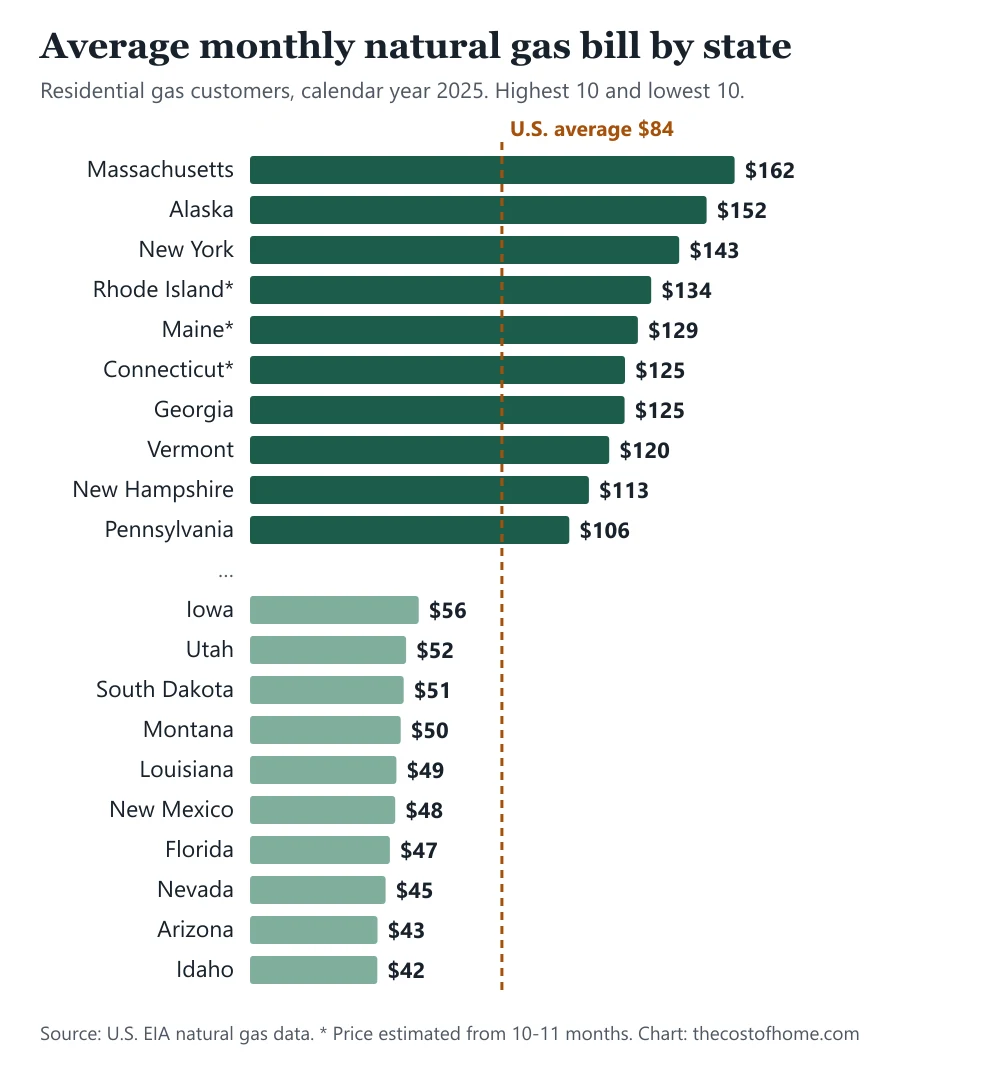
The five most expensive states for a monthly gas bill were:
- Massachusetts ($162 a month, 64 ccf at $2.51 per ccf)
- Alaska ($152 a month, 117 ccf at $1.30 per ccf)
- New York ($143 a month, 81 ccf at $1.76 per ccf)
- Rhode Island* ($134 a month, 62 ccf at $2.15 per ccf)
- Maine* ($129 a month, 65 ccf at $2.00 per ccf)
They get there in different ways. Massachusetts has the third-highest gas price in the country, after Hawaii and Florida, at $2.51 per ccf. Alaska is the opposite: its price is among the lowest at $1.30 per ccf, but the average customer buys 117 ccf a month, more than twice the national average. New York sits between the two, with a price a little above average and use about 50% above it.
Which states have the cheapest natural gas bills?
The lowest average bills were in the Mountain West and the Sun Belt:
- Idaho ($42 a month, 55 ccf at $0.77 per ccf)
- Arizona ($43 a month, 23 ccf at $1.86 per ccf)
- Nevada ($45 a month, 34 ccf at $1.31 per ccf)
- Florida ($47 a month, 18 ccf at $2.55 per ccf)
- New Mexico ($48 a month, 49 ccf at $0.98 per ccf)
Idaho has the cheapest gas in the country at $0.77 per ccf, so its bill stays low even though a typical customer uses about as much gas as the national average. Arizona, Nevada and Florida get there through mild winters: their customers buy only 23, 34 and 18 ccf a month, which is why a price of $2.55 per ccf in Florida still adds up to just $47.
Why doesn't the price per ccf predict the bill?
Because use varies just as much as price. Illinois has one of the cheaper prices, $1.13 per ccf, yet its bill ($93) is above the national average because a typical customer buys 83 ccf a month. California shows the reverse: a price of $2.20 per ccf, and a bill of only $66, because its customers buy 30 ccf.
Hawaii is the extreme case. Gas there costs $5.24 per ccf, more than twice the price of any other state, but the 28,624 residential customers buy only 17 ccf a month, so the average bill is $90.
How much does the gas bill change from month to month?
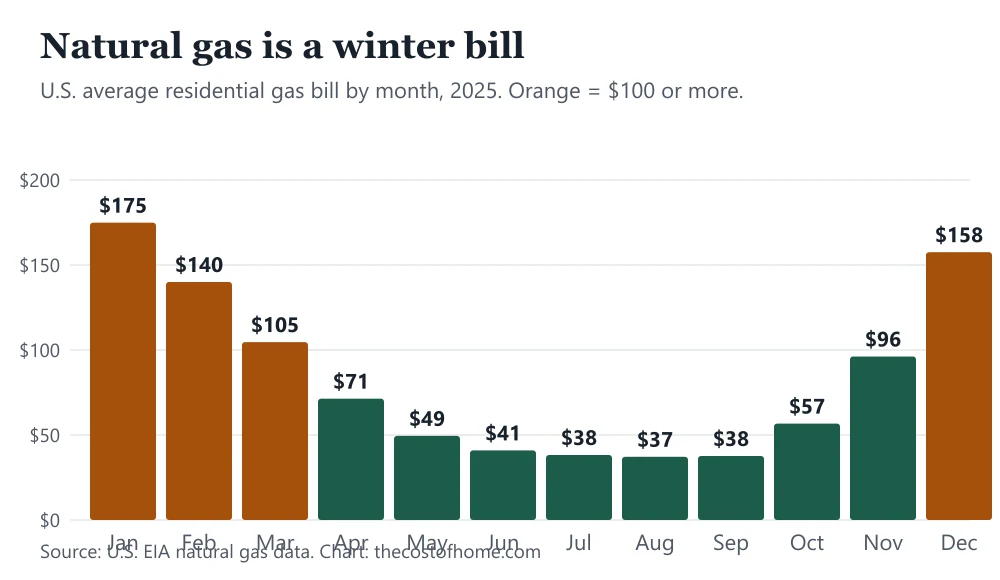
More than any other household bill. Across the U.S., the average gas bill swung from $175 in January 2025 to $38 in July, and the average customer used 141 ccf in January against 15 ccf in July. Heating is the reason: in summer, gas mostly runs the water heater and the stove.
| Month | Avg. bill | Avg. use |
|---|---|---|
| Jan 2025 | $174.86 | 141 ccf |
| Feb 2025 | $139.98 | 108 ccf |
| Mar 2025 | $104.64 | 72 ccf |
| Apr 2025 | $71.37 | 44 ccf |
| May 2025 | $49.45 | 26 ccf |
| Jun 2025 | $40.93 | 18 ccf |
| Jul 2025 | $38.25 | 15 ccf |
| Aug 2025 | $37.19 | 14 ccf |
| Sep 2025 | $37.67 | 15 ccf |
| Oct 2025 | $56.68 | 29 ccf |
| Nov 2025 | $96.15 | 64 ccf |
| Dec 2025 | $157.55 | 112 ccf |
U.S. average for residential gas customers, by month, 2025. Source: U.S. EIA, natural gas data.
The swing is even larger in cold states. In Massachusetts the average bill was about $390 in January and $40 in July; in New York, $272 against $62. Even Texas went from $161 in January to $41 in July.
The price per ccf moves the other way. It averaged $1.24 in January 2025 and $2.54 in July. The EIA price is total revenue divided by the gas delivered, so charges that do not depend on how much gas you burn, like the monthly customer charge, make up a bigger share of a small summer bill. That is why budgeting around the yearly average does not work for gas: plan around your winter months instead.
Is natural gas getting more expensive?
Compared with 2024, yes. The average residential price was 15.34 per thousand cubic feet ($1.53 per ccf), up 6% from 14.50 in 2024 and about level with 2023 ($15.40), according to the EIA. Use grew faster: total residential gas use rose 10% in 2025, so the average bill, calculated the same way, went from about $72 in 2024 to $84 in 2025.
The early 2026 numbers point up again. The U.S. average price was $1.40 per ccf in January 2026, 12% above January 2025, and the average January bill came to about $184. Because of this, the averages on this page may run a little low for 2026 in states where prices rose. This guide is updated when the EIA publishes complete 2026 data.
How do you compare your bill with your state's average?
You need two numbers from your bill: the total amount and the gas used in the billing period, in ccf or therms. Then:
- Find your price per ccf. Divide the total by the ccf. For example, $120 for 70 ccf works out to about $1.71 per ccf. This "all-in" price includes delivery charges and fees, which is how the EIA averages are calculated too.
- Compare your use. Put your ccf next to the "monthly use" column for your state, keeping the season in mind: a January bill will be far above the yearly average. If your bill shows therms, divide by 1.04 to get ccf.
- See which number is out of line. If your price is higher than your state's average, look at your rate plan and fixed charges. If your use is higher, heating and water heating are the usual places to look.
If gas also heats your home, our guide to heat pump vs gas furnace running costs shows how gas compares with electricity for heating in every state, and the average electric bill by state gives the other half of your energy costs. To see what the gas a furnace burns costs each month, read how much it costs to run a furnace per month.
What does this average leave out?
A few things to keep in mind when you read the table:
- Only homes with gas service. About 61% of U.S. households used natural gas for at least one purpose in 2020, according to the EIA's latest household survey. Homes that heat with electricity, propane or fuel oil are not in these averages.
- Small states. Maine, Vermont and Hawaii each have fewer than 50,000 residential gas customers in the EIA data, so one utility's rates can move their average a lot.
- A customer count that is a year old. The EIA publishes the number of residential customers once a year, and the latest is for 2024. We used it for 2025 too, which can overstate the average bill slightly where the number of customers is growing: nationally the count rose 0.6% from 2023 to 2024.
The method behind every number on this site is in how we research costs. More guides on household energy are in the Energy Bills section. For another large yearly cost of owning a house, see the average homeowners insurance cost by state.
Frequently asked questions
What is the average natural gas bill in the U.S.?
About $84 a month in 2025, the latest full year of EIA data, for a home using 55 ccf at $1.53 per ccf. In January 2025 the average was $175, and in July it was $38.
Which state has the highest natural gas bill?
Massachusetts, at about $162 a month, because it has one of the highest gas prices in the country ($2.51 per ccf). Alaska ($152) and New York ($143) come next.
Which state has the lowest natural gas bill?
Idaho, at about $42 a month, followed by Arizona ($43) and Nevada ($45). Idaho has the lowest gas price in the country, and Arizona and Nevada have mild winters.
How much gas does an average home use per month?
About 55 ccf a month over the year, or roughly 57 therms. In January the average customer used 141 ccf, and in July only 15 ccf.
Why is my gas bill so high in winter?
Heating. The average U.S. customer used about 9 times as much gas in January 2025 (141 ccf) as in July (15 ccf). A colder-than-normal month, or a higher price per ccf, pushes it up further.
Is a $100 gas bill high?
It depends on the month. A $100 bill is above the yearly national average of $84, but it is well below the $175 national average of January 2025, so in the middle of winter it is a normal bill, and in summer it would be unusually high.
How do I convert ccf to therms?
Multiply ccf by about 1.04. Natural gas averaged 1,037 Btu per cubic foot in 2025 according to the EIA, so 100 cubic feet (1 ccf) holds about 103,700 Btu, and 1 therm is 100,000 Btu.
Sources
- U.S. Energy Information Administration, Natural Gas Prices: average residential price by state, annual and monthly (accessed October 17, 2026)
- U.S. Energy Information Administration, Natural Gas Consumption by End Use: residential volumes by state (accessed October 17, 2026)
- U.S. Energy Information Administration, Number of Natural Gas Consumers: residential consumers by state (accessed October 17, 2026)
- U.S. Energy Information Administration, Natural Gas Prices definitions: prices include all tax, delivery, commodity, demand and other charges, and are computed by dividing revenue by sales volume
- U.S. Energy Information Administration, "How do I convert natural gas prices in dollars per cubic feet to dollars per British thermal unit or therm?" (average heat content of natural gas, 1,037 Btu per cubic foot in 2025)
- U.S. Energy Information Administration, "The majority of U.S. households used natural gas in 2020" (Residential Energy Consumption Survey, March 23, 2023)

Founder and editor, The Cost of Home
I lived in the United States for five years, and this site grew out of the question every household there keeps asking: what will this cost, and is it worth it? Every number here comes from a public source listed at the end of the article.