Energy Bills
Electricity Prices by State in 2026: Cheapest to Most Expensive
Quick answer
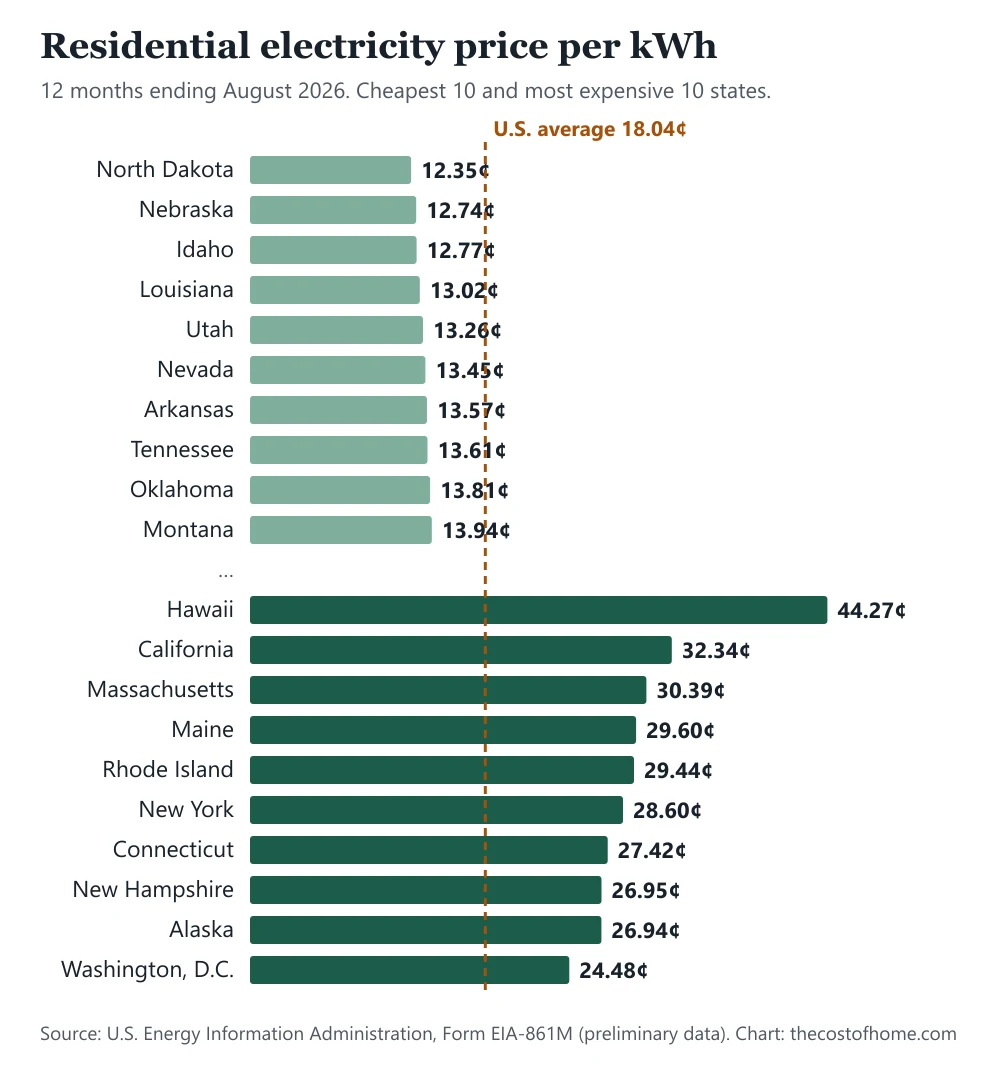
U.S. homes paid an average of 18.04¢ per kWh over the 12 months ending August 2026, up 6.5% from a year earlier. North Dakota (12.35¢), Nebraska and Idaho were the cheapest. Hawaii (44.27¢), California (32.34¢) and Massachusetts (30.39¢) were the most expensive. The price rose in 49 of the 50 states and DC.
On this page
- Which states have the cheapest electricity?
- Which states have the most expensive electricity?
- What is the price of electricity in each state?
- What does the price gap mean in dollars?
- Is electricity getting more expensive?
- Why did electricity get cheaper in Connecticut?
- Does the price change from month to month?
- How do you find the price you pay per kWh?
- Do plug-in energy saver devices lower your electric bill?
- What does the price of electricity mean for solar, heat pumps and electric cars?
- FAQ
- Sources
The price of electricity is the one number on your bill that you can't change by turning something off. It is set by where you live, and the gap is huge: a kilowatt-hour (kWh) costs about three and a half times as much in Hawaii as in North Dakota. This guide ranks all 50 states and Washington, D.C. from the cheapest electricity to the most expensive, using the latest data from the U.S. Energy Information Administration (EIA).
The price here is the "all-in" price that residential customers actually paid per kWh: everything on the bill, including delivery charges and fees, divided by the kWh used. It is the 12-month average from September 2025 to August 2026, so it smooths out summer and winter rates. The 2026 months are still marked preliminary by the EIA.
Which states have the cheapest electricity?
The five cheapest states for residential electricity over the 12 months were:
- North Dakota (12.35¢)
- Nebraska (12.74¢)
- Idaho (12.77¢)
- Louisiana (13.02¢)
- Utah (13.26¢)
Nevada (13.45¢), Arkansas (13.57¢), Tennessee (13.61¢), Oklahoma (13.81¢) and Montana (13.94¢) complete the cheapest ten. Most are in the Great Plains, the Mountain West and the South. The EIA says electricity prices "vary by locality based on the availability of power plants and fuels, local fuel costs, and pricing regulations," which is why neighboring regions can look so different.
Which states have the most expensive electricity?
The five most expensive were:
- Hawaii (44.27¢)
- California (32.34¢)
- Massachusetts (30.39¢)
- Maine (29.60¢)
- Rhode Island (29.44¢)
Hawaii is in a class of its own, at about 2.5 times the national average. The EIA says its prices are high mainly because most of its electricity is generated with petroleum fuels that must be imported into the state. The rest of the top ten are mostly in the Northeast (Massachusetts, Maine, Rhode Island, New York, Connecticut and New Hampshire), plus California, Alaska and Washington, D.C., at 24.48¢.
What is the price of electricity in each state?
The table runs from the most expensive state to the cheapest. "Change" compares the latest 12 months with the 12 months before, and the last column shows the price for August 2026 alone.
| Rank | State | Price, 12 months | Year earlier | Change | August 2026 |
|---|---|---|---|---|---|
| – | U.S. average | 18.04¢ | 16.94¢ | +6.5% | 18.16¢ |
| 1 | Hawaii | 44.27¢ | 40.67¢ | +8.9% | 47.18¢ |
| 2 | California | 32.34¢ | 31.19¢ | +3.7% | 29.75¢ |
| 3 | Massachusetts | 30.39¢ | 30.15¢ | +0.8% | 30.48¢ |
| 4 | Maine | 29.60¢ | 26.97¢ | +9.8% | 32.11¢ |
| 5 | Rhode Island | 29.44¢ | 29.11¢ | +1.1% | 28.18¢ |
| 6 | New York | 28.60¢ | 25.71¢ | +11.2% | 28.65¢ |
| 7 | Connecticut | 27.42¢ | 30.11¢ | −8.9% | 24.51¢ |
| 8 | New Hampshire | 26.95¢ | 23.69¢ | +13.8% | 27.64¢ |
| 9 | Alaska | 26.94¢ | 25.65¢ | +5.0% | 29.41¢ |
| 10 | District of Columbia | 24.48¢ | 20.43¢ | +19.8% | 25.98¢ |
| 11 | Vermont | 23.90¢ | 22.54¢ | +6.0% | 23.84¢ |
| 12 | New Jersey | 23.74¢ | 21.54¢ | +10.2% | 24.61¢ |
| 13 | Michigan | 21.28¢ | 19.71¢ | +8.0% | 22.99¢ |
| 14 | Maryland | 21.18¢ | 18.79¢ | +12.7% | 21.40¢ |
| 15 | Pennsylvania | 20.86¢ | 18.58¢ | +12.3% | 21.77¢ |
| 16 | Illinois | 18.91¢ | 17.10¢ | +10.6% | 19.32¢ |
| 17 | Wisconsin | 18.79¢ | 17.70¢ | +6.2% | 19.41¢ |
| 18 | Ohio | 18.41¢ | 16.49¢ | +11.6% | 19.38¢ |
| 19 | Delaware | 17.98¢ | 16.95¢ | +6.1% | 18.70¢ |
| 20 | Indiana | 16.90¢ | 15.53¢ | +8.8% | 17.02¢ |
| 21 | Virginia | 16.64¢ | 14.92¢ | +11.5% | 17.64¢ |
| 22 | Colorado | 16.61¢ | 15.39¢ | +7.9% | 17.17¢ |
| 23 | Alabama | 16.44¢ | 15.82¢ | +3.9% | 16.33¢ |
| 24 | Minnesota | 16.28¢ | 15.63¢ | +4.2% | 17.20¢ |
| 25 | Texas | 15.98¢ | 15.25¢ | +4.8% | 15.91¢ |
| 26 | South Carolina | 15.77¢ | 14.94¢ | +5.6% | 15.76¢ |
| 27 | West Virginia | 15.53¢ | 15.39¢ | +0.9% | 16.31¢ |
| 28 | Oregon | 15.53¢ | 15.19¢ | +2.2% | 15.92¢ |
| 29 | Florida | 15.41¢ | 14.76¢ | +4.4% | 14.99¢ |
| 30 | Arizona | 15.39¢ | 15.13¢ | +1.7% | 15.05¢ |
| 31 | New Mexico | 15.31¢ | 14.58¢ | +5.0% | 16.51¢ |
| 32 | Georgia | 15.17¢ | 14.54¢ | +4.3% | 15.90¢ |
| 33 | Kansas | 15.13¢ | 14.30¢ | +5.8% | 15.47¢ |
| 34 | Mississippi | 14.85¢ | 13.78¢ | +7.8% | 14.43¢ |
| 35 | North Carolina | 14.79¢ | 14.02¢ | +5.5% | 14.95¢ |
| 36 | South Dakota | 14.28¢ | 13.19¢ | +8.3% | 15.15¢ |
| 37 | Iowa | 14.20¢ | 13.54¢ | +4.9% | 17.06¢ |
| 38 | Washington | 14.20¢ | 12.69¢ | +11.9% | 14.63¢ |
| 39 | Wyoming | 14.01¢ | 13.04¢ | +7.4% | 14.43¢ |
| 40 | Missouri | 13.97¢ | 13.16¢ | +6.2% | 16.02¢ |
| 41 | Kentucky | 13.94¢ | 13.05¢ | +6.8% | 13.80¢ |
| 42 | Montana | 13.94¢ | 12.73¢ | +9.5% | 15.57¢ |
| 43 | Oklahoma | 13.81¢ | 12.99¢ | +6.3% | 14.82¢ |
| 44 | Tennessee | 13.61¢ | 13.13¢ | +3.7% | 13.42¢ |
| 45 | Arkansas | 13.57¢ | 12.66¢ | +7.2% | 14.37¢ |
| 46 | Nevada | 13.45¢ | 13.54¢ | −0.7% | 12.72¢ |
| 47 | Utah | 13.26¢ | 12.81¢ | +3.5% | 13.31¢ |
| 48 | Louisiana | 13.02¢ | 12.36¢ | +5.3% | 12.87¢ |
| 49 | Idaho | 12.77¢ | 11.63¢ | +9.8% | 13.37¢ |
| 50 | Nebraska | 12.74¢ | 11.88¢ | +7.2% | 13.54¢ |
| 51 | North Dakota | 12.35¢ | 11.58¢ | +6.6% | 13.31¢ |
Average residential electricity price per kilowatt-hour (kWh), in cents. Rank 1 = most expensive. The 12-month figure is total residential revenue divided by total kWh sold, September 2025 to August 2026 (preliminary), and the year-earlier figure is the same calculation for September 2024 to August 2025. States that tie at two decimals are ordered by the unrounded price. Source: U.S. EIA, Form EIA-861M, with August checked against the Electric Power Monthly, Table 5.6.A.
33 of the 51 are below the national average of 18.04¢, because a few very expensive places pull it up. The middle of the pack, South Carolina, pays 15.77¢.
What does the price gap mean in dollars?
Take a home that uses 900 kWh in a month, close to the national average. At each state's price, the electricity alone would cost about:
- North Dakota: $111 a month (12.35¢ per kWh)
- U.S. average: $162 a month (18.04¢ per kWh)
- California: $291 a month (32.34¢ per kWh)
- Hawaii: $398 a month (44.27¢ per kWh)
That is a difference of nearly $290 a month between the cheapest and most expensive state for the same amount of electricity. Real bills are closer together than these examples, because homes in expensive states tend to use less. The actual average bill in every state is in our guide to average electric bill by state, and the reasons use matters so much are in why your electric bill is so high.
Is electricity getting more expensive?
Yes. The U.S. average price rose from 16.94¢ to 18.04¢, an increase of 6.5%, and 49 of the 50 states and DC saw their 12-month price go up. The biggest jumps were:
- Washington, D.C.: 20.43¢ to 24.48¢ (+19.8%)
- New Hampshire: 23.69¢ to 26.95¢ (+13.8%)
- Maryland: 18.79¢ to 21.18¢ (+12.7%)
- Pennsylvania: 18.58¢ to 20.86¢ (+12.3%)
- Washington: 12.69¢ to 14.20¢ (+11.9%)
In all, 9 states and DC rose by 10% or more. Only Connecticut (−8.9%) and Nevada (−0.7%) came down. Looking at August 2026 alone, the U.S. average was 18.16¢, up 3.4% from 17.57¢ in August 2025, and 44 of the 51 were higher than a year before.
Why did electricity get cheaper in Connecticut?
Because of a change in how the state collects part of the bill. Connecticut's governor announced that from May 1, 2026, the public benefits charge on electric bills would become a credit instead of an added cost. The state said the change would save an average Eversource customer about $30 a month and an average United Illuminating customer about $34, and that the credit would last "through at least September." The state also credits its fixed-price nuclear contracts with Millstone and Seabrook for keeping bills steadier.
Only four of the 12 months in the table, May to August 2026, include the lower rates. That is why Connecticut is still the 7th most expensive state for the 12 months but shows 24.51¢ for August, against 30.17¢ a year earlier. The 12-month figure will show more of the lower rates as the older months drop out. The state described the credit as lasting "through at least September," so check your own bill for what applies now.
Does the price change from month to month?
Yes, and the monthly ranking doesn't always match the yearly one. In August 2026, Nevada (12.72¢), Louisiana (12.87¢) and North Dakota (13.31¢) had the lowest prices, and Hawaii (47.18¢), Maine (32.11¢) and Massachusetts (30.48¢) the highest. Nevada is the sixth cheapest state for the full year and was the cheapest state in August. A single month can be pushed around by fuel costs, seasonal rate plans and billing timing, so use the 12-month column to compare states and the August column to see where prices are heading now.
How do you find the price you pay per kWh?
You need two numbers from your bill: the total amount due and the kWh used in the billing period. Divide the first by the second. For example, $162 for 900 kWh works out to 18 cents per kWh. This all-in price includes delivery charges and fees, which is how the EIA calculates the state averages above, so the two are directly comparable. Our guide to how to read your electric bill explains each line.
If your number is well above your state's price, look at your rate plan and fixed charges. If it is close but your bill is still high, the cause is probably use: heating, cooling and water heating are the usual places to look. See how much a central air conditioner, a refrigerator or an electric car adds in your state.
Do plug-in energy saver devices lower your electric bill?
No. Small boxes that plug into a wall outlet and promise to cut your bill are sold online and in some stores, and the marketing talks about "dirty electricity" and a "smooth, stable" current. Your price per kWh is set by your utility and your state's rates, and a gadget in an outlet doesn't change it. It doesn't change how many kWh your appliances use either. A Facebook post about one of these devices in 2024 claimed that every American could "slash their electricity bill by 90%"; the fact-checking group Science Feedback rated the claim inaccurate. Here is what testing and reviews found:
- Same current, same meter reading. Engineers at Electric Cooperatives of Arkansas plugged in one of these boxes and measured almost 8.4 amps. When they unplugged it, "the current is unchanged," the engineer said, so "the meter at the house would still meter the same amount of electricity." A co-op spokesperson called it a nightlight that people paid $50 to $60 for. KATV reported the test in December 2020.
- Very little inside. Science Feedback's September 2024 review says reviewers who opened similar devices found "little more than an LED light and a single, basic capacitor."
- Homes aren't billed that way. These devices are usually sold as correcting power factor. Science Feedback explains that most electricity providers only charge residential customers for the power they actually use, and that power-factor charges mainly affect industrial and business customers, not homes.
- Safety. The same review reports that tests of similar devices in the U.K., by Electrical Safety First and by Buckinghamshire and Surrey Trading Standards, found poorly made units that were shock or fire hazards. Electrical Safety First said they "failed to reduce electrical consumption and, in some cases, actually increased it."
What does lower a bill is using fewer kWh or paying less for each one. Heating, cooling and water heating are where most of the kWh go, which we break down in why your electric bill is so high, and your rate plan and fixed charges are worth a look too. If you ever test a gadget anyway, compare the kWh on your bill with the same month last year, not the dollars, because weather and price changes move the dollars on their own.
What does the price of electricity mean for solar, heat pumps and electric cars?
The higher your price per kWh, the more each of them saves you. Home solar pays for itself fastest where electricity is expensive, which is why the payback in Hawaii and California is so much shorter than in the cheapest states. We work it out in solar panel payback period by state. The same logic applies to heat pumps and to the seasonal swing in winter versus summer electric bills.
Frequently asked questions
Which state has the cheapest electricity?
North Dakota, at 12.35¢ per kWh over the 12 months ending August 2026, followed by Nebraska (12.74¢) and Idaho (12.77¢).
Which state has the most expensive electricity?
Hawaii, at 44.27¢ per kWh, followed by California (32.34¢) and Massachusetts (30.39¢). Hawaii's price is about 3.6 times North Dakota's.
What is the average price of electricity per kWh in the U.S.?
18.04¢ over the 12 months ending August 2026, based on EIA data for residential customers. In August 2026 alone the average was 18.16¢.
Why is electricity so expensive in Hawaii?
The EIA says Hawaii's prices are high mainly because most of its electricity is generated with petroleum fuels that must be imported into the state.
Is the price of electricity going up?
Yes. The U.S. average rose 6.5% compared with the previous 12 months, from 16.94¢ to 18.04¢, and the price went up in 49 of the 50 states and DC. Connecticut and Nevada were the only two where it fell.
Does a low price per kWh mean a low electric bill?
Not always. The bill is the price times the kWh you use, so a cheap state can still have a high bill if homes there use a lot of electricity. Our guide to the average electric bill by state shows both numbers side by side.
Do plug-in energy saver devices really lower your electric bill?
No. Engineers at Electric Cooperatives of Arkansas found the current was unchanged with the device plugged in or unplugged, so the meter records the same usage. Science Feedback reports that reviewers who opened similar devices found little more than an LED light and a basic capacitor.
How do I calculate my price per kWh?
Divide the total amount due on your bill by the kWh used in the billing period. For example, $162 for 900 kWh is 18 cents per kWh. The result includes delivery charges and fees, like the EIA state averages.
Sources
- U.S. Energy Information Administration, Form EIA-861M: monthly sales, revenue and customers by state (accessed October 27, 2026; data through August 2026, preliminary)
- U.S. Energy Information Administration, Electric Power Monthly, Table 5.6.A: average price of electricity by state, August 2026 and 2025 (released October 23, 2026)
- U.S. Energy Information Administration, Electricity Explained: factors affecting electricity prices (accessed October 27, 2026)
- Office of Governor Ned Lamont, "Governor Lamont announces lower electricity rates" (April 22, 2026)
- Science Feedback, "The Pro Power Save will not cut electric bills, nor will any other scam device of its kind" (September 26, 2024)
- KATV (Little Rock), "Engineering study says electricity-saving devices don’t really work," on the Electric Cooperatives of Arkansas test (December 3, 2020)

Founder and editor, The Cost of Home
I lived in the United States for five years, and this site grew out of the question every household there keeps asking: what will this cost, and is it worth it? Every number here comes from a public source listed at the end of the article.