Energy Bills
How to Read Your Electric Bill: kWh, Delivery Charges and Fees
Quick answer
An electric bill is the kilowatt-hours (kWh) you used, multiplied by a price, plus a fixed monthly fee, riders and taxes. Look for the kWh used, the customer charge, the delivery and supply charges, then divide the total by the kWh to see what you really pay per kWh. Across the U.S., that averaged 18.0 cents over the last 12 months, for about 870 kWh and $156 a month.

On this page
- What is a kilowatt-hour (kWh) on your bill?
- What are the main lines on an electric bill?
- What is the difference between delivery and supply charges?
- What are riders, fees and taxes on an electric bill?
- How do you find your real price per kWh?
- What does a real electric bill look like?
- Why does your electric bill change from month to month?
- How can you check that your bill makes sense?
- How was this calculated?
- FAQ
- Sources
An electric bill looks like one number, but it is built from a handful of lines, and each line answers a different question. How much electricity did you use? What does the utility charge to bring it to your door? Which fees do you pay no matter what? Once you can tell them apart, you can see where the money goes and check the total yourself.
This guide goes through the lines on a typical residential bill, using the U.S. Energy Information Administration (EIA) for the national picture and two state commissions, North Carolina's Public Staff and Pennsylvania's Public Utility Commission, for how the lines are defined. Layouts differ by utility, so use it as a map and match the names to your own bill. For what a bill costs in your state, see our guide to the average electric bill by state.
What is a kilowatt-hour (kWh) on your bill?
A kilowatt-hour is the unit your utility sells. The EIA defines a watt as a very small amount of power and a kilowatt as 1,000 watts. A kilowatt-hour is one kilowatt used for one hour, a measure of energy rather than power. The EIA's example: a 40-watt light bulb run for five hours uses 200 watt-hours, or 0.2 kWh. North Carolina's Public Staff gives a bigger one: a 100-watt bulb left on for 10 hours uses one kWh. The arithmetic is always watts × hours ÷ 1,000.
Your meter counts the kWh, and the bill shows the meter reading at the start and at the end of the billing period, usually about 30 days. The difference between the two readings is your use for the period. The EIA reports that the average U.S. home used 865 kWh a month in 2024, and the 12 months through July 2026 average about 870 kWh. Your number can sit far from that, because it depends on the size of the home, how it is heated and cooled, the season and how many people live in it.
What are the main lines on an electric bill?
Most residential bills have some version of the lines below. Some utilities show every line, and others combine several into one called "electric charges". If your bill does not list one of them, it is usually inside another.
| Line on the bill | What it pays for | How it is charged |
|---|---|---|
| Customer charge (basic service charge) | The meter, meter reading, billing and the connection to the grid | A fixed amount each month, whatever you use |
| Energy charge | The electricity you used in the billing period | Per kWh, from the difference between two meter readings |
| Supply (generation) | Producing the electricity itself, the largest part of most bills | Per kWh |
| Delivery (distribution) | Local wires, transformers, substations and other equipment that bring power to your home | Per kWh, plus the customer charge in many states |
| Transmission | The high-voltage lines that carry power from plants to local distribution lines | Federally regulated charges, often rolled into supply or delivery |
| Riders and adjustments | Costs that change during the year: fuel, energy-efficiency programs, clean-energy requirements | Usually per kWh; some per account |
| Taxes and surcharges | State and local taxes the utility collects for the government | A percentage of the charges, or a state-specific tax or credit |
The usual lines on a residential electric bill, what each one pays for and how it is charged. Names and layout differ by utility and state.
Two things in the table are worth a closer look. The customer charge is fixed: the North Carolina Public Staff describes it as a fixed monthly charge that recovers part of the specific costs of serving you, such as the meter, meter reading, bill processing and the basic connection. You pay it even in a month when you are away. The energy charge is the variable part. It is billed per kWh and recovers the cost of the electricity you consumed in the period.
What is the difference between delivery and supply charges?
Supply, also called generation, pays for producing the electricity. The EIA says the cost of generating electricity is the largest component of the price. Delivery, also called distribution, pays for getting it to you. Pennsylvania's PUC describes it as the use of local wires, transformers, substations and other equipment. Transmission, the high-voltage leg of the trip, is a federally regulated charge, and the PUC notes that with a competitive supplier it is rolled into the generation charge.
The split matters because of who sets each part. In some states you can buy the supply from a power marketer while the local utility still delivers it, as the EIA explains, and the local utility runs the wires whichever supplier you choose. Pennsylvania's PUC says delivery remains regulated by the commission, and that the "price to compare" is the per-kWh supply price your utility charges, so a supplier's offer is measured against the supply line only. Either way, the local utility still charges you for delivery. The EIA also notes that residential prices are usually among the highest of any customer group because it costs more to distribute electricity to homes.
What are riders, fees and taxes on an electric bill?
A rider is a separate charge that changes on a schedule and is added to the base rates. The North Carolina Public Staff lists three on Duke Energy bills: a fuel rider, which covers fuel costs that differ from what is built into the base energy charge; a rider for energy-efficiency programs; and a clean-energy rider for required purchases of renewable power. The fuel and program riders are billed per kWh, and each changes on a set date during the year, which is one reason a bill can move even when your use does not. The Public Staff adds that the energy charge itself can only change in a general rate case.
Taxes depend on where you live. In North Carolina, the Public Staff says, the state sales tax is 7% of the total current charges, and the utility passes it to the state. In Pennsylvania, the PUC explains, a gross receipts tax is imposed on the sale of electric energy and is included in the price to compare, and a state tax adjustment surcharge can appear as a charge or a credit. The same line can have a different name in each state, so the best reference is your own state commission's bill guide.
How do you find your real price per kWh?
Divide the total of the bill by the kWh used. That is how the EIA calculates the average price it publishes: residential revenue divided by kilowatt-hours sold, with delivery, riders and taxes all counted. For the U.S., $156.49 divided by 870 kWh is 18.0 cents per kWh, the 12-month average. Every state's price, ranked from cheapest to most expensive, is in electricity prices by state.
The number you get is almost always higher than the rate printed next to "supply" or "energy". The example below shows why, with made-up round numbers for a 900 kWh month.
| Line | Calculation | Amount |
|---|---|---|
| Customer charge | Fixed monthly | $12.00 |
| Delivery | 900 kWh × 7.5¢ | $67.50 |
| Supply | 900 kWh × 9.0¢ | $81.00 |
| Riders (fuel and programs) | 900 kWh × 1.2¢ | $10.80 |
| Subtotal | $171.30 | |
| Taxes and fees | 6% of the subtotal | $10.28 |
| Total | $181.58 ÷ 900 kWh | $181.58 (20.2¢ per kWh) |
An illustrative bill for 900 kWh. The rates are round numbers chosen to show the arithmetic; they are not from any utility.
The supply line says 9.0 cents per kWh, but the home paid 20.2 cents for each kWh once the customer charge, delivery, riders and taxes were added. When you compare one month to another, or your bill to a neighbor's or to the state average, compare this all-in price, not a single line.

What does a real electric bill look like?
Here is a real bill from a home in Southern California, for the billing period of July 11 to August 10, 2025 (31 days). Names, addresses and account numbers have been removed. It is a useful example because the bill has two sets of charges: the local utility delivers the electricity, and a separate power provider supplies it, a setup like the one the EIA describes, where the supply comes from another company and the local utility still delivers it. Rates have changed since, so read it for the layout, not as current prices.
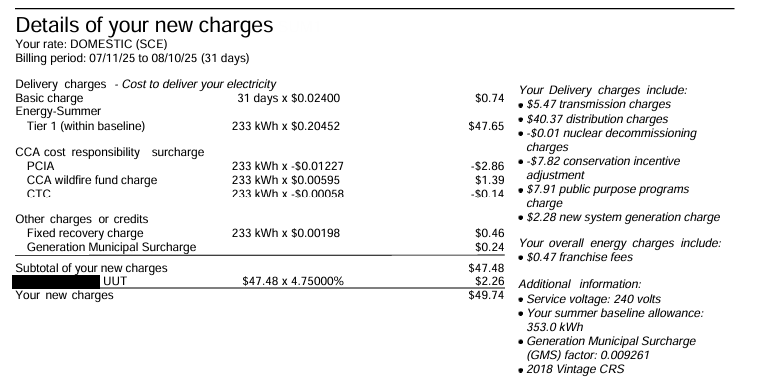
The delivery section, from the utility, comes to $49.74. It starts with a basic charge of $0.74 for 31 days (2.4 cents a day), then the energy line: 233 kWh at 20.452 cents, or $47.65, billed at the Tier 1 price because the home stayed within its baseline allowance. Smaller lines add or subtract a few cents to a few dollars: surcharges and credits, a fixed recovery charge of $0.46 and a local utility users tax of 4.75% on the $47.48 subtotal, which is $2.26. The bill also lists what delivery includes: $5.47 for transmission, $40.37 for distribution and $7.91 for public purpose programs, among others.
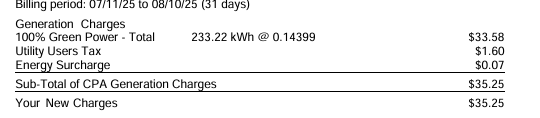
The supply section comes from the power provider and is $35.25: 233.22 kWh at 14.399 cents is $33.58, plus a utility users tax of $1.60 and an energy surcharge of $0.07. Together the two sections are $84.99 for 233 kWh, which is 36.5 cents per kWh all in. That is more than double the 18.0-cent U.S. average and a little above California's 12-month average of 33.0 cents. The home used less than half of California's average 487 kWh a month, so the fixed and per-line charges weigh more on each kWh.
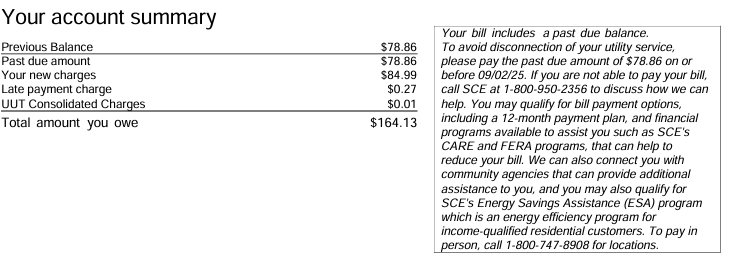
One more detail from the first page: the amount due, $164.13, is not what that month's electricity cost. It adds a past-due balance of $78.86 from the previous bill and a $0.27 late payment charge to the new charges of $84.99. To find the price per kWh, use the new charges only, as above. If your own bill carries a balance forward, the same applies.
Why does your electric bill change from month to month?
Mostly because of the kWh. The table shows the average U.S. home month by month: use ranged from 678 kWh in April 2026 to 1,160 kWh in July 2026, and the average bill from $128 to $212. The price per kWh moved far less, between 17.2 and 18.8 cents.
| Month | Use | Average bill | Price per kWh |
|---|---|---|---|
| August 2025 | 1,078 kWh | $189.77 | 17.6¢ |
| September 2025 | 878 kWh | $158.64 | 18.1¢ |
| October 2025 | 740 kWh | $132.99 | 18.0¢ |
| November 2025 | 705 kWh | $125.41 | 17.8¢ |
| December 2025 | 892 kWh | $153.78 | 17.2¢ |
| January 2026 | 1,003 kWh | $175.11 | 17.5¢ |
| February 2026 | 888 kWh | $156.82 | 17.7¢ |
| March 2026 | 748 kWh | $138.80 | 18.6¢ |
| April 2026 | 678 kWh | $127.71 | 18.8¢ |
| May 2026 | 736 kWh | $135.70 | 18.4¢ |
| June 2026 | 930 kWh | $170.65 | 18.3¢ |
| July 2026 | 1,160 kWh | $212.44 | 18.3¢ |
| 12-month average | 870 kWh | $156.49 | 18.0¢ |
What the average U.S. home used and paid each month, with the price per kWh that results (bill divided by kWh). EIA residential data, August 2025 to July 2026 (preliminary).
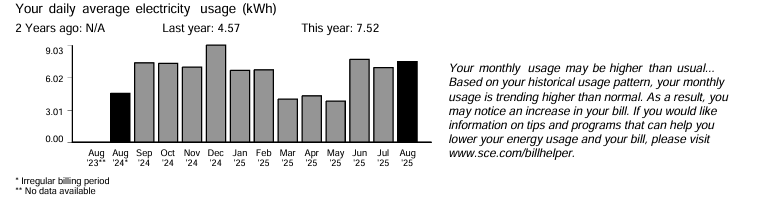
Other things move the bill a little. Billing periods are not all the same length, so a 33-day period collects more kWh than a 28-day one. Riders change on set dates, as above. Prices can also follow the season or the time of day: the EIA says prices are usually highest in summer and at the peak afternoon and early evening hours, but most consumers pay seasonal average rates, while some utilities offer time-of-day pricing. The Department of Energy (DOE) adds that many utilities offer time-based programs that reward use during off-peak hours, and that with a smart meter there is often a customer web portal showing your use hour by hour. Many bills include a chart of this, like the one on the real bill above, which shows an average of 7.52 kWh a day in the period against 4.57 a year earlier.
To see how big the summer and winter swings are by state, read our guide to the electric bill in winter vs summer.
How can you check that your bill makes sense?
Five checks take about ten minutes and use only what is printed on the bill:
- Check the kWh. Subtract the previous meter reading from the current one and see that it matches the kWh billed.
- Check the dates. Count the days in the billing period, and compare it with last month's.
- Find the fixed part. The customer charge is the same every month. If it changed, look for a rate-change notice from your utility.
- Work out your all-in price. Divide the total by the kWh, and compare it with the same month last year and with the 18.0-cent U.S. average.
- Read the riders. A new or higher rider explains an increase when your kWh did not change.
If your use is the part that looks high, work out what the big appliances cost to run. Multiply the watts by the hours a day and divide by 1,000 for the daily kWh, then multiply by your all-in price. Our guides to why your electric bill is so high, what a refrigerator costs to run and what central air costs to run do that for the biggest items. If a line on your bill is still unclear, your utility's customer service can explain it, and state commissions such as North Carolina's Public Staff and Pennsylvania's PUC publish their own plain-language bill guides.
How was this calculated?
The monthly use and bills come from the EIA's Form EIA-861M for the 12 months from August 2025 to July 2026 (preliminary data). The average bill is residential revenue divided by the number of residential customers, and the use is residential kilowatt-hours sold divided by customers. The price per kWh is the bill divided by the kWh, so it includes everything on the bill: delivery, riders, fees and taxes. The national 2024 use of 865 kWh a month comes from the EIA's Today in Energy of May 12, 2025. The definitions and line descriptions come from the EIA, North Carolina's Public Staff, Pennsylvania's PUC and the DOE, as listed in the sources. The bill with 900 kWh is an illustration, not a real utility. The real bill shown is from August 2025 for a home in Southern California; the amounts are copied from it, and the price per kWh is its new charges divided by its kWh. Charges, names and taxes vary by state and utility, so your bill may differ. Our full approach is in how we research costs.
Frequently asked questions
What does kWh mean on my electric bill?
kWh is a kilowatt-hour, one kilowatt of power used for one hour. It is the unit the utility bills you in. A 100-watt bulb running for 10 hours uses one kWh. The bill shows the meter reading at the start and the end of the period, and the difference is your kWh.
What is a delivery charge on an electric bill?
It is the cost of the local wires, transformers, substations and other equipment that bring electricity to your home, and it is usually regulated by your state commission. Even if you can choose who supplies the electricity, the local utility delivers it.
Why is my total higher than the rate per kWh on my bill?
The printed rate is usually one line, such as supply or energy. The total also includes the fixed customer charge, delivery, riders and taxes. Divide the total by the kWh to get the all-in price, which in the 12 months through July 2026 averaged 18.0 cents per kWh in the U.S.
What is the customer charge on an electric bill?
A fixed monthly charge that helps cover the meter, meter reading, billing and the connection to the grid. You pay it whatever you use, so it is the same in a month when you are away.
What is a rider on an electric bill?
A separate charge that changes on a set schedule and is added to the base rates, for example for fuel costs, energy-efficiency programs or required clean-energy purchases. Riders are why a bill can change when your kWh did not.
How do I calculate my price per kWh?
Divide the total amount due by the kWh used in the same billing period. For the average U.S. home, $156.49 divided by 870 kWh is 18.0 cents per kWh.
Why is the amount due higher than this month's electricity?
The amount due can include a balance carried over from an earlier bill and a late payment charge. On the real bill above, the new charges were $84.99 but the total owed was $164.13 because of a $78.86 past-due balance and a $0.27 late charge. Use the new charges to work out your price per kWh.
Do I pay taxes on my electric bill?
In most places, yes, though the type depends on the state. North Carolina applies a 7% sales tax to the total current charges, and Pennsylvania has a gross receipts tax on electric sales and a state tax adjustment surcharge. The utility collects the tax and passes it to the state.
Sources
- U.S. Energy Information Administration, Form EIA-861M: monthly sales, revenue and customers by state (August 2025 to July 2026, accessed October 15, 2026)
- U.S. Energy Information Administration, Today in Energy: Residential electric bills in Hawaii and Connecticut are twice those in New Mexico, Utah (May 12, 2025; accessed October 24, 2026)
- U.S. Energy Information Administration, Electricity explained: Measuring electricity (accessed October 24, 2026)
- U.S. Energy Information Administration, Electricity explained: Factors affecting electricity prices (accessed October 24, 2026)
- U.S. Energy Information Administration, Electricity explained: Delivery to consumers (accessed October 24, 2026)
- North Carolina Utilities Commission Public Staff, Understanding Your Electric Bill (accessed October 24, 2026)
- Pennsylvania Public Utility Commission, PA Power Switch: Understanding your bill (accessed October 24, 2026)
- U.S. Department of Energy, Tips on Saving Money and Energy in Your Home (2022 edition; time-based rates and smart meters; accessed October 23, 2026)

Founder and editor, The Cost of Home
I lived in the United States for five years, and this site grew out of the question every household there keeps asking: what will this cost, and is it worth it? Every number here comes from a public source listed at the end of the article.