Owning a Home
Average HOA Fees: What They Cost and What They Cover
Quick answer
The typical owner who pays an HOA or condo fee pays about $81 a month, and the average is higher, about $244, because a minority pay hundreds. Condo owners have a median near $331; owners of houses and townhouses, near $50. The fee usually pays for common areas, management, shared utilities and insurance, and a reserve for big repairs.
On this page
A homeowners association fee is easy to leave out of a budget, because it does not arrive with the mortgage, the tax bill or the insurance. It comes from a different place, on a different schedule, and it can change. About 24% of owner households report one, so for roughly one owner in four it is a real line in the monthly cost of the home.
This guide uses the Census Bureau's 2023 American Housing Survey to show what owners say they pay, by type of home and by region, and the Community Associations Institute's 2025 statistics to show what these associations are and how they spend. It also covers what a special assessment is and what to ask before you buy. For the costs that come with every home, see my guide to the monthly cost of owning a home, which leaves association fees out because they vary so much.
What is the average HOA fee?
Among owners who pay a fee, the median is $81 a month and the average is about $244. Half of those owners pay less than the median and half pay more. The average sits far above it because a minority pay a lot: one in ten owners who pay reports about $495 a month or more. The two numbers answer different questions. The median is the better guess for a typical neighbor, and the average is the better guide to what a month of fees costs across everyone who pays, high fees included.
The Census Bureau's own table for all occupants who pay (owners and renters) shows a median of $82 and an average of $244, and my calculation for owners alone matches it. The survey counts 20.5 million owner households paying a fee, out of 86.9 million owner households.
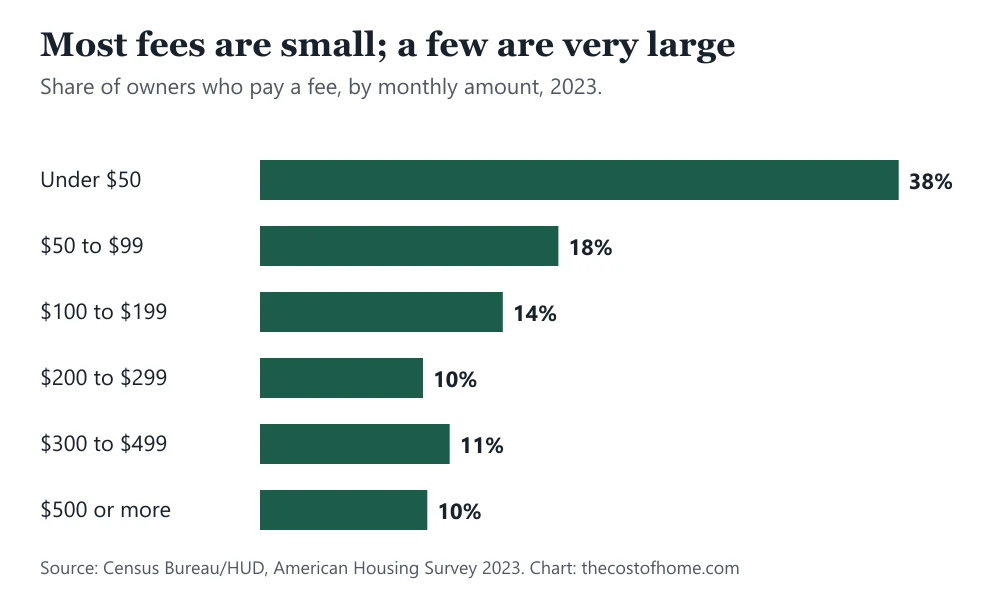
The spread is the main fact. About 56% of the owners who pay a fee pay under $100 a month, and about 21% pay $300 or more. A $40 fee for a neighborhood sign and a pool and a $600 fee for a building with an elevator and a doorman are both HOA fees, and they have almost nothing in common.
A figure from the association side gives a second view. The Foundation for Community Association Research counts 373,000 associations in 2025 with 29.6 million housing units and 78.1 million residents, 35.2% of U.S. housing, and says the associations collected $124.2 billion in assessments from homeowners that year. Dividing one by the other gives about $4,200 per unit a year, or about $350 a month. That is my arithmetic, not a published average, and it should not match the survey, since it spreads total dollars, reserve contributions included, across every unit in an association, co-ops among them, while the survey asks occupants what they pay.
Do condos have higher HOA fees than houses?
Yes, by a wide margin, and the gap starts with how many people pay at all. Nearly 89% of condo owners report a fee. Only about 20% of owners of houses and townhouses do, and about 9% of mobile home owners. The survey records lot rent separately, so a mobile home owner on rented land can pay for the land without showing up here.
| Home | Paying | Median | Average |
|---|---|---|---|
| Condo | 89% | $331 | $527 |
| Mobile home | 9% | $140 | $281 |
| House or townhouse | 20% | $50 | $123 |
Monthly fee paid by owners, by type of home, from the 2023 American Housing Survey. "Paying" is the share of owners of that type who report a fee. Houses and townhouses exclude condos; the fee can include a mobile home park fee for the mobile home row.
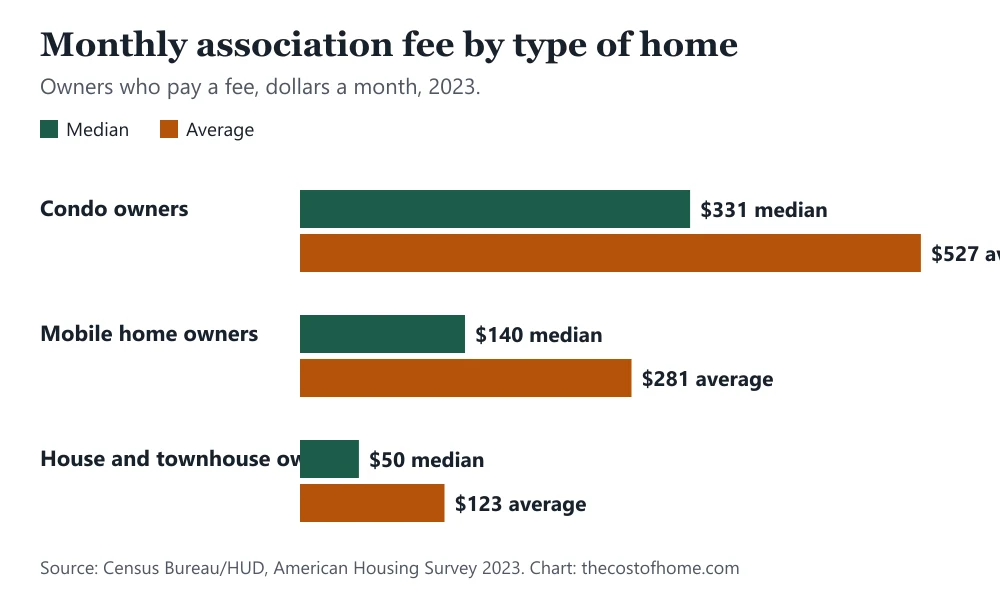
The reason is in what each fee has to carry. A condo association maintains the roof, the walls, the halls and often the water and heat for a whole building. A neighborhood association of detached houses maintains an entrance, a few streets or a pool, and each owner still maintains their own roof. For a house, the typical fee is $50, though one in ten who pay report about $253 or more. For a condo, the middle fee is $331, and one in ten reports about $825 or more.
Where are HOA fees highest?
The Pacific states and the Northeast are highest by a wide margin, and the South and Midwest are lowest. The Northeast is the clearest case: only about one owner in eight there reports a fee, but those who do pay a median near $290, which fits with condos and co-ops being common there.
| Region | Paying | Median | Houses |
|---|---|---|---|
| Middle Atlantic (NY, NJ, PA) | 14% | $296 | $90 |
| New England | 12% | $289 | $42 |
| Pacific (West Coast) | 23% | $184 | $84 |
| Mountain | 38% | $86 | $72 |
| South Atlantic | 34% | $81 | $60 |
| East North Central | 18% | $59 | $26 |
| West North Central | 17% | $48 | $31 |
| West South Central | 28% | $44 | $43 |
| East South Central | 14% | $32 | $30 |
Monthly association fee paid by owners, by Census division, 2023. "Paying" is the share of owners in the division who report a fee. The last column is the median for houses and townhouses only, with condos left out. Divisions with fewer survey households, such as East South Central and West North Central, are less certain.
The last column is a check on that explanation. Take condos out, and the Middle Atlantic median falls from $296 to $90 and New England's from $289 to $42. The share of owners paying runs the other way: 38% in the Mountain states and 34% in the South Atlantic, where an association is common, against 12% in New England. In my opinion, that is the better way to read the map: in the South and Mountain West you are more likely to pay a fee, in the Northeast and on the West Coast the fee is likelier to be a large one.
What does an HOA fee cover?
The Community Associations Institute says assessments fund professional management, utilities, security, insurance, common-area maintenance, landscaping, capital improvement projects and amenities such as pools and clubhouses. It also reports that $31.1 billion of the $124.2 billion collected in 2025 went into reserve funds for repairing and replacing common property, such as roofs, streets, pools and elevators. By my arithmetic that is about a quarter of the money.
The Census Bureau's survey definitions show how much the label stretches:
- HOA fee. Upkeep of common property, such as lawns, parking areas and streetlights, and the use of pools or other recreational facilities. It can include security personnel.
- Condo fee. Operating and maintenance costs of common property, administrative costs, and utilities billed communally, plus management fees.
- Co-op fee. A share of the cooperative's real estate taxes, mortgage interest and operating cost.
Read what is missing. The HOA and condo definitions do not list property tax, so that bill still comes to you, and my guide to property tax by state shows how large it can be. Only the co-op fee carries a share of the taxes. What the fee does not cover inside your own walls is the work of keeping your home: my guide to home maintenance costs covers it, and the homeowners insurance guide covers the policy. Because every association splits these things differently, ask for the budget and the governing documents. Two questions matter most: which parts of the building or grounds the association insures and maintains, and which parts you are responsible for.

What is a special assessment?
A special assessment is a charge on owners on top of the regular fee, usually when the association needs money it has not saved. The survey I used does not measure them, and I found no national figure for how often they happen or how big they are, so I will not give you a typical amount.
What I can show comes from the mortgage side. Fannie Mae's Selling Guide, which sets the rules for many condo loans, says a lender must check that a condo project's budget sets aside at least 10% for replacement reserves, and that special assessment income can be left out of that 10%. The same rules say no more than 15% of the units in a project may be 60 days or more past due on each special assessment. In plain terms, a building that cannot fund its reserves from the regular fee is the kind that ends up billing owners for a large repair, which is why lenders look at it. The rules change, so ask a lender to confirm the current ones for a specific building.
In my opinion, a low fee is not a bargain if the reason is that the association is saving too little for the roof. That is a risk mostly in older condo buildings, where the big repairs come due together.
What should you check before you buy?
- The monthly amount and the last increases. Ask for the budget and for the fee history, not only the current number.
- What the fee includes. Water, heat, trash, insurance on the building, cable and internet are included in some and not in others.
- The reserve study. This is the independent report on the major parts of the property, their remaining life and what the association should set aside.
- Special assessments, past and planned. Ask for any in the last five years and any proposed, along with the amount owed per unit.
- How many owners are behind on the fee. The mortgage rules above treat late payers as a risk to the building's finances.
Then add the fee to the rest of the bill. A $350 fee is $4,200 a year, which is more than three times the average owner's routine upkeep in my maintenance guide, and it moves the real monthly cost of the home with it. The insurance guide shows another line that has been rising, which is a reason to ask how the association's own insurance bill is changing.
How was this calculated?
The fee figures come from the American Housing Survey 2023 national public use file (Census Bureau and HUD), variable HOAAMT, the monthly homeowner or condominium association fee. In the survey, the fee covers homeowner, condominium and cooperative fees, and mobile home park fees, and it is self-reported by whoever lives in the home. I kept owner-occupied homes with a reported fee above zero, weighted by the survey weight (7,849 households in the file: 1,928 condo, 5,617 house or townhouse and 165 mobile home). The Census Bureau adds noise to the public file, so figures are close, not exact. A condo is a home the survey marks as a condominium. A house or townhouse is a detached or attached single-family home that is not a condo. I did not calculate margins of error, which are widest for the smallest regions.
Association counts, dollars and reserves are from the Foundation for Community Association Research 2025 Statistical Review, and the lender rules are from the Fannie Mae Selling Guide page on full-review projects, which I read on November 14, 2026. The $350 a month and the quarter of assessments in reserves are my own arithmetic on the Foundation's totals.
Frequently asked questions
What is the average HOA fee per month?
Among owners who pay one, the median is about $81 a month and the average about $244, according to the 2023 American Housing Survey. Condo owners have a median near $331, and owners of houses and townhouses near $50.
What does an HOA fee usually cover?
The Community Associations Institute lists management, utilities, security, insurance, common-area maintenance, landscaping, capital projects and amenities, plus reserves for big repairs. What is included differs by association, so ask for the budget.
Why are condo fees higher than house fees?
A condo association maintains shared structure and often shared utilities for a whole building, while a neighborhood association of houses usually maintains only common grounds. In the survey, the median condo fee is about $331 against about $50 for houses and townhouses.
Do HOA fees include property taxes?
Not by the Census definitions. A co-op fee includes a share of the cooperative's real estate taxes, but the HOA and condo fee definitions list upkeep, amenities, management and shared utilities, so property tax is usually a separate bill.
What is a special assessment?
It is a one-time or short-term charge on owners on top of the regular fee, usually when the association needs money it has not saved. I found no national figure for how common or how large they are.
How many Americans live in an HOA?
The Foundation for Community Association Research counts 373,000 associations in 2025, with 29.6 million housing units and 78.1 million residents, about 35.2% of U.S. housing. That includes condominiums and cooperatives as well as planned communities.
Where are HOA fees highest?
In the 2023 survey, owners in the Pacific states and in the Northeast who pay a fee have the highest medians, about $184 and $296, but fewer owners there pay one. The South Atlantic and Mountain states have the highest shares of owners paying.
Sources
- U.S. Census Bureau and HUD, American Housing Survey 2023, national public use file v1.1: household file, variable HOAAMT, and the survey table specifications with the 2023 median of $82 and average of $244 (accessed November 14, 2026)
- U.S. Census Bureau and HUD, American Housing Survey 2023 definitions, Appendix A: monthly homeowner or condominium association fee, HOA fee, condominium fee and cooperative maintenance fee (accessed November 14, 2026)
- Foundation for Community Association Research, "2025 U.S. National and State Statistical Review for Community Associations": associations, units, residents, assessments and reserve contributions (accessed November 14, 2026)
- Fannie Mae Selling Guide, B4-2.2-02 Full Review Process: replacement reserves of at least 10% of the budget, special assessment income excluded, and the 15% delinquency limit (accessed November 14, 2026)

Founder and editor, The Cost of Home
I write and check every guide on this site myself, working from public data. The sources behind each number are listed at the end of the article, so you can check them too.