Owning a Home
What Does It Really Cost to Own a Home per Month?
Quick answer
A U.S. homeowner with no mortgage pays about $730 a month to keep a typical house running: $279 in property tax, $156 for electricity, $145 for insurance, $87 for upkeep and $63 for water and sewer. Natural gas adds $84 for homes that have it. Before upkeep, the monthly total runs from $399 in West Virginia to $1,159 in New Jersey.
On this page
- How much does it cost to own a home per month?
- What is the biggest cost of owning a home?
- Does that match what the Bureau of Labor Statistics sees?
- What changes if you have a mortgage?
- How much does it cost to own a home in each state?
- Why does the monthly number hide the biggest costs?
- What costs are not in this total?
- How should you budget for it?
- How was this calculated?
- FAQ
- Sources
The price of a house is one number. The cost of owning it is a handful of bills that arrive on different days, in different sizes, from the county, the insurer, the power company, the water utility and the roofer. Nobody sends one statement that adds them up, so most owners never see the total.
This guide adds them up. It takes the five recurring costs I have priced in my other guides, property tax, electricity, insurance, upkeep and water, and puts them side by side for a home with no mortgage. It also says what is left out, because the biggest omission is the mortgage itself. The national figures come first, then all 50 states and D.C., then a check against a separate Bureau of Labor Statistics survey.
How much does it cost to own a home per month?
For a typical paid-off home, about $730 a month, or $8,758 a year, before natural gas. Homes that have gas service add about $84 a month on average, which brings the total to about $814. Property tax is the biggest single line at $279, 38% of the total, and water is the smallest.
| Cost | A month | A year | Basis |
|---|---|---|---|
| Property tax | $279 | $3,344 | Median, 2025 |
| Electricity | $156 | $1,878 | Average, 12 months to July 2026 |
| Homeowners insurance | $145 | $1,737 | Average premium, 2023 policies |
| Upkeep and repairs | $87 | $1,038 | Median, 2023 |
| Water and sewer | $63 | $761 | Average with a bill, 2024 |
| Total | $730 | $8,758 | Five lines |
| Natural gas, if you have it | $84 | $1,008 | Average gas customer, 2025 |
| Total with gas | $814 | $9,765 | Six lines |
The recurring costs of a typical U.S. home with no mortgage and no HOA fee. The lines use different yardsticks, medians for property tax and upkeep and averages for the rest, so treat the total as a yardstick for planning and not as a statistic. Each line is explained in the guide linked in the text.
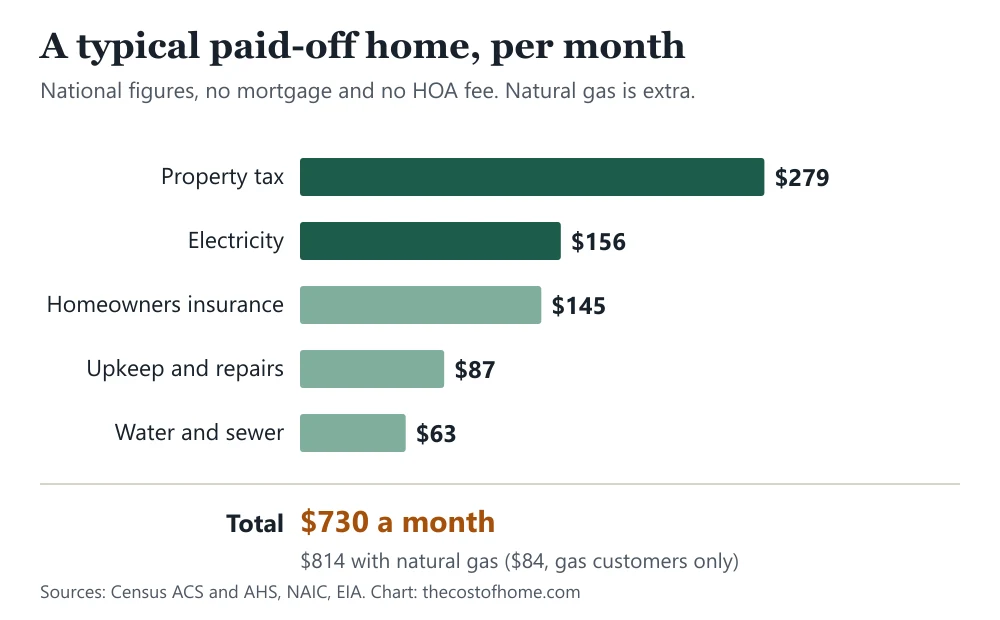
Two cautions before you plan around this. First, the lines do not measure the same thing: tax and upkeep are medians, the middle homeowner, while the bills are averages that big spenders pull up. Second, the figures are national, so they describe nobody in particular. Your own total depends on the state, the county and the house, which is what the rest of this guide shows.
What is the biggest cost of owning a home?
Property tax, in most of the country. It is the largest of the four bills I can compare state by state in 38 of the 51 places, and it is bigger than the electric bill in 39. The exceptions are low-tax states: electricity is the largest of the four in 10 of them, and insurance leads in 3, among them Louisiana, Oklahoma and Arkansas, where it costs more than the tax bill.
The tax bill is also the one that varies most. The median homeowner in New Jersey pays $804 a month in property tax and the one in West Virginia pays $75. My guide to property tax by state has the full ranking and the tax rates behind it. Insurance varies less in dollars but more in cause: the average premium is $145 a month nationally, and my guide to homeowners insurance by state shows Louisiana at $252 and Wisconsin at $77.
The utility bills are steadier. Electricity runs from about $99 in New Mexico to $224 in Hawaii, and water from $41 to $93. The details are in my guides to electric bills and water and sewer bills. My read: the bills you can lower are small, and the ones that are large are set by your county and your insurer.
Does that match what the Bureau of Labor Statistics sees?
Close, once the lumpy part is handled the same way. The Bureau of Labor Statistics runs the Consumer Expenditure Survey, which asks households what they spend. For owners with no mortgage, its 2025 average for owned dwellings, a category that covers property tax, insurance, maintenance, repairs and a few other items such as interest on home equity loans and ground rent, was $8,766 a year, or $731 a month.
| Measure | A month | A year |
|---|---|---|
| Tax + insurance + median upkeep | $510 | $6,119 |
| Tax + insurance + average upkeep | $722 | $8,665 |
| BLS, owned dwellings, no mortgage | $731 | $8,766 |
My ownership lines against the Bureau of Labor Statistics. The BLS figure is the 2025 average of owned dwellings for homeowners with no mortgage, per household. Mine adds property tax, insurance and upkeep from my guides, once with the median upkeep and once with the average.
My three matching lines come to $510 a month with the median upkeep and $722 with the average. The average is the fair comparison, because the survey also reports averages, and it lands within about 1% of the BLS figure. The median version is lower because the typical owner spends far less on upkeep than the average does. The two surveys are different years and different questions, so I would not push the match too far. It tells me the bottom-up numbers are in the right place.
The same survey puts utilities, fuels and public services for owners with no mortgage at $453 a month. That is higher than my electricity, water and gas combined ($304) because the category also includes telephone service and fuels such as heating oil, which I did not price.
What changes if you have a mortgage?
Everything on this page stays, and the loan comes on top. In the same survey, owners with a mortgage averaged $20,514 a year in owned dwellings in 2025, against $8,766 for owners without one, a gap of about $979 a month. Most of that gap is interest on the loan. The survey does not count the principal you pay down, so your actual payment can be higher still. Your own payment depends on the price, the rate, the term and the down payment, which no national figure can settle.
That is why I kept the mortgage out of the totals. It is the largest cost of owning for many people, but it is a choice about financing, not a cost of the house. If you are comparing homes, use the totals here for everything except the loan, and get the loan from a lender's quote.
How much does it cost to own a home in each state?
From about $399 a month in West Virginia to $1,159 in New Jersey for the four bills I can compare by state, before upkeep. The top five are New Jersey ($1,159), Connecticut ($983), Massachusetts ($958), New York ($930) and New Hampshire ($916). The cheapest five are West Virginia ($399), Idaho ($432), New Mexico ($433), Arkansas ($439) and Nevada ($450). New Jersey costs about 2.9 times as much as West Virginia, and 69% of the New Jersey total is property tax.
| State | Property tax | Insurance | Electric + water | Total |
|---|---|---|---|---|
| U.S. typical | $279 | $145 | $220 | $643 |
| Alabama | $79 | $159 | $232 | $470 |
| Alaska | $339 | $101 | $235 | $675 |
| Arizona | $158 | $100 | $226 | $484 |
| Arkansas | $95 | $156 | $188 | $439 |
| California | $461 | $138 | $248 | $847 |
| Colorado | $245 | $208 | $180 | $633 |
| Connecticut | $560 | $170 | $253 | $983 |
| Delaware | $159 | $100 | $221 | $480 |
| District of Columbia | $400 | $129 | $231 | $761 |
| Florida | $265 | $232 | $231 | $728 |
| Georgia | $223 | $152 | $209 | $585 |
| Hawaii | $199 | $129 | $316 | $644 |
| Idaho | $160 | $95 | $177 | $432 |
| Illinois | $471 | $123 | $194 | $789 |
| Indiana | $157 | $105 | $214 | $476 |
| Iowa | $251 | $112 | $181 | $544 |
| Kansas | $262 | $144 | $191 | $597 |
| Kentucky | $145 | $127 | $207 | $479 |
| Louisiana | $106 | $252 | $205 | $563 |
| Maine | $284 | $96 | $211 | $591 |
| Maryland | $364 | $132 | $260 | $755 |
| Massachusetts | $529 | $178 | $251 | $958 |
| Michigan | $264 | $93 | $193 | $549 |
| Minnesota | $307 | $166 | $177 | $649 |
| Mississippi | $104 | $169 | $212 | $486 |
| Missouri | $179 | $132 | $204 | $515 |
| Montana | $246 | $147 | $173 | $566 |
| Nebraska | $305 | $179 | $171 | $655 |
| Nevada | $181 | $84 | $185 | $450 |
| New Hampshire | $582 | $108 | $226 | $916 |
| New Jersey | $804 | $129 | $226 | $1,159 |
| New Mexico | $155 | $124 | $154 | $433 |
| New York | $559 | $150 | $222 | $930 |
| North Carolina | $181 | $154 | $203 | $539 |
| North Dakota | $217 | $118 | $186 | $521 |
| Ohio | $259 | $93 | $217 | $569 |
| Oklahoma | $148 | $207 | $204 | $559 |
| Oregon | $334 | $84 | $214 | $631 |
| Pennsylvania | $274 | $101 | $243 | $618 |
| Rhode Island | $408 | $200 | $224 | $832 |
| South Carolina | $114 | $146 | $216 | $476 |
| South Dakota | $258 | $135 | $195 | $588 |
| Tennessee | $130 | $137 | $208 | $475 |
| Texas | $350 | $239 | $245 | $834 |
| Utah | $228 | $92 | $164 | $485 |
| Vermont | $452 | $101 | $199 | $752 |
| Virginia | $250 | $128 | $239 | $617 |
| Washington | $409 | $103 | $223 | $735 |
| West Virginia | $75 | $98 | $225 | $399 |
| Wisconsin | $318 | $77 | $186 | $580 |
| Wyoming | $166 | $154 | $177 | $497 |
Monthly cost of four recurring bills for a paid-off home, by state. Property tax is the Census median (2025), insurance the NAIC average HO-3 premium for 2023 policies, electricity the EIA average bill for the 12 months to July 2026 and water the Census average for owners who get a bill (2024). Upkeep and natural gas are not included. The total adds the unrounded figures, so it can differ by a dollar from the columns.
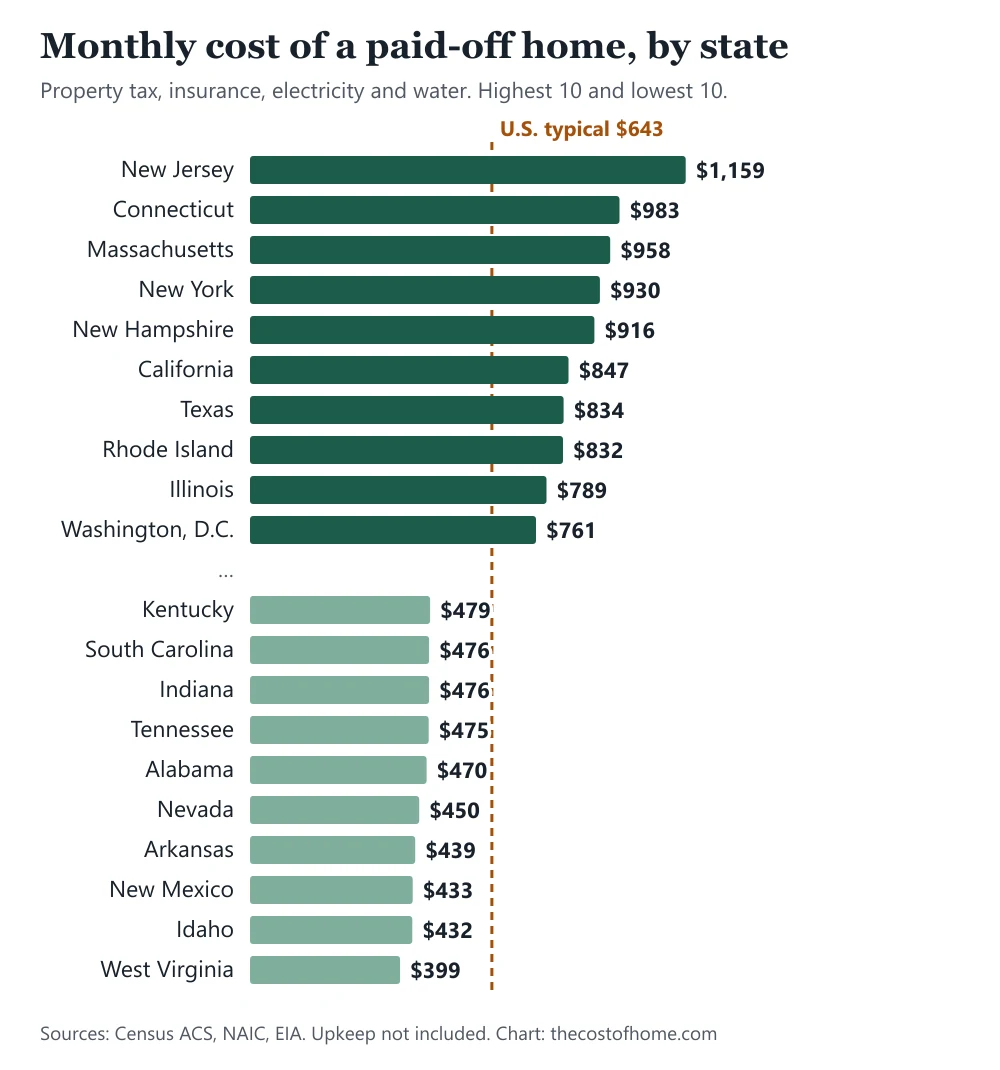
Read the table by column, not just by total. Texas ends up near the top at $834 because it combines $350 in property tax with $239 in insurance, so there is no cheap line to offset. Florida is in the middle at $728, but $232 of it is insurance, higher than its $265 tax bill. Hawaii has a middling total of $644, built on the highest electric bill in the country ($224) and below-average property tax ($199) and insurance ($129).
The insurance column is the weakest in the table. It comes from NAIC data on 2023 policies, and the NAIC has found premiums climbing in every region since 2018, so today's quotes can be well above it, most of all where premiums are already high. Treat it as a floor.
Why does the monthly number hide the biggest costs?
Because upkeep comes in lumps. In the 2023 American Housing Survey, the median owner's routine upkeep plus repairs and replacements was $1,038 a year, which is the $87 a month in the table. The average was $3,584 a year, $299 a month, since a few owners replace a roof or a heating system in a given year while most have an ordinary one. My guide to home maintenance costs per year has the spending by home age and value.
The big jobs are the ones to plan for. By my other guides, a roof replacement runs roughly $6,000 to $14,000, a new gas furnace about $4,250 to $4,950 installed, a water heater about $950 to $1,350 for most types and a heat pump $5,000 to $15,000. None of them hits in a typical month, and every one of them is a decision you will make eventually.
The old rule of thumb gives a way to budget for it. One percent of the median U.S. home value of $371,100 is $3,711 a year, or $309 a month. The average upkeep in the survey, $299 a month, lands almost exactly on that figure. I would put the $87 median in the monthly budget and set the difference aside, since a year with nothing to fix is normal and a year with a roof is not.
What costs are not in this total?
Four, and each one can be large:
- The mortgage payment. Left out on purpose, as explained above.
- HOA and condo fees. Common in condos, townhomes and planned communities, and not included here. They can include water or trash, so they change what the other lines look like.
- Natural gas and other fuels. Gas is a winter bill, so the $84 average hides a month at $175 in January and a month near $37 in the summer, by my natural gas bill guide. Homes heated with propane or oil have a different bill, covered in my propane versus natural gas guide.
- Everything optional. Phone, internet, trash pickup where it is not in the tax bill, lawn care, a security system with professional monitoring at roughly $20 to $50 a month, pool upkeep and remodeling.
I would add whichever of these applies to you to the $730 before comparing any house with another.
How should you budget for it?
Turn the totals into a monthly number and start from the three lines you cannot change. Property tax and insurance together are $423 a month nationally, 58% of the total, and both are set by your county and your insurer. Look up your own tax bill on the county's site and ask an insurer for a quote before you assume the national figures.
Then add the bills you can partly steer. For electricity, my guide to reading your electric bill shows which part is usage and which is fixed, and electricity prices by state shows what your neighbors pay per kilowatt-hour. For water, the EPA says fixing easy household leaks can save about 10 percent on the bill, which on the national average of $761 a year is roughly $76.
Last, fund the lumps. Put the $87 median in the budget and move toward the $309 1% figure if your home is older or its big systems are. Everything else in the owning-a-home series is on the Owning a Home page.
How was this calculated?
Every line is a figure from one of my guides, rounded to the dollar, and the total adds the unrounded values. Property tax is the median real estate tax paid by owner-occupied homes in the Census Bureau's 2025 American Community Survey (table B25103), divided by 12. Insurance is the average HO-3 premium for 2023 policies in the NAIC's homeowners report, published in July 2026, divided by 12. Electricity is the average residential bill from the EIA's Form EIA-861M for the 12 months to July 2026. Water and sewer is the average yearly bill of owners who get one in the 2024 ACS microdata, divided by 12. Upkeep is the median of routine maintenance plus repairs and replacements in the 2023 American Housing Survey, divided by 12. Natural gas is the EIA's average for residential gas customers in 2025.
The state totals use the same sources by state, except upkeep, which exists only as a national figure, and gas, which only some homes use. The Bureau of Labor Statistics figures were read from its public API on November 5, 2026: owned dwellings (series CXUOWNDWELLLB1703M and 1704M), maintenance, repairs, insurance and other expenses (CXUOWNEXPENLB1704M) and utilities, fuels and public services (CXUUTILSLB1704M), all annual means per household for 2025. The BLS defines owned dwellings to include mortgage interest, interest on home equity loans, property taxes, insurance, repairs and maintenance, and to leave out principal repayments. The three-line sum, the 1% figure and the totals are my own arithmetic. The page on how I research costs explains how I pick and check sources.
Frequently asked questions
How much does it cost to own a home per month without a mortgage?
About $730 a month for a typical U.S. home: $279 in property tax, $156 for electricity, $145 for insurance, $87 for upkeep and $63 for water and sewer. Natural gas adds about $84 for homes that have it. HOA fees, phone and internet are not included.
What is the most expensive part of owning a home?
Apart from the mortgage, property tax: a median $279 a month nationally, and the largest of the four bills I compared in 38 of the 51 places. In states with high insurance costs, such as Louisiana and Florida, insurance can be larger than the tax bill.
Which state is the most expensive to own a home in?
New Jersey, at about $1,159 a month for property tax, insurance, electricity and water on a paid-off home, followed by Connecticut, Massachusetts and New York. West Virginia is the lowest at about $399. These totals leave out upkeep.
How much should you set aside for home maintenance each month?
The median owner reports about $87 a month in upkeep, repairs and replacements, and the average is $299. The old 1% rule on the median U.S. home value gives $309 a month. I would budget the median and save toward the 1% figure for the years with a big repair.
Is homeowners insurance included in these costs?
Yes. I used the NAIC's average HO-3 premium of about $145 a month, from 2023 policies. The NAIC has found premiums climbing in every region since 2018, so a current quote can be higher.
What does it cost to own a home with a mortgage?
More, by the size of the loan payment. In the Bureau of Labor Statistics survey, owners with a mortgage averaged $20,514 a year in owned dwellings in 2025 against $8,766 for owners without one, a gap of about $979 a month that does not count the principal repaid.
Are HOA fees included in the monthly cost of owning a home?
No. HOA and condo fees are left out of every figure here because they vary by community and sometimes include water or trash. If your home has one, add it to the monthly total.
Sources
- U.S. Census Bureau, American Community Survey 2025 1-year estimates, Table B25103, median real estate taxes paid, and Table B25077, median home value of owner-occupied housing units, $371,100 (see my property tax guide; accessed October 29, 2026)
- National Association of Insurance Commissioners, Dwelling Fire, Homeowners Owner-Occupied, and Homeowners Tenant and Condominium/Cooperative Unit Owners Insurance Report: Data for 2023, average HO-3 premium by state (see my insurance guide; accessed October 25, 2026)
- U.S. Energy Information Administration, Form EIA-861M: monthly electricity sales, revenue and customers by state, residential bill for the 12 months to July 2026 (see my electric bill guide; accessed October 15, 2026)
- U.S. Energy Information Administration, Natural Gas Prices and consumption: residential, average bill of gas customers in 2025 (see my natural gas bill guide; accessed October 17, 2026)
- U.S. Census Bureau, American Community Survey 2024 1-year Public Use Microdata Sample (PUMS), housing records, water and sewer cost (see my water bill guide; accessed November 2, 2026)
- U.S. Census Bureau and HUD, American Housing Survey 2023, national public-use file v1.1: routine maintenance and repair and replacement jobs (see my maintenance guide; accessed October 30, 2026)
- U.S. Bureau of Labor Statistics, Consumer Expenditure Surveys, 2025 annual means for homeowners with and without a mortgage: owned dwellings (series CXUOWNDWELLLB1703M, 1704M), maintenance, repairs, insurance and other expenses (CXUOWNEXPENLB1704M) and utilities, fuels and public services (CXUUTILSLB1704M); read from the public API on November 5, 2026
- U.S. Bureau of Labor Statistics, Consumer Expenditure Survey glossary: definition of owned dwellings (accessed November 5, 2026)
- Financial Security for All, Cooperative Extension (USDA-supported), "How much money should homeowners set aside each year for maintenance and repairs to their home?" (May 30, 2019; see my maintenance guide; accessed October 30, 2026)
- U.S. Environmental Protection Agency, WaterSense, Fix a Leak Week: fixing easily corrected household leaks can save about 10 percent on a water bill (see my water bill guide; accessed November 2, 2026)

Founder and editor, The Cost of Home
I write and check every guide on this site myself, working from public data. The sources behind each number are listed at the end of the article, so you can check them too.