Owning a Home
Property Tax by State: What the Average Homeowner Pays
Quick answer
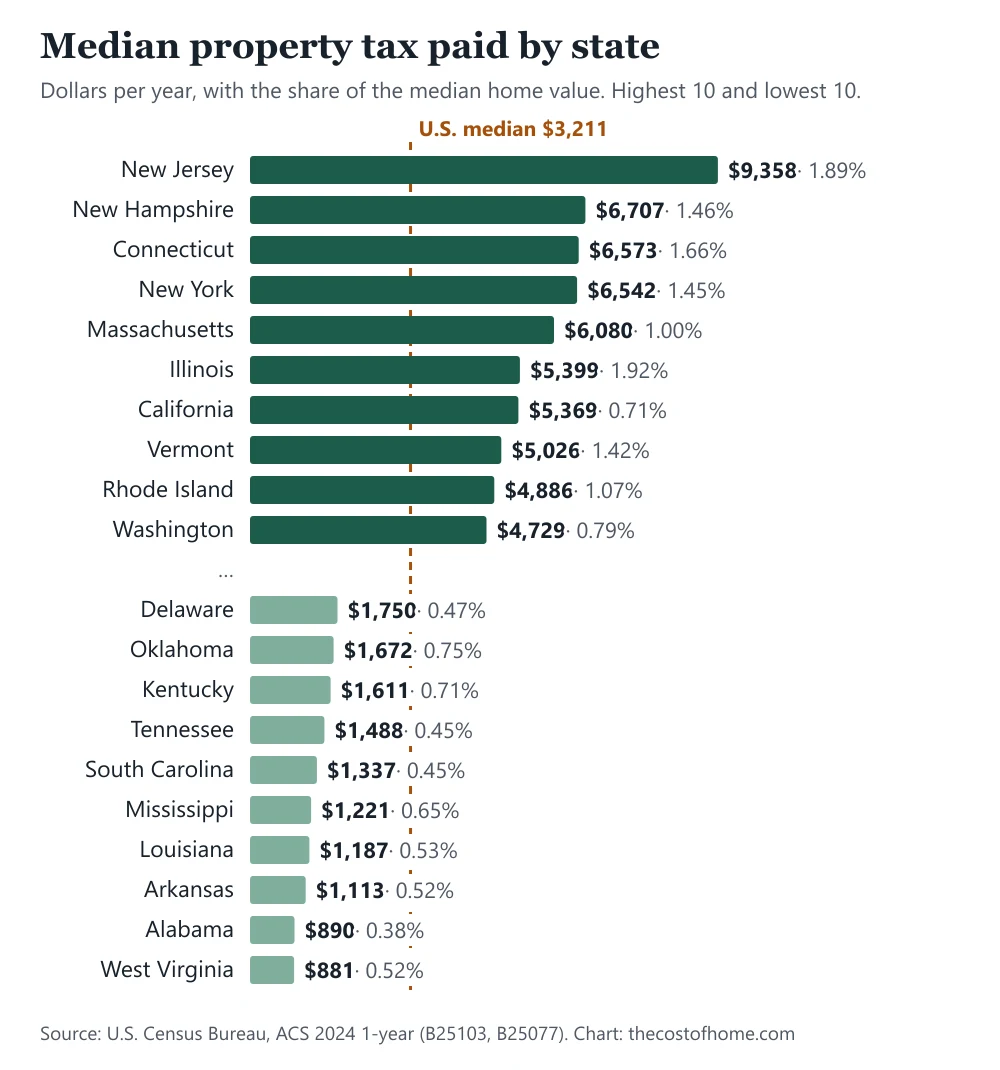
The median U.S. homeowner paid $3,211 in property tax in 2024, about $268 a month, equal to 0.89% of the median home value of $360,600, according to Census Bureau data. New Jersey had the highest bill at $9,358 and West Virginia the lowest at $881. Illinois had the highest tax rate (1.92%) and Hawaii the lowest (0.27%).
On this page
- What is the average property tax in each state?
- Which states have the highest property tax bills?
- Which states have the highest property tax rates?
- Why do the dollar bill and the tax rate tell different stories?
- Which states have the lowest property taxes?
- Why does property tax vary so much from state to state?
- Do homeowners with a mortgage pay more property tax?
- How does property tax compare with homeowners insurance and utilities?
- How do you use these numbers for your own home?
- FAQ
- Sources
Property tax is the one housing cost that does not end when the mortgage does. It is billed by the county, the city and the school district, it changes with the value of the house, and where you live decides most of it. The median bill in New Jersey is more than ten times the median bill in Alabama.
The numbers below come from the U.S. Census Bureau's American Community Survey (ACS), which asks owners how much they paid in real estate taxes and what they think their home would sell for. The 2024 estimates are the newest available as of October 28, 2026, and the Census Bureau has scheduled the 2025 release for October 29, so this guide will be updated when those numbers land.
Two measures matter here, and they do not tell the same story. The dollar bill is what leaves your account each year. The tax rate is that bill as a share of the home's value, which shows how heavy the tax is for the money tied up in the house. Both are in the table.
What is the average property tax in each state?
The table shows the median homeowner, the one in the middle: half of homeowners in the state paid more and half paid less. The median is a better yardstick than the average because a few very expensive homes can drag an average up. The tax rate is the median tax divided by the median home value.
| State | Tax per year | Tax per month | Median home value | Tax rate | Rank by dollars | Rank by rate |
|---|---|---|---|---|---|---|
| U.S. median | $3,211 | $268 | $360,600 | 0.89% | – | – |
| Alabama | $890 | $74 | $233,300 | 0.38% | 50 | 50 |
| Alaska | $3,976 | $331 | $376,500 | 1.06% | 14 | 16 |
| Arizona | $1,828 | $152 | $426,000 | 0.43% | 39 | 48 |
| Arkansas | $1,113 | $93 | $215,600 | 0.52% | 49 | 40 |
| California | $5,369 | $447 | $759,500 | 0.71% | 7 | 32 |
| Colorado | $2,828 | $236 | $574,600 | 0.49% | 29 | 42 |
| Connecticut | $6,573 | $548 | $396,900 | 1.66% | 3 | 3 |
| Delaware | $1,750 | $146 | $371,600 | 0.47% | 42 | 44 |
| District of Columbia | $4,594 | $383 | $733,400 | 0.63% | 11 | 36 |
| Florida | $2,993 | $249 | $396,900 | 0.75% | 21 | 26 |
| Georgia | $2,554 | $213 | $343,300 | 0.74% | 31 | 28 |
| Hawaii | $2,385 | $199 | $875,900 | 0.27% | 33 | 51 |
| Idaho | $1,912 | $159 | $446,400 | 0.43% | 38 | 49 |
| Illinois | $5,399 | $450 | $280,700 | 1.92% | 6 | 1 |
| Indiana | $1,798 | $150 | $243,500 | 0.74% | 40 | 29 |
| Iowa | $2,937 | $245 | $227,300 | 1.29% | 26 | 9 |
| Kansas | $2,983 | $249 | $238,700 | 1.25% | 23 | 10 |
| Kentucky | $1,611 | $134 | $226,000 | 0.71% | 44 | 30 |
| Louisiana | $1,187 | $99 | $223,200 | 0.53% | 48 | 39 |
| Maine | $3,103 | $259 | $341,900 | 0.91% | 20 | 22 |
| Maryland | $4,144 | $345 | $436,300 | 0.95% | 12 | 21 |
| Massachusetts | $6,080 | $507 | $607,400 | 1.00% | 5 | 19 |
| Michigan | $2,988 | $249 | $254,200 | 1.18% | 22 | 13 |
| Minnesota | $3,501 | $292 | $344,600 | 1.02% | 18 | 17 |
| Mississippi | $1,221 | $102 | $186,500 | 0.65% | 47 | 34 |
| Missouri | $2,021 | $168 | $254,400 | 0.79% | 36 | 23 |
| Montana | $2,939 | $245 | $425,400 | 0.69% | 25 | 33 |
| Nebraska | $3,739 | $312 | $263,100 | 1.42% | 16 | 7 |
| Nevada | $2,143 | $179 | $455,500 | 0.47% | 34 | 45 |
| New Hampshire | $6,707 | $559 | $458,800 | 1.46% | 2 | 4 |
| New Jersey | $9,358 | $780 | $496,000 | 1.89% | 1 | 2 |
| New Mexico | $1,776 | $148 | $279,900 | 0.63% | 41 | 35 |
| New York | $6,542 | $545 | $449,800 | 1.45% | 4 | 5 |
| North Carolina | $2,044 | $170 | $333,000 | 0.61% | 35 | 37 |
| North Dakota | $2,550 | $213 | $266,100 | 0.96% | 32 | 20 |
| Ohio | $2,937 | $245 | $239,800 | 1.22% | 26 | 12 |
| Oklahoma | $1,672 | $139 | $222,100 | 0.75% | 43 | 27 |
| Oregon | $3,895 | $325 | $497,500 | 0.78% | 15 | 25 |
| Pennsylvania | $3,214 | $268 | $277,600 | 1.16% | 19 | 14 |
| Rhode Island | $4,886 | $407 | $455,700 | 1.07% | 9 | 15 |
| South Carolina | $1,337 | $111 | $299,500 | 0.45% | 46 | 47 |
| South Dakota | $2,940 | $245 | $289,600 | 1.02% | 24 | 18 |
| Tennessee | $1,488 | $124 | $332,600 | 0.45% | 45 | 46 |
| Texas | $4,108 | $342 | $313,200 | 1.31% | 13 | 8 |
| Utah | $2,648 | $221 | $545,200 | 0.49% | 30 | 43 |
| Vermont | $5,026 | $419 | $352,800 | 1.42% | 8 | 6 |
| Virginia | $2,872 | $239 | $403,500 | 0.71% | 28 | 31 |
| Washington | $4,729 | $394 | $602,200 | 0.79% | 10 | 24 |
| West Virginia | $881 | $73 | $170,800 | 0.52% | 51 | 41 |
| Wisconsin | $3,680 | $307 | $294,700 | 1.25% | 17 | 11 |
| Wyoming | $1,947 | $162 | $339,500 | 0.57% | 37 | 38 |
Median property tax paid by owner-occupied homes, by state, 2024. Rank 1 = highest. The rate is the median tax divided by the median home value. Source: U.S. Census Bureau, American Community Survey 2024 1-year estimates, tables B25103 and B25077.
These are survey estimates, so each one carries a margin of error. The Census Bureau's margins on the tax figures run from $15 to $245 depending on the state, and they are widest in small places such as D.C. and Alaska. They do not change the big picture, only the last digits.
Which states have the highest property tax bills?
The five states where the median homeowner paid the most were:
- New Jersey ($9,358 a year, $780 a month)
- New Hampshire ($6,707 a year, $559 a month)
- Connecticut ($6,573 a year, $548 a month)
- New York ($6,542 a year, $545 a month)
- Massachusetts ($6,080 a year, $507 a month)
New Jersey's median bill is 2.9 times the national median. The top four are all in the Northeast, and so are seven of the top ten. The bill is not only a matter of rate: Massachusetts and California land near the top largely because homes there are worth a lot, as the next sections show.
Which states have the highest property tax rates?
Rank the states by rate instead of dollars and the list changes. The five highest effective rates were:
- Illinois (1.92%, on a median home worth $280,700)
- New Jersey (1.89%, on a median home worth $496,000)
- Connecticut (1.66%, on a median home worth $396,900)
- New Hampshire (1.46%, on a median home worth $458,800)
- New York (1.45%, on a median home worth $449,800)
Illinois has the highest rate in the country but only the sixth-highest dollar bill, because a median Illinois home is worth $280,700, well below the $496,000 of New Jersey. On the rate list, Nebraska (1.42%), Iowa (1.29%) and Ohio (1.22%) also rank in the top twelve, while their dollar bills rank 16th, 26th and 26th.
Why do the dollar bill and the tax rate tell different stories?
Because the bill is the rate multiplied by the value of the home. A state with a modest rate and very expensive houses can end up with a big bill, and a state with a high rate and cheaper houses can end up with a smaller one.
| State | Tax per year | Median home value | Tax rate | Rank by dollars | Rank by rate |
|---|---|---|---|---|---|
| Illinois | $5,399 | $280,700 | 1.92% | 6 | 1 |
| Nebraska | $3,739 | $263,100 | 1.42% | 16 | 7 |
| Massachusetts | $6,080 | $607,400 | 1.00% | 5 | 19 |
| California | $5,369 | $759,500 | 0.71% | 7 | 32 |
| Washington | $4,729 | $602,200 | 0.79% | 10 | 24 |
| Hawaii | $2,385 | $875,900 | 0.27% | 33 | 51 |
Dollars and rate rank differently. Rank 1 = highest. Source: U.S. Census Bureau, American Community Survey 2024 1-year estimates, tables B25103 and B25077.
Hawaii is the clearest example. Its median home is worth $875,900, the most of any state, yet the median tax bill is only $2,385 and the rate is 0.27%, the lowest in the table. The Lincoln Institute of Land Policy, which compares effective property tax rates across the country, found the same pattern in Honolulu, where a low rate comes from high property values, low local government spending and tax rules that favor homeowners, with school funding handled by the state. California and Massachusetts show the other side: bills among the top seven, but rates around 0.7% and 1.0%.
When you compare states, use dollars to see what you will pay and the rate to see how heavily a place taxes housing. A low rate does not mean a low bill if the house costs a lot.
Which states have the lowest property taxes?
The five states with the lowest median bills were:
- West Virginia ($881 a year, $73 a month)
- Alabama ($890 a year, $74 a month)
- Arkansas ($1,113 a year, $93 a month)
- Louisiana ($1,187 a year, $99 a month)
- Mississippi ($1,221 a year, $102 a month)
All five are in the South, and in all five the median home is worth far less than the U.S. median of $360,600: between $170,800 and $233,300. By rate, the lowest are Hawaii (0.27%), Alabama (0.38%), Idaho (0.43%), Arizona (0.43%), South Carolina (0.45%). Alabama is the only state in the bottom five on both lists, with the second-lowest bill and a 0.38% rate.
Why does property tax vary so much from state to state?
The Lincoln Institute names four factors behind the differences in effective rates: how much a state and its local governments rely on the property tax, the value of the property, the level of government spending, and how the local tax system treats different kinds of property. In practice that shows up in three places on a bill.
- How the value is set. The local assessor decides what your home is worth for tax purposes. In Florida's official explanation, the tax starts from the "just value," subtracts assessment limits to reach the assessed value, subtracts exemptions to reach the taxable value, and multiplies that by the millage rate.
- What the local rate is. Counties, cities and school districts each set a rate. A mill is $1 of tax for every $1,000 of taxable value, so a total of 18 mills is 1.8%.
- What is limited or exempt. Some places cap how fast a home's assessed value can rise or exempt part of a home's value for the owner. The Lincoln Institute notes that these limits shift the burden to newer owners, and that in Tampa, Los Angeles and Miami a recent buyer may pay at least double what a neighbor in an identical house pays.
The state is also only the starting point. The Lincoln Institute found a 3.02% rate for a median-valued home in Detroit, mainly because home values there are low, against a 1.18% median for Michigan as a whole. Two houses in the same state can sit in very different tax districts.

Do homeowners with a mortgage pay more property tax?
In the Census data, usually yes. The median owner with a mortgage paid $3,580 against $2,663 for owners without one, and the mortgage group paid more in 49 of the 51 places in the table. The size of the gap varies a lot:
| State | Homes with a mortgage | Homes without a mortgage |
|---|---|---|
| U.S. median | $3,580 | $2,663 |
| Texas | $5,273 | $2,771 |
| California | $6,071 | $3,956 |
| Georgia | $2,957 | $1,743 |
| New Jersey | $9,435 | $9,222 |
Median property tax by mortgage status, 2024. Source: U.S. Census Bureau, American Community Survey 2024 1-year estimates, table B25103.
The Census data do not say why. One possibility is that owners without a mortgage tend to have owned their homes longer, and assessment limits in some places keep long-time owners' bills lower than those of recent buyers. In New Jersey, where the two groups pay almost the same, that effect is small. If you are buying, check the seller's current bill and ask the county how the tax will be set for you, because the seller's number may not carry over.
How does property tax compare with homeowners insurance and utilities?
For the typical homeowner, property tax is the larger bill. The national median tax of $3,211 is about 1.8 times the average homeowners insurance premium of $1,737 in the latest NAIC data, and about 1.7 times a year of electricity at the average U.S. bill of $156 a month. The balance changes by state:
| State | Property tax per year | Homeowners insurance per year | Tax compared with insurance |
|---|---|---|---|
| United States | $3,211 | $1,737 | 1.8 times |
| New Jersey | $9,358 | $1,551 | 6.0 times |
| New Hampshire | $6,707 | $1,300 | 5.2 times |
| Vermont | $5,026 | $1,215 | 4.1 times |
| Louisiana | $1,187 | $3,027 | 0.4 times |
| Alabama | $890 | $1,906 | 0.5 times |
| Oklahoma | $1,672 | $2,486 | 0.7 times |
Property tax next to the average homeowners insurance premium. Tax: Census ACS 2024 (median). Insurance: NAIC, Homeowners Insurance Report, data for 2023 (average HO-3 premium, July 2026).
In Louisiana, insurance costs more than two and a half times the property tax, and in Alabama and Oklahoma insurance also costs more. In New Jersey it is the other way around: the tax bill is six times the premium. The tax figures are 2024 medians and the insurance figures are 2023 averages from different sources, so read the last column as a rough guide, not an exact ratio. Our guide to average homeowners insurance cost by state has the full premium table.
If you are comparing places to live, add the other regular bills before deciding. The average electric bill by state, the price of a kilowatt-hour in each state and the average natural gas bill by state show the utility side, and the winter heating forecast shows what a cold season can add.
How do you use these numbers for your own home?
- Get a rough estimate. Multiply the home's value by your state's rate. On a $400,000 home that is about $3,562 at the U.S. rate, $7,547 at New Jersey's rate and $1,526 at Alabama's. Treat it as a starting point: the tax is set on the assessed value, not the price you paid, and local rates differ inside each state.
- Read the real bill. The county's notice shows the assessed value, any exemptions and the rates from each taxing body, the same three pieces described above.
- Ask the county assessor what applies to your home. Exemptions and assessment limits differ by state and county, and some require you to apply.
- Check the escrow if you have a mortgage. Many lenders collect the tax with your monthly payment, so a change in the assessment can change the payment even when the loan has not changed.
- Budget it next to the other costs of owning. Add the tax to insurance and utilities. Two ways to trim other ownership costs are covered in our guides to attic insulation cost and the cost of a home security system, which some insurers reward with a discount.
The Census Bureau counts all real estate taxes on the home and land, including school and county taxes and special assessments, converted to a yearly amount. Taxes owed from earlier years are left out.
Frequently asked questions
What is the average property tax in the U.S.?
The median homeowner paid $3,211 in property tax in 2024, about $268 a month, according to Census Bureau ACS data. That is 0.89% of the median home value of $360,600.
Which state has the highest property taxes?
New Jersey has the highest median bill at $9,358 a year. By tax rate, Illinois is highest at 1.92% of the median home value.
Which state has the lowest property taxes?
West Virginia has the lowest median bill at $881 a year, followed by Alabama ($890) and Arkansas ($1,113). By rate, Hawaii is lowest at 0.27%.
Why can a state have high tax bills but a low tax rate?
The bill is the rate times the value of the home. California has a 0.71% rate but a $5,369 median bill because its median home is worth $759,500. Hawaii has the lowest rate, 0.27%, on the most expensive median home.
How is property tax calculated?
Generally, the local assessor sets the value of the home, any assessment limits and exemptions reduce it to a taxable value, and each taxing body applies its rate, often written in mills, where one mill is $1 per $1,000. The steps differ by state and county.
How much is property tax per month?
The U.S. median is about $268 a month. It ranges from about $73 in West Virginia to about $780 in New Jersey.
Is property tax the same as my mortgage escrow?
No. Escrow is the account where many lenders collect part of your monthly payment to pay the tax bill, and usually the insurance premium too, when it comes due. The bill itself comes from the local government.
Will my property tax match the number for my state?
Probably not exactly. The figures are state medians, and your bill depends on your county and school district, the assessed value of your home and any exemptions or limits that apply to it.
Sources
- U.S. Census Bureau, American Community Survey 2024 1-year estimates, Table B25103, Mortgage Status by Median Real Estate Taxes Paid (accessed October 28, 2026)
- U.S. Census Bureau, American Community Survey 2024 1-year estimates, Table B25077, Median Value (Dollars) (accessed October 28, 2026)
- U.S. Census Bureau, American Community Survey and Puerto Rico Community Survey 2024 Subject Definitions: Real Estate Taxes and Value
- Lincoln Institute of Land Policy, "New Report Analyzes Variation in Effective Property Tax Rates Across US States" (July 16, 2025), on the 50-State Property Tax Comparison Study, 2024 edition
- Florida Department of Revenue, "How can I calculate my property taxes?"
- National Association of Insurance Commissioners, Homeowners Insurance Report: Data for 2023 (July 2026), used for the insurance comparison
- U.S. Energy Information Administration, Form EIA-861M, used for the electric bill comparison

Founder and editor, The Cost of Home
I lived in the United States for five years, and this site grew out of the question every household there keeps asking: what will this cost, and is it worth it? Every number here comes from a public source listed at the end of the article.