Heating & Cooling
Propane vs Natural Gas: Which Is Cheaper to Heat a Home?
Quick answer
Natural gas is cheaper than propane to heat a home in every one of the 33 states I could compare. At the EIA's 2026-27 forecast prices, 100,000 Btu of fuel costs $1.30 as natural gas and $2.76 as propane, about 2.1 times as much. A home that burns the average 44.9 million Btu of gas a winter pays about $582 on gas and $1,237 on propane for the same heat.
On this page
- Is propane or natural gas cheaper to heat a home?
- How much does it cost to heat a house with propane versus natural gas?
- Does a high-efficiency furnace close the gap?
- How do propane and natural gas compare in each state?
- How much propane does a house use in a winter?
- Is it worth switching from propane to natural gas?
- How was this calculated?
- FAQ
- Sources
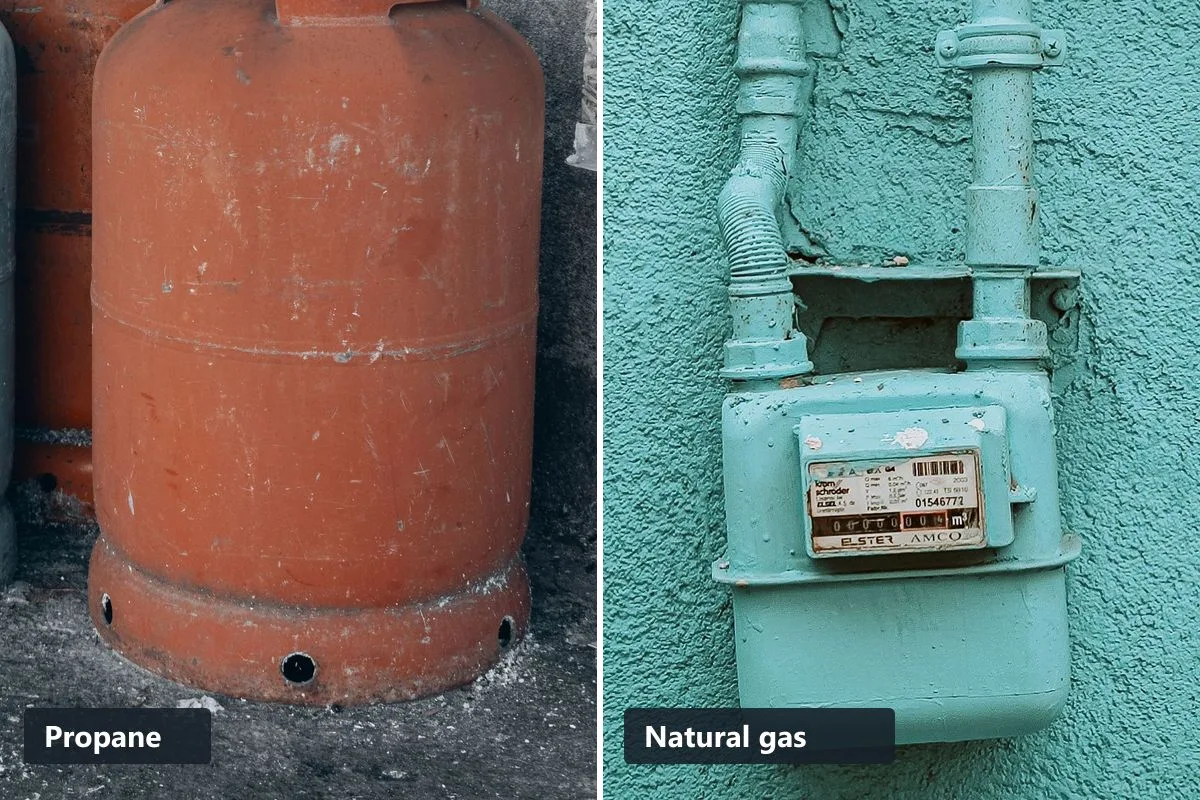
Propane and natural gas heat a home the same way: a furnace or boiler burns the fuel. The difference is the bill. Natural gas comes through a pipe and is billed by the cubic foot or the therm. Propane sits in a tank at the house that a supplier fills, and is billed by the gallon. With different units on the two bills, the prices cannot be compared at a glance. The EIA says most propane consumed in the U.S. is used as a fuel, generally where natural gas supply is limited or not available, and its winter forecast counts 61.0 million U.S. households that heat mainly with natural gas and 6.4 million that heat mainly with propane.
This guide puts both fuels on the same footing, heat measured in Btu, then prices a typical winter for each, checks whether a more efficient furnace changes the answer, and compares the two in 33 states. The gas prices and heating use come from the same EIA data behind my monthly furnace cost guide.
Is propane or natural gas cheaper to heat a home?
Natural gas, by a wide margin. A Btu (British thermal unit) is the common unit of heat. The EIA puts a gallon of propane at 91,452 Btu and a thousand cubic feet (Mcf) of natural gas at about 1,037,000 Btu, so dividing each price by its heat content gives the price of the same energy. For the winter of 2026-27 the EIA forecasts $13.44 per Mcf for natural gas and $2.52 per gallon for propane.
| Measure | Natural gas | Propane | Propane ÷ gas |
|---|---|---|---|
| Forecast price | $13.44 per Mcf | $2.52 per gallon | — |
| Heat in one unit | 1,037,000 Btu per Mcf | 91,452 Btu per gallon | — |
| Price per therm of fuel | $1.30 | $2.76 | 2.1× |
| Price per million Btu | $12.96 | $27.56 | 2.1× |
| Cost of the heat in 1 Mcf of gas | $13.44 | $28.58 (11.3 gallons) | 2.1× |
The same heat from natural gas and propane, at the EIA's winter 2026-27 forecast for the U.S. average. A therm is 100,000 Btu.
Per therm, propane costs $2.76 against $1.30 for gas, which is 2.1 times as much. To match natural gas at those forecast prices, propane would have to sell for about $1.19 a gallon. The EIA's own winter outlook shows the same split in the household bills: $640 for the average gas household and $1,246 for the average propane household, which I come back to below.
How much does it cost to heat a house with propane versus natural gas?
The EIA's 2020 Residential Energy Consumption Survey (RECS) measured how much fuel homes burn for space heating. The average home that heats with natural gas burned 44.9 million Btu of gas, 60.8 in the Very Cold and Cold zones and 19.0 in the Mixed-dry and Hot-dry zones. At the forecast price, 44.9 million Btu of gas costs $582 over a winter. The same energy as propane is 491 gallons, which costs $1,237, or $655 more. The table repeats the sum for each climate zone.
| Climate zone | Fuel burned for heat | Natural gas | Propane (gallons) | Propane | Extra for propane |
|---|---|---|---|---|---|
| U.S. average | 44.9 million Btu | $582 | 491 | $1,237 | $655 |
| Very cold and Cold | 60.8 million Btu | $788 | 665 | $1,676 | $887 |
| Mixed-humid | 44.0 million Btu | $570 | 481 | $1,213 | $642 |
| Marine | 30.2 million Btu | $391 | 330 | $832 | $441 |
| Hot-humid | 20.8 million Btu | $270 | 227 | $573 | $304 |
| Mixed-dry and Hot-dry | 19.0 million Btu | $246 | 208 | $524 | $277 |
What the heating fuel of the average home that heats with natural gas costs for one winter, bought as natural gas or as propane for the same heat. Prices are the EIA's forecast for winter 2026-27 ($13.44 per Mcf, $2.52 per gallon). Fuel burned is from the EIA's 2020 household survey.
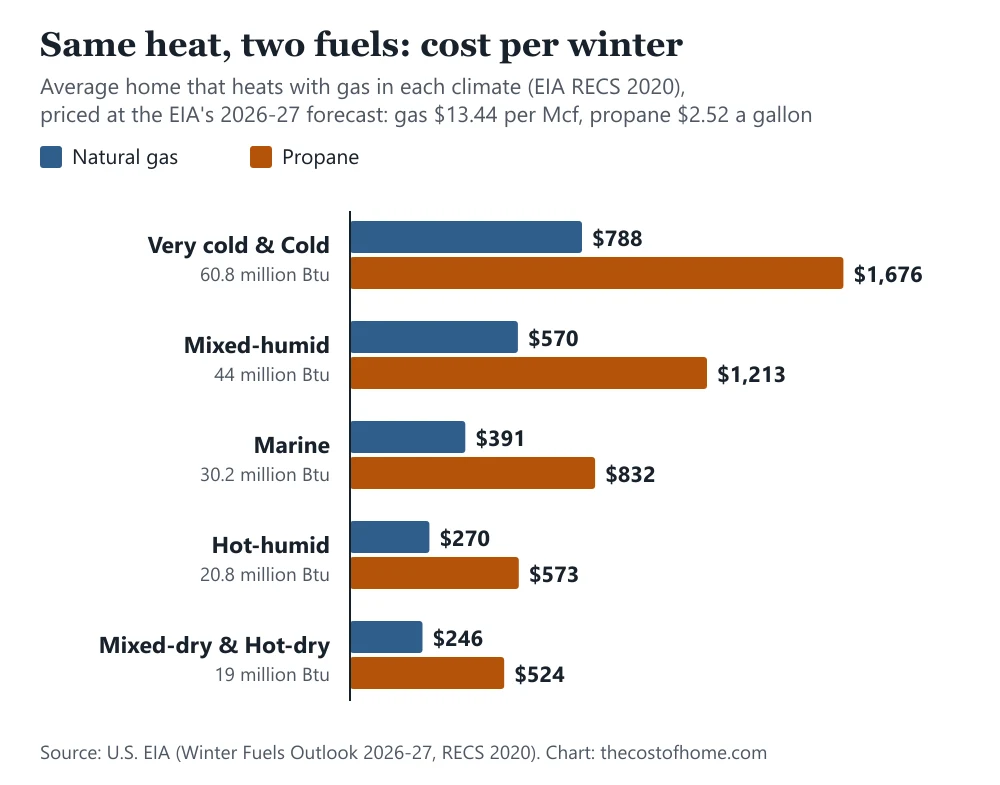
The colder the climate, the bigger the dollar gap, because the price ratio stays the same while the fuel burned grows. In the Very Cold and Cold zones, propane adds $887 a winter. In the Mixed-dry and Hot-dry zones it adds $277.
The EIA's winter outlook gives a second check with real households. For 2026-27 it expects the average natural gas household to use 47.6 Mcf and pay $640, and the average propane household to use 494 gallons and pay $1,246, down from $1,287 last winter. Those are different homes, and the propane average covers the Northeast, Midwest and South only, so the $606 gap is not a same-heat figure. It lands close to the $655 in the table, which is a good sign for the method. I wrote about the same outlook in my winter heating costs guide.
Does a high-efficiency furnace close the gap?
No. The Department of Energy says most furnaces are fueled by natural gas and others by electricity, oil or propane, and it rates furnaces and boilers by annual fuel utilization efficiency, or AFUE: the share of the fuel's energy that ends up as heat in the house. ENERGY STAR defines a residential furnace as one that burns natural gas, propane or oil, and its certified gas furnaces must reach 95% AFUE in the South and 97% in the North. A better furnace saves the same share of either fuel, so it cannot close a gap of more than two to one.
| Furnace efficiency (AFUE) | Gas per 100,000 Btu | Propane per 100,000 Btu | Gas per winter | Propane per winter |
|---|---|---|---|---|
| 80% | $1.62 | $3.44 | $648 | $1,378 |
| 90% | $1.44 | $3.06 | $576 | $1,225 |
| 96% | $1.35 | $2.87 | $540 | $1,148 |
Cost of heating a home that needs 40 million Btu of heat in a winter, by furnace efficiency (AFUE), at the EIA's forecast prices for 2026-27. The 40 million Btu is an example, not a survey figure. The cost per 100,000 Btu is of heat delivered: the fuel price divided by the efficiency.
A 96% propane furnace costs $1,148 a winter in this example, $500 more than an 80% gas furnace at $648. The fuel matters more than the furnace. Upgrading still pays inside each fuel: going from 80% to 96% saves $230 a winter on propane and $108 on gas in the example.
How do propane and natural gas compare in each state?
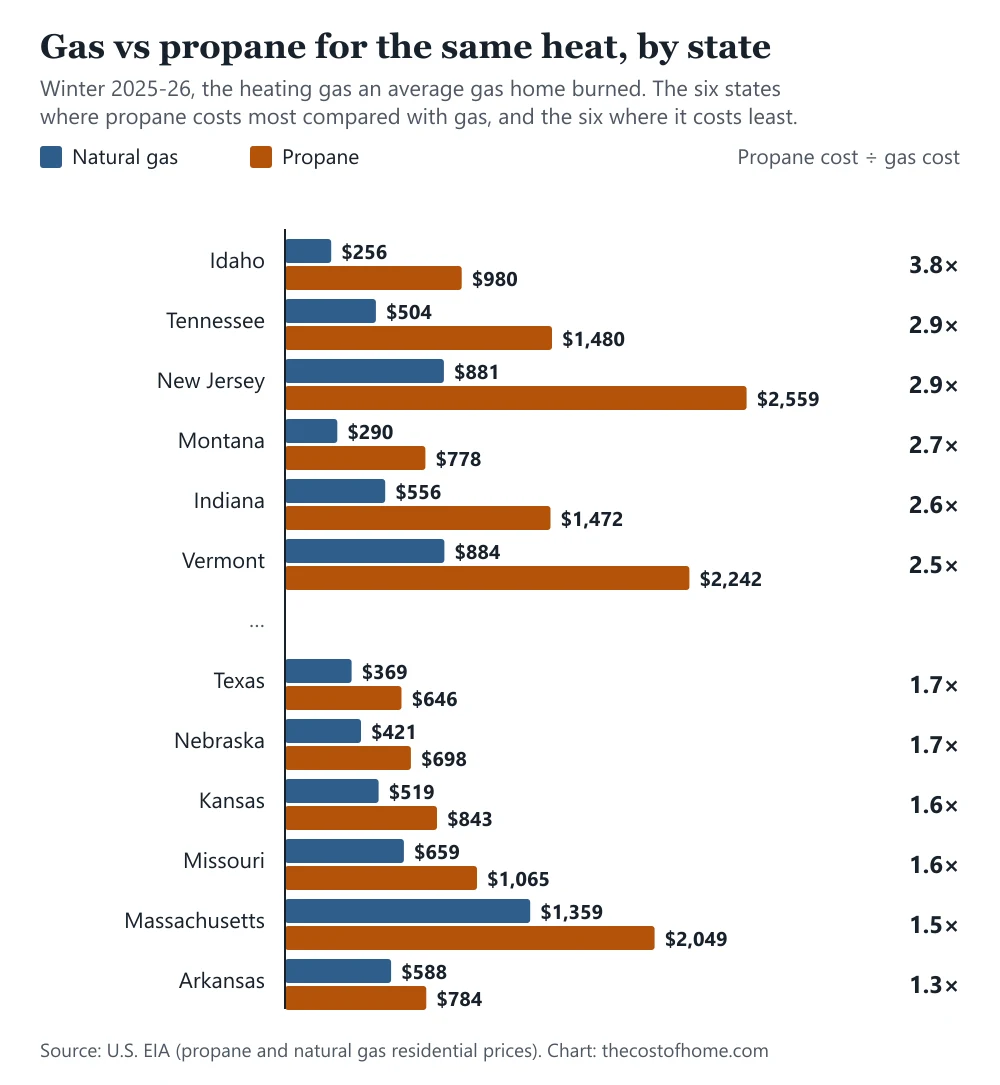
The size of the gap changes from state to state. The EIA publishes a weekly residential propane price for 38 states during the heating season. For 33 of them I also had a complete winter of gas prices, so I took the gas the average gas home in each state burned for heat from November 2025 to March 2026 and priced the same energy as propane, month by month, at that state's propane price. The table shows the result.
| State | Gas per therm | Propane per gallon | Propane per therm | Winter on gas | Same heat on propane | Propane costs |
|---|---|---|---|---|---|---|
| U.S. average | $1.41 | $2.573 | $2.81 | $582 | $1,162 | 2.0× |
| Alabama | $1.63 | $3.463 | $3.79 | $411 | $955 | 2.3× |
| Arkansas | $1.97 | $2.395 | $2.62 | $588 | $784 | 1.3× |
| Colorado | $1.04 | $2.241 | $2.45 | $343 | $808 | 2.4× |
| Connecticut | $1.68 | $3.842 | $4.20 | $1,064 | $2,654 | 2.5× |
| Delaware | $1.62 | $3.606 | $3.94 | $848 | $2,069 | 2.4× |
| Georgia | $1.57 | $3.100 | $3.39 | $582 | $1,253 | 2.2× |
| Idaho | $0.68 | $2.375 | $2.60 | $256 | $980 | 3.8× |
| Illinois | $1.00 | $1.933 | $2.11 | $669 | $1,413 | 2.1× |
| Indiana | $1.04 | $2.516 | $2.75 | $556 | $1,472 | 2.6× |
| Iowa | $0.98 | $1.603 | $1.75 | $440 | $789 | 1.8× |
| Kansas | $1.30 | $1.925 | $2.10 | $519 | $843 | 1.6× |
| Kentucky | $1.33 | $2.686 | $2.94 | $602 | $1,329 | 2.2× |
| Massachusetts | $2.47 | $3.410 | $3.73 | $1,359 | $2,049 | 1.5× |
| Michigan | $1.02 | $2.275 | $2.49 | $691 | $1,687 | 2.4× |
| Minnesota | $1.05 | $1.979 | $2.16 | $604 | $1,245 | 2.1× |
| Mississippi | $1.41 | $3.032 | $3.32 | $435 | $1,025 | 2.4× |
| Missouri | $1.43 | $2.117 | $2.31 | $659 | $1,065 | 1.6× |
| Montana | $0.84 | $2.065 | $2.26 | $290 | $778 | 2.7× |
| Nebraska | $1.06 | $1.610 | $1.76 | $421 | $698 | 1.7× |
| New Hampshire | $1.86 | $3.597 | $3.93 | $939 | $1,989 | 2.1× |
| New Jersey | $1.37 | $3.646 | $3.99 | $881 | $2,559 | 2.9× |
| New York | $1.62 | $3.549 | $3.88 | $1,114 | $2,669 | 2.4× |
| North Dakota | $0.84 | $1.661 | $1.82 | $453 | $981 | 2.2× |
| Ohio | $1.17 | $2.584 | $2.83 | $719 | $1,737 | 2.4× |
| Pennsylvania | $1.41 | $2.947 | $3.22 | $900 | $2,054 | 2.3× |
| Rhode Island | $2.01 | $3.632 | $3.97 | $1,073 | $2,124 | 2.0× |
| South Dakota | $0.95 | $1.824 | $1.99 | $391 | $821 | 2.1× |
| Tennessee | $1.18 | $3.167 | $3.46 | $504 | $1,480 | 2.9× |
| Texas | $1.84 | $2.938 | $3.21 | $369 | $646 | 1.7× |
| Utah | $1.05 | $2.296 | $2.51 | $335 | $801 | 2.4× |
| Vermont | $1.60 | $3.713 | $4.06 | $884 | $2,242 | 2.5× |
| Virginia | $1.59 | $3.461 | $3.78 | $788 | $1,878 | 2.4× |
| Wisconsin | $1.11 | $1.946 | $2.13 | $575 | $1,102 | 1.9× |
Propane and natural gas for the same heat, in the 33 states where the EIA publishes a residential propane price and I had a complete winter of gas prices. Winter 2025-26 (November to March). The "winter on gas" column is what the average gas home in the state paid for the gas it burned for heat; "same heat on propane" prices that energy as propane at each month's state price. Prices are weighted by the months the gas was burned.
Propane cost more than gas for the same heat in all 33 states. The ratio runs from 1.3× in Arkansas ($588 on gas against $784 on propane) to 3.8× in Idaho ($256 against $980). The U.S. figure is 2.0×: $582 on gas against $1,162 on propane. The cheapest gas in the table is Idaho's, at $7.04 per Mcf, which is part of why that gap is the widest. In dollars the gap is smallest in Arkansas at $195 and largest in New Jersey at $1,678, followed by Connecticut ($1,590) and New York ($1,556).
Propane itself is cheapest in the Midwest and the Rocky Mountain states and dearest in the Northeast and Florida. Last winter the EIA's weekly survey averaged $2.095 a gallon in the Midwest and $2.212 in the Rocky Mountain states, against $3.455 on the East Coast and $3.583 in New England; Florida averaged $4.693. The national price is moving up this fall: $2.730 a gallon on October 26, 2026, from $2.586 on October 5 and 12.2% above the $2.434 of a year earlier. The EIA collects these prices weekly only from October to March, and they exclude taxes, so your delivered price can differ.
How much propane does a house use in a winter?
The EIA expects the average propane household to use 494 gallons in the winter of 2026-27, with large regional differences: the Midwest burns the most and the South the least, about 641 and 365 gallons. Fixr's cost guide says a 500-gallon tank is the minimum size needed to heat most homes, and that tanks are usually filled to 70% to 80% of capacity, so a 500-gallon tank holds roughly 350 to 400 gallons per fill. An average propane home would use more than one fill of such a tank over a winter, and a Midwest home close to two. As a conversion, the heat in 1 Mcf of natural gas equals 11.3 gallons of propane.
Is it worth switching from propane to natural gas?
If a gas main runs past your house, the numbers favor it. At the $655 national gap in the climate table above, every $1,000 of connection cost pays back in about 1.5 years. The gap is the national average, so check your state's row: it was $195 in Arkansas and $1,678 in New Jersey.
Fixr's cost guide breaks a new gas connection into pieces. Running the service line from the main to the house costs $0 to $1,100 (about $850 to $1,100 for an extra 50 feet, installed by the utility, and free, per Fixr, if the meter is 100 feet or less from the street). Hooking up to the main is $0 to $300, and the meter $0 to $425. Piping inside the house for a furnace averages around $800 for a 25-foot line, with a range of $500 to $2,000, and it can reach $5,000 if the service line has to be extended by several hundred feet and a new interior line is needed. At $2,000 the switch would pay back in about 3 years on the national gap, and at $5,000 in about 8. Those figures leave out any work on the furnace or other appliances, so I would ask the gas utility whether service is available at the address and what it charges, and then a contractor what your furnace needs.
If you are choosing for a new house, propane adds a tank. Fixr puts tank installation at $1,500 to $3,750, with an average near $2,500, and says most suppliers rent or lease the tank at no cost or a low rate. Gas has no tank to buy, but it needs the pipe.
My take: where I can get gas, I would price the hookup before replacing anything else in a propane house, because the fuel gap is larger than anything a furnace upgrade recovers. Where I cannot get gas, I would look at the other option the DOE names for houses with central propane or oil, the heat pump. My heat pump cost guide prices one, and heat pump vs gas furnace compares the running cost against gas. For the gas side of the bill, see the average natural gas bill by state.
How was this calculated?
Prices for the winter of 2026-27 come from the EIA's Winter Fuels Outlook of October 6, 2026, table WF01: $13.44 per Mcf for natural gas and $2.52 per gallon for propane. The EIA's propane figure is a household-weighted average of the Northeast, Midwest and South. Heat content is the EIA's: 91,452 Btu per gallon of propane, 1,037 Btu per cubic foot of natural gas (its 2025 figure), and 100,000 Btu per therm. All comparisons assume the same furnace efficiency for both fuels, so efficiency drops out of the ratio.
Fuel burned for heat is from the EIA's 2020 RECS, table CE4.6: the average home that uses natural gas for space heating burned 44.9 million Btu of it, with the climate-zone averages shown in the table. The survey is from 2020, so newer homes and furnaces may burn less. The AFUE table uses a round 40 million Btu of delivered heat as an example.
The state table uses the EIA's weekly residential propane price, in dollars per gallon excluding taxes, for the weeks of November 2025 to March 2026 (the monthly figure is the average of that month's weeks), and the EIA's monthly residential natural gas price for the same months. For each state I took the gas the average gas customer burned above the summer base each month, the same method as in the furnace cost guide, and priced that same energy as propane at 91,452 Btu per gallon. I left out 5 states with a propane price but an incomplete gas series (ME, MD, FL, NC, OK), and the states and D.C. where the EIA publishes no propane price. The propane homes in each state are not the gas homes: this is the cost of the same heat, not what propane households pay. Connection costs are Fixr's published ranges, accessed November 1, 2026, and are estimates. My sources and method are set out in how I research costs; for more on heating and cooling, see Heating & Cooling.
Frequently asked questions
Is propane more expensive than natural gas?
Yes. For the same heat, propane costs about 2.1 times as much as natural gas at the EIA's forecast prices for winter 2026-27: $2.76 against $1.30 per 100,000 Btu. In the 33 states I compared, the ratio ran from 1.3× in Arkansas to 3.8× in Idaho.
How many gallons of propane equal 1,000 cubic feet of natural gas?
About 11.3 gallons. A gallon of propane holds 91,452 Btu and 1,000 cubic feet of natural gas about 1,037,000 Btu, according to the EIA.
How much does it cost to heat a house with propane for a winter?
The EIA expects the average propane household to pay about $1,246 for the winter of 2026-27, using 494 gallons at $2.52. Priced as the same heat as the average gas home burns, propane costs about $1,237 against $582 for gas.
How many gallons of propane does it take to heat a house for a winter?
The EIA's average is 494 gallons for a propane household in 2026-27, from about 365 in the South to about 641 in the Midwest. A 500-gallon tank is usually filled to 70% to 80%, so it holds roughly 350 to 400 gallons per fill.
Is a propane furnace less efficient than a natural gas furnace?
No. Both are rated on the same AFUE scale, and ENERGY STAR defines a residential furnace as one that burns natural gas, propane or oil. The cost difference comes from the fuel price, not the furnace.
Where is propane closest in price to natural gas?
In the states I compared, Arkansas (propane 1.3× the gas cost), Massachusetts (1.5×) and Missouri (1.6×). It is furthest in Idaho (3.8×).
How much does it cost to connect a house to natural gas?
Fixr lists $0 to $1,100 for the service line from the main, $0 to $300 to hook up to the main, $0 to $425 for the meter, and about $500 to $2,000 for piping to a furnace. Ask your gas utility what it charges at your address.
How many U.S. homes heat with propane?
The EIA's winter outlook counts about 6.4 million U.S. households that heat mainly with propane in 2026-27, against 61.0 million that heat mainly with natural gas.
Sources
- U.S. Energy Information Administration, Weekly Heating Oil and Propane Prices: residential propane by state and region, dollars per gallon excluding taxes (weeks from October 2025 to October 26, 2026; release of October 28, 2026; accessed November 1, 2026)
- U.S. Energy Information Administration, Heating Oil and Propane Update: weekly prices are collected from October through March (accessed November 1, 2026)
- U.S. Energy Information Administration, Winter Fuels Outlook 2026-27, published October 6, 2026 (accessed October 18, 2026)
- U.S. Energy Information Administration, Table WF01: seasonal household consumption, prices and expenditures by heating fuel, and households by primary heating fuel, winter 2026-27 forecast (accessed October 18, 2026)
- U.S. Energy Information Administration, Natural Gas Prices: average residential price by state, monthly (accessed October 17, 2026)
- U.S. Energy Information Administration, Natural Gas Consumption by End Use: residential volumes by state, monthly (data for July 2025 to March 2026, accessed October 17, 2026)
- U.S. Energy Information Administration, Number of Natural Gas Consumers: residential customers by state, annual (2024; accessed October 17, 2026)
- U.S. Energy Information Administration, 2020 Residential Energy Consumption Survey, table CE4.6: household end-use consumption by fuel, averages, including climate regions (accessed October 22, 2026)
- U.S. Energy Information Administration, British thermal units (Btu): 1 therm = 100,000 Btu; propane 91,452 Btu per gallon (accessed October 22, 2026)
- U.S. Energy Information Administration, "How do I convert natural gas prices in dollars per cubic feet to dollars per British thermal unit or therm?" (1,037 Btu per cubic foot in 2025)
- U.S. Energy Information Administration, Uses of hydrocarbon gas liquids: propane used as a fuel where natural gas is limited or not available (accessed November 1, 2026)
- U.S. Department of Energy, Tips on Saving Money and Energy in Your Home (2022 edition; furnaces, boilers, AFUE, heat pumps for homes with propane; accessed October 22, 2026)
- ENERGY STAR, Furnaces key product criteria: residential furnace definition (natural gas, propane or oil) and AFUE requirements of 95% South and 97% North for gas furnaces (accessed November 1, 2026)
- Fixr, Propane Tank Installation Cost: tank sizes, installation range, leasing and fill levels (accessed November 1, 2026)
- Fixr, Gas Line Installation Cost: service line, main hookup, meter and furnace line ranges (accessed November 1, 2026)

Founder and editor, The Cost of Home
I write and check every guide on this site myself, working from public data. The sources behind each number are listed at the end of the article, so you can check them too.