Home Repairs & Appliances
How Much Does a New Furnace Cost in 2026?
Quick answer
A new gas furnace costs about $4,250 to $4,950 installed in 2026, from a standard 80% model to the most efficient ones, by U.S. government averages. An electric furnace averages about $1,700 and an oil furnace $4,000 to $11,650. A published contractor guide puts the typical job near $4,800, with most between $2,800 and $6,900, so a real quote can land above or below these averages.
On this page
- How much does a new furnace cost installed?
- Why does a high-efficiency furnace cost more?
- What makes a furnace replacement cost more or less?
- Is a high-efficiency furnace worth the extra cost?
- How long does a 95% furnace take to pay back in your state?
- Are there tax credits or new rules for furnaces?
- What is not included in these furnace prices?
- FAQ
- Sources
A furnace quote is mostly labor and parts around the unit itself. The price also moves with the fuel it burns and with how much of that fuel it turns into heat. This guide lays out what a new furnace costs installed, why a high-efficiency model costs more, and how many years the extra price takes to come back in gas savings in each state.
The installed prices come from the U.S. Energy Information Administration (EIA), which publishes the Department of Energy's (DOE) cost data for furnaces in 2022 dollars. I added 15% for consumer price inflation since 2022 (my estimate, from the Bureau of Labor Statistics), so the 2026 column is a starting point. A national average blends cheap and expensive markets, so your quote may be higher or lower. For a second reference I used HomeAdvisor's 2026 cost guide, which is built from what homeowners reported paying contractors.
How much does a new furnace cost installed?
A gas furnace averages about $4,250 installed for a standard 80% model and about $4,800 for a 95% high-efficiency model, in 2026 dollars. The most efficient gas models (98-99% AFUE) average about $4,950. An electric furnace is the cheapest to buy at about $1,700, and an oil furnace is the most expensive, from $4,000 for a standard model to $11,650 at the top of the range for a 97% model.
| Furnace type | Efficiency | Unit | As published | 2026 estimate |
|---|---|---|---|---|
| Electric | 98-100% | $1,100 | $1,480 | $1,700 |
| Gas, standard | 80% | $1,250 | $3,690 | $4,250 |
| Gas, mid-efficiency | 90% | $1,400 | $4,130 | $4,750 |
| Gas, high-efficiency | 95% | $1,400 | $4,150 | $4,800 |
| Gas, most efficient | 98-99% | $1,600 | $4,320 | $4,950 |
| Oil, standard | 85% | $3,050 to $4,000 | $3,480 to $6,820 | $4,000 to $7,850 |
| Oil, most efficient | 97% | $3,650 to $4,700 | $5,140 to $10,110 | $5,900 to $11,650 |
Average cost to replace a furnace, installed, by type. "Unit" is the retail price of the furnace; installation covers labor, materials and the contractor's margin. "As published" is EIA's figure in 2022 dollars; "2026 estimate" adds 15% for consumer price inflation (BLS CPI-U) and rounds to the nearest $50. Gas furnaces are 80,000 Btu/h, oil 105,000 and electric 68,000. EIA gives a low and a high value for oil furnaces. Source: U.S. EIA, 2023.
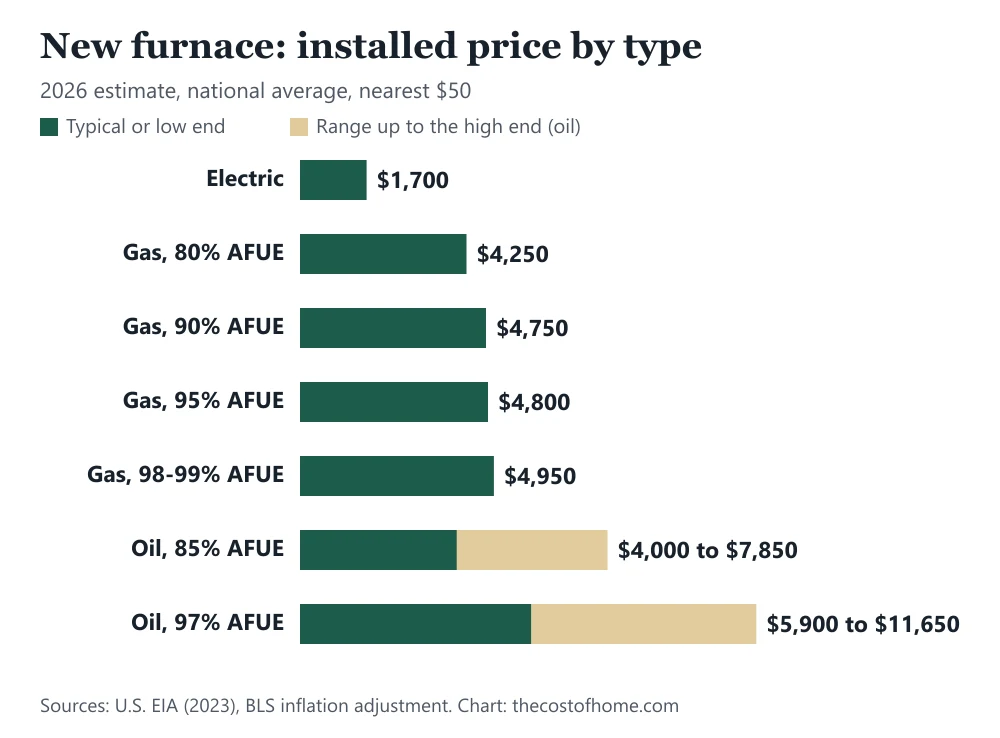
The unit is the smaller part of the bill. For a standard gas furnace, EIA's retail price of the unit is about $1,250 of the $4,250 total, so roughly 71% goes to installation. That covers the contractor's labor, the venting and gas connections, and the contractor's margin.
HomeAdvisor's guide, updated in June 2026, reports a normal range of $2,823 to $6,897 for a furnace replacement, with an average of about $4,813 across all fuels. By fuel it gives $3,800 to $10,000 for gas (up to $12,000 in some cases), $2,000 to $7,000 for electric and $6,750 to $10,000 for oil. EIA's averages sit toward the low end of those ranges, so I would treat the table as the floor of a realistic budget and not the likely quote.
Why does a high-efficiency furnace cost more?
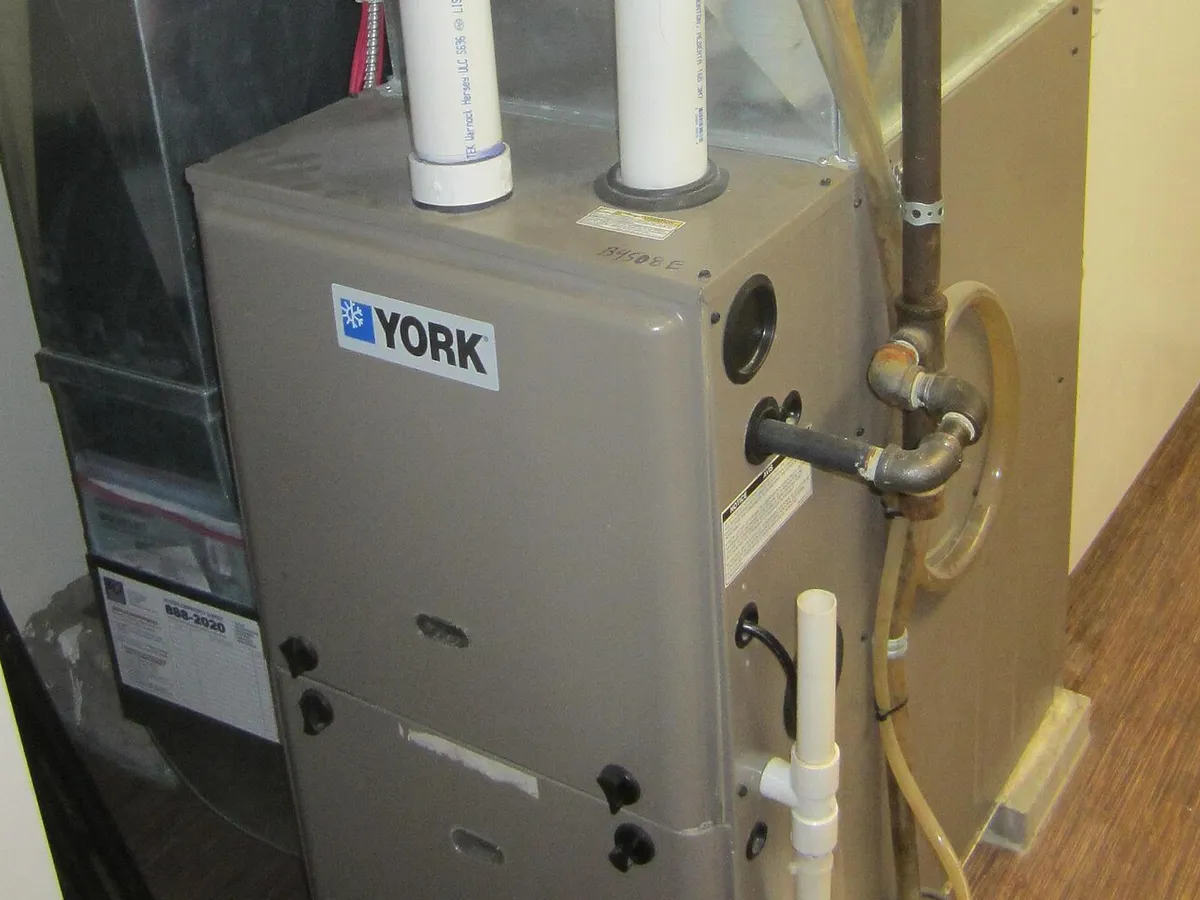
A furnace can only reach about 82% AFUE if its exhaust stays hot enough not to condense. EIA notes that above that level the exhaust condenses, and the liquid is corrosive. A condensing furnace is built for that: it has a stainless steel heat exchanger, and the cooled exhaust can leave through plastic pipe, as in the photo at the top of this page. Many models are sealed-combustion units that pull air from outdoors through a second pipe, and depending on the house they may need a condensate pump or an acid neutralizer. The photo shows both pipes and the pump.
That extra equipment is why a 95% furnace costs more than an 80% one. In EIA's table the unit costs about $150 more at retail, and the installed price is about $530 higher ($4,800 against $4,250). Installers' quotes for the same upgrade can show a wider gap, especially when the old flue has to be replaced or a drain has to be run, so I give the payback for several gaps below.
The efficiency tiers are not priced evenly. The jump from 80% to 90% adds about $500, from 90% to 95% only about $50, and from 95% to the most efficient models about $150. ENERGY STAR sets its bar at 95% AFUE for gas furnaces in the South and 97% in the North, and at 87% for oil.
What makes a furnace replacement cost more or less?
- Fuel. Gas furnaces sit in the middle of the range, electric furnaces are the cheapest to buy and install in EIA's table, and oil furnaces cost the most. Electric furnaces are also the most expensive to run, and I price each fuel by state and furnace size in how much a furnace costs to run per month.
- Efficiency. Each step up in AFUE adds to the price, as the table shows, and the largest step is the move to a condensing model.
- Size. A bigger house needs a bigger furnace. HomeAdvisor says residential furnaces typically run from 40,000 to 120,000 Btu/h.
- Venting and gas connections. Swapping a standard furnace for a condensing one often means new plastic vent pipes and a condensate drain, and it is a common reason quotes differ from house to house.
- Removing the old furnace. HomeAdvisor puts removal and disposal at up to about $330, depending on access and local dump fees.
- Where you live. Labor rates and permit rules differ from city to city, which is why a national average only gets you close.
Is a high-efficiency furnace worth the extra cost?
For an average home that heats with gas and replaces an 80% furnace, a 95% model saves about $92 a year in gas, which is 16% of an average winter heating bill of $582. Against the $530 price gap in EIA's table, that pays back in about 5.8 years. EIA puts the average life of a gas furnace at 22.5 years in the North and 21.5 years in the rest of the country, with a typical range of 17 to 26 years, so the payback falls well inside the furnace's life.
The payback depends on the size of your gas bill and on the gap in your quote. The table below runs the numbers for three winter bills and four price gaps, so you can find your own case.
| Extra price | $600 bill | $1,000 bill | $1,500 bill |
|---|---|---|---|
| $530 (EIA) | 5.6 yrs | 3.4 yrs | 2.2 yrs |
| $1,000 | 10.6 yrs | 6.3 yrs | 4.2 yrs |
| $1,500 | 15.8 yrs | 9.5 yrs | 6.3 yrs |
| $2,000 | 21.1 yrs | 12.7 yrs | 8.4 yrs |
Years to earn back the extra price of a 95% furnace over an 80% one, by the winter gas bill for heating. The 95% furnace burns 16% less gas for the same heat (1 - 80/95). $530 is the price gap in EIA's table in 2026 dollars; the other rows show what a bigger gap in a quote does to the payback. The U.S. average winter bill is $582.
A home with a $1,500 winter bill earns back even a $2,000 premium in about 8.4 years. A home with a $600 bill needs about 15.8 years to earn back a $1,500 premium, which is near the low end of a furnace's life. The same upgrade can be a clear win in one house and break even in another.
How long does a 95% furnace take to pay back in your state?
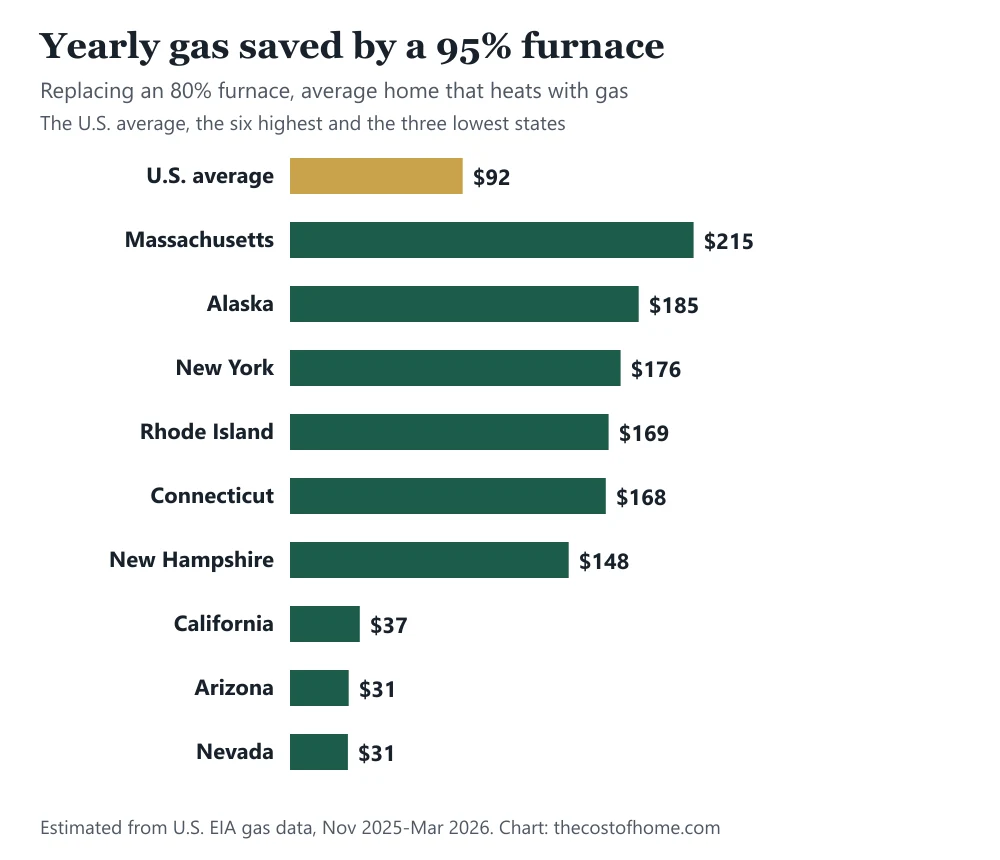
The payback is under 5 years in 15 of the 41 places in the table and over 10 years in 6. It is shortest where winters are cold and gas is expensive: Massachusetts, Alaska and New York at 2.5 to 3.0 years. It is longest in mild states such as California, Arizona and Nevada, where the furnace barely runs and the yearly saving is $31 to $37.
| State | Winter bill | Saving a year | Payback |
|---|---|---|---|
| U.S. average | $582 | $92 | 5.8 yrs |
| Alabama | $411 | $65 | 8.2 yrs |
| Alaska | $1,175 | $185 | 2.9 yrs |
| Arizona | $198 | $31 | 17.0 yrs |
| Arkansas | $588 | $93 | 5.7 yrs |
| California | $235 | $37 | 14.3 yrs |
| Colorado | $343 | $54 | 9.8 yrs |
| Connecticut | $1,064 | $168 | 3.2 yrs |
| Delaware | $848 | $134 | 4.0 yrs |
| District of Columbia | $835 | $132 | 4.0 yrs |
| Georgia | $583 | $92 | 5.8 yrs |
| Idaho | $256 | $40 | 13.1 yrs |
| Illinois | $669 | $106 | 5.0 yrs |
| Indiana | $556 | $88 | 6.0 yrs |
| Iowa | $440 | $69 | 7.6 yrs |
| Kansas | $519 | $82 | 6.5 yrs |
| Kentucky | $602 | $95 | 5.6 yrs |
| Massachusetts | $1,360 | $215 | 2.5 yrs |
| Michigan | $691 | $109 | 4.9 yrs |
| Minnesota | $604 | $95 | 5.6 yrs |
| Mississippi | $435 | $69 | 7.7 yrs |
| Missouri | $660 | $104 | 5.1 yrs |
| Montana | $290 | $46 | 11.6 yrs |
| Nebraska | $421 | $67 | 8.0 yrs |
| Nevada | $195 | $31 | 17.2 yrs |
| New Hampshire | $939 | $148 | 3.6 yrs |
| New Jersey | $881 | $139 | 3.8 yrs |
| New York | $1,114 | $176 | 3.0 yrs |
| North Dakota | $453 | $72 | 7.4 yrs |
| Ohio | $719 | $113 | 4.7 yrs |
| Oregon | $466 | $74 | 7.2 yrs |
| Pennsylvania | $900 | $142 | 3.7 yrs |
| Rhode Island | $1,073 | $169 | 3.1 yrs |
| South Dakota | $391 | $62 | 8.6 yrs |
| Tennessee | $504 | $80 | 6.7 yrs |
| Texas | $369 | $58 | 9.1 yrs |
| Utah | $335 | $53 | 10.0 yrs |
| Vermont | $883 | $139 | 3.8 yrs |
| Virginia | $788 | $124 | 4.3 yrs |
| West Virginia | $705 | $111 | 4.8 yrs |
| Wisconsin | $575 | $91 | 5.8 yrs |
| Wyoming | $445 | $70 | 7.5 yrs |
Estimated gas saved in a year by replacing an 80% furnace with a 95% one, in a home that heats with gas, by state. The winter bill is the gas the average home burns for heating from November 2025 to March 2026, at that state's monthly prices (EIA). Saving is the bill times 16%. Payback is the $530 price gap divided by the yearly saving. 40 states and Washington, D.C.
The winter bill in this table covers November to March, so it leaves out some heating in October and April, and the true saving is a little higher. The bill is for the gas the average home actually burned. I explain how I built it in my furnace cost guide, and the average natural gas bill by state shows what a whole year of gas costs where you live.
My read is that a high-efficiency furnace is an easy yes in the cold Northeast and the northern Midwest, where the saving is large and the payback is short. In the warm South and the West Coast I would let the quote decide, because a small saving can be cancelled by an expensive vent job.
Are there tax credits or new rules for furnaces?
The federal tax credit has ended. The Energy Efficient Home Improvement Credit covered qualifying natural gas, propane and oil furnaces, with a limit of $600 per item, but only for improvements made through December 31, 2025, according to the IRS. Many utilities and states still pay rebates on high-efficiency furnaces, so I would check the ENERGY STAR Rebate Finder by ZIP code before signing a quote.
A 95% standard is coming, and its date may move. DOE's final rule of December 18, 2023 sets a minimum of 95% AFUE for new non-weatherized gas furnaces and mobile home gas furnaces, with compliance required from December 18, 2028. In April 2026 DOE asked for public comment on a petition from the American Gas Association and two other gas groups to push that date back to January 1, 2030 at the earliest. Comments closed on May 27, 2026, and I found no decision by the time of writing. If the rule stands, the 80% furnace in the table will leave the market for new sales and the 95% model becomes the standard price.
What is not included in these furnace prices?
- Ductwork and extras. EIA's averages are for the furnace and its installation. Repairing or sealing ducts, a new thermostat or a new air conditioning coil would add to the bill.
- Maintenance. EIA assumes about $140 a year for an 80% gas furnace and $150 for a high-efficiency one, in 2026 dollars. HomeAdvisor puts an annual tune-up at $100 to $300.
- Gas prices change. The savings use last winter's prices. A colder winter or a higher gas price shortens the payback, and a milder one stretches it.
- Propane and oil. Homes on propane or oil pay more for fuel, which makes the efficiency gain worth more. My comparison of propane vs natural gas heating cost shows how far apart the two fuels are.
- Other ways to heat. A heat pump can replace a furnace and an air conditioner in one unit. I compare the running costs in heat pump vs gas furnace cost and the price of the equipment in the heat pump cost guide.
When a furnace is more than 15 years old, HomeAdvisor lists rising energy bills, uneven heating and frequent cycling among the signs that it is wearing out. I would get at least three quotes and ask each contractor to price both an 80% and a 95% model, since the gap between them is the number that decides the payback. The way I check each source is in how I research costs. For the bills the furnace will run up, see winter heating costs 2026-27. The other big replacement that keeps the house running is in my water heater replacement cost guide, and more guides are in the Home Repairs and Heating & Cooling sections.
Frequently asked questions
How much does it cost to replace a furnace?
About $4,250 to $4,950 for a gas furnace, $1,700 for an electric furnace and $4,000 to $11,650 for an oil furnace, all installed, in 2026 dollars (EIA's 2023 cost tables, adjusted by me for inflation). HomeAdvisor's 2026 guide reports a normal range of $2,823 to $6,897 and an average near $4,813.
How much does a new gas furnace cost?
About $4,250 installed for a standard 80% model, $4,800 for a 95% high-efficiency model and $4,950 for the most efficient 98-99% models, on EIA's national averages. HomeAdvisor reports $3,800 to $10,000 for gas, so a real quote often comes in higher than the averages.
Is a 95% AFUE furnace worth it?
Usually in cold states. Replacing an 80% furnace with a 95% one saves about $92 a year in gas for the average home that heats with gas, and the extra price of about $530 (EIA) pays back in about 5.8 years. The payback is under 5 years in 15 of 41 places and over 10 years in 6, mostly mild states.
How long does a furnace last?
EIA puts the average life of a gas furnace at 22.5 years in the North and 21.5 years in the rest of the country, with a typical range of 17 to 26 years. HomeAdvisor lists an age of more than 15 years as one sign that it may be time to replace one.
Is there a tax credit for a new furnace in 2026?
No federal credit. The Energy Efficient Home Improvement Credit covered qualifying gas, propane and oil furnaces, up to $600 per item, but only for improvements made through December 31, 2025. Some state and utility rebates are still on offer, and you can look them up by ZIP code in the ENERGY STAR Rebate Finder.
Will I have to buy a 95% efficiency furnace?
Not yet. DOE's rule requires new non-weatherized gas furnaces to be at least 95% AFUE from December 18, 2028. In April 2026 DOE asked for comment on a petition to move that date to January 1, 2030 at the earliest, and I found no decision as of November 3, 2026. Furnaces already installed do not have to be replaced.
How much does furnace maintenance cost?
EIA assumes about $140 a year for an 80% gas furnace and $150 for a high-efficiency one, in 2026 dollars. HomeAdvisor puts a professional tune-up at $100 to $300 a year.
Sources
- U.S. Energy Information Administration, "Updated Buildings Sector Appliance and Equipment Costs and Efficiencies" (March 2023): residential gas-fired, oil-fired and electric furnaces, installed cost in 2022 dollars, lifetimes, maintenance, condensing furnace notes (accessed November 3, 2026)
- HomeAdvisor, "How Much Does a Furnace Replacement Cost?" (updated June 17, 2026; accessed November 3, 2026)
- ENERGY STAR, Furnaces: key product criteria (95% AFUE South and 97% North for gas, 87% for oil; accessed November 3, 2026)
- U.S. Department of Energy, "Energy Conservation Program: Notification of Petition for Rulemaking," Federal Register, April 27, 2026 (consumer furnace standard of 95% AFUE, compliance date of December 18, 2028 under 88 FR 87502; comments due May 27, 2026; accessed November 3, 2026)
- Internal Revenue Service, Energy Efficient Home Improvement Credit (page last reviewed April 28, 2026; credit available for improvements made through December 31, 2025; accessed November 3, 2026)
- ENERGY STAR, Rebate Finder: rebates on certified equipment by ZIP code (accessed November 3, 2026)
- U.S. Bureau of Labor Statistics, Consumer Price Index for All Urban Consumers (CPI-U), U.S. city average, all items: 2022 annual average 292.655, September 2026 336.940 (accessed November 3, 2026)
- U.S. Energy Information Administration, Natural Gas Consumption by End Use: residential volumes by state, monthly (data for July 2025 to March 2026, accessed October 17, 2026)
- U.S. Energy Information Administration, Natural Gas Prices: average residential price by state, monthly (accessed October 17, 2026)
- U.S. Energy Information Administration, Number of Natural Gas Consumers: residential customers by state, annual (2024; accessed October 17, 2026)

Founder and editor, The Cost of Home
I write and check every guide on this site myself, working from public data. The sources behind each number are listed at the end of the article, so you can check them too.