Home Repairs & Appliances
How Much Does It Cost to Run a Clothes Dryer?
Quick answer
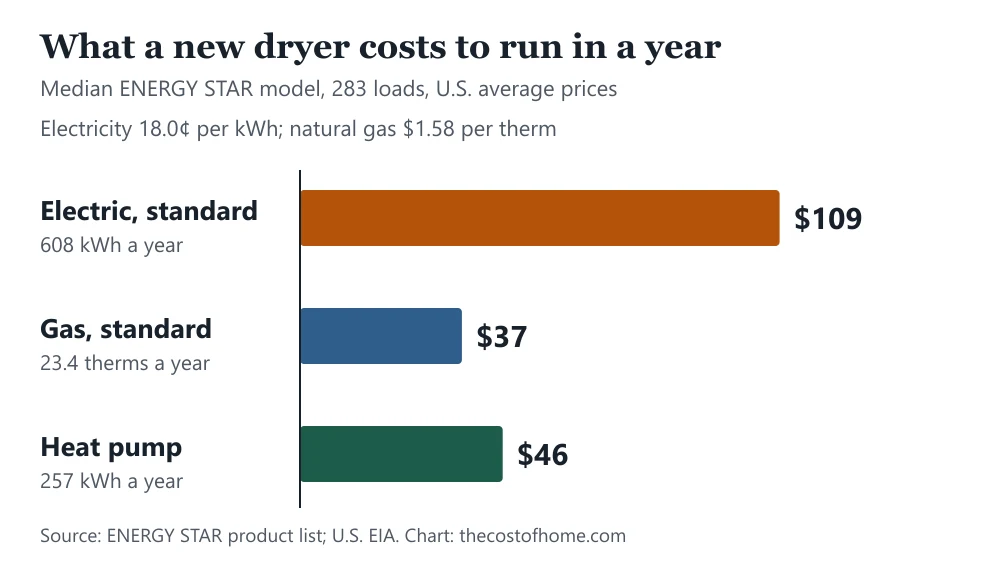
At the U.S. average of 18.0 cents per kWh, a new electric dryer costs about $109 a year to run, or 39 cents a load. A gas dryer comes to about $37 a year and a heat pump dryer to about $46. Homes in the EIA's survey averaged 680 kWh, or $122, since many use older machines. Your state decides most of it: an electric dryer runs $75 a year in North Dakota and $265 in Hawaii.
On this page
- How much does it cost to run a dryer per load, month and year?
- How much does the average home spend on a dryer?
- How does the number of loads change the cost?
- Is a gas dryer cheaper to run than an electric one?
- How much does a heat pump dryer save?
- How much does it cost to run a dryer in each state?
- Is it worth replacing a dryer to cut the bill?
- What habits cut the cost of drying clothes?
- How was this calculated?
- FAQ
- Sources
A dryer costs what its energy use costs. Multiply the energy one load takes by the number of loads you dry in a year and by what your utility charges, and you have the yearly cost. For an electric dryer the energy is in kilowatt-hours (kWh), for a gas dryer it is in therms (a therm is 100,000 Btu of natural gas), and both prices are on your bills. The U.S. Energy Information Administration (EIA) counts 102.3 million U.S. homes with a dryer: 82.2 million electric, 18.9 million gas and 1.2 million propane.
This guide prices the three kinds you can buy today, electric, gas and heat pump, per load, per month and per year, then shows what changes the number: how many loads you dry and where you live. The electricity prices are the EIA figures I also used for my state-by-state electric bill guide.
How much does it cost to run a dryer per load, month and year?
ENERGY STAR lists the yearly energy use of every certified dryer. I took the standard-size models on that list, grouped them by type, and used the median of each group. The yearly figure on the list assumes 283 loads a year, about 5.4 a week, which is the number the Department of Energy (DOE) uses in its dryer test. Each load in the test is an 8.45-pound batch of damp cloth.
| Type of dryer | Models on the list | Energy per year | Cost per load | Cost per month | Cost per year |
|---|---|---|---|---|---|
| Electric, standard vented | 342 | 608 kWh | $0.39 | $9.11 | $109 |
| Gas, standard vented | 184 | 23.4 therms | $0.13 | $3.08 | $37 |
| Heat pump, standard | 31 | 257 kWh | $0.16 | $3.85 | $46 |
What a new full-size dryer costs to run, by type: the median of the ENERGY STAR certified models on the list (October 31, 2026), at 283 loads a year. Electricity is 18.0 cents per kWh and natural gas $1.58 per therm, the 12-month U.S. averages (August 2025 to July 2026).
A typical new electric dryer uses 2.1 kWh a load, which is 39 cents at 18.0 cents per kWh, or $109 a year. The test cycle takes about 70 minutes, so the dryer works out to an average of 1.8 kWh an hour, about 33 cents an hour of running. A gas dryer burns 0.08 therms a load, 13 cents at the national gas price. A heat pump dryer uses 0.9 kWh a load, 16 cents.
How much does the average home spend on a dryer?
The EIA's 2020 Residential Energy Consumption Survey (RECS) measured what households really use, and it runs higher than the new-model figure. The average home with an electric dryer used 680 kWh a year on it, about 57 kWh a month. At 18.0 cents per kWh that is $122 a year, or $10.19 a month, $13 more than a new model on the ENERGY STAR list. Dryers account for about 4% of all the electricity U.S. homes use, according to the same survey.
Two things probably explain the gap: real loads can be bigger or wetter than the 8.45-pound test load, and many dryers are old. 29.6 million homes (29%) have a dryer that is 10 years old or more, and 11.9 million (12%) one that is 15 or more. Most homes dry little: 67.5 million of the 102.3 million homes with a dryer (66%) run 1 to 4 loads a week, 25.9 million (25%) run 5 to 9, and 7.0 million (7%) run 10 or more.
How does the number of loads change the cost?
Each load costs about the same, so the number of loads is the part you control. The table multiplies the per-load cost by the loads you dry in a week. Find your row, then read across to your type of dryer.
| Loads per week | Loads per year | Electric | Gas | Heat pump |
|---|---|---|---|---|
| 3 | 156 | $60 | $20 | $25 |
| 5 | 260 | $100 | $34 | $42 |
| 7 | 364 | $141 | $48 | $59 |
| 10 | 520 | $201 | $68 | $85 |
Yearly cost of a new dryer by how many loads you dry a week, at the 12-month U.S. average prices (18.0 cents per kWh, $1.58 per therm). The 283-load test figure is about 5.4 loads a week.
A household that dries 3 loads a week spends $60 a year with an electric dryer, and one that dries 10 spends $201. The same 7 loads cost $141 in an electric dryer and $48 in a gas one. These are new-model figures; a heavy load or an old machine moves you toward the $122 survey average.
Is a gas dryer cheaper to run than an electric one?
Yes, in every state in this guide. At U.S. average prices a gas dryer costs $37 a year against $109 for an electric one, $72 less. The gap is narrowest in Arkansas, where gas costs $51 and electric $82, and widest in California, $50 against $201. The DOE says the same in plainer words: gas dryers can cost less to operate, depending on local fuel costs, but may cost more at first, and they need venting and a dedicated gas line.
The gas figure is a floor. The ENERGY STAR list states a gas dryer's energy in kWh-equivalent, and I turned it into therms at 3,412 Btu per kWh and priced all of it as gas. The motor and controls also draw some electricity, which adds a little. My take: if your laundry room already has a gas hookup, a gas dryer is the cheaper one to run, and if it does not, the saving has to cover the cost of running a gas line before it pays.
How much does a heat pump dryer save?
A heat pump dryer reuses its hot air instead of venting it outside, which is why it uses so much less. The 31 standard-size heat pump models on the list use a median of 257 kWh a year, 58% less than the 608 kWh of the median conventional electric model. That is $63 a year at the U.S. average price, from $43 in North Dakota to $153 in Hawaii. The savings estimates vary: ENERGY STAR says heat pump dryers use around 70% less energy than conventional ones, and the DOE says they can save 20% to 60%, with the largest savings for people who dry a lot and pay high electricity rates.
The test cycle is about as long as a conventional dryer's (71 minutes against 70). ENERGY STAR also notes two practical differences: there is no vent to install, which can save money in a home without one, and the moisture ends up as water that has to drain or be emptied from a tank.
Against gas, the picture changes. At the national average a heat pump dryer costs $46 a year and a gas dryer $37, so gas is still cheaper. Where electricity is dear and gas is not, the heat pump comes out ahead in 12 states: Arizona, Arkansas, Florida, Georgia, Hawaii, Kentucky, Louisiana, Mississippi, Missouri, North Carolina, Texas and Washington. I did not price heat pump dryers, which usually cost more to buy, so set the yearly saving against the price difference in the store. I would pick one when I am buying a dryer anyway and have no vent, or high electricity rates, and I would not replace a working dryer for the saving alone.
How much does it cost to run a dryer in each state?
The same dryer costs very different amounts in different places, because electricity and gas prices differ a lot. The table prices the median new electric, gas and heat pump dryer at each state's own 12-month price. Find your state, then read across.
| State | Electricity per kWh | Gas per therm | Electric dryer | Gas dryer | Heat pump dryer |
|---|---|---|---|---|---|
| U.S. average | 18.0¢ | $1.58 | $109 | $37 | $46 |
| Alabama | 16.4¢ | $1.78 | $100 | $42 | $42 |
| Alaska | 26.9¢ | $1.31 | $163 | $31 | $69 |
| Arizona | 15.4¢ | $1.95 | $94 | $46 | $40 |
| Arkansas | 13.4¢ | $2.19 | $82 | $51 | $35 |
| California* | 33.0¢ | $2.12 | $201 | $50 | $85 |
| Colorado | 16.6¢ | $1.12 | $101 | $26 | $43 |
| Connecticut* | 28.0¢ | $1.63 | $170 | $38 | $72 |
| Delaware | 17.8¢ | $1.77 | $108 | $42 | $46 |
| District of Columbia | 24.2¢ | $1.71 | $147 | $40 | $62 |
| Florida* | 15.4¢ | $2.46 | $94 | $58 | $40 |
| Georgia | 15.1¢ | $2.13 | $92 | $50 | $39 |
| Hawaii* | 43.5¢ | $5.05 | $265 | $118 | $112 |
| Idaho | 12.7¢ | $0.77 | $77 | $18 | $33 |
| Illinois | 18.8¢ | $1.15 | $114 | $27 | $48 |
| Indiana | 16.9¢ | $1.18 | $103 | $28 | $44 |
| Iowa | 14.1¢ | $1.12 | $86 | $26 | $36 |
| Kansas* | 15.1¢ | $1.43 | $92 | $33 | $39 |
| Kentucky | 13.9¢ | $1.58 | $85 | $37 | $36 |
| Louisiana* | 13.0¢ | $1.68 | $79 | $39 | $33 |
| Maine* | 29.3¢ | $1.93 | $178 | $45 | $75 |
| Maryland* | 21.0¢ | $1.63 | $128 | $38 | $54 |
| Massachusetts | 30.4¢ | $2.54 | $185 | $60 | $78 |
| Michigan | 21.1¢ | $1.11 | $128 | $26 | $54 |
| Minnesota | 16.2¢ | $1.09 | $99 | $25 | $42 |
| Mississippi | 14.8¢ | $1.70 | $90 | $40 | $38 |
| Missouri | 13.9¢ | $1.64 | $85 | $38 | $36 |
| Montana | 13.8¢ | $0.89 | $84 | $21 | $36 |
| Nebraska | 12.9¢ | $1.25 | $78 | $29 | $33 |
| Nevada | 13.4¢ | $1.08 | $81 | $25 | $34 |
| New Hampshire* | 26.7¢ | $1.79 | $162 | $42 | $69 |
| New Jersey | 23.8¢ | $1.43 | $145 | $33 | $61 |
| New Mexico* | 15.3¢ | $0.95 | $93 | $22 | $39 |
| New York | 28.4¢ | $1.81 | $173 | $42 | $73 |
| North Carolina* | 14.8¢ | $1.76 | $90 | $41 | $38 |
| North Dakota | 12.3¢ | $0.98 | $75 | $23 | $32 |
| Ohio* | 18.3¢ | $1.34 | $111 | $31 | $47 |
| Oklahoma* | 13.7¢ | $1.39 | $83 | $33 | $35 |
| Oregon | 15.5¢ | $1.68 | $94 | $39 | $40 |
| Pennsylvania | 20.7¢ | $1.54 | $126 | $36 | $53 |
| Rhode Island* | 29.3¢ | $2.08 | $178 | $49 | $75 |
| South Carolina* | 15.6¢ | $1.65 | $95 | $39 | $40 |
| South Dakota | 14.2¢ | $1.02 | $86 | $24 | $36 |
| Tennessee | 13.6¢ | $1.29 | $82 | $30 | $35 |
| Texas | 16.0¢ | $2.19 | $97 | $51 | $41 |
| Utah | 13.3¢ | $1.07 | $81 | $25 | $34 |
| Vermont | 23.8¢ | $1.77 | $145 | $41 | $61 |
| Virginia | 16.5¢ | $1.73 | $100 | $41 | $42 |
| Washington* | 14.1¢ | $1.70 | $86 | $40 | $36 |
| West Virginia* | 15.5¢ | $1.33 | $94 | $31 | $40 |
| Wisconsin* | 18.7¢ | $1.04 | $114 | $24 | $48 |
| Wyoming | 14.0¢ | $1.26 | $85 | $29 | $36 |
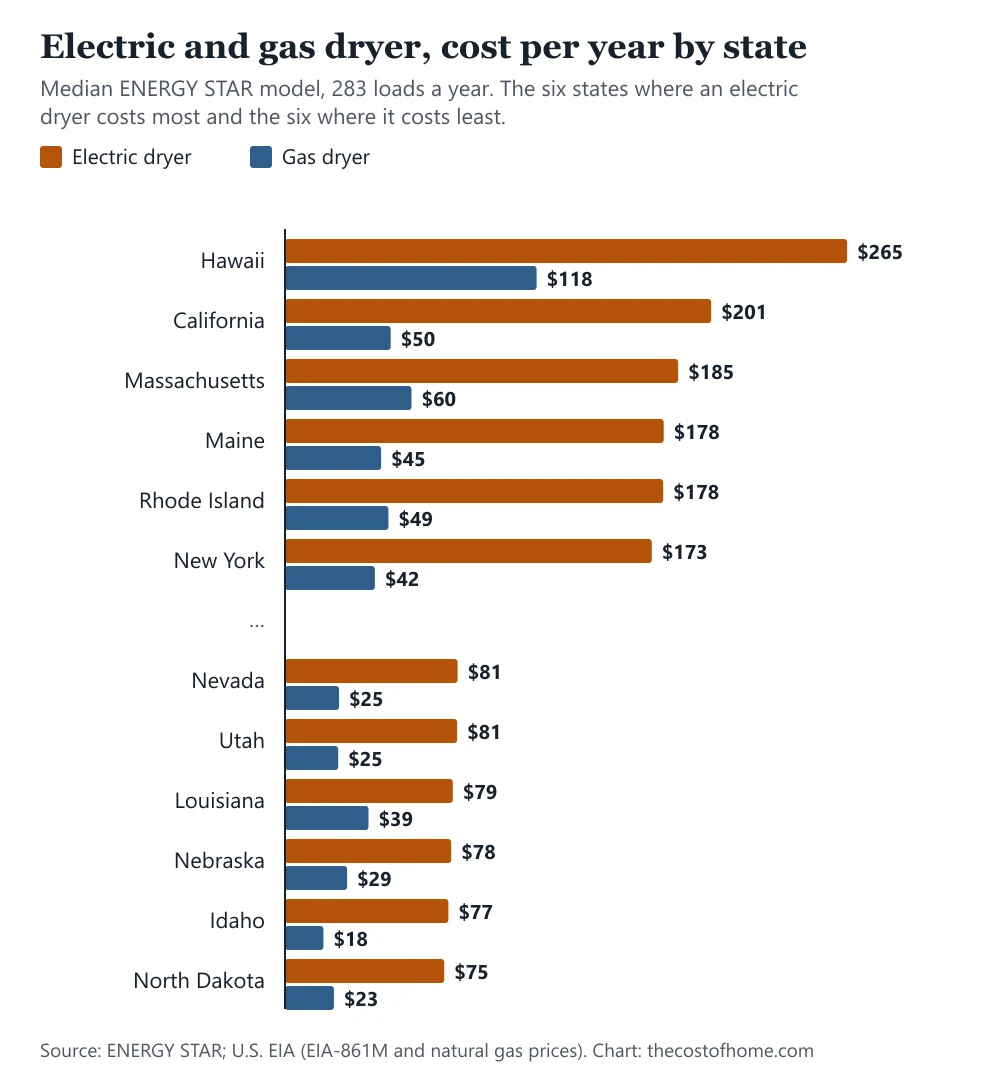
Estimated yearly cost of a new ENERGY STAR dryer (the median electric, gas and heat pump model, 283 loads a year) by state. Electricity is the state's 12-month average residential price, August 2025 to July 2026 (preliminary). Gas is the state's 12-month price; * the EIA's monthly series is incomplete for this state, so the 2025 calendar-year price is used.
An electric dryer runs from $75 a year in North Dakota to $265 in Hawaii. California is next at $201, and the cheapest states after North Dakota are Idaho ($77) and Nebraska ($78). The cost of a gas dryer ranges from $18 in Idaho to $118 in Hawaii. Gas beats electric in all 51 places, D.C. included. The state figures are a calculation, not a survey of what residents pay: they use the same dryer everywhere and change only the price.
Is it worth replacing a dryer to cut the bill?
Rarely, for the bill alone. A new conventional electric dryer on the list uses 608 kWh against the survey's 680 for the average home, a difference of about $13 a year at the national price, so the savings from swapping like for like are small. The numbers get more interesting when you change type: a heat pump saves $63 a year at the national price and $116 in California, and a gas dryer saves $72 at the national price if you already have the gas line. If your dryer is failing, those savings belong in the decision. If it works, I would put the effort into the habits below first.
What habits cut the cost of drying clothes?
ENERGY STAR and the DOE give a short list of habits that cost nothing:
- Clean the lint filter after every load. ENERGY STAR says it improves air circulation and efficiency, and to scrub the filter now and then if you use dryer sheets, which can leave a film that reduces airflow.
- Keep the vent clear. The DOE says thousands of dryer fires are reported each year, many caused by failure to clean the dryer, and recommends rigid vent material, not plastic vents that can collapse.
- Spin the wash longer. The DOE suggests the high-speed or extended spin cycle on the washer to remove as much moisture as possible before drying.
- Use the sensor and lower heat. ENERGY STAR dryers detect when clothes are dry and stop; the DOE says lower heat settings use less energy and are less likely to over-dry, even if the cycle runs longer.
- Dry towels and heavy cottons apart from lighter clothes, and use a cool-down cycle so clothes finish drying with the heat already in the drum.
- Air-dry what you can on a line or a rack.
If you are on a time-of-use rate, ENERGY STAR notes that delaying the start of the dryer can lower the cost when your utility charges less at certain hours. When you shop, look for the ENERGY STAR label and compare the yearly kWh and the cycle time on the list; the criteria require a combined energy factor of at least 3.93 for standard electric models and 3.48 for gas, with a test cycle of 80 minutes or less. The rest of the bill is explained in why your electric bill is so high, and the other large appliances are the refrigerator, central air and the water heater, and my heat pump cost guide covers the larger kind.

How was this calculated?
Yearly cost is energy per year times price. For new models I used the yearly energy in the ENERGY STAR certified clothes dryer list (downloaded October 31, 2026, 695 models from 45 brands) for standard-size dryers, 4.4 cubic feet and up, and took the median of 342 conventional electric, 184 gas and 31 heat pump models. I left out compact dryers, combination washer-dryers, stacked laundry centers and ventless models that the list does not mark as heat pump. The list's yearly figure equals the 8.45-pound test load divided by the model's combined energy factor, times 283 loads, a figure the DOE specifies for its dryer test. Real loads and real habits differ, which is what the survey average shows.
Electricity prices come from the EIA's Form EIA-861M (preliminary) for August 2025 to July 2026: total residential revenue over total kilowatt-hours sold, which is 18.0 cents for the U.S. Gas prices are the EIA's residential price per thousand cubic feet for the same 12 months ($16.34 for the U.S.), converted to therms at 1,037 Btu per cubic foot, which gives $1.58 per therm. For 18 states the EIA's monthly series has gaps, and I used the 2025 calendar-year price there, marked with an asterisk. The state figures change only the price, since the survey does not break dryer use out by state.
The home averages come from the EIA's 2020 Residential Energy Consumption Survey: table CE5.3a for electricity per home with an electric dryer (2.3 million Btu, which is 680 kWh at 293.07 kWh per million Btu), CE5.1a for the dryer's share of household electricity, and HC3.1 for the number of homes by fuel, age and loads per week. The survey is from 2020, so dryers bought since then may use less. A home with rooftop solar draws less from the grid than it uses, so its dryer adds less to the bill than these figures show. My sources and method are set out in how I research costs; for more on appliances and repairs, see Home Repairs & Appliances.
Frequently asked questions
How much does it cost to run a dryer per load?
About 39 cents for a new electric dryer, 13 cents for a gas dryer and 16 cents for a heat pump dryer, at the 12-month U.S. average prices of 18.0 cents per kWh and $1.58 per therm. A load takes 2.1 kWh in the electric model.
How much does it cost to run a dryer per month?
A new electric dryer costs about $9.11 a month, a gas dryer $3.08 and a heat pump dryer $3.85, at about 5.4 loads a week. The EIA's survey puts the average home with an electric dryer at $10.19 a month.
How much does it cost to run a dryer for an hour?
An electric dryer averages about 1.8 kWh an hour over the 70-minute test cycle, so roughly 33 cents an hour at 18.0 cents per kWh. It draws more while heating and less near the end, so treat it as an average.
Is a gas dryer cheaper to run than an electric dryer?
Yes, in every state in this guide: about $37 a year against $109 at U.S. average prices. The DOE notes gas dryers may cost more up front and need venting and a dedicated gas line.
Do heat pump dryers really save money?
They use about 58% less energy than a conventional electric dryer on the ENERGY STAR list, or about $63 a year at the U.S. average price. ENERGY STAR says they use around 70% less than conventional dryers and the DOE says 20% to 60%, so the saving depends on how much you dry and your rate.
How many kWh does a dryer use per year?
A new electric dryer uses about 608 kWh a year at 283 loads. The EIA's 2020 survey found 680 kWh for the average home with an electric dryer.
Does a dryer use more electricity than a washing machine?
Yes, by a wide margin. In the EIA's 2020 survey, clothes dryers used 55.9 billion kWh across U.S. homes, and clothes washers 7.1 billion kWh, because heating air takes much more energy than turning a drum.
Does cleaning the lint filter save money?
ENERGY STAR says cleaning the lint filter after every load improves air circulation and increases the dryer's efficiency. The DOE adds that a clean filter and a clear vent reduce the risk of fire.
Sources
- ENERGY STAR, Certified Clothes Dryers: product list with combined energy factor and estimated annual energy use by model (downloaded October 31, 2026)
- ENERGY STAR, Clothes Dryers: buying guidance, heat pump dryers and savings tips (accessed October 31, 2026)
- ENERGY STAR, Clothes Dryers key product criteria: combined energy factor, 8.45-pound test load and cycle time (accessed October 31, 2026)
- U.S. Department of Energy, Energy Conservation Program: Test Procedures for Residential Clothes Dryers, Federal Register, August 14, 2013 (283 cycles per year; accessed October 31, 2026)
- U.S. Department of Energy, Tips on Saving Money and Energy in Your Home (2022 edition; clothes dryers, gas and heat pump models, dryer fires; accessed October 31, 2026)
- U.S. Energy Information Administration, 2020 Residential Energy Consumption Survey, table CE5.3a: household electricity end-use consumption, averages (accessed October 21, 2026)
- U.S. Energy Information Administration, 2020 Residential Energy Consumption Survey, table CE5.1a: household electricity end-use consumption, totals (accessed October 21, 2026)
- U.S. Energy Information Administration, 2020 Residential Energy Consumption Survey, table HC3.1: appliances in U.S. homes (clothes dryer fuel, age and loads per week; accessed October 23, 2026)
- U.S. Energy Information Administration, Form EIA-861M: monthly sales, revenue and customers by state (August 2025 to July 2026, accessed October 15, 2026)
- U.S. Energy Information Administration, Natural Gas Prices: residential price by state (accessed October 17, 2026)

Founder and editor, The Cost of Home
I write and check every guide on this site myself, working from public data. The sources behind each number are listed at the end of the article, so you can check them too.