Energy Bills
How Much Does a Home Solar Battery Cost?
Quick answer
A home solar battery costs about $15,647 installed for a typical 13.5 kWh unit, the size of a Tesla Powerwall 3, or roughly $1,159 per kWh, before incentives. Average quotes run from $7,600 in Alabama to $21,400 in Louisiana. The federal homeowner credit no longer applies to batteries placed in service after 2025, so the case for one rests mostly on backup power.

On this page
- How much does a home solar battery cost?
- How much does the brand change the price?
- What does a home battery cost in your state?
- How much does a battery add if you buy solar panels with it?
- Is there a federal tax credit for a home battery?
- How long does a home battery last, and what does that cost per year?
- Is a battery worth it for power outages?
- Can a battery pay for itself by saving on your bill?
- How should you compare battery quotes?
- What does this estimate miss?
- FAQ
- Sources
Home batteries are the add-on people ask about most after they price solar panels. A battery keeps the lights on when the grid goes down and can store cheap or solar power for later, and it adds a lot to the price of a solar system. The question is what a battery costs, what that buys and when it is worth it.
This guide uses installer quotes for the price, federal data for how often the power actually goes out, and the tax rules as they stand now. It puts a price on a 13.5 kWh battery in every state, compares brands, and then asks whether the money is better spent on backup or on saving on the bill.
How much does a home solar battery cost?
About $15,647 for a typical home. EnergySage puts it at $15,647 before incentives for the 13.5 kWh of storage a home needs to keep essential devices running during an outage. EnergySage does not give a national price per kWh, so dividing it out myself gives about $1,159 per kWh.
That price is the battery installed, not the battery alone. EnergySage says equipment is typically 50% to 60% of the cost of an energy storage system, which leaves the rest for installation, wiring and the work around it. The inverter, the part that turns the battery's direct current into the alternating current a home uses, “could add a couple of thousand dollars,” according to the same page, and a battery added to solar panels already on the roof costs extra for labor, wiring and in some cases equipment.
How much does the brand change the price?
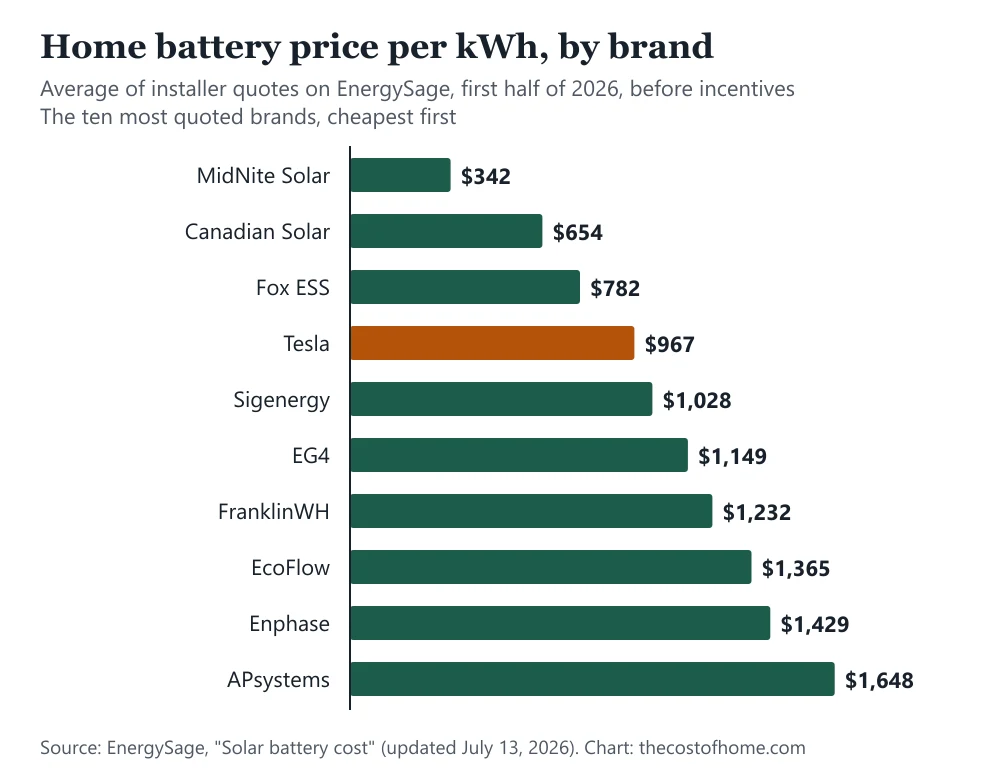
A lot, on paper. Among the ten brands installers quoted most, the average price runs from $342 per kWh for MidNite Solar to $1,648 for APsystems. Tesla, the best-known name, averages $967 per kWh, or $13,055 for a 13.5 kWh Powerwall. Enphase averages $1,429 per kWh, which for its 10 kWh size comes to $14,290.
| Brand | Per kWh | Size | Total |
|---|---|---|---|
| Tesla | $967 | 13.5 kWh | $13,055 |
| Enphase | $1,429 | 10 kWh | $14,290 |
| FranklinWH | $1,232 | 15 kWh | $18,480 |
| EG4 | $1,149 | 12.9 kWh | $14,822 |
| EcoFlow | $1,365 | 9.5 kWh | $12,968 |
| Sigenergy | $1,028 | 15.4 kWh | $15,831 |
| APsystems | $1,648 | 10.2 kWh | $16,810 |
| MidNite Solar | $342 | 16 kWh | $5,472 |
| Fox ESS | $782 | 14.3 kWh | $11,183 |
| Canadian Solar | $654 | 10 kWh | $6,540 |
The ten most quoted home battery brands on EnergySage in the first half of 2026. “Per kWh” is the average price per kilowatt-hour of storage; “Size” is the median usable capacity quoted for the brand; “Total” is EnergySage's battery cost for that size. All before incentives. Per-kWh prices are not like for like: a brand can look cheap because of the size it is quoted in or what the quote includes. Source: EnergySage.
I would not read the cheapest rows as the best deal. The per-kWh average depends on the size quoted and on what the quote includes, and it moves with how many quotes a brand has. EnergySage itself says it has quoted batteries as cheap as $342 per kWh and as dear as about $3,505 per kWh. What the table does show is that the middle of the market sits between about $1,000 and $1,400 per kWh, and that a 13.5 kWh battery from a well-known brand lands in the low to mid teens in thousands of dollars.
What does a home battery cost in your state?
Across the 49 states and D.C. that EnergySage lists, a 13.5 kWh battery runs from about $7,600 in Alabama to $21,400 in Louisiana, with a middle of about $15,700. To make the states comparable I multiplied each state's average price per kWh by 13.5 kWh. EnergySage's own state table shows a different battery size in each state, from 5 kWh in Delaware to 40.5 kWh in North Dakota, Nebraska and South Dakota, which is a sign that some states rest on few quotes.
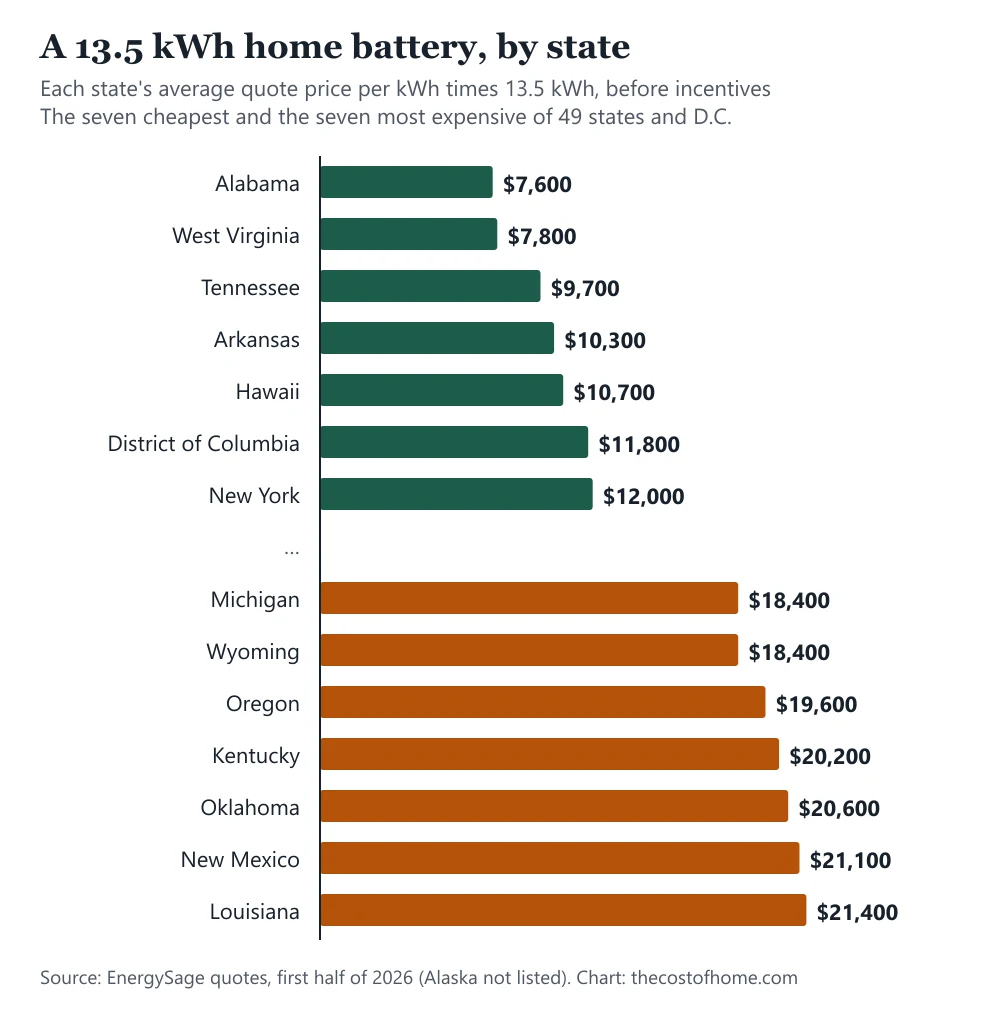
The pattern does not follow the size of the state or how sunny it is. California averages $1,079 per kWh, close to the national figure, and Hawaii $789. The page does not say why one state is cheaper than another, so I would treat any single state's number as a rough guide. In a state with few quotes the average can move a lot with one big job.
| State | Per kWh | 13.5 kWh | Out 2025 | Out 2024 |
|---|---|---|---|---|
| Alabama* | $563 | $7,600 | 4.5 | 3.3 |
| West Virginia | $578 | $7,800 | 16.9 | 19.4 |
| Tennessee | $720 | $9,700 | 3.8 | 4.8 |
| Arkansas | $761 | $10,300 | 7.9 | 8.8 |
| Hawaii* | $789 | $10,700 | 5.6 | 6.4 |
| District of Columbia | $873 | $11,800 | 0.8 | 0.5 |
| New York* | $888 | $12,000 | 4.1 | 8.0 |
| Nebraska | $910 | $12,300 | 9.0 | 11.6 |
| South Dakota | $914 | $12,300 | 4.7 | 1.4 |
| North Dakota | $920 | $12,400 | 3.5 | 1.7 |
| Nevada | $932 | $12,600 | 2.1 | 2.6 |
| Rhode Island | $937 | $12,600 | 3.0 | 1.7 |
| Florida | $1,005 | $13,600 | 1.2 | 24.8 |
| Arizona | $1,019 | $13,800 | 1.1 | 1.4 |
| New Jersey | $1,038 | $14,000 | 2.6 | 2.9 |
| Texas | $1,059 | $14,300 | 3.5 | 26.9 |
| California | $1,079 | $14,600 | 6.0 | 4.8 |
| Utah | $1,079 | $14,600 | 1.9 | 1.9 |
| New Hampshire | $1,089 | $14,700 | 2.5 | 12.3 |
| Missouri | $1,109 | $15,000 | 7.8 | 3.5 |
| Montana | $1,115 | $15,100 | 4.8 | 5.7 |
| Vermont* | $1,148 | $15,500 | 4.2 | 14.9 |
| Connecticut | $1,153 | $15,600 | 3.1 | 2.5 |
| Delaware | $1,153 | $15,600 | 1.7 | 2.0 |
| Minnesota | $1,155 | $15,600 | 3.0 | 3.7 |
| Maine | $1,171 | $15,800 | 6.1 | 29.1 |
| Kansas | $1,193 | $16,100 | 3.2 | 4.8 |
| Virginia* | $1,210 | $16,300 | 12.7 | 16.0 |
| Illinois | $1,240 | $16,700 | 2.4 | 2.6 |
| North Carolina | $1,241 | $16,800 | 3.2 | 25.3 |
| Ohio | $1,242 | $16,800 | 3.4 | 8.5 |
| Pennsylvania | $1,246 | $16,800 | 6.9 | 5.9 |
| South Carolina | $1,244 | $16,800 | 2.5 | 52.6 |
| Colorado | $1,261 | $17,000 | 4.5 | 4.3 |
| Iowa | $1,263 | $17,100 | 3.1 | 3.3 |
| Georgia | $1,278 | $17,300 | 4.5 | 20.1 |
| Washington | $1,283 | $17,300 | 6.4 | 10.7 |
| Idaho | $1,301 | $17,600 | 4.9 | 3.4 |
| Wisconsin | $1,309 | $17,700 | 4.4 | 4.9 |
| Mississippi | $1,323 | $17,900 | 8.7 | 10.1 |
| Indiana | $1,333 | $18,000 | 6.3 | 5.2 |
| Maryland | $1,341 | $18,100 | 3.0 | 2.0 |
| Massachusetts | $1,352 | $18,300 | 2.0 | 1.7 |
| Michigan | $1,364 | $18,400 | 10.1 | 8.0 |
| Wyoming | $1,364 | $18,400 | 3.7 | 2.3 |
| Oregon | $1,452 | $19,600 | 5.0 | 9.7 |
| Kentucky | $1,494 | $20,200 | 6.6 | 9.0 |
| Oklahoma* | $1,525 | $20,600 | 5.0 | 3.7 |
| New Mexico | $1,561 | $21,100 | 2.7 | 4.5 |
| Louisiana | $1,586 | $21,400 | 4.5 | 10.5 |
What a 13.5 kWh home battery costs in each state, cheapest first, next to the hours the average customer was without power. “Per kWh” is the state's average price per kilowatt-hour on EnergySage quotes in the first half of 2026. “13.5 kWh” is that price times 13.5, rounded to the nearest $100, before incentives, so every state has the same size. “Out 2025” and “Out 2024” are hours without power per customer, all events, from the EIA (IEEE method). An asterisk means the EIA data cover less than half of the state's customers. Alaska is not on EnergySage's list. Sources: EnergySage; U.S. EIA, Electric Power Annual, Table 11.2.
The last two columns are for the section on outages below. They are not part of the price.
How much does a battery add if you buy solar panels with it?
More than a third of new systems now come with storage: Berkeley Lab's 2026 Data Update counts 37% of 2025 installs as paired, with 13.5 kWh the median battery. It prices a paired system per watt of solar so it can be set against solar alone. For all owner-owned systems the median rose from 3.6 to 4.9 dollars per watt, so at the median size of 7.7 kW the price of a solar system goes from about $27,700 to about $37,700, before incentives. Most of those paired-system price records come from one state, California, so I would not read the gap as a national average.
Buying them together is usually cheaper than adding a battery later. EnergySage notes that a retrofit costs extra for labor and wiring, and that adding batteries “can double your solar costs.” If you do not have solar and are weighing both, how long solar takes to pay back by state is the better place to start, because a battery does not make the panels pay back faster.
Is there a federal tax credit for a home battery?
Not for a battery you buy yourself and place in service now. The IRS page for the Residential Clean Energy Credit says the credit “is not available for any property placed in service after December 31, 2025.” Battery storage with a capacity of at least 3 kWh was eligible beginning in 2023, so a battery installed in 2025 or earlier could have claimed 30%. Installed in 2026 or later, it cannot, on the rules as the IRS page now states them. The same page also carries an older line about a phase-out beginning in 2033, so if you are near a deadline, ask a tax preparer about your exact case.
What remains is local. EnergySage says state and utility incentives can be “the difference between batteries being a smart investment and an expensive luxury,” and it gives California's Self-Generation Incentive Program as an example that can stack up to over $1,000 per kWh, with eligibility requirements. Check your utility and state energy office before you sign, because a rebate that exists on the day of the quote can run out.
How long does a home battery last, and what does that cost per year?
EnergySage says most solar batteries last 10 to 15 years before they need replacing, and that most manufacturers guarantee at least 60% to 70% of the original capacity after 10 years. A 10-year warranty is “fairly standard,” with some premium makers offering 12, 15 or even 20. By that guidance a 13.5 kWh battery would still hold about 9 kWh after a decade.
Read the warranty for a cycle or throughput limit. A warranty that covers a fixed number of cycles can end early if you charge and discharge the battery more than once a day, and EnergySage says some makers, Tesla among them, now offer unlimited-cycle warranties. Spread over its life, the median-size battery works out to the figures below.
| Life | Cost a year | Gap needed |
|---|---|---|
| 10 years | $1,560 | 32 cents |
| 12 years | $1,300 | 26 cents |
| 15 years | $1,040 | 21 cents |
What the median-size battery from this guide costs per year of use, for three lifespans, and the gap between peak and off-peak electricity prices (per kWh) it would take to cover that cost by shifting one full battery charge a day, with no losses counted. This is my arithmetic from EnergySage's $15,647 for 13.5 kWh, not a forecast.
Is a battery worth it for power outages?
For most homes, outages are shorter than a battery's range, but they are lumpy. The average U.S. customer was without power for about 4.5 hours in 2025 and about 11.0 hours in 2024, according to the U.S. Energy Information Administration. The EIA says major events such as Hurricanes Beryl, Helene and Milton were 80% of the hours in 2024, and that interruptions not tied to major events routinely average about two hours a year. In 2025 that ordinary level was 2.1 hours.
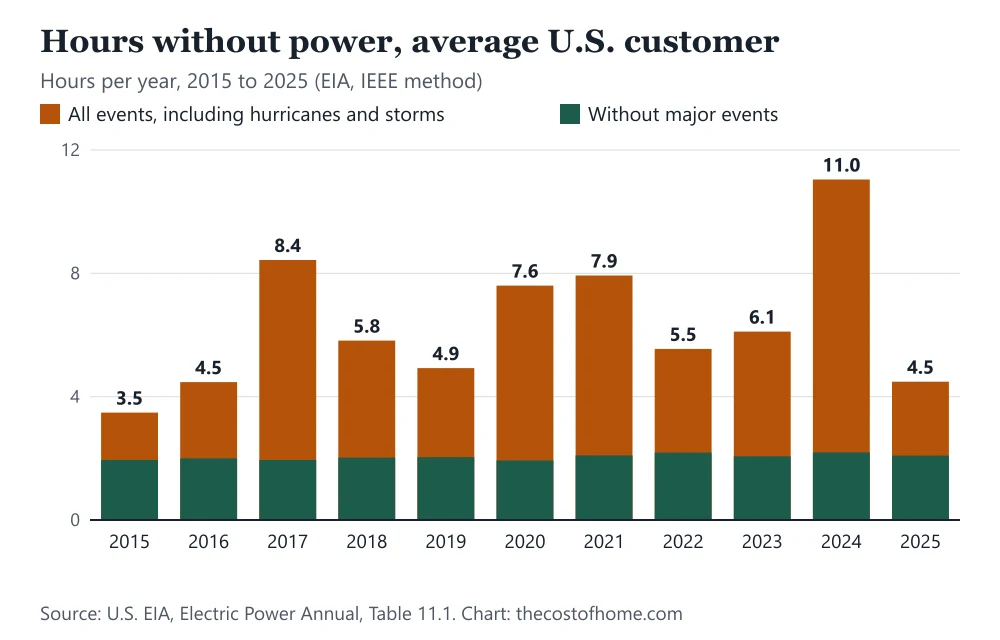
An average hides the places that get hit. In South Carolina the average customer lost about 52.6 hours of power in 2024, after Hurricane Helene, and about 2.5 hours in 2025. Maine went from 29.1 to 6.1 hours, Texas from 26.9 to 3.5 and Florida from 24.8 to 1.2. West Virginia is the other kind of state, with about 19.4 hours in 2024 and 16.9 in 2025, year after year. The table in the price section has every state, and EIA numbers for a state with partial coverage, marked with an asterisk, are less reliable.
What a battery covers depends on what you ask of it. EnergySage says most homes with a standard battery get about a day of backup for essential loads such as the refrigerator, lights, internet and phone chargers, and that running central air conditioning at 3,000 watts or more can drain it in a few hours. At 3 kW, a 13.5 kWh battery runs out in about four and a half hours. With solar panels on the roof, the battery can recharge each day, so backup can last as long as the outage does.
My read is that a battery earns its price as backup for people who live where long outages happen, or who depend on power at home, such as medical equipment or a home office. For the average customer, with a couple of hours of ordinary outages a year, a $15,000 battery is insurance against a rare event, not a bill-saver.
Can a battery pay for itself by saving on your bill?
Only in a few places. A battery saves money on the bill by storing power when it is cheap, from solar panels or off-peak hours, and using it when it is expensive. The saving per kWh is the gap between the two prices. For the median battery to cover its cost over 10 years by shifting one full charge a day, that gap would need to be about 32 cents per kWh, and about 21 cents over 15 years, with no losses counted.
For scale, the average residential price of electricity over the 12 months to August 2026 was above 32 cents in only California and Hawaii, and above 21 cents in 13 states and D.C. A peak-to-off-peak gap is the peak price minus the off-peak price, so it is always smaller than the peak price itself. Peak prices can sit well above a state's average, so a gap that size is possible in a few places, but I would not assume it. See electricity prices by state for the prices, and how to read your electric bill for how rates are set.
It gets closer where the utility pays little for solar power you send to the grid and charges much more at peak, because a battery then turns exported power into power you use yourself. That is the case for a battery with solar, and why the solar payback guide has a section on export rules. My advice is to ask any installer for the first-year saving in dollars on your own rate plan, not a general promise, and to compare it with the yearly cost in the table above.
How should you compare battery quotes?
- Compare the installed price per kWh, not the battery alone. Ask what the quote includes: the inverter, wiring, permits, the labor to connect it to the panel and any changes to the panel itself.
- Check the usable kWh and the kW. Storage (kWh) is how long it runs, and the power rating (kW) is how much it can run at once. EnergySage says most modern batteries deliver 5 to 15 kW, and a Powerwall 3 offers 11.5 kW.
- Decide what to back up first. Most people back up the refrigerator, lights and internet and leave out central air conditioning, the electric water heater and the dryer. A smaller list means a smaller battery.
- Read the warranty. Look for the years, the capacity it guarantees at the end (60% to 70% is typical) and any limit on cycles or energy throughput.
- Ask for the incentives in writing. Include state and utility programs, and the date they end.
- Get more than one quote. EnergySage says homeowners who use its marketplace typically pay 20% less than the market average, which is its own claim, but the spread between brands above shows why quotes are worth comparing.
If you want the other half of a solar decision, how solar panels do in winter shows what the roof makes in December, which is when a battery is hardest to recharge.
What does this estimate miss?
- Quotes, not paid prices. EnergySage's numbers are installer quotes sent through its marketplace in the first half of 2026. The page does not say how many quotes sit behind each one, so I treat state numbers as a guide.
- Thin states. Delaware's typical size is 5 kWh and three Plains states show 40.5 kWh, which points to few or unusual quotes. My 13.5 kWh figure lets you compare states, but it does not fix a thin sample.
- Per-kWh prices are not like for like. A brand's average depends on the sizes and the equipment in its quotes.
- No incentives. Every price is before any state or utility program, which can be large in some places.
- Outages by state. The EIA numbers are averages for a whole state, and in a state with partial coverage (marked with an asterisk) they may not match your town or your utility.
- The bill-saving math has no losses. It leaves out the energy lost when charging and discharging, what the battery is worth as backup and any utility program that pays for stored power.
The page how I research costs explains where each source comes from, and the Energy Bills section has the rest of the series, including the average electric bill by state.
Frequently asked questions
How much does a home solar battery cost?
About $15,647 installed for a typical 13.5 kWh battery before incentives, or roughly $1,159 per kWh, according to EnergySage quotes in the first half of 2026. State averages for the same size run from about $7,600 in Alabama to $21,400 in Louisiana.
How much does a Tesla Powerwall cost?
EnergySage's average quote for Tesla was $967 per kWh in the first half of 2026, or $13,055 for a 13.5 kWh unit, before incentives.
Is there a tax credit for a home solar battery?
The IRS says the Residential Clean Energy Credit is not available for property placed in service after December 31, 2025, so a homeowner who installs a battery now cannot claim it. State and utility incentives still exist in some places, such as California's Self-Generation Incentive Program.
How long does a home solar battery last?
Most last 10 to 15 years, according to EnergySage. Many manufacturers guarantee 60% to 70% of the original capacity after 10 years, so a 13.5 kWh battery would still hold about 9 kWh. Check the warranty for a limit on cycles.
How long can a home battery power a house?
About a day for essential loads such as the refrigerator, lights, internet and phone chargers, says EnergySage. Running central air conditioning at 3,000 watts or more drains a 13.5 kWh battery in a few hours. With solar panels the battery can recharge each day.
Is a home battery worth it?
Mostly as backup. The average U.S. customer lost power for about 4.5 hours in 2025 and 11.0 hours in 2024, so it matters most where outages are long. To pay for itself on bill savings alone, a 10-year battery needs about 32 cents per kWh of gap between peak and off-peak prices.
Can I add a battery to solar panels I already have?
Yes, but it costs more. EnergySage says a retrofit adds charges for labor, wiring and sometimes equipment, and that adding batteries can double solar costs when bought together. Ask your installer whether your inverter works with the battery.
Sources
- EnergySage, "Solar battery cost: Are they actually worth it in 2026?" (updated July 13, 2026; $15,647 for 13.5 kWh, price per kWh by brand and by state from quotes in the first half of 2026; accessed November 6, 2026)
- EnergySage, "How long do solar batteries last?" (updated August 14, 2026; lifespan, warranty guidance, backup time; accessed November 6, 2026)
- Internal Revenue Service, "Residential Clean Energy Credit" (page reviewed July 4, 2026; end date of the credit and battery storage eligibility; accessed November 6, 2026)
- U.S. Energy Information Administration, Electric Power Annual with data for 2025 (released October 21, 2026), Table 11.1, "Reliability Metrics of U.S. Distribution System" (SAIDI by year, IEEE method; accessed November 6, 2026)
- U.S. Energy Information Administration, Electric Power Annual with data for 2025, Table 11.2, "Reliability Metrics Using IEEE of U.S. Distribution System by State, 2025 and 2024" (accessed November 6, 2026)
- U.S. Energy Information Administration, "Hurricanes in 2024 led to the most hours without power in the United States in 10 years," Today in Energy (December 1, 2025; accessed November 6, 2026)
- Lawrence Berkeley National Laboratory, "U.S. Distributed Solar and Storage, 2026 Data Update" (August 2026; storage attachment rates, median battery size and the price gap for paired systems; accessed October 20, 2026)
- U.S. Energy Information Administration, Form EIA-861M: average residential price of electricity by state, 12 months to August 2026, preliminary (accessed October 27, 2026)

Founder and editor, The Cost of Home
I write and check every guide on this site myself, working from public data. The sources behind each number are listed at the end of the article, so you can check them too.