Energy Bills
How Much Do Christmas Lights Add to Your Electric Bill?
Quick answer
A string of 100 LED mini lights costs about 22 cents to run for a whole season, and a lit tree about $1.30. The same tree in incandescent bulbs costs about $9. A small home display runs about $57 in incandescent and $3 in LED, at 6 hours a night for 40 nights and the U.S. average price.
On this page
- How do you calculate what Christmas lights cost to run?
- How many watts do Christmas lights use?
- How much do Christmas lights cost for a tree, a house and a big display?
- How much do Christmas lights cost in your state?
- How much does a timer change the cost?
- What do inflatable decorations cost to run?
- Is it worth switching to LED Christmas lights?
- How can you cut what Christmas lights cost?
- What do Christmas lights cost in all 50 states?
- How was this calculated?
- FAQ
- Sources
Christmas lights are the one holiday cost you can work out before you plug anything in. Each string has its watts on the label, the hours are up to you, and the price per kilowatt-hour (kWh) is on your electric bill. For a single tree the answer is small. It only turns into real money with older incandescent strings, a big roofline or lights that stay on all day.
Below I price one string, a tree, a small home and a big display, in LED and incandescent bulbs, then look at hours, timers, inflatables and what the same display costs in five states and all fifty. The electricity prices are the ones from my electricity prices by state guide. The watts come from the Department of Energy (DOE).
How do you calculate what Christmas lights cost to run?
Take the watts printed on the box, divide by 1,000 to get kilowatts, multiply by the hours the lights are on, then multiply by your price per kWh. A 100-bulb incandescent mini string is about 36 watts in the DOE's averages, so lit for 6 hours it uses 0.22 kWh. At 18.0 cents per kWh, the U.S. average from my electricity prices guide, that is 4 cents a night.
For the season I use 6 hours a night for 40 nights, which is 240 hours, about the span from late November to early January. Those hours are my assumption. The DOE's own estimate for holiday lights in 2008 averaged 9 hours a day for 45 days, or about 410 hours a year, a figure that includes commercial displays. Your hours may be higher or lower, and the cost moves in step with them.
How many watts do Christmas lights use?
It depends on the bulb type far more than on the brand. The DOE's 2008 report on LEDs in niche lighting applications lists average watts for a whole string: about 36 W for a 100-bulb incandescent mini string against 5 W for the LED version, and 159 W for an incandescent C9 string of 25 big bulbs against 2.5 W in LED. The same table puts energy-saver incandescent mini strings at 24 W, against 42 W for a regular one. EnergySage gives a similar figure for the common case: 40 W for 100 incandescent bulbs and 5 to 10 W for 100 LEDs.
| String | Incandescent | LED | Season, incandescent | Season, LED |
|---|---|---|---|---|
| Mini lights | 36 W | 5 W | $1.56 | $0.22 |
| C6 | 36 W | 0.9 W | $1.56 | $0.04 |
| C7 | 92 W | 2.5 W | $3.98 | $0.11 |
| C9 | 159 W | 2.5 W | $6.88 | $0.11 |
What one string of lights draws and what it costs for a season, from the Department of Energy's averages for each type of string. A season here is 6 hours a night for 40 nights (240 hours) at the U.S. average price of 18.0 cents per kWh. Mini lights are 100 bulbs a string, C6 are 35, and C7 and C9 are 25.
ENERGY STAR says certified decorative light strings use about 92 percent less energy than incandescent strings, and it caps them at 0.2 W per bulb. Those are statements about the label, not a measurement of the string in your attic, so read the wattage on the box if you can. An old string with a broken-off tag is the case where the table is your best guess.
How much do Christmas lights cost for a tree, a house and a big display?
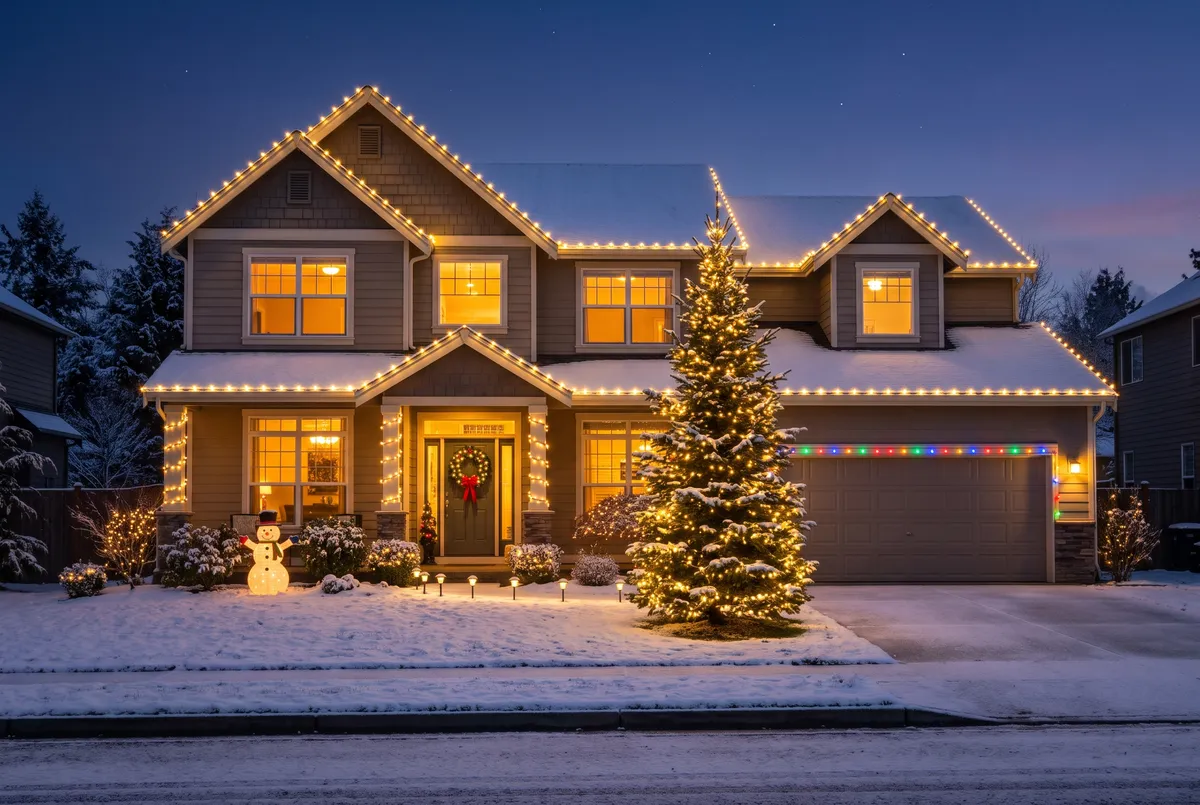
At the U.S. average price, a tree with 6 mini strings (600 bulbs) draws 216 W in incandescent and 30 W in LED. Lit 6 hours a night, that is 23 cents a night in incandescent and 3 cents in LED, or $9.35 and $1.30 for 40 nights. A single mini string is $1.56 for the season in incandescent and 22 cents in LED.
| Display | Watts, incandescent | Watts, LED | Season, incandescent | Season, LED |
|---|---|---|---|---|
| 1 mini string | 36 W | 5 W | $1.56 | $0.22 |
| Tree | 216 W | 30 W | $9.35 | $1.30 |
| Small home | 1,314 W | 65 W | $57 | $2.81 |
| Big display | 4,260 W | 200 W | $184 | $8.66 |
What a season of lights costs for four sizes of display, at the U.S. average price of 18.0 cents per kWh and 6 hours a night for 40 nights. The tree is 6 mini strings (600 bulbs); the small home is the tree plus 4 mini strings and 6 C9 strings outside; the big display is 30 mini strings and 20 C9 strings. These layouts are my examples, built from the Department of Energy's watts per string.
The jump comes from the big bulbs outside. In my small home example the 10 mini strings draw only 360 watts; the 6 C9 strings outside draw 954 of the 1,314 total. That display costs $1.42 a night and $57 for the season in incandescent, about 315 kWh. That is roughly a third of the 870 kWh an average U.S. home uses in a month, according to my average electric bill by state guide, spread across two bills. In LED the same layout draws 65 W and costs about $3.
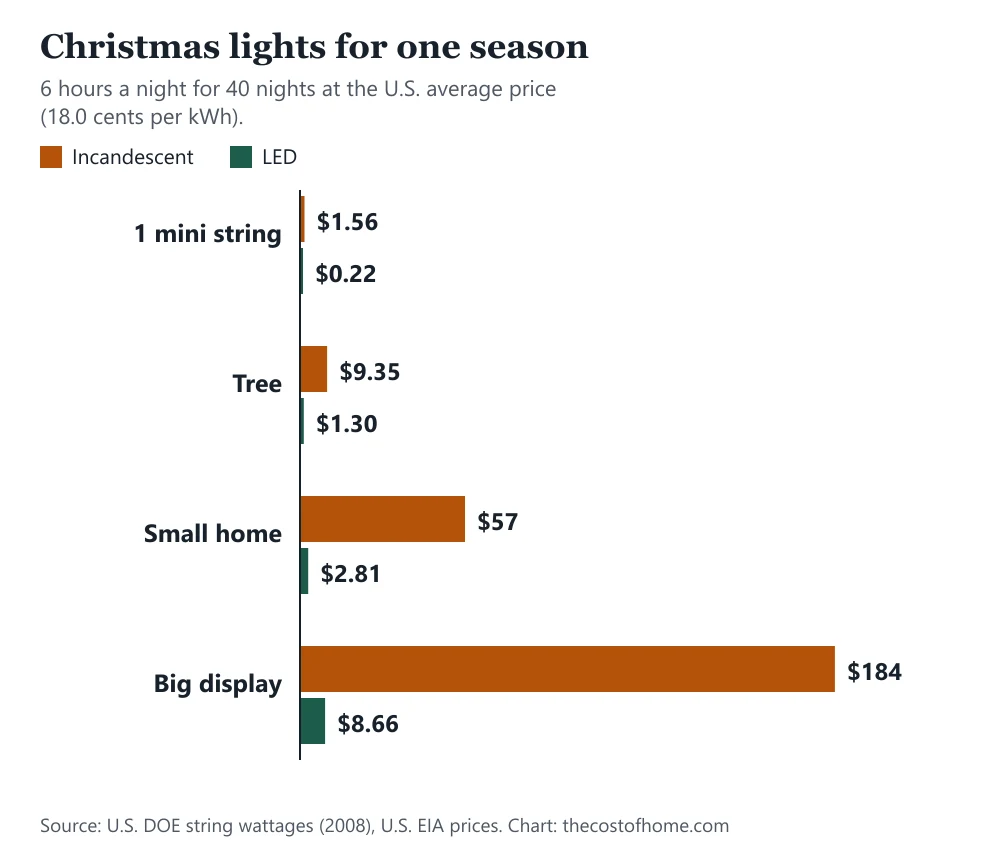
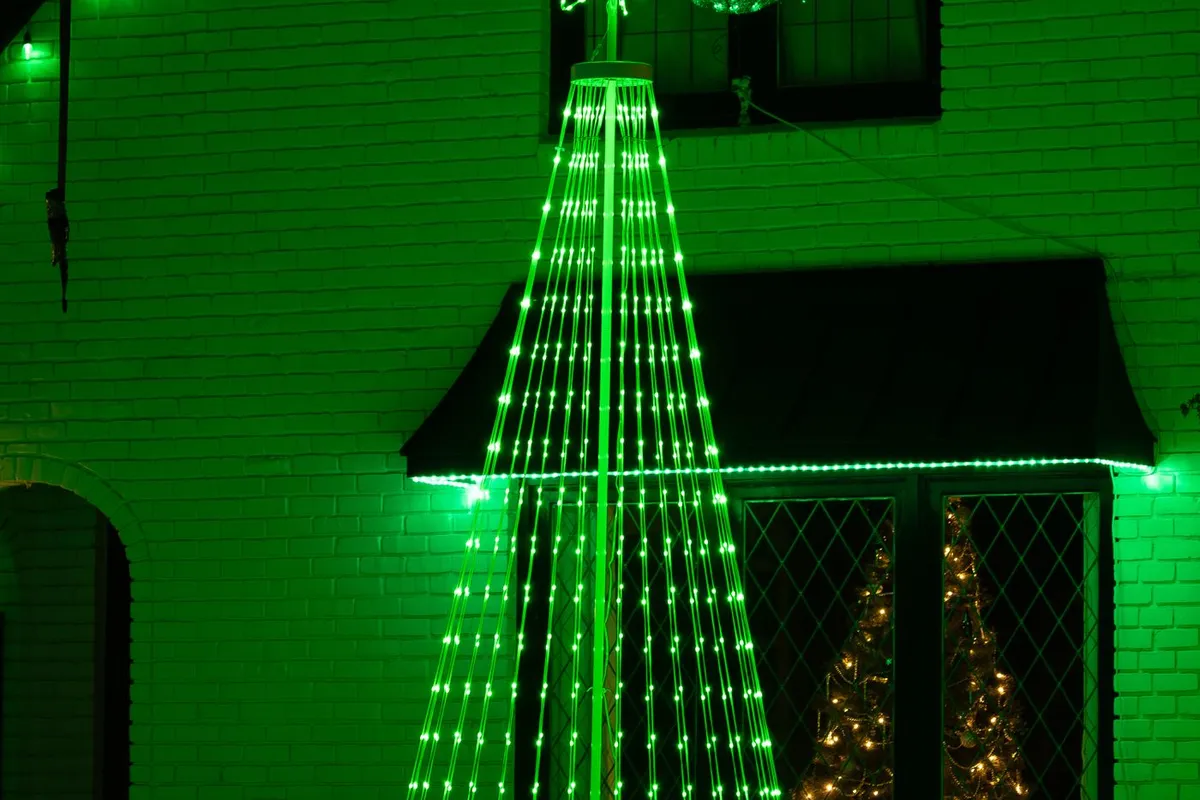
A big display of 30 mini strings and 20 C9 strings draws 4,260 W in incandescent, which is $4.61 a night and $184 for the season. In LED the same layout is 200 W and $9. In my opinion, the bulb type is the one choice here that moves the bill by hundreds of dollars on a large display, so it is worth checking before you buy more strings of the same kind.
One caution on the LED numbers. The DOE figures come from a 2008 report, and today's LED strings vary. If yours sit at the top of EnergySage's range, 10 W per 100 bulbs, the tree costs about $2.60 and the small home about $4.98 for the season, still a fraction of the incandescent bill. The DOE's own 2015 example for a 6-foot tree lit 12 hours a day for 40 days gives $0.27 for LED against $10 for incandescent.
How much do Christmas lights cost in your state?
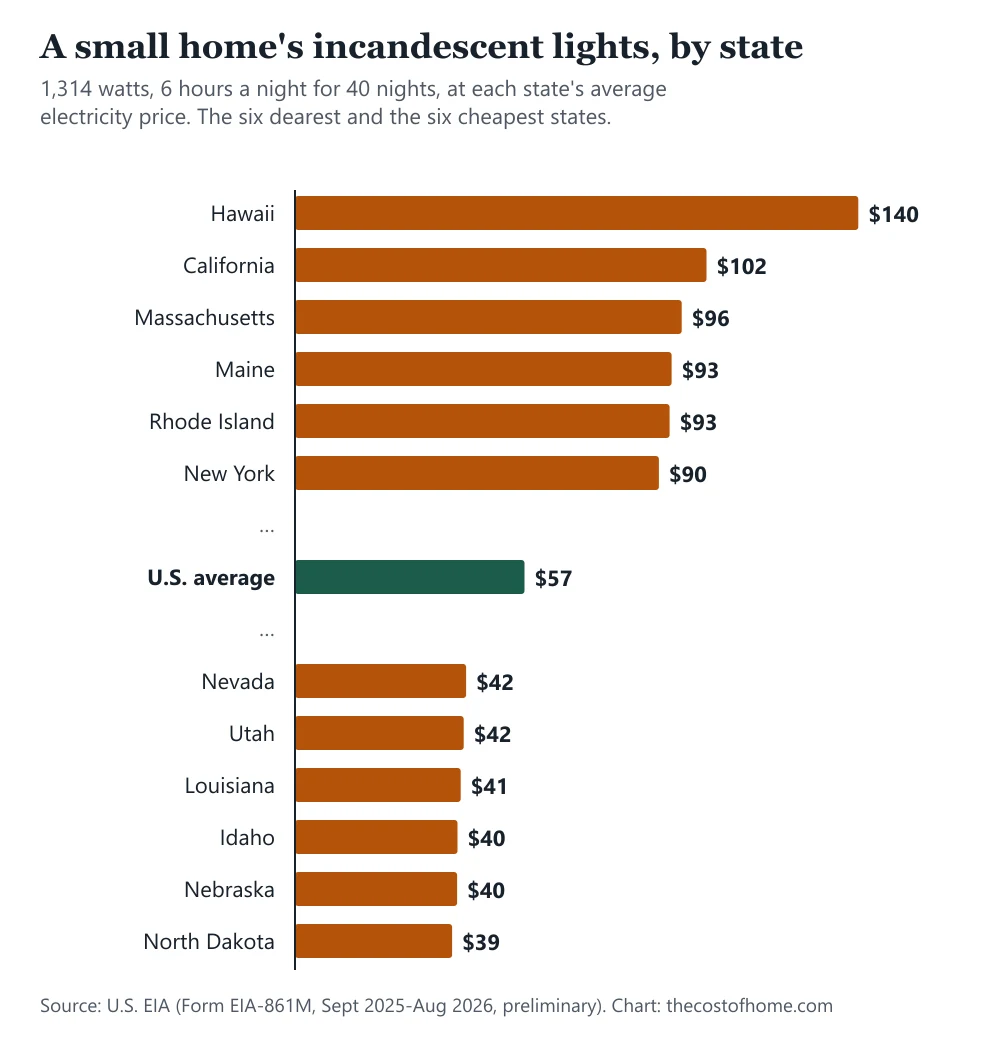
The lights are the same everywhere and the price per kWh is not. The same small home display costs about $45 for the season in Washington, $50 in Texas, $58 in Ohio, $90 in New York and $102 in California, with incandescent bulbs. In LED it is between $2.22 and $5.05 in those same states.
| State | kWh price | Incandescent season | LED season |
|---|---|---|---|
| U.S. average | 18.0¢ | $57 | $2.81 |
| Washington | 14.2¢ | $45 | $2.22 |
| Texas | 16.0¢ | $50 | $2.49 |
| Ohio | 18.4¢ | $58 | $2.87 |
| New York | 28.6¢ | $90 | $4.46 |
| California | 32.3¢ | $102 | $5.05 |
The small home display priced in five states with low, middle and high electricity prices. Prices are each state's average residential price per kWh, September 2025 to August 2026 (preliminary), from my electricity prices guide. A season is 6 hours a night for 40 nights.
Across all the states, the incandescent season runs from $39 in North Dakota to $140 in Hawaii. California is next at $102, and after North Dakota the cheapest is Nebraska at $40. Find your row in the table at the end of this guide. If your own bill shows a different price, use that one in the formula.
How much does a timer change the cost?
A timer changes it more than the bulb does for a small display. The cost is proportional to the hours, so lights that run 12 hours instead of 6 cost twice as much, and lights left on around the clock cost four times as much. A small home display in incandescent bulbs costs $57 for the season at 6 hours a night and $228 if it stays on all 24 hours. The same layout in LED goes from $3 to $11.
| Hours a night | Tree, incandescent | Tree, LED | Home, incandescent | Home, LED |
|---|---|---|---|---|
| 3 | $4.68 | $0.65 | $28 | $1.41 |
| 6 | $9.35 | $1.30 | $57 | $2.81 |
| 9 | $14 | $1.95 | $85 | $4.22 |
| 12 | $19 | $2.60 | $114 | $5.63 |
| 24 | $37 | $5.20 | $228 | $11 |
What a season of 40 nights costs by hours lit a night, at the U.S. average price of 18.0 cents per kWh. The tree is 6 mini strings and the small home is the layout from the table above. The 24-hour row is a display left on all day and night.
That is why the lights that surprise people on a bill are the ones nobody remembers to turn off: a roofline plugged into an outlet that is always live. A plug-in timer on that outlet, or lights with a built-in timer, stops the hours at the number you chose. EnergySage suggests the same, since outdoor lights are easy to forget in the morning rush. My why your electric bill is so high guide shows how a few always-on loads add up over a month.
What do inflatable decorations cost to run?
I could not find an official source for how many watts an inflatable draws, so I use the formula with an example. Many inflatables keep a small fan running the whole time to hold their shape, and the watts are on the fan's label or the box. If I take a 100 W fan as my example, an inflatable costs 11 cents for 6 hours and $4.33 for a 40-night season at the U.S. average price. Run all day, the same example costs $17.
So one inflatable on a timer costs about what a tree of incandescent mini lights does, and three of them are a real addition. Read the label on yours: the number printed there replaces my example in the formula.
Is it worth switching to LED Christmas lights?
On the electricity alone, yes where the display is large. Switching the small home example from incandescent to LED saves about $54 a season at the U.S. average price, and about $97 in California. For a tree alone it is about $8. ENERGY STAR says certified LED strings can last up to 10 times longer than incandescent strands and are cool to the touch, which counts for something every year you reuse them.
What I do not know is what the strings cost you, since prices vary by size and store, so I cannot say how many seasons a swap takes to pay off. The saving per season is in the tables above, and you can set it against the price on the box. Where the display is a single tree, the electricity is small either way, and I would not replace working strings for the bill alone.
How can you cut what Christmas lights cost?
- Put the lights on a timer. The hours are the biggest lever in the formula, and a timer keeps them where you set them.
- Replace the biggest strings first. The C9 and C7 strings draw many times what a mini string does, so they are where an LED swap saves the most.
- Read the label before you buy more strings. The watts are printed on the package, and a mix of old and new strings makes your own total easy to compute.
- Check your own price per kWh on the bill, since it moves the cost more than the brand does. If your utility charges less at night, my time-of-use rates guide explains when lights are cheapest to run.
- Light fewer hours. Most people only see the display from dusk to bedtime, and the hours after that cost money for nobody.
For more on keeping the winter bill in check, see my guides on space heater costs and the electric bill in winter versus summer. For more on the electricity costs I follow, see Energy Bills.
What do Christmas lights cost in all 50 states?
Every state and D.C. (the District of Columbia) is below. Each row uses the same small home display and the same 6 hours a night for 40 nights, so only the price per kWh differs. Treat the figures as arithmetic from average string watts, not a count of what residents actually pay.
| State | kWh price | Incandescent season | LED season |
|---|---|---|---|
| U.S. average | 18.0¢ | $57 | $2.81 |
| Alabama | 16.4¢ | $52 | $2.56 |
| Alaska | 26.9¢ | $85 | $4.20 |
| Arizona | 15.4¢ | $49 | $2.40 |
| Arkansas | 13.6¢ | $43 | $2.12 |
| California | 32.3¢ | $102 | $5.05 |
| Colorado | 16.6¢ | $52 | $2.59 |
| Connecticut | 27.4¢ | $86 | $4.28 |
| Delaware | 18.0¢ | $57 | $2.80 |
| District of Columbia | 24.5¢ | $77 | $3.82 |
| Florida | 15.4¢ | $49 | $2.40 |
| Georgia | 15.2¢ | $48 | $2.37 |
| Hawaii | 44.3¢ | $140 | $6.91 |
| Idaho | 12.8¢ | $40 | $1.99 |
| Illinois | 18.9¢ | $60 | $2.95 |
| Indiana | 16.9¢ | $53 | $2.64 |
| Iowa | 14.2¢ | $45 | $2.22 |
| Kansas | 15.1¢ | $48 | $2.36 |
| Kentucky | 13.9¢ | $44 | $2.17 |
| Louisiana | 13.0¢ | $41 | $2.03 |
| Maine | 29.6¢ | $93 | $4.62 |
| Maryland | 21.2¢ | $67 | $3.30 |
| Massachusetts | 30.4¢ | $96 | $4.74 |
| Michigan | 21.3¢ | $67 | $3.32 |
| Minnesota | 16.3¢ | $51 | $2.54 |
| Mississippi | 14.8¢ | $47 | $2.32 |
| Missouri | 14.0¢ | $44 | $2.18 |
| Montana | 13.9¢ | $44 | $2.17 |
| Nebraska | 12.7¢ | $40 | $1.99 |
| Nevada | 13.4¢ | $42 | $2.10 |
| New Hampshire | 27.0¢ | $85 | $4.20 |
| New Jersey | 23.7¢ | $75 | $3.70 |
| New Mexico | 15.3¢ | $48 | $2.39 |
| New York | 28.6¢ | $90 | $4.46 |
| North Carolina | 14.8¢ | $47 | $2.31 |
| North Dakota | 12.3¢ | $39 | $1.93 |
| Ohio | 18.4¢ | $58 | $2.87 |
| Oklahoma | 13.8¢ | $44 | $2.15 |
| Oregon | 15.5¢ | $49 | $2.42 |
| Pennsylvania | 20.9¢ | $66 | $3.25 |
| Rhode Island | 29.4¢ | $93 | $4.59 |
| South Carolina | 15.8¢ | $50 | $2.46 |
| South Dakota | 14.3¢ | $45 | $2.23 |
| Tennessee | 13.6¢ | $43 | $2.12 |
| Texas | 16.0¢ | $50 | $2.49 |
| Utah | 13.3¢ | $42 | $2.07 |
| Vermont | 23.9¢ | $75 | $3.73 |
| Virginia | 16.6¢ | $52 | $2.60 |
| Washington | 14.2¢ | $45 | $2.22 |
| West Virginia | 15.5¢ | $49 | $2.42 |
| Wisconsin | 18.8¢ | $59 | $2.93 |
| Wyoming | 14.0¢ | $44 | $2.19 |
What the small home display costs for a season in each state at its average residential electricity price (September 2025 to August 2026, preliminary, from my electricity prices guide). The display is 10 mini strings and 6 C9 strings, lit 6 hours a night for 40 nights: 315 kWh with incandescent bulbs.
How was this calculated?
Each cost is watts divided by 1,000, times hours, times the price per kWh. The watts per string are the averages in Table 2-10 of the DOE's October 2008 report, "Energy Savings Estimates of Light Emitting Diodes in Niche Lighting Applications": 36 W incandescent and 5 W LED for a 100-bulb mini string, 159 W and 2.5 W for a C9 string, 92 W and 2.5 W for C7, 36 W and 0.9 W for C6. The price per kWh for each state is residential revenue divided by kilowatt-hours sold, from the EIA's Form EIA-861M (preliminary), September 2025 to August 2026, the same figures as in my electricity prices guide: 18.0 cents for the U.S.
The 6 hours a night, the 40 nights and the four layouts (one string, a tree of 6 mini strings, a small home of 10 mini and 6 C9 strings and a big display of 30 mini and 20 C9 strings) are my examples, and each string is assumed to draw its average watts the whole time it is lit. The 100 W inflatable is also an example, with no official source. ENERGY STAR's statements come from its decorative light strings page, and the 6-foot tree example comes from the DOE's 2015 blog post on holiday lights. My sources and method are set out in how I research costs.
Frequently asked questions
How much does it cost to run Christmas lights?
A 100-bulb incandescent mini string costs about $1.56 for a season of 6 hours a night for 40 nights at the U.S. average price of 18.0 cents per kWh, and an LED string about 22 cents. A tree of 6 strings costs about $9 in incandescent and $1.30 in LED.
Do Christmas lights use a lot of electricity?
Not many for a tree: about $9 for the season in incandescent bulbs. They add up with big incandescent strings. My small home example draws 1,314 W and costs about $57 for the season, and the big display costs about $184. The same layouts in LED cost about $3 and $9.
How many watts is a string of Christmas lights?
In the Department of Energy's averages, a 100-bulb incandescent mini string draws about 36 W and an LED one about 5 W. A C9 string of 25 bulbs draws about 159 W in incandescent and 2.5 W in LED. The exact figure is on the package.
How much does it cost to leave Christmas lights on all night?
The cost is proportional to the hours. A 6-string tree lit 12 hours instead of 6 costs twice as much, and lights left on 24 hours cost four times as much. For the small home example in incandescent bulbs, 6 hours a night costs about $57 for 40 nights and 24 hours costs about $228.
Are LED Christmas lights really cheaper to run?
Yes. ENERGY STAR says certified light strings use about 92 percent less energy than incandescent strings. In my examples the small home display falls from about $57 to $3 for the season at the U.S. average price.
Does a timer save money on Christmas lights?
Yes, because the cost follows the hours. A timer stops lights that would otherwise stay on all day. For the small home example in incandescent bulbs, 6 hours a night costs about $57 for the season and 24 hours about $228.
How much does an inflatable Christmas decoration cost to run?
It depends on the watts on its label. If I take an example fan of 100 W, it costs about 11 cents for 6 hours and $4.33 for a 40-night season at the U.S. average price, and about $17 if it runs all day.
Sources
- U.S. Department of Energy, "Energy Savings Estimates of Light Emitting Diodes in Niche Lighting Applications" (October 2008): holiday lights, Tables 2-9 and 2-10 (accessed November 15, 2026)
- ENERGY STAR, "Decorative Light Strings": 92 percent less energy than incandescent strings, 0.2 W per bulb limit (accessed November 15, 2026)
- U.S. Department of Energy, "How Do Holiday Lights Work?" (December 16, 2015): LED and incandescent cost for a 6-foot tree (accessed November 15, 2026)
- EnergySage, "How much electricity do Christmas lights use?": watts per 100 bulbs and timers (accessed November 15, 2026)
- U.S. Energy Information Administration, Form EIA-861M: monthly sales, revenue and customers by state (September 2025 to August 2026, preliminary; used in my electricity prices guide)

Founder and editor, The Cost of Home
I write and check every guide on this site myself, working from public data. The sources behind each number are listed at the end of the article, so you can check them too.