Energy Bills
How to Read Your Natural Gas Bill: Therms, Baseline Rates and Fees
Quick answer
A natural gas bill is the therms you used, multiplied by a delivery price and a gas price, plus a fixed monthly fee and taxes. Find the therms, the customer charge, the transportation charge, which some utilities split into a cheaper baseline tier and a costlier one, and the gas commodity charge. Divide the total by the therms for your real price: across the U.S. it averaged $1.57 per therm over the last 12 months.
On this page
- What is a therm on your gas bill?
- What are the main lines on a gas bill?
- What is a baseline rate on a gas bill?
- What does a real gas bill look like?
- Why does the price per therm change so much?
- How can you check that your gas bill makes sense?
- How can you lower a natural gas bill?
- How was this calculated?
- FAQ
- Sources
A gas bill is harder to read than an electric one, because the gas is measured in one unit and billed in another, and the price is split into pieces that move at different speeds. Once you know which line is which, you can check the total yourself, see why the price per unit changes with the season, and spot a month that does not make sense.
This guide goes through the lines on a typical residential bill, using the U.S. Energy Information Administration (EIA) for the national picture and the California Public Utilities Commission (CPUC) for how a tiered rate and the gas price work. Then it takes apart a real bill from Southern California, one line at a time. Utilities name and order the lines differently, so read the guide with your own bill next to it. For what a gas bill costs in your state, see my guide to the average natural gas bill by state.
What is a therm on your gas bill?
A therm is a unit of heat: 100,000 British thermal units (Btu). Your meter does not count heat, though. It counts volume, in hundreds of cubic feet (ccf), and the utility converts that volume to therms using the heat content of the gas it delivered. The EIA gives the conversion: in 2025 the U.S. average was about 1,037 Btu per cubic foot, so one ccf holds about 1.037 therms. The EIA adds that heat content varies by location and over time, and that some utilities print it on the bill, as a "BTU factor" or similar.
| Unit | What it is | In therms |
|---|---|---|
| Ccf | 100 cubic feet of gas | About 1.04 therms |
| Mcf | 1,000 cubic feet of gas | About 10.4 therms |
| Therm | 100,000 Btu of heat | 1 therm |
The units gas is measured and priced in. The Btu content of gas varies by place and year; 1,037 Btu per cubic foot is the 2025 U.S. average from the EIA.
The meter works like a car's odometer. The bill shows the reading at the start and at the end of the billing period, usually about 30 days, and the difference is the gas used. That difference, multiplied by the heat factor, is your therms. The EIA's 12 months through July 2026 average works out to about 54 therms a month for the typical home that has gas service.
What are the main lines on a gas bill?
Most residential bills have some version of the lines below. Some utilities show every line and others combine several into one called "gas charges". If your bill does not list one of them, it is usually inside another.
| Line on the bill | What it pays for | How it is charged |
|---|---|---|
| Customer charge | Having a connection: the meter, billing and service to your home | A fixed amount per day or per month, whatever you use |
| Gas used | The gas that went through your meter in the billing period | The difference between two meter readings, in ccf, converted to therms |
| Transportation (delivery) | Moving the gas by pipeline to your local utility and through its pipes to your home | Per therm, sometimes in tiers (baseline and over baseline) |
| Gas commodity | The gas itself, which the utility buys on the market | Per therm, at a price that changes with the market |
| Taxes and other fees | State and local taxes and program charges the utility collects | A percentage or a set amount, depending on the state |
The usual lines on a residential gas bill, what each one pays for and how it is charged. Names, layout and the tier system differ by utility and state.
Two of them matter most. The customer charge is fixed: you pay it for being connected, even in a month with almost no gas used. Everything else depends on therms. The EIA says the price consumers pay has two main components, which include various taxes and fees: the commodity cost, which is the gas itself, and the transmission and distribution cost, which is moving the gas by pipeline from where it is produced or stored to your local utility and then delivering it to you.
What is a baseline rate on a gas bill?
Some states bill gas in tiers. California is one example: a first block of therms each month, the baseline, is billed at a lower rate, and the therms above it at a higher one. The bill in the next section prints its allowance as "Baseline Allowance" next to the rate and the climate zone, so the size of the block depends on where you live. The CPUC's advice to customers with a high gas bill is that the less gas you use, the more of it is likely to be billed at the lower baseline rate.
Not every utility does this. Many bill every therm at the same price, so if you cannot find a baseline line on your bill, your rate is probably flat. The principle is still the same, and the real bill below shows the tiers in numbers.
What does a real gas bill look like?
Here is a real bill from a home in Southern California, for the billing period of May 12 to June 11, 2025 (30 days). Names, addresses, account and meter numbers have been removed. It is a good first example because it is small and shows every piece: a fixed charge, two tiers of transportation and a commodity price. Rates have changed since, so read it for the layout, not as current prices.
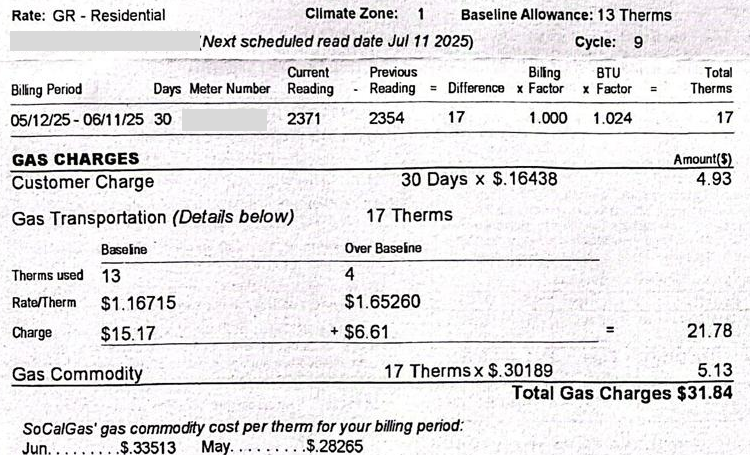
The meter went from 2,354 to 2,371, a difference of 17 ccf. With a billing factor of 1.000 and a heat factor of 1.024, that makes 17 therms. The home's baseline allowance was 13 therms, so the bill splits them: 13 at the baseline rate and 4 above it. Here is the arithmetic on the gas charges:
| Line | Calculation | Amount |
|---|---|---|
| Customer charge | 30 days × $0.164 | $4.93 |
| Transportation, baseline | 13 therms × $1.17 | $15.17 |
| Transportation, over baseline | 4 therms × $1.65 | $6.61 |
| Gas commodity | 17 therms × $0.302 | $5.13 |
| Total gas charges | Sum of the four lines | $31.84 |
The gas charges on the real bill, line by line. A therm is a unit of heat; the bill uses 17 of them for the 30-day period.
The customer charge is $0.164 a day for 30 days, or $4.93, and it is the same whether the home uses 17 therms or none. Transportation is billed in two tiers: 13 therms at $1.17 and 4 therms at $1.65, which comes to $21.78. If all 17 therms had been billed at the baseline rate, transportation would have been $19.84, so crossing the baseline cost $1.94 more. The gas commodity is a single price, $0.302 a therm, on all 17 therms. The bill also prints the commodity price for each month it covers, $0.28265 in May and $0.33513 in June, and the $0.302 sits between the two, because the period spans both months.
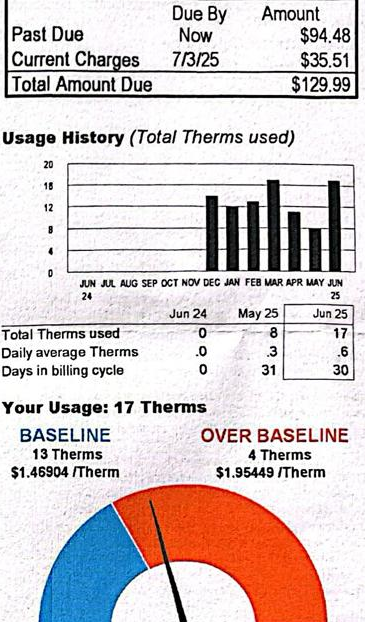
The panel on the right of the bill adds the commodity to each tier, which is the all-in price per therm for that block: $1.17 + $0.302 is $1.46904 for baseline therms, and $1.65 + $0.302 is $1.95449 for over-baseline therms. The bar chart above it is the usage history, and it shows use month by month: in the months with gas use, this home's bars run from about 8 to 17 therms.
The first page of the bill lists current charges of $35.51, which is $3.67 more than the gas charges; the itemized difference is on the second page of the bill, which is not shown here. Dividing the current charges by the therms gives $2.09 per therm all in, and the fixed customer charge alone is about 14% of that month's bill. Compare it with the national table below: in June 2026 the average U.S. home used 18 therms and paid $41.27, which is $2.33 per therm. A different year and a different place, but the same kind of small summer bill.

One more detail from the first page: the total amount due, $129.99, is not what that month's gas cost. It adds the unpaid $94.48 from the previous bill to the new charges of $35.51. To find the price per therm, use the current charges only, as above. If your own bill carries a balance forward, the same applies.
Why does the price per therm change so much?
Because the two halves of the price behave differently. Transportation is regulated and moves slowly, usually when the commission approves a rate change. The commodity moves with the market. In its fact sheet on the winter 2023 bills, the CPUC says the utility passes the gas cost on to customers without a markup, and that the procurement rate in Southern California went from 84 cents a therm in January 2022 to about $3.45 in January 2023, driven by high demand, low storage and pipeline outages. Its table for a household using 64 therms a month shows a Southern California gas bill going from $123.52 to $299.77 between those two Januaries.
There is also a built-in reason that the price per therm is higher in summer, even when the gas is cheap: the fixed customer charge is spread over fewer therms. The table shows the average U.S. home month by month. Use ranged from 15 therms in August 2025 to 137 in January 2026, and the average bill from $37 to $184. The all-in price per therm was lowest in January 2026 ($1.35) and highest in July 2026 ($2.56).
| Month | Use | Average bill | Per therm |
|---|---|---|---|
| August 2025 | 15 therms | $37.19 | $2.53 |
| September 2025 | 16 therms | $37.67 | $2.37 |
| October 2025 | 30 therms | $56.68 | $1.87 |
| November 2025 | 66 therms | $96.15 | $1.45 |
| December 2025 | 116 therms | $157.55 | $1.36 |
| January 2026 | 137 therms | $184.45 | $1.35 |
| February 2026 | 102 therms | $146.65 | $1.44 |
| March 2026 | 68 therms | $105.45 | $1.56 |
| April 2026 | 40 therms | $69.33 | $1.74 |
| May 2026 | 26 therms | $50.40 | $1.91 |
| June 2026 | 18 therms | $41.27 | $2.33 |
| July 2026 | 16 therms | $39.75 | $2.56 |
| 12-month average | 54 therms | $85.21 | $1.57 |
What the average U.S. home with gas service used and paid each month, with the price per therm that results (bill divided by therms). EIA residential data, August 2025 to July 2026 (preliminary). Therms are the EIA's Mcf × 10.37.
The winter swing is why gas is a "winter bill". If your use is the part that looks high, my guides to winter heating costs, what a furnace costs to run and propane vs natural gas heating show what the biggest user in the house, the furnace, adds each month.
How can you check that your gas bill makes sense?
You do not need an account login for this. Everything below is printed on the bill itself, and it takes about ten minutes:
- Check the usage. Subtract the previous meter reading from the current one, multiply by the heat factor, and see that it matches the therms billed.
- Check the dates. Count the days in the billing period, and compare it with last month's. A 33-day period collects more therms than a 28-day one.
- Find the fixed part. The customer charge should be the same every month, adjusted for the number of days. If it changed, look for a rate-change notice from your utility.
- Work out your all-in price. Divide the total of the current charges by the therms, and compare it with the same month last year and with the $1.57 U.S. 12-month average.
- Look for a balance carried over. The amount due can include an earlier unpaid bill, as on the real bill above.
In my opinion, the one number worth tracking is the current charges divided by the therms, month after month. If it jumps while your use stayed flat, the cause is a rate or a balance, not your habits. The same method works for the other bill in the house, and my guide to how to read your electric bill follows it with kWh.
How can you lower a natural gas bill?
The EIA lists a few ways, and they match the lines above. Where customer choice programs exist, you can shop for a lower gas price, which changes the commodity line. A utility's budget plan, where one is offered, spreads the bills evenly through the year, which helps with the winter peak but does not lower the total. Checking that gas heating equipment runs efficiently, lowering the thermostat when nobody is home and getting an energy audit all reduce the therms. Households with limited budgets can look at federal programs such as LIHEAP and the Weatherization Assistance Program, which the EIA also lists; my guide to LIHEAP heating bill assistance explains how that one works.
Gas also runs more than the furnace. In many homes the water heater, the stove and sometimes the dryer burn it too, which is why the therms never fall to zero in summer. My guides to gas vs electric stove cost, what a clothes dryer costs to run and water heater replacement cost cover them. If a line on your bill is still unclear, your utility's customer service can explain it, and your state utility commission is where to take a bill you think is wrong.
How was this calculated?
The monthly use, bills and prices come from the EIA's natural gas data for the 12 months from August 2025 to July 2026 (preliminary data). The average bill is the residential price times the volume delivered, divided by the number of residential customers (2024 count). Therms are the EIA's volume in thousand cubic feet times 10.37, the heat content the EIA gives for 2025, so they are close but not exact for any single home. The price per therm is the bill divided by those therms, so it includes delivery, taxes and fees. The definitions of the two price components come from the EIA, and the tier system, the gas price pass-through and the 2022-2023 figures from the CPUC fact sheet, as listed in the sources. The real bill shown is from June 2025 for a home in Southern California: the amounts are copied from it, and the price per therm is its current charges divided by its therms. Charges, names and taxes vary by state and utility, so your bill may differ. My method for the numbers on this page is in how I research costs.
Frequently asked questions
What is a therm on a gas bill?
A therm is 100,000 British thermal units (Btu) of heat. Your meter counts cubic feet, and the utility converts that volume to therms using the heat content of the gas. In 2025 one ccf (100 cubic feet) held about 1.037 therms, according to the EIA.
How do I convert ccf to therms?
Multiply the ccf by the heat factor printed on your bill, or by about 1.04 if your bill does not show one. The EIA puts the 2025 U.S. average at 1,037 Btu per cubic foot, so 1 ccf is 1.037 therms and 1 Mcf (1,000 cubic feet) is 10.37 therms.
What is the baseline on a gas bill?
A monthly block of therms billed at a lower rate in states that use tiered gas rates, such as California. The size depends on your climate zone and the season. Therms above the baseline are billed at a higher rate, so using less gas keeps more of it at the lower price.
What is the difference between transportation and commodity on a gas bill?
Transportation is the cost of moving the gas by pipeline and delivering it to your home, and it is regulated. The commodity is the gas itself, bought on the market, and its price changes with supply and demand. The EIA names these as the two main components of the price consumers pay.
Why is my gas bill high when I did not use much gas?
Part of the bill is fixed: the customer charge is the same no matter how many therms you use. In a low-use month it is a larger share of the total, and the all-in price per therm goes up. A balance carried over from an earlier bill can also raise the amount due.
How do I calculate my price per therm?
Divide the current charges, not the amount due with any past-due balance, by the therms used in the same billing period. For the average U.S. home, $85.21 divided by 54 therms is $1.57 per therm, the 12-month average through July 2026.
Why is the amount due higher than this month's gas?
The amount due can include a balance carried over from an earlier bill. On the real bill above, the current charges were $35.51, but the total due was $129.99 because of $94.48 unpaid from the previous bill. Use the current charges to work out your price per therm.
Can I choose my natural gas supplier?
In some places, yes. The EIA lists shopping for lower-priced gas as an option where customer choice programs are available. Even then the local utility still delivers the gas and charges for transportation; the choice applies to the commodity.
Sources
- U.S. Energy Information Administration, Natural gas data: prices, consumption and customers by state (August 2025 to July 2026, accessed October 17, 2026)
- U.S. Energy Information Administration, Natural gas explained: Factors affecting natural gas prices (accessed November 11, 2026)
- U.S. Energy Information Administration, FAQ: How do I convert natural gas prices in dollars per cubic feet to dollars per British thermal unit or therm? (2025 heat content; accessed November 11, 2026)
- California Public Utilities Commission, High Gas Bills & Sempra 2023 Gas Rates Increase (fact sheet; accessed November 11, 2026)

Founder and editor, The Cost of Home
I write and check every guide on this site myself, working from public data. The sources behind each number are listed at the end of the article, so you can check them too.