Energy Bills
Time-of-Use Electricity Rates: When Power Is Cheapest
Quick answer
Power is cheapest during a time-of-use plan's off-peak hours, which are often overnight and, on some California and Arizona plans, midday on weekdays. It costs the most in the early evening, commonly from 4 to 9 p.m. Where the peak price is far above the off-peak price, moving an electric car's charging or a dryer load can save real money.
On this page
- What is a time-of-use electricity rate?
- When is electricity cheapest on a time-of-use plan?
- How much cheaper is off-peak power?
- How much can you save by shifting your use?
- How many homes are on time-of-use rates?
- Is a time-of-use plan worth it for you?
- How do you check a plan before you switch?
- How was this calculated?
- FAQ
- Sources
A time-of-use plan (TOU) charges a different price for a kilowatt-hour depending on when you use it. A flat rate charges the same at 3 a.m. and at 6 p.m.; a TOU rate charges more when everyone on the grid wants power at once and less when almost nobody does. The idea sounds simple, but the hours, the prices and the rules around weekends change from one utility to the next, and that is where people go wrong.
This guide uses what four utilities publish on their own rate pages to show when power is cheapest, how big the price gap is, and what a household can save by moving a car charger or a dryer. It also counts how many U.S. homes are on these plans, from the EIA's 2025 data. The EIA collects how many customers are enrolled in time-based rate programs but says it does not publish the peak and off-peak prices themselves, so the prices here come from the utilities. For the other pieces of a bill, see my guide to reading your electric bill.
What is a time-of-use electricity rate?
It is a rate where the price of electricity is tied to the clock. Most plans have two or three price periods: a peak, when the price is highest; an off-peak, when it is lowest; and sometimes a mid-peak or a "super off-peak" in between or below. Seasons can change the prices too, and weekends and holidays can follow different rules. The EIA files TOU under the wider heading of time-based rate programs, along with real-time pricing, variable peak pricing and critical-peak pricing, and counts critical-peak rebate programs next to them.
Utilities say the point is to move use away from the hours when the grid is under the most strain. Seattle City Light, which launched a residential TOU rate in May 2026, says the peak is the time of day when demand is highest, and that shifting use away from it reduces strain on the grid and helps avoid costly infrastructure upgrades. For you, the point is narrower: it only pays if you use more of your electricity in the cheap hours than the average customer does.
When is electricity cheapest on a time-of-use plan?
It depends on the utility. I read the plans of four utilities in different parts of the country, and the cheapest hours are not the same in any two of them.
| Utility | Costliest | Cheapest |
|---|---|---|
| Con Edison (NY) | 8 a.m. to midnight; summer weekdays 2 to 6 p.m. cost the most of all | Midnight to 8 a.m. |
| SDG&E (CA) | 4 to 9 p.m., every day | 10 a.m. to 2 p.m. on weekdays |
| Arizona Public Service | 4 to 7 p.m. on weekdays | 10 a.m. to 3 p.m. on weekdays, November to April bills |
| Seattle City Light (WA) | 5 to 9 p.m., Monday to Saturday | Midnight to 6 a.m., every day |
Price periods on four residential time-of-use plans, as published in November 2026. Con Edison's prices are its delivery charge only; its summer super-peak applies to the supply charge of customers who buy supply from Con Edison. SDG&E's periods are as reported by EnergySage.
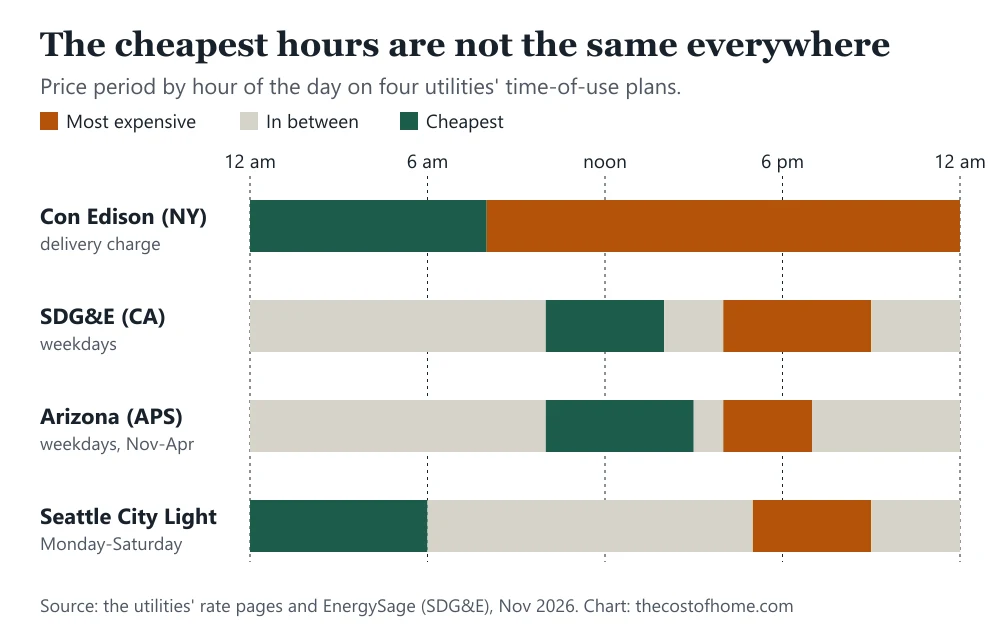
Two patterns stand out. First, the expensive window is almost always in the evening, and it is narrow where the plan is designed to catch the busiest hours: 4 to 7 p.m. in Arizona, 4 to 9 p.m. in San Diego, 5 to 9 p.m. in Seattle. Con Edison's is the long exception, with its higher price running from 8 a.m. to midnight. Second, the cheapest window is overnight in New York and Seattle but at midday in San Diego and, in winter, in Arizona. A habit of running everything overnight is the right move on one of these plans and the wrong one on another.
Weekends and holidays are where plans differ most. Arizona Public Service treats weekends and a list of holidays as off-peak all day. Seattle City Light's peak runs Monday through Saturday, and on Sundays and holidays it prices the whole day from 6 a.m. to midnight at the middle rate, not the lowest. Con Edison says weekends and holidays have the same peak and off-peak delivery prices as weekdays, although the summer super-peak applies only Monday through Friday from 2 to 6 p.m., holidays included. So "run it on Saturday" works in Arizona and not in New York.
How much cheaper is off-peak power?
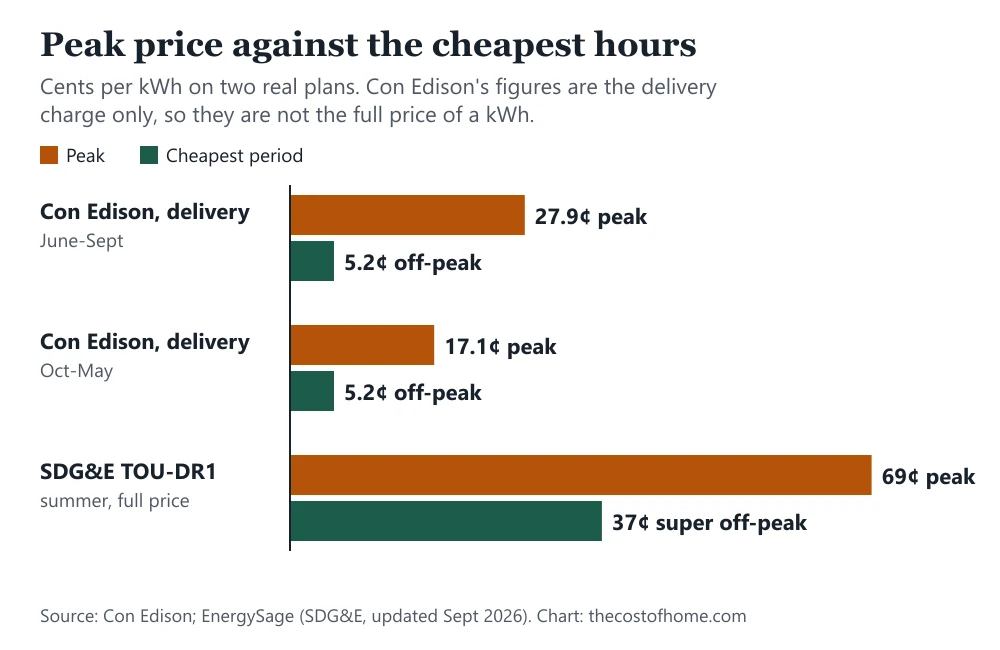
The size of the gap decides whether any of this is worth the effort. On Con Edison's plan the delivery charge is 27.86¢ per kWh at the peak from June through September, 17.11¢ the rest of the year, and 5.22¢ off-peak at any time of year. That makes the peak about 5.3 times the off-peak price in summer and 3.3 times in the other months. It is only the delivery part of the bill. Con Edison buys the energy in competitive markets and passes the cost on without a profit, so the supply charge sits on top and moves with the market.
San Diego's gap is smaller in ratio and larger in cents, because its prices are much higher overall. EnergySage, which lists SDG&E's tariff updated in September 2026, puts the summer price on the default TOU-DR1 plan at 69¢ per kWh at the peak, 46¢ off-peak and 37¢ in the weekday super off-peak window. SDG&E also offers a second plan, TOU-DR, with a lower peak and a higher off-peak price, so the spread is only about 6 cents. The same utility, the same hours, and a reward for shifting that is about four times smaller. That is why reading the plan matters more than choosing to be on one.
| Plan | Peak | Cheapest | Gap | Peak is |
|---|---|---|---|---|
| Con Edison, June to Sept. | 27.86¢ | 5.22¢ | 22.64¢ | 5.3x |
| Con Edison, Oct. to May | 17.11¢ | 5.22¢ | 11.89¢ | 3.3x |
| SDG&E TOU-DR1 | 69¢ | 46¢ | 23¢ | 1.5x |
| SDG&E TOU-DR | 58¢ | 52¢ | 6¢ | 1.1x |
What one kWh costs at the peak and in the cheapest period on two plans, in cents. Con Edison's figures are the delivery charge only. SDG&E's are the full price per kWh in summer 2026 on its TOU-DR1 plan and on its second plan, TOU-DR, against the regular off-peak price; its weekday super off-peak on TOU-DR1 is lower still, at 37¢.
How much can you save by shifting your use?
Multiply the kWh you can move by the gap. I used three gaps taken from the plans above: 12 cents, about Con Edison's delivery gap outside summer; 23 cents, close to both Con Edison's summer gap and SDG&E's peak-to-off-peak gap; and 32 cents, SDG&E's gap between the peak and its super off-peak. The kWh come from my own guides: the average electric car adds about 270 kWh a month in my guide to charging an EV at home, a dryer load uses about 2.1 kWh in my dryer guide, and the average home used about 870 kWh a month over the 12 months ending July 2026. The 20 dryer loads a month, about five a week, are my assumption.
| Load moved | kWh a month | At 12¢ | At 23¢ | At 32¢ |
|---|---|---|---|---|
| Electric car, U.S. average | 270 | $32 | $62 | $86 |
| Clothes dryer, 20 loads | 43 | $5 | $10 | $14 |
| One-tenth of an average home | 87 | $10 | $20 | $28 |
Monthly savings from moving a load out of the peak, at three price gaps in cents per kWh. The kWh are my averages from the guides linked in the text; the gaps are rounded from the plans above. It assumes the load would otherwise run at the peak price, so it is a ceiling.
The car is the big one: about $32 to $86 a month, if the charging would otherwise start at the evening peak. Many chargers and cars can schedule charging, so the work is a one-time setup, and if you already plug in overnight, a plan with an overnight window gives you the cheap hours without changing anything. The dryer is the opposite. Twenty loads a month moved out of the peak saves $5 to $14, so I would treat a delayed start as a convenience, not a budget decision. If you can move a tenth of everything the home uses, the saving is $10 to $28 a month.
The research on how much households actually shift is mixed. A 2025 meta-analysis by Resources for the Future and Berkeley Lab, funded by the Department of Energy, reviewed over 100 utility evaluations and drew on 140 analyses across 39 papers. It estimates that time-based rates cut peak demand by 16% per participant on average, with individual results running from increases in peak demand to cuts of more than 50%. A 16% cut in peak demand is not a 16% cut in the bill, since it measures the hours that are costly, not the total kWh. It is a working paper that has not necessarily been peer reviewed, and the authors say the spread comes from real differences between rate designs.
One finding is practical. Plans offered together with a control technology, such as a smart thermostat, showed a 22 percentage point larger peak demand response in the meta-analysis. That fits what I would expect: the evening peak is when a household cooks, runs the lights and, in summer, the air conditioner, and a thermostat that cools the house before the peak does the shifting without you. My guides to smart thermostat savings and the cost to run central air conditioning show the size of that load.
How many homes are on time-of-use rates?
More than most people think, and the share varies enormously by utility. In the EIA's final 2025 data, 18.4 million residential customers were enrolled in a time-based rate or peak-rebate program, about 13% of the 137.7 million residential customers the EIA counts for the 50 states and D.C. 345 of the 1,215 utilities that serve homes list a residential time-of-use program, and those utilities serve 59% of residential customers. About 8.7 million of the enrolled are at utilities whose only listed program is time-of-use. The EIA's count covers every time-based program together, so it overstates TOU alone, and a customer of a community choice program can be reported by both the program and the utility that delivers the power, so I treat the share as approximate.
| Utility | Enrolled | Share |
|---|---|---|
| Southern California Edison (CA) | 2,680,506 | 58% |
| Consumers Energy (MI) | 1,646,325 | 99% |
| Public Service of Colorado | 1,375,000 | 100% |
| San Diego Gas & Electric (CA) | 1,200,084 | 87% |
| Union Electric (MO) | 931,654 | 85% |
| Arizona Public Service | 746,931 | 58% |
| Pacific Gas & Electric (CA) | 659,141 | 13% |
| Sacramento Municipal (CA) | 583,470 | 97% |
The eight utilities with the most residential customers enrolled in a time-based rate or peak-rebate program in 2025 that list a time-of-use plan, with the enrolled count as a share of their residential customers. The count covers every time-based program the utility reports, not only time-of-use.
Compare that with 2016, when a Berkeley Lab report for the Department of Energy said that most U.S. utilities had fewer than 2% of residential customers on time-based rates, because almost all plans were opt-in. It named Salt River Project in Arizona, with more than 25% of its residential customers on a TOU rate, and Arizona Public Service, with more than 50%, as the exceptions. The 2025 data still show them high, with APS at 58% and Salt River at 34%. Where nearly every customer is counted as enrolled, as at Consumers Energy and Public Service of Colorado, I read that as a sign of an opt-out rollout. The meta-analysis finds that opt-out designs raise enrollment by about 80 percentage points, though the EIA file does not say how each utility enrolled its customers.
Being put on a TOU rate by default is not the same as choosing it, and the response is weaker. The same meta-analysis finds that participants in opt-out programs cut their peak demand by about 9 percentage points less than those who opted in. If your utility has moved you to a TOU rate, nothing changes on your bill until you change when you use power.
Is a time-of-use plan worth it for you?
Not automatically, and the best evidence I found is candid about it. In the Berkeley Lab study of Sacramento Municipal Utility District's TOU pilot, the customers' bills were expected to rise 1.8% to 1.9% on the new rate if they changed nothing. After they adjusted, the volunteers' bills ended 2.6% lower and the customers placed on the rate by default 1.8% lower than the control group, though only the default result was statistically different from zero. Few customers dropped out: 3.9% of the default group and 4.4% of the volunteers.
So a TOU plan usually rewards people who can move something big. In my opinion, three situations make a trial reasonable: you charge an electric car at home, you are out of the house on weekday evenings, or you have a battery or a thermostat that can shift the load for you. It is a harder bet if your biggest use is air conditioning or cooking during the peak and you cannot change either. Plans with a deep overnight discount, like Con Edison's delivery charge, suit people who can run things at night, and plans with a short evening peak, like Arizona's, suit people who can get through three hours.
How do you check a plan before you switch?
Five checks take about ten minutes:
- Read the periods. Write down the peak hours, the seasons, and what happens on weekends and holidays. They differ more than the prices do.
- Check the fixed rules. Con Edison's TOU plan has a $21.00 monthly customer charge and requires a year on the plan, and after you go back to the standard rate you cannot rejoin for 18 months. Ask your utility about any minimum stay or fee.
- Use the utility's own estimator. Seattle City Light's Energy Insights tool compares bill estimates under each rate, and Arizona Public Service has an Energy Estimator for its plans.
- Start from your last 12 months of bills. My guide to why your electric bill is so high lists the big loads to look for, and the average bill by state shows what is typical where you live.
- Ask about bill protection. Some utilities charge the lower of the old and new bill for a period. The meta-analysis notes this is common in pilots, and that it is estimated to raise enrollment by about 23 percentage points, though the estimate is uncertain, while lowering the response of participants.
If you do switch, give it a full season before you decide. The price of a kWh also changes with where you live, as the electricity prices by state guide shows, and a plan that saves money in one place can cost more in another.
How was this calculated?
Enrollment is from the EIA-861 annual survey for 2025 (final data released in October 2026): the Dynamic Pricing file gives the residential customers enrolled in time-based rate or peak-rebate programs and which program types each utility offers, and the Sales to Ultimate Customers file gives residential customers, counted once by the utility that delivers the power, so energy-only sellers are not counted twice. Residential customers are the bundled and delivery-only customers of the 50 states and D.C. The utility table keeps utilities that list a TOU program and whose enrolled count does not exceed their own customers; Baltimore Gas and Electric, the fifth largest enrolled count overall, is left out because its only listed program is a rebate, and community choice programs are left out because the file reports no customers for them.
Windows and Con Edison's prices are from the utilities' pages as I read them on November 13, 2026. The SDG&E, PG&E and Southern California Edison pages would not open for automated reading, so for SDG&E I used EnergySage's summary of the tariff, and I did not use PG&E or Southern California Edison prices. Prices change when a utility files a new tariff. The savings table is my arithmetic: kWh moved times the price gap, with the kWh and assumptions described above.
Frequently asked questions
What are the peak hours for electricity?
There is no single answer, because each utility sets its own. Among the plans I read, the costliest hours are 4 to 7 p.m. on weekdays at Arizona Public Service, 4 to 9 p.m. every day at SDG&E, 5 to 9 p.m. Monday through Saturday at Seattle City Light, and 8 a.m. to midnight on Con Edison's delivery charge. Check your utility's rate page.
What time of day is electricity cheapest?
On the plans I read, it is overnight in New York (Con Edison, midnight to 8 a.m.) and Seattle (midnight to 6 a.m.), and midday at SDG&E (10 a.m. to 2 p.m. on weekdays) and, for winter bills, at Arizona Public Service (10 a.m. to 3 p.m. on weekdays).
Is a time-of-use plan cheaper than a flat rate?
Not automatically. In a Berkeley Lab study of a Sacramento utility's pilot, customers' bills were expected to rise about 1.8% to 1.9% if they did not change when they used power, and ended up 1.8% to 2.6% lower after they adjusted. It pays most when you can move a large load, such as an electric car, out of the peak.
Are weekends cheaper on a time-of-use plan?
It depends on the plan. Arizona Public Service treats weekends and listed holidays as off-peak, Seattle City Light's peak runs Monday through Saturday and prices Sundays and holidays at its middle rate, and Con Edison applies the same peak and off-peak delivery periods to weekends and holidays as to weekdays.
How many homes are on time-of-use rates?
In the EIA's final 2025 data, 18.4 million residential customers, about 13% of the total, were enrolled in a time-based rate or peak-rebate program. The count includes every program type, not only time-of-use, and 345 of 1,215 utilities serving homes list a residential TOU plan.
How much does the peak price differ from the off-peak price?
On Con Edison's delivery charge the peak is 27.86¢ per kWh in summer and 17.11¢ the rest of the year against 5.22¢ off-peak. On SDG&E's TOU-DR1 plan in summer it is 69¢ at the peak against 46¢ off-peak and 37¢ super off-peak, according to EnergySage.
Can I switch back from a time-of-use rate?
The rules are the utility's. Con Edison requires one year on its time-of-use plan, and after you return to the standard rate you cannot rejoin for 18 months, unless you buy your energy from an energy service company. Ask your utility about any minimum stay before you switch.
Sources
- U.S. Energy Information Administration, Form EIA-861 detailed data files, 2025 (final, released October 2026): Dynamic_Pricing_2025 and Sales_Ult_Cust_2025 (accessed November 13, 2026)
- U.S. Energy Information Administration, "Does EIA publish electric utility rate, tariff, and demand charge data?": EIA publishes enrollment in time-based rate programs, not peak and off-peak prices (accessed November 13, 2026)
- Kahn-Lang, Zhu, Palmer and Cappers, "Different Prices for Different Slices: A Meta-Analysis of Time-Based Electricity Rates," Resources for the Future Working Paper 25-04, February 2025, funded by the U.S. Department of Energy through Lawrence Berkeley National Laboratory (accessed November 13, 2026)
- Cappers et al., "Time-of-Use as a Default Rate for Residential Customers: Issues and Insights," Lawrence Berkeley National Laboratory, June 2016, for the U.S. Department of Energy: Sacramento Municipal Utility District study, drop-out rates and bill effects (accessed November 13, 2026)
- Con Edison, Time-of-Use: residential periods, delivery and super-peak prices, $21.00 monthly customer charge and enrollment rules (page dated October 23, 2026; accessed November 13, 2026)
- Arizona Public Service, Compare Service Plans: Time-of-Use 4 p.m.-7 p.m. weekdays, off-peak holidays and winter super off-peak hours (accessed November 13, 2026)
- Seattle City Light, "Introducing our New Time of Use Rate," Powerlines blog, May 4, 2026: peak, mid-peak and off-peak hours and the Energy Insights tool (accessed November 13, 2026)
- EnergySage, "SDG&E peak hours: what you need to know in 2026," updated September 16, 2026: SDG&E TOU-DR1 and TOU-DR windows and summer prices (secondary source; SDG&E's own site blocked automated access; accessed November 13, 2026)

Founder and editor, The Cost of Home
I write and check every guide on this site myself, working from public data. The sources behind each number are listed at the end of the article, so you can check them too.