Heating & Cooling
How Much Can a Smart Thermostat Save?
Quick answer
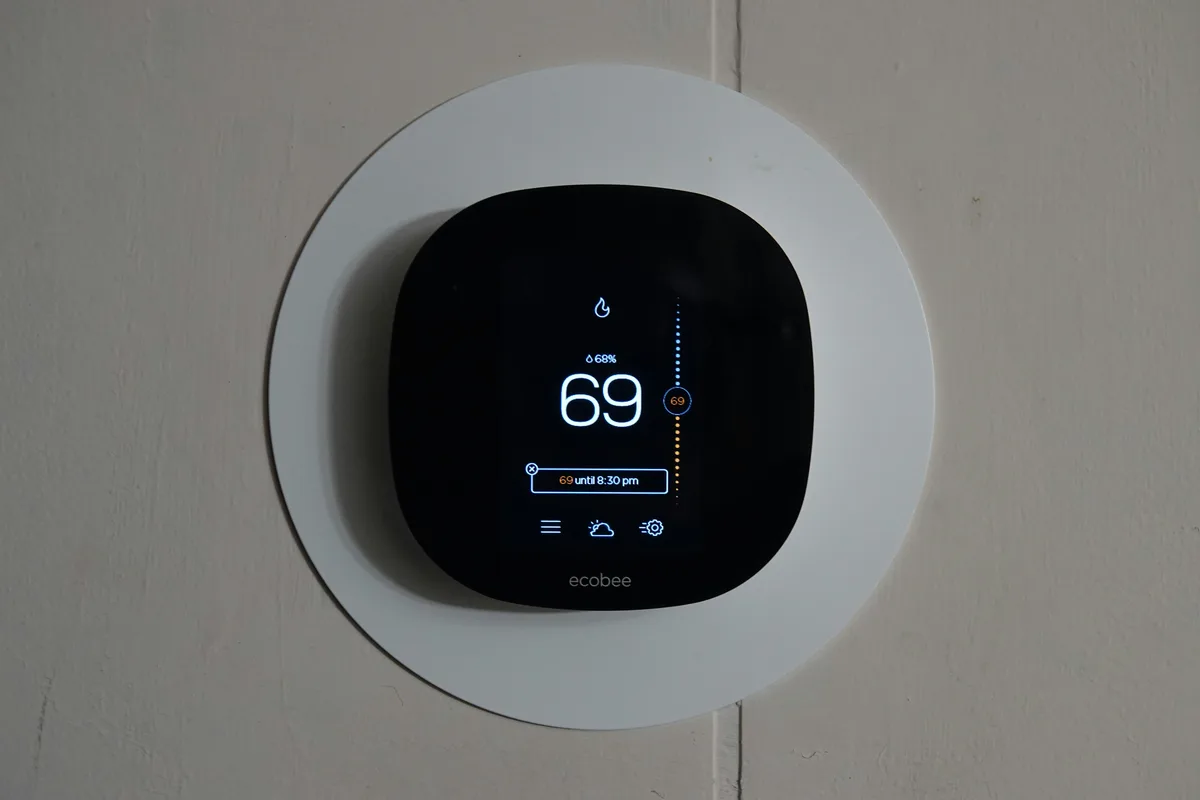
Studies of real homes mostly find that a smart thermostat saves roughly 3% to 10% of the heating and cooling bill, and some homes save nothing. On the average U.S. bill of $757 that is about $30 to $76 a year. ENERGY STAR certifies a model only if it cuts run time by at least 8% in heating and 10% in cooling, so a $140 to $280 thermostat pays for itself in about 2 to 9 years.
On this page
- How much can a smart thermostat save a year?
- How many dollars is that on a real heating and cooling bill?
- Does a smart thermostat pay for itself?
- Why do the studies disagree so much?
- Who saves the most, and who saves little?
- Does a smart thermostat work with a heat pump or electric heat?
- Is a smart thermostat better than a programmable one?
- How do I get the most out of a smart thermostat?
- How was this calculated?
- FAQ
- Sources
A smart thermostat costs between $140 and $280 in the makers' own online stores, and what it saves is a small percentage of one part of your bill. Whether that adds up to a good buy depends on two things: how big your heating and cooling bill is, and how much of it you waste today by leaving the temperature alone.
Here I put dollars on what the studies found. I read the ENERGY STAR rules for smart thermostats, a utility analysis of real bills in Oregon, a metered field study in Florida and the Department of Energy's advice, then ran the percentages against what the EIA says homes spend on heating and cooling. For where the rest of your bill goes, see my guide to why your electric bill is so high.
How much can a smart thermostat save a year?
The sources do not agree on one number, and the gap between them is the useful part. ENERGY STAR sets the floor: to carry its label, a smart thermostat has to show, in a year of data from hundreds of customers' homes, a cut in heating run time of at least 8% and in cooling run time of at least 10%. That is the lower 95% confidence limit of the national average. The second test is harder on the weak performers: the average of the 20th percentiles has to reach 4% for heating and 5% for cooling, which means four out of five homes in the sample saved at least that much.
| Source | Savings | Homes |
|---|---|---|
| ENERGY STAR floor | 8% heating, 10% cooling | Hundreds per maker |
| Oregon bills | 4% gas, 2% electricity | 924 gas-heated |
| Florida meters | 9.6% cooling, 9.5% heating | 22 |
| DOE tip | Up to 10% | None (a setback example) |
What each source found. ENERGY STAR's figures are the minimum a certified model must show, as a cut in heating and cooling run time against a home with no setback, measured in real homes. The Oregon figures are changes in utility bills; the Florida figures are metered (average of 22 homes); the DOE figure is a tip, not a measurement. Heating and cooling are combined where a source does not split them.
Run time is not the same as dollars, and the baseline matters. According to the Lawrence Berkeley National Laboratory and EPA researchers who studied the program, ENERGY STAR measures the cut against a self-referential baseline that assumes no setback or setup at all. A household that already turns the heat down every night starts closer to the finish line, so the label's percentage is the saving you can expect only if you currently hold one temperature around the clock.
Bills tell a quieter story. Energy Trust of Oregon had Recurve Analytics compare the usage of 924 gas-heated homes before and after a smart thermostat, against similar homes without one. Gas fell by about 28 therms a year, 4% of the 713 therms those homes used, and electricity fell by about 202 kWh, 2% of the 8,675 kWh used. The memo rates the gas result as high confidence. Among Nest owners the gas saving was 4%; among the 146 ecobee homes it was 6%, which the memo calls less certain because the group is small.
How many dollars is that on a real heating and cooling bill?
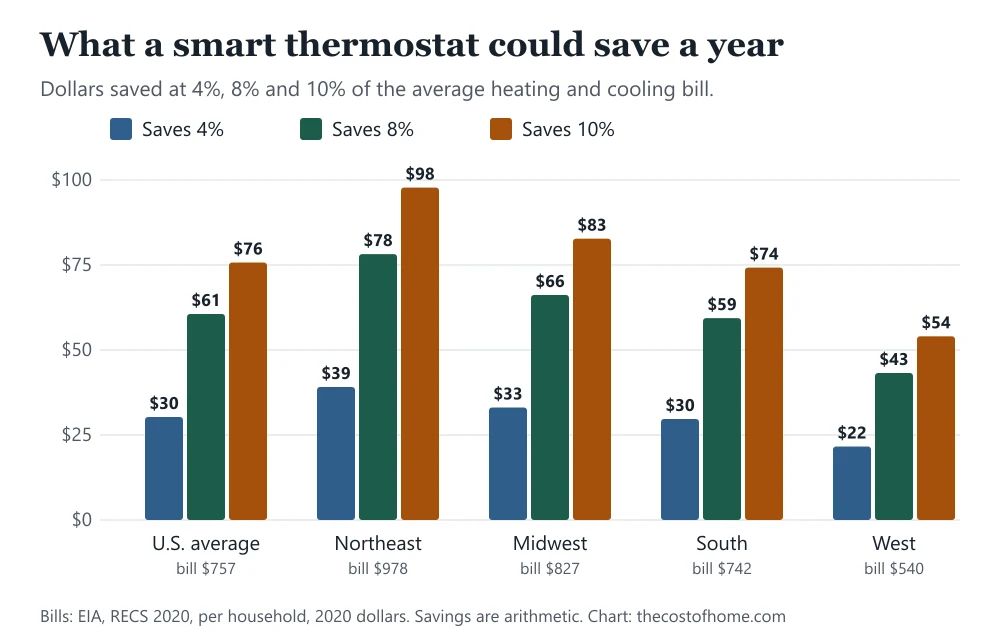
It depends on the bill you start with. The EIA's 2020 survey puts the average household's spending on space heating and air conditioning at $757 a year, which I worked out the same way as in my attic insulation guide. ENERGY STAR cites a higher figure, more than $900 a year for the average American household, and prices have moved since 2020, so your own bill may be well above $757. At $900, 4% to 10% is $36 to $90.
| Region | Bill | Saves 4% | Saves 8% | Saves 10% |
|---|---|---|---|---|
| U.S. average | $757 | $30 | $61 | $76 |
| Northeast | $978 | $39 | $78 | $98 |
| Midwest | $827 | $33 | $66 | $83 |
| South | $742 | $30 | $59 | $74 |
| West | $540 | $22 | $43 | $54 |
The average bill for heating plus air conditioning in 2020 (the region's total spending spread over all its homes), and what a smart thermostat would save at 4%, 8% and 10% of it. Savings are my arithmetic, not a measurement. Source: EIA, RECS 2020, Tables CE3.6 to CE3.10 (2020 dollars).
The Northeast has the biggest bill, $978, because heating there costs about $760 per household; a 10% saving is $98. In the West, where winters and summers are milder, the average bill is $540 and the same 10% is $54. The South splits its bill almost evenly: about $360 of the $742 goes to air conditioning.
The Oregon study lets me price a measured result. At today's U.S. average prices (see my natural gas and electricity price guides), 28 therms of gas is about $44 and 202 kWh of electricity about $36. That is roughly $80 a year for a gas-heated home with central air, my arithmetic, and it sits inside the 4% to 10% range of dollars in the table.
Does a smart thermostat pay for itself?
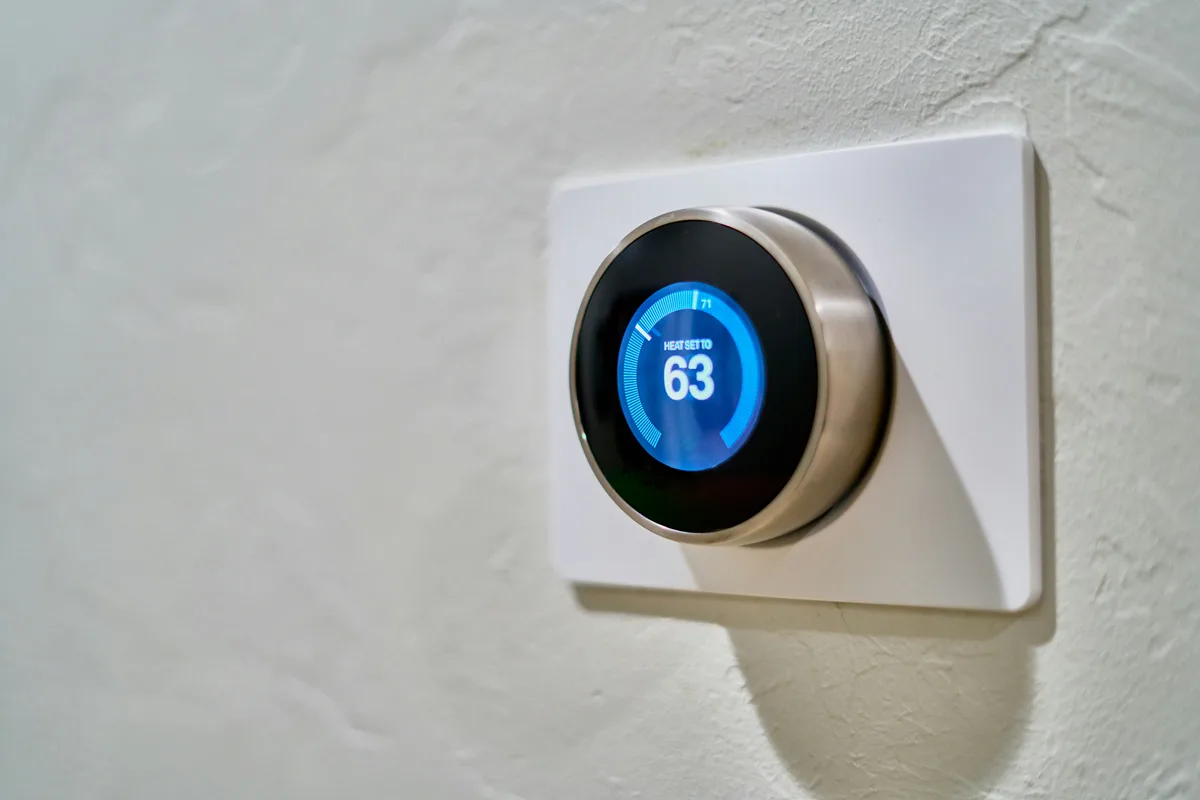
Usually, yes, and the wait depends on which model you buy and how much heating and cooling you do. On November 7, 2026, the list prices in the makers' own online stores were $139.99 for the ecobee Smart Thermostat Essential, $199.99 for the Enhanced, $259.99 for the Premium and $279.99 for the Google Nest Learning Thermostat (4th gen), which the Google Store was selling for $219.99 that day. Sale prices come and go, so check the store before you buy.
| Price | At 4% | At 8% | At 10% |
|---|---|---|---|
| $140 | 4.6 years | 2.3 years | 1.8 years |
| $200 | 6.6 years | 3.3 years | 2.6 years |
| $260 | 8.6 years | 4.3 years | 3.4 years |
| $280 | 9.2 years | 4.6 years | 3.7 years |
Years to earn back the price of a thermostat, at the average U.S. bill of $757 and savings of 4%, 8% or 10% ($30, $61 and $76 a year). Prices are rounded from the list prices in the makers' online stores on November 7, 2026; installation and rebates are not included. Simple payback is my arithmetic.
At the average U.S. bill, the best case in the table is 1.8 years: the cheapest model at a 10% saving. The worst is 9.2 years: the most expensive model at 4%. I left installation out of the price. Many people put a thermostat in themselves, and if you hire an electrician, add the fee to the price column. The Florida researchers, working with the $250 Nest of 2016, estimated a simple payback of 4 years. Rebates can shorten the wait: ENERGY STAR runs a rebate finder, where its partners list rebates on certified products.
Why do the studies disagree so much?
Because they start from different homes and habits. The Florida Solar Energy Center measured 22 homes with a Nest, hour by hour, with a full year of data from before the install. Cooling fell by 9.6% on average (498 kWh a year), but the median was 6.3% (219 kWh), and 6 of the 22 homes used more cooling energy afterwards. The authors tie that mostly to what people did before: a home that already used a programmable thermostat well has little left to save, while one with a lot of empty hours saves more. They also found that turning off the thermostat's away function hurt the result.
A second reason is that most people do not use the automatic part. In the EIA's 2020 survey, 12.8 million homes had a smart thermostat and 52.6 million a programmable one, 65.4 million together. Only 19.8 million homes said their programmable or smart thermostat adjusts the heat on its own, and 16.6 million said so for air conditioning. Set against 65.4 million, the heating figure is about 3 in 10 homes, my arithmetic; the EIA's bases are not identical, so read it as a rough ratio. Across all homes, 50.7 million said they set one temperature and leave it there most of the time, and 31.0 million said they adjust it by hand.
| Thermostat | Homes | Share |
|---|---|---|
| Smart or internet-connected | 12.8 million | 10% |
| Programmable | 52.6 million | 43% |
| Not programmable | 44.1 million | 36% |
| None | 12.7 million | 10% |
| No heating or cooling in use | 1.4 million | 1% |
What U.S. homes had in 2020, out of 123.5 million housing units. Percentages are my arithmetic. Source: EIA, RECS 2020, Table HC6.1.
A third reason is that predictions run high. The Berkeley Lab researchers who tested occupancy-sensing thermostats in three university residence halls (not homes) saw 0% to 9% savings in cooling and 5% to 8% in heating during the school term, against the 10% to 25% and 20% to 50% a pre-install energy model had predicted. The ENERGY STAR savings are real, but they are the measured gain over a no-setback baseline, and your bill decides how much of it you keep.
Who saves the most, and who saves little?
The homes that gain are the ones that heat or cool an empty house all day, or never turn the temperature back at night. Add a big bill in a cold or hot climate and the dollars grow. The homes that gain little are the ones that already turn the temperature down by hand, or that have a small bill. In my opinion, the question to ask before buying is not "is it smart?" but "what is my heating and cooling bill, and how often is the house empty or asleep?"
The bill itself is where to look first. My furnace cost guide and my central air guide show what each side of it costs, and this winter's forecast shows whether it is going up.
Does a smart thermostat work with a heat pump or electric heat?
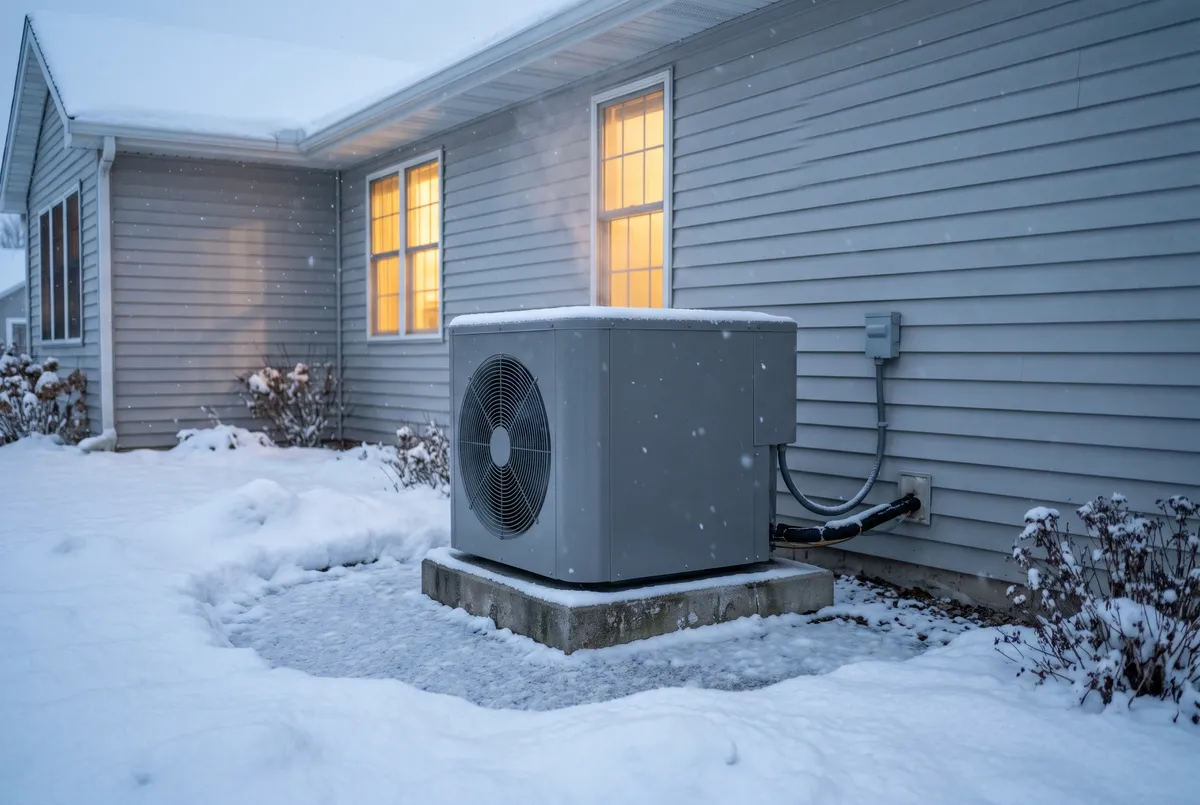
It can, with a caution. The DOE says that if you have a heat pump, you should not turn the thermostat down for hours without a smart or programmable thermostat designed for heat pumps, and ENERGY STAR makes its certified thermostats report how much electric resistance heat they use for heat pump installations, and its buying tips say to check that the thermostat is compatible with your heating and cooling system.
The Oregon study also looked at 77 homes with electric heat and found no saving; their use rose by about 194 kWh a year, 2%. The memo calls this too small a sample to be sure, with poor precision, and says the result is far from definitive. I would read it as a reason to check compatibility before assuming electric-heated homes save as much as gas-heated ones. If you are weighing a bigger change, my heat pump vs. gas furnace comparison has the numbers.
Is a smart thermostat better than a programmable one?
It is easier to live with, and the DOE says as much: smart thermostats are generally easier to use and have more reporting and interactive features, while programmable ones need to be set up to change the temperature on a schedule, usually do not have interactive features, and cost less. The Florida paper cites older research finding that only about one in four households programmed a programmable thermostat, and one Florida utility study found programmable homes using more cooling than homes with manual thermostats, because people on the manual ones adjusted them more.
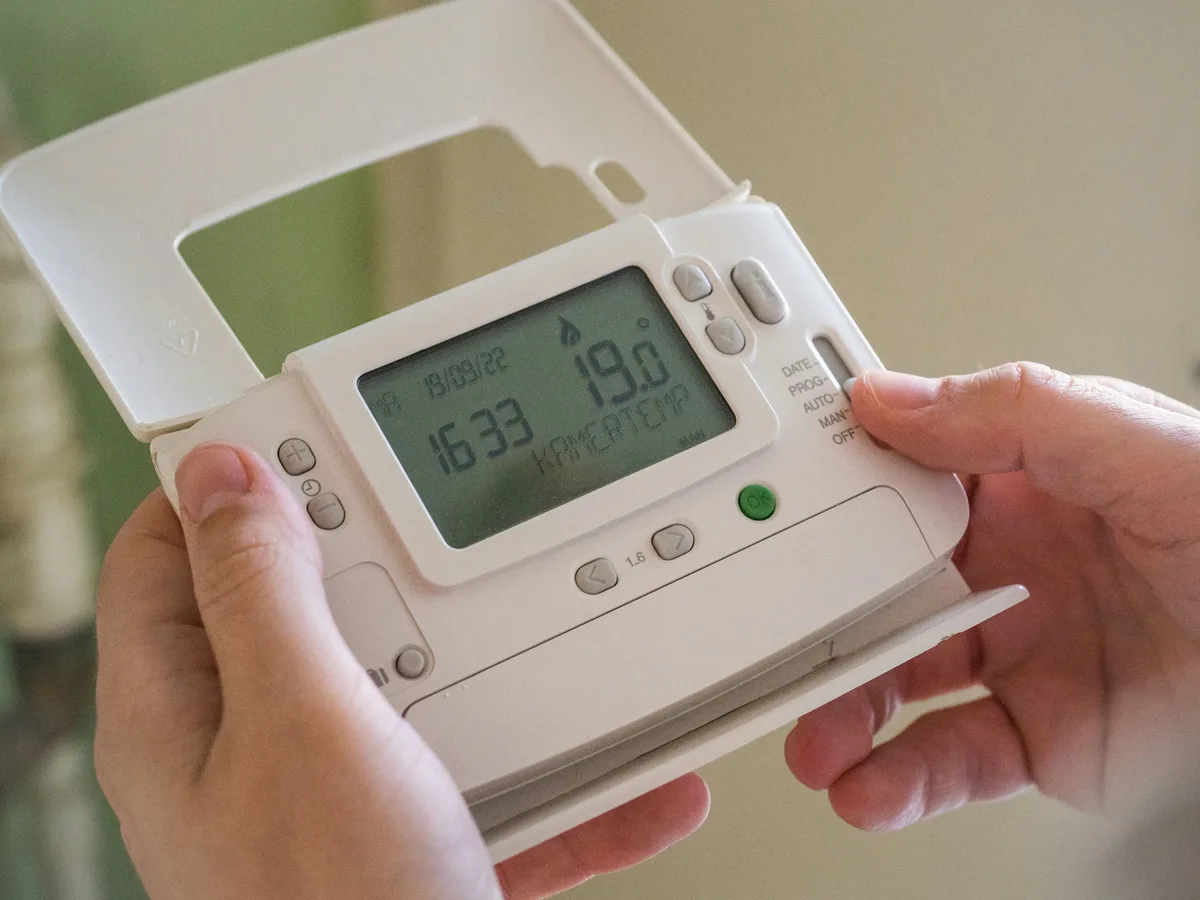
So the thermostat that saves money is the one that gets a schedule. If you will set it once and leave it, a programmable thermostat at a lower price does the same job. In my opinion, a smart thermostat earns its extra cost when the schedule is hard to predict, when you want to change the temperature from your phone, or when you have never made a schedule stick.
How do I get the most out of a smart thermostat?
- Pick a setback and keep it. The DOE's example is a setback of 7°F to 10°F lasting 8 hours a day: lower in the cold months, higher in the warm ones. It says that can take up to 10% off the year's bill.
- Leave away mode on. The Florida study found that turning the away function off cut the savings.
- Raise the setting in summer when you can. The DOE says to set the thermostat as high as is comfortable when you are home and awake, and it says a ceiling fan makes about 4°F more feel the same.
- Check compatibility first. ENERGY STAR says the thermostat has to work with your heating and cooling system, and that Wi-Fi models need a signal where they are mounted.
- Use the usage data. ENERGY STAR certified models report heating and cooling run time, so you can see which month used the most.
A certified smart thermostat also has to keep working as a basic thermostat when the internet drops. For the rest of the house, attic insulation and a newer furnace change the bill by more than a thermostat does, and my Heating & Cooling section has the other guides.
How was this calculated?
The percentages come from the sources named in the text: the ENERGY STAR Smart Thermostats key product criteria (read November 7, 2026), the Energy Trust of Oregon memo of February 7, 2020 on the Recurve analysis (installs from 2015 to 2017, forced-air homes, monthly bills compared with matched homes and with later buyers), and the Florida Solar Energy Center paper from the 2016 ACEEE Summer Study. The dollar figures are my arithmetic: 4%, 8% and 10% of the EIA's 2020 average heating plus cooling spending per household, in 2020 dollars. I chose 4% because it is the Oregon gas result and the ENERGY STAR heating floor for the weaker performers, 8% because it is the heating floor, and 10% because it is the cooling floor and the top of the DOE's example.
The Oregon dollars multiply 28 therms at $1.58 per therm and 202 kWh at 18.0 cents per kWh, the U.S. averages I use in my other guides (EIA, 12 months to July 2026). The payback table divides the price by the yearly saving at the average U.S. bill. Thermostat prices are the list prices on the Google Store and ecobee pages on November 7, 2026. The thermostat counts and control figures come from tables HC6.1 and HC7.1 of the EIA's 2020 household survey, which is older than today's market. Meier, Daken and Rainer write that connected thermostats now take about half of annual thermostat sales, so the share of smart ones is probably higher now. For how I pick and check every source, see how I research costs.
Frequently asked questions
How much does a smart thermostat save per year?
Roughly 3% to 10% of the heating and cooling bill in studies of real homes, which is about $30 to $76 a year on the average U.S. bill of $757. Some homes save nothing. ENERGY STAR certifies a model only if it cuts run time by at least 8% for heating and 10% for cooling.
Does a smart thermostat pay for itself?
Usually, in about 2 to 9 years at the average U.S. bill and list prices of $140 to $280. A cheaper model at a 10% saving pays back in about 1.8 years; the most expensive at 4% takes about 9.2. A bigger bill or a rebate shortens it.
Is a smart thermostat worth it in a mild climate?
Often not for the savings alone. The bill is smaller, so the same percentage is fewer dollars: the average Western household spent $540 on heating and cooling in 2020, and 10% of that is $54. Convenience and remote control may still be worth it to you.
Do smart thermostats work with heat pumps?
Many do, but check compatibility first. The Department of Energy says not to turn a heat pump thermostat down for long periods without a smart or programmable thermostat designed for heat pumps. ENERGY STAR certified models also report how much resistance heat they use with a heat pump.
Is a smart thermostat better than a programmable thermostat?
It is easier to use and has more features, according to the DOE, but a programmable thermostat costs less and saves just as much if you set a schedule. Only about one in four households programmed theirs, in older research cited by Florida researchers.
What does ENERGY STAR certified mean for a smart thermostat?
The thermostat has to show, with a year of data from real homes, at least 8% less heating run time and 10% less cooling run time against a no-setback baseline. It also has to keep working as a basic thermostat without internet, offer a schedule and report energy use.
Do smart thermostats save electricity or gas?
Both, in a gas-heated home. In Oregon, homes with gas heat saved about 28 therms of gas (4%) and 202 kWh of electricity (2%) a year. Electrically heated homes in that study showed no saving, but the sample was small.
Sources
- ENERGY STAR, Smart Thermostats Key Product Criteria: required features and the heating and cooling run-time savings criteria (accessed November 7, 2026)
- ENERGY STAR, Smart Thermostats: features and buying tips (accessed November 7, 2026)
- U.S. Department of Energy, Tips on Saving Money and Energy in Your Home (2022 edition; smart and programmable thermostats, cooling tips; accessed November 7, 2026)
- Energy Trust of Oregon, Summary of Recurve Residential Smart Thermostat Impact Analysis (memo of February 7, 2020; accessed November 7, 2026)
- Parker, Sutherland and Chasar (Florida Solar Energy Center), Evaluation of the Space Heating and Cooling Energy Savings of Smart Thermostats in a Hot-Humid Climate using Long-term Data, ACEEE Summer Study 2016 (accessed November 7, 2026)
- Meier, Daken and Rainer (Lawrence Berkeley National Laboratory and EPA), Long-term trends in connected thermostat performance, eceee Summer Study 2022 (accessed November 7, 2026)
- Pritoni, Woolley and Modera (Lawrence Berkeley National Laboratory), Do occupancy-responsive learning thermostats save energy? A field study in university residence halls, Energy and Buildings, 2016 (accessed November 7, 2026)
- U.S. Energy Information Administration, 2020 Residential Energy Consumption Survey, table HC6.1: space heating in U.S. homes, including thermostat type and heating control (accessed November 7, 2026)
- U.S. Energy Information Administration, 2020 Residential Energy Consumption Survey, table HC7.1: air conditioning in U.S. homes, including air-conditioning control (accessed November 7, 2026)
- U.S. Energy Information Administration, RECS 2020, Tables CE3.6 to CE3.10: annual household end-use expenditures, U.S. and Census regions (2020 dollars; accessed October 25, 2026)
- Google Store, Nest Learning Thermostat (4th gen): price (accessed November 7, 2026)
- ecobee, Smart Thermostats: prices of the Essential, Enhanced and Premium models (accessed November 7, 2026)
- U.S. Energy Information Administration, Form EIA-861M: monthly sales, revenue and customers by state (August 2025 to July 2026, accessed October 15, 2026)
- U.S. Energy Information Administration, Natural Gas Prices: residential price by state (accessed October 17, 2026)

Founder and editor, The Cost of Home
I write and check every guide on this site myself, working from public data. The sources behind each number are listed at the end of the article, so you can check them too.