Heating & Cooling
Heating Oil Costs This Winter: What Will a Tank Fill Cost?
Quick answer
A full 275-gallon tank of heating oil, about 250 gallons, costs roughly $1,479 at the U.S. average of $5.92 a gallon in the EIA's weekly survey for November 9, 2026. A year earlier the same fill was about $930. The EIA expects the average oil-heated home to burn about 397 gallons this winter and spend about $2,179, 25% more than last winter.
On this page
- How much does heating oil cost per gallon right now?
- How much does it cost to fill a heating oil tank?
- How much will a winter of heating oil cost?
- Why did heating oil prices jump this year?
- How much does heating oil cost in each state?
- Is heating oil more expensive than gas, propane or electricity?
- What can you do about a higher heating oil bill?
- How was this calculated?
- FAQ
- Sources
Most people who heat with oil do not see a monthly bill. They see a delivery: a truck fills the tank, the driver hands over a slip, and the price is whatever the gallon cost that day. This fall that slip got a lot bigger. The EIA's weekly survey put the U.S. average residential price at $5.92 a gallon on November 9, 2026, against $3.72 on the same Monday last year, a rise of 59%.
This guide turns the EIA's prices into what you pay at the tank: the cost of one fill by tank size, the EIA's estimate for a whole winter, the price in 21 states, and how oil compares with gas, propane and electricity for the same heat. If you heat with oil, it also helps to know the numbers around it in my guide to winter heating costs and my monthly furnace cost guide.
How much does heating oil cost per gallon right now?
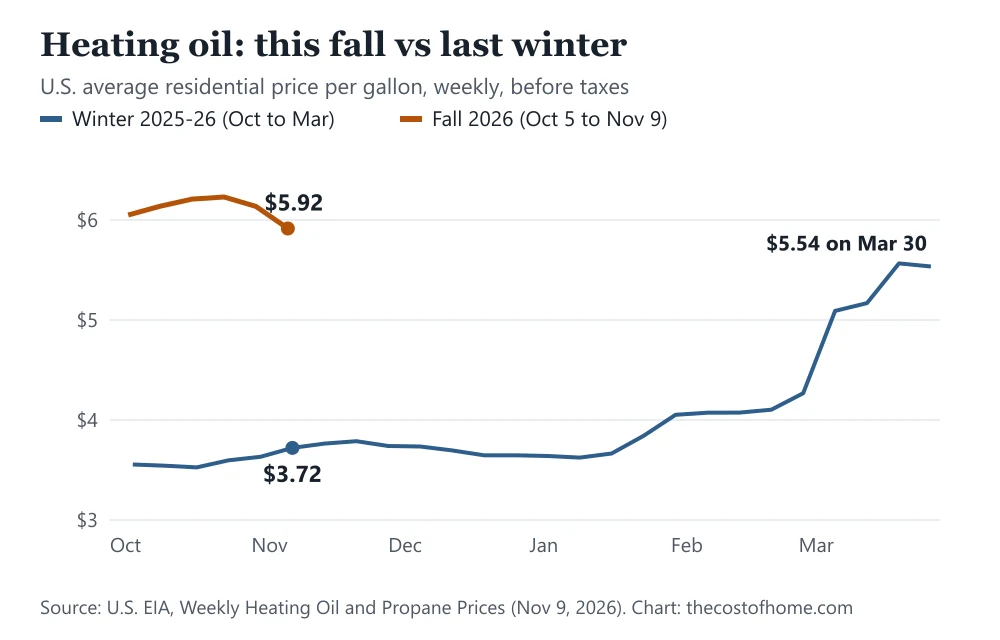
The EIA surveys residential heating oil prices every week from October through March. For the week of November 9, 2026, the U.S. average was $5.92 a gallon before taxes. That is below the fall high of $6.23 on October 26, down 5% in two weeks, and still 59% above a year ago. Last winter's weekly prices averaged $4.09 from November to March, and they were not flat: they stayed between about $3.50 and $3.85 through January, passed $4 in February, and jumped from $4.27 on March 2 to $5.09 on March 9, ending the survey at $5.54 on March 30. This fall's prices started above where last winter's ended.
| Region | Nov 9, 2026 | Nov 10, 2025 | Change | Last winter |
|---|---|---|---|---|
| U.S. average | $5.92 | $3.72 | +59% | $4.09 |
| East Coast | $5.92 | $3.73 | +59% | $4.12 |
| New England | $5.84 | $3.65 | +60% | $4.06 |
| Central Atlantic | $6.00 | $3.82 | +57% | $4.19 |
| Lower Atlantic | $5.83 | $3.53 | +65% | $3.79 |
| Midwest | $5.75 | $3.56 | +62% | $3.57 |
The EIA's weekly residential heating oil price, in dollars per gallon before taxes, for the U.S. average and five regions. "Last winter" is the average of the weekly prices from November 2025 to March 2026.
The East Coast, where most oil-heated homes are, matches the national figure almost to the cent, because the U.S. average is weighted toward the Northeast. The Central Atlantic region (Delaware, D.C., Maryland, New Jersey, New York and Pennsylvania) is the dearest at $6.00. The Midwest is the cheapest of the five at $5.75, though it also rose 62%.
How much does it cost to fill a heating oil tank?
A fill is the gallons the driver pumps times the price per gallon. Tank size matters here. PickHVAC lists the common residential sizes as 275, 330, 500 and 550 gallons, and says a heating oil company normally fills a tank to about 90% of its nominal size to leave room for the oil to expand when it warms. That makes a "full" 275-gallon tank about 250 gallons, a 330 about 300, a 500 about 450 and a 550 about 500.
| Tank | Usual fill | At $5.92 | At $5.50 | A year ago |
|---|---|---|---|---|
| 275-gallon | 250 gallons | $1,479 | $1,374 | $930 |
| 330-gallon | 300 gallons | $1,775 | $1,649 | $1,116 |
| 500-gallon | 450 gallons | $2,662 | $2,473 | $1,674 |
| 550-gallon | 500 gallons | $2,958 | $2,748 | $1,861 |
| Any tank | 100 gallons | $592 | $550 | $372 |
What one fill costs at the EIA's U.S. average price. A heating oil company usually fills a tank to about 90% of its nominal size, so the gallons in the second column are what a delivery brings a tank to when it starts nearly empty. The forecast column uses the EIA's average for this winter, $5.50 a gallon.
A 275-gallon tank that is nearly empty costs about $1,479 to fill at the national average, $549 more than the same fill a year ago. A 500-gallon tank costs about $2,662. The middle column shows what the same fills cost at the $5.50 the EIA expects for the winter as a whole, which is lower than the current weekly price. Neither number is a quote: your supplier sets its own price, and the delivered price depends on the day you order and how much you take.
How much will a winter of heating oil cost?
For a whole winter the EIA gives a household figure. In the version of its Winter Fuels Outlook updated with the November 10 Short-Term Energy Outlook, it expects a home that heats mainly with oil to use about 397 gallons from November through March, at an average of $5.50 a gallon, for a bill of about $2,179. That is 25% more than last winter's $1,748, even though the EIA expects less oil to be burned (11% fewer gallons) because the winter is forecast to be milder.
| Measure | Last winter | This winter | Change |
|---|---|---|---|
| Gallons used | 444 | 397 | -11% |
| Price per gallon | $3.94 | $5.50 | +39% |
| Spending | $1,748 | $2,179 | +25% |
| If the winter is warmer | — | $2,036 | +16% |
| If the winter is colder | — | $2,390 | +37% |
The EIA's estimate for the average household that heats mainly with heating oil, November to March. Last winter is the EIA's current estimate; this winter is its forecast in the version updated with the November 2026 Short-Term Energy Outlook.
The EIA's October version of the outlook estimated a $5.26 price and a 21% rise in oil spending; the November update raised both. The forecast average is also below this week's $5.92. If the price stayed where it is now for the whole winter, the same 397 gallons would cost about $2,345. The EIA notes that its household figures assume homes pay the prevailing retail price at the time they use the oil, and that they do not account for fuel bought ahead of the winter or contracted at a price set earlier. If you pre-bought or locked a price, your own bill can differ in either direction.
In fills, the average household would use about 1.6 fills of a 275-gallon tank over the winter, or about 0.9 of a 500-gallon tank. The EIA's household average is for the whole country. Its 2020 household survey measured how much oil homes that heat with it burn for space heating alone: 445 gallons in the Northeast, 493 in New England, 482 in the Very Cold and Cold climate zones and 286 in the South. At $5.92, 445 gallons would cost about $2,632, and 493 gallons about $2,916. Those survey figures are from 2020 and include kerosene, so I treat them as a range, not a forecast.
Why did heating oil prices jump this year?
Heating oil is a form of distillate fuel, the same family as diesel, so it follows the crude oil and diesel markets. The EIA's winter outlook of October 6 says global production of distillate fuel has dropped because of reduced refining activity, which has pushed international prices up. That raises the cost of importing distillate into the United States and increases foreign demand for U.S. exports, so U.S. distillate stocks were low heading into winter. The EIA also says warmer forecast temperatures than last year partly offset the price rise for oil households.
The November 10 Short-Term Energy Outlook points to crude oil. It says crude prices rose for a third month in October because of falling global inventories, attacks on oil tankers in the Persian Gulf, constrained shipping capacity and higher transportation costs, and it expects Brent crude to stay near $100 a barrel through the end of 2026. U.S. commercial crude inventories ended October at 410 million barrels, the lowest end-of-October level since 2014. The EIA assumes most Middle East production outside Iran returns to pre-conflict levels by the middle of next year and that Brent falls to an average of $77 a barrel in the fourth quarter of 2027. It also raised its 2027 retail diesel forecast to $5.03 a gallon, 12% above last month's forecast, and expects product markets to stay tight through the end of 2027.
Retail heating oil is not regulated the way gas and electricity are, so wholesale changes reach customers fast. The EIA generally estimates that changes in wholesale prices are fully reflected in retail prices over four to six weeks. In my opinion, that is the most useful number for timing: the weekly price has already slipped 5% from its October high, and what happens in crude over the next month or so will show up at the tank over the same stretch.
How much does heating oil cost in each state?
The EIA publishes a weekly residential heating oil price for 22 states and the District of Columbia. Illinois and D.C. had no price for the two weeks compared here, so the table has 21 states. On November 9 the highest price was in Maryland at $6.15, followed by New York ($6.14) and Delaware ($6.12). The lowest was in Nebraska at $5.30, with Wisconsin ($5.46) and Iowa ($5.50) next. A 250-gallon fill ran from $1,325 in Nebraska to $1,538 in Maryland.
| State | Nov 9, 2026 | Nov 10, 2025 | Change | 250 gallons |
|---|---|---|---|---|
| Connecticut | $5.67 | $3.68 | +54% | $1,417 |
| Delaware | $6.12 | $4.14 | +48% | $1,531 |
| Indiana | $5.79 | $3.62 | +60% | $1,448 |
| Iowa | $5.50 | $3.19 | +73% | $1,375 |
| Kentucky | $5.82 | $3.15 | +84% | $1,454 |
| Maine | $5.83 | $3.34 | +74% | $1,458 |
| Maryland | $6.15 | $3.83 | +61% | $1,538 |
| Massachusetts | $5.96 | $3.76 | +59% | $1,491 |
| Michigan | $5.78 | $3.36 | +72% | $1,444 |
| Minnesota | $5.61 | $3.64 | +54% | $1,402 |
| Nebraska | $5.30 | $2.98 | +78% | $1,325 |
| New Hampshire | $5.93 | $3.55 | +67% | $1,482 |
| New Jersey | $6.05 | $3.99 | +52% | $1,513 |
| New York | $6.14 | $4.00 | +53% | $1,536 |
| North Carolina | $5.77 | $3.38 | +71% | $1,443 |
| Ohio | $6.01 | $3.76 | +60% | $1,502 |
| Pennsylvania | $5.71 | $3.43 | +66% | $1,427 |
| Rhode Island | $5.96 | $3.84 | +55% | $1,489 |
| Vermont | $5.81 | $3.63 | +60% | $1,452 |
| Virginia | $5.88 | $3.65 | +61% | $1,471 |
| Wisconsin | $5.46 | $3.37 | +62% | $1,366 |
The EIA's weekly residential heating oil price by state, in dollars per gallon before taxes, and what 250 gallons (a usual fill of a 275-gallon tank) cost at that price. Change is the rise from Nov 10, 2025 to Nov 9, 2026.
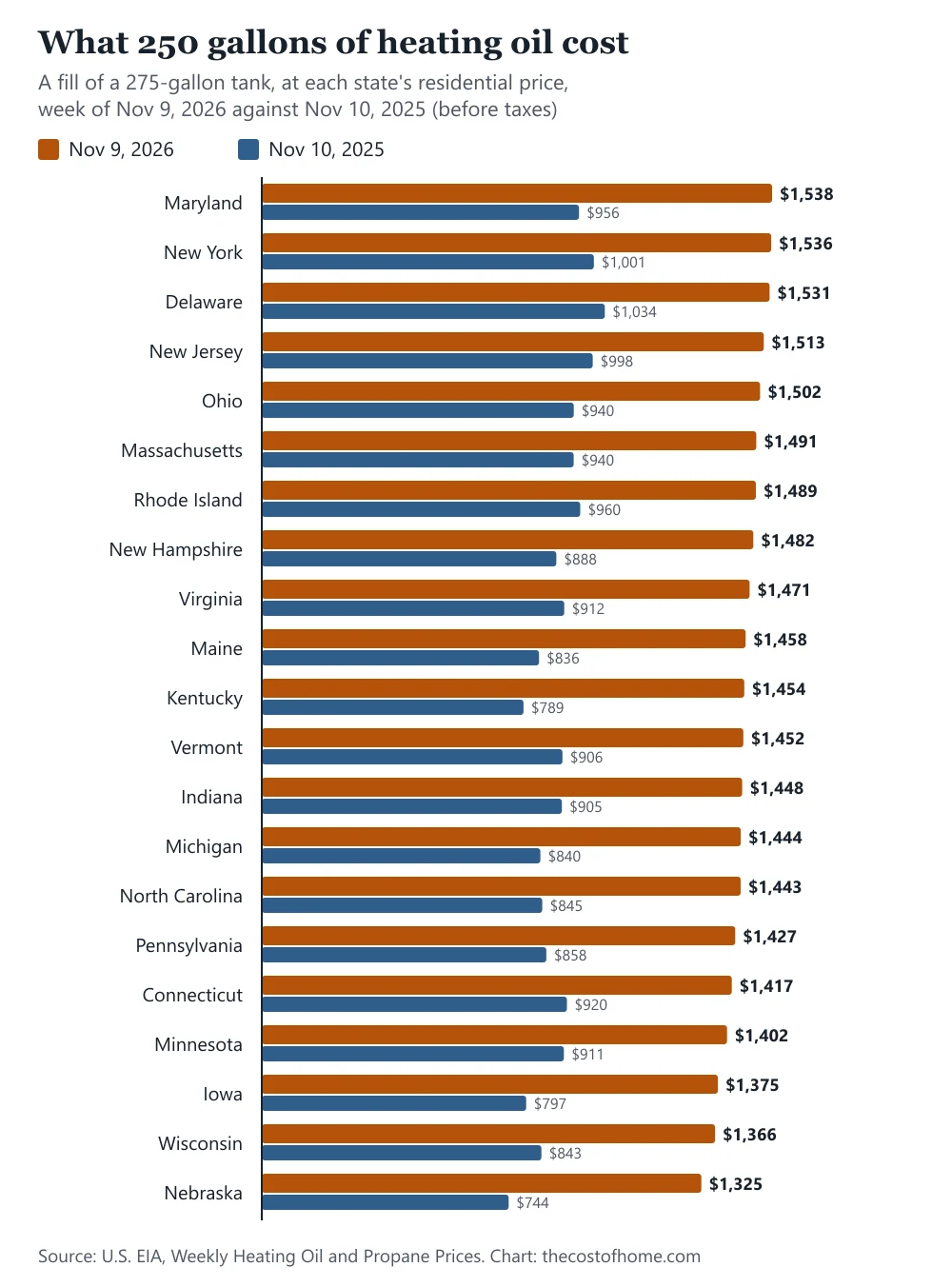
Every state rose, by 48% in Delaware up to 84% in Kentucky, followed by Nebraska (78%) and Maine (74%). The states that rose most had the lowest prices a year ago, which narrowed the spread between them and the Northeast. The average gap between the highest and lowest state was $0.85 a gallon this week against $1.16 a year ago.
Oil heating is concentrated in a few places. The EIA's winter outlook counts 4.2 million U.S. households that heat mainly with heating oil (the count includes kerosene), and 82% of them, 3.4 million, are in the Northeast. The South has 0.4 million, the Midwest 0.2 million and the West 0.2 million. The count has been shrinking: it was 5.0 million in the winter of 2021-22 and 4.4 million last winter. The EIA puts oil at about 3% of U.S. households.

Is heating oil more expensive than gas, propane or electricity?
Yes, by a wide margin against gas. To compare fuels, I priced the same winter of heat for the average oil-heated home, using the heat content the EIA publishes: 138,500 Btu in a gallon of heating oil, 91,452 in a gallon of propane and about 1,037 in a cubic foot of natural gas. At the EIA's forecast prices for this winter, a million Btu costs $39.68 as heating oil and $13.17 as natural gas, 3.0 times as much, and $28.22 as propane.
| Fuel | Price | Per million Btu | One winter |
|---|---|---|---|
| Heating oil | $5.50 per gallon | $39.68 | $2,179 |
| Natural gas | $13.66 per Mcf | $13.17 | $723 |
| Propane | $2.58 per gallon | $28.22 | $1,550 |
| Electric heat | 18.2 cents per kWh | $53.34 | $2,548 |
| Heat pump, COP 2.5 | 18.2 cents per kWh | — | $1,019 |
The same winter of heat for the average oil-heated home, 54.9 million Btu of oil burned (397 gallons), at the EIA's U.S. average forecast prices for this winter. Gas, propane and oil are compared with the same 87% furnace efficiency; electricity gives the same delivered heat (47.8 million Btu).
The 54.9 million Btu that the average oil home burns cost $2,179 as oil. Bought as natural gas, the same fuel energy costs about $723, and as propane (601 gallons) about $1,550. Electric resistance heat, the kind in baseboard heaters and electric furnaces, costs more than oil at $2,548, because electricity is $53.34 per million Btu. A heat pump with a COP of 2.5, a typical figure, delivers the same heat for about $1,019, using about 5,601 kWh. The COP and the 87% furnace efficiency are my assumptions, the same ones I use in the furnace cost guide, so treat the heat pump row as an example.
Most oil homes cannot switch to gas, because they are where no gas main runs. For the gap between propane and gas, where both are an option, see propane vs natural gas. The heat pump is the switch that does not need a pipe. In my opinion, a quote for one is worth getting before the next heating season, and the cost to buy and install is in my heat pump cost guide, with the running cost against gas in heat pump vs gas furnace.
What can you do about a higher heating oil bill?
The levers are small, but they add up when a fill costs $1,479. Connecticut's Department of Consumer Protection gives a checklist that applies to any oil home: know your tank capacity and how much oil you use in a year so you do not over-buy; have the furnace or boiler serviced each year, since a dirty or poorly adjusted unit may waste oil; consider an energy audit, because insulation, efficient windows and programmable thermostats can make a difference; and check that the dealer is registered with the state, as the law requires there. It also advises asking for a signed, dated copy of any contract and keeping delivery receipts for at least a year.
On price plans, Connecticut says pre-buy contracts can be risky because you do not know whether the price will drop, and that cap price plans, which set a maximum per-gallon price for the season, may be less risky than pre-buys. It says pre-buy contracts should be signed by October 31, so for this winter that window has passed in Connecticut. Other states have their own rules, so ask a supplier what a plan covers and what happens if you use more oil than it assumes.
Two of my other guides help lower the amount of oil you burn: attic insulation and a smart thermostat. If the bill is more than the budget can take, the federal LIHEAP program helps with heating costs, including oil; see my guide to LIHEAP heating bill assistance for who qualifies and how to apply. If a furnace or boiler is near the end of its life, the furnace replacement cost guide covers what a new one costs.
How was this calculated?
Prices come from the EIA's Weekly Heating Oil and Propane Prices: residential No. 2 heating oil, in dollars per gallon excluding taxes, for the weeks of November 9, 2026 and November 10, 2025, with the weekly series from October 2025 for the chart. The EIA collects these prices weekly from October through March and only once a month from April to September. "Last winter" in the region table is the simple average of the weekly prices from November 2025 to March 2026, which is a different measure from the EIA's own $3.94 estimate for last winter in the winter outlook (a simple average of weekly prices against the EIA's household estimate). The 21 states are those with a price for both weeks.
The winter bill, gallons and household counts are from the EIA's Winter Fuels Outlook 2026-27, table WF01, in the version updated with the November 2026 Short-Term Energy Outlook. Gas, propane and electricity prices in the comparison are the same table's U.S. averages. Heat content is the EIA's, and the comparison table burns the same fuel energy in each fuel at a 87% furnace efficiency, with electric heat delivering the heat that the furnace would. Tank fills use PickHVAC's usual fill levels, and the extra winter estimate at $5.92 is my own multiplication of the EIA's gallons by this week's price. Space-heating gallons by region are from the EIA's 2020 Residential Energy Consumption Survey, table CE4.6, which counts oil and kerosene together. All sources were read on November 13, 2026, and my approach is set out in how I research costs; for more on heating and cooling, see Heating & Cooling.
Frequently asked questions
How much does it cost to fill a 275-gallon oil tank?
About $1,479 for the usual fill of 250 gallons at the EIA's U.S. average of $5.92 a gallon on November 9, 2026. A year earlier the same fill cost about $930. The price runs from about $1,325 in Nebraska to $1,538 in Maryland, before taxes.
How many gallons of heating oil does a house use in a winter?
The EIA expects the average home that heats mainly with oil to use about 397 gallons from November through March this winter, against 444 last winter. The EIA's 2020 household survey found 445 gallons for space heating in the Northeast and 493 in New England.
Why is heating oil so expensive this winter?
The EIA says global distillate production has dropped because of reduced refining activity, which raised international prices and left U.S. distillate stocks low. Its November outlook adds that crude oil prices rose for a third month in October amid falling inventories and attacks on tankers in the Persian Gulf.
How much does a gallon of heating oil cost in my state?
On November 9, 2026 the EIA's weekly price ran from $5.30 in Nebraska to $6.15 in Maryland, with a U.S. average of $5.92. These prices exclude taxes, so check with your own supplier.
How much will heating oil cost for the whole winter?
The EIA's forecast is about $2,179 for the average oil-heated household, from $2,036 in a warmer winter to $2,390 in a colder one. Last winter's estimate was $1,748. At this week's $5.92, 397 gallons would cost about $2,345.
Is heating oil more expensive than natural gas or propane?
Yes. At the EIA's forecast prices, a million Btu costs $39.68 as heating oil, $28.22 as propane and $13.17 as natural gas. For the same fuel energy, the average oil home would pay about $2,179 on oil, $1,550 on propane and $723 on gas.
How many U.S. homes heat with oil?
The EIA's winter outlook counts about 4.2 million households that heat mainly with heating oil, including kerosene, about 82% of them in the Northeast. The EIA puts oil at about 3% of U.S. households.
Will heating oil prices go down this winter?
The EIA's forecast average for the winter is $5.50 a gallon, below the $5.92 of November 9, which had already slipped from $6.23 in late October. The EIA expects Brent crude to stay near $100 a barrel through the end of 2026 and to ease through 2027, and says wholesale changes reach retail prices in four to six weeks. It is a forecast, not a promise.
Sources
- U.S. Energy Information Administration, Weekly Heating Oil and Propane Prices: residential heating oil by state and region, dollars per gallon excluding taxes (weeks from October 2025 to November 9, 2026; accessed November 13, 2026)
- U.S. Energy Information Administration, Heating Oil and Propane Update: prices are collected weekly from October through March (accessed November 13, 2026)
- U.S. Energy Information Administration, Winter Fuels Outlook 2026-27, published October 6, 2026: heating oil, distillate supply, retail price pass-through and household assumptions (accessed November 13, 2026)
- U.S. Energy Information Administration, Table WF01: seasonal household consumption, prices and expenditures by heating fuel, and households by primary heating fuel, winter 2026-27 forecast, version updated with the November 2026 Short-Term Energy Outlook (accessed November 13, 2026)
- U.S. Energy Information Administration, Short-Term Energy Outlook, November 10, 2026: crude oil, inventories and diesel price forecast (accessed November 13, 2026)
- U.S. Energy Information Administration, British thermal units (Btu): heating oil 138,500 Btu per gallon, propane 91,452 Btu per gallon, 1 kilowatt-hour = 3,412 Btu (accessed October 22, 2026)
- U.S. Energy Information Administration, "How do I convert natural gas prices in dollars per cubic feet to dollars per British thermal unit or therm?" (1,037 Btu per cubic foot in 2025)
- U.S. Energy Information Administration, 2020 Residential Energy Consumption Survey, table CE4.6: household end-use consumption by fuel, including fuel oil or kerosene gallons for space heating (accessed October 22, 2026)
- PickHVAC, Oil Tank Standard Sizes: common residential sizes and usual fill levels (accessed November 13, 2026)
- Connecticut Department of Consumer Protection, Tips for Buying Heating Oil or Propane: contracts, cap price plans, dealer registration and energy audits (accessed November 13, 2026)

Founder and editor, The Cost of Home
I write and check every guide on this site myself, working from public data. The sources behind each number are listed at the end of the article, so you can check them too.