Heating & Cooling
How Much Does a Space Heater Cost to Run?
Quick answer
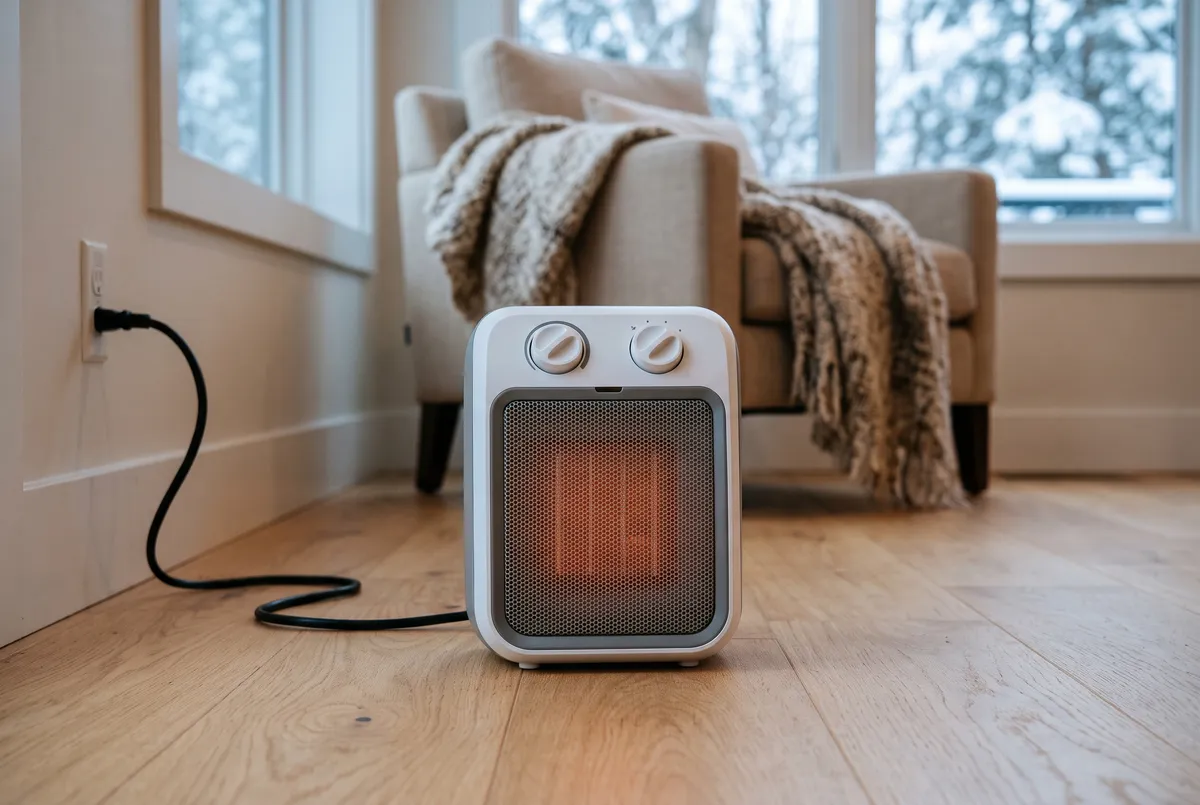
A 1,500-watt space heater costs about 27 cents an hour at the U.S. average price of 18.0 cents per kWh. Run 8 hours a day, that is about $2.16 a day and $65 a month. A 750-watt heater costs half as much. Per unit of heat it is dearer than a gas furnace or a heat pump, so it pays only when it lets you turn the rest of the house down.
On this page
- How do you calculate what a space heater costs to run?
- How much does a space heater cost per hour, day, month and winter?
- How does the cost change with the hours you run it?
- How much does a space heater cost to run in your state?
- Is a space heater cheaper than running the furnace?
- When does a space heater save money?
- What are the safety rules for running a space heater?
- How can you cut what a space heater costs?
- What does a space heater cost to run in all 50 states?
- How was this calculated?
- FAQ
- Sources
A space heater is the one appliance where you can work out the bill in your head. Every watt it draws turns into heat, so the cost is its wattage, times the hours it runs, times what you pay for a kilowatt-hour (kWh). No tables of efficiency, no ratings to decode. The number only gets confusing because the answer changes with the hours you run it and with the state you live in.
Below I show the one-line math, run it for the three common sizes, then look at what it costs in five states and in all fifty. The electricity prices are the ones from my electricity prices by state guide. After that comes the question that decides whether a space heater saves money or wastes it: how its heat compares with what your furnace or heat pump would have charged for the same warmth.
How do you calculate what a space heater costs to run?
Take the heater's wattage, divide by 1,000 to get kilowatts, multiply by the hours it runs, then multiply by your price per kWh. A 1,500-watt heater running for one hour uses 1.5 kWh. At 18.0 cents per kWh, the U.S. average from my electricity prices guide (Energy Information Administration, EIA, data for September 2025 to August 2026), that is $0.27 an hour.
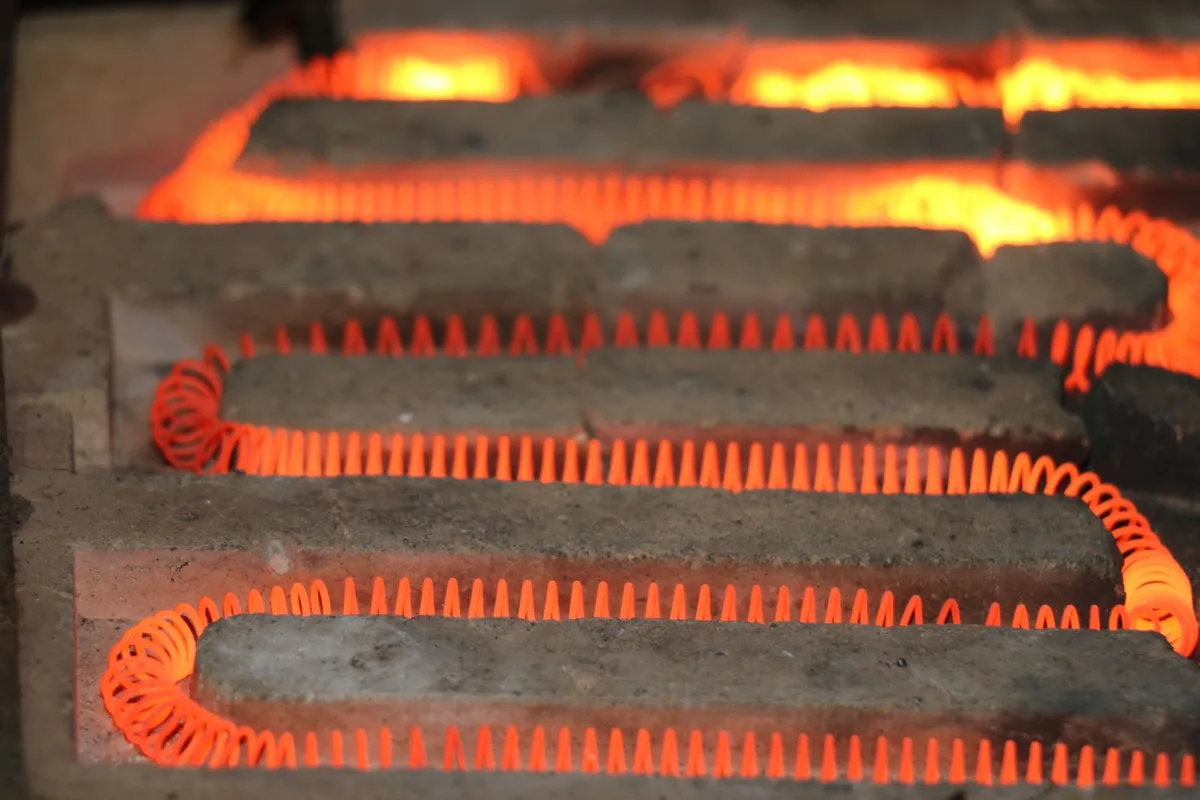
Most plug-in heaters list 1,500 watts on the high setting, and EnergySage uses that figure as the average for a space heater. Many also have lower settings, and small ones are sold at 750 W or 1,000 W, so check the label of the one you own. I priced all three below.
How much does a space heater cost per hour, day, month and winter?
At the U.S. average price, a 1,500 W heater costs $0.27 an hour, $2.16 for 8 hours of use, $65 for a month of 8-hour days (360 kWh) and about $260 over a 120-day winter. The 120 days, four months of cold, and the 8 hours are my assumptions, not a measured average: your winter may be shorter or much longer.
| Heater | kWh an hour | Per hour | Per 8 hours | Per month | Per winter |
|---|---|---|---|---|---|
| 750 W | 0.75 | $0.14 | $1.08 | $32 | $130 |
| 1,000 W | 1.00 | $0.18 | $1.44 | $43 | $173 |
| 1,500 W | 1.50 | $0.27 | $2.16 | $65 | $260 |
What a plug-in electric heater costs to run at the U.S. average price of 18.0 cents per kWh, by its wattage. A day of use is 8 hours, a month is 30 days of 8 hours, and a winter is 120 days of 8 hours. All of these assume the heater draws its full rated power the whole time.
These figures are a ceiling. Most heaters have a thermostat that cuts the power when the room reaches the temperature you set, so a heater in a small, tight room may run at full power for only part of each hour. The cost is then lower than the table says, in proportion to the share of time it is on. The only way to know yours is a plug-in watt meter on the outlet, or your own bill before and after.
How does the cost change with the hours you run it?
Almost one for one. Doubling the hours doubles the bill, which is why the habit matters more than the model. A heater on for two hours in the evening costs $0.54 a day, or about $16 a month. Left running around the clock it costs $6.49 a day, about $195 a month, which is the kind of jump that shows up as a surprise on an electric bill. My guide on why your electric bill is so high shows where heating sits among the other big users.
| Hours a day | kWh a day | Per day | Per month |
|---|---|---|---|
| 2 | 3 | $0.54 | $16 |
| 4 | 6 | $1.08 | $32 |
| 8 | 12 | $2.16 | $65 |
| 12 | 18 | $3.25 | $97 |
| 24 | 36 | $6.49 | $195 |
What a 1,500 W heater costs by hours of use a day, at the U.S. average price of 18.0 cents per kWh. Per month means 30 days at the same hours, and the heater is assumed to draw full power the whole time.
How much does a space heater cost to run in your state?
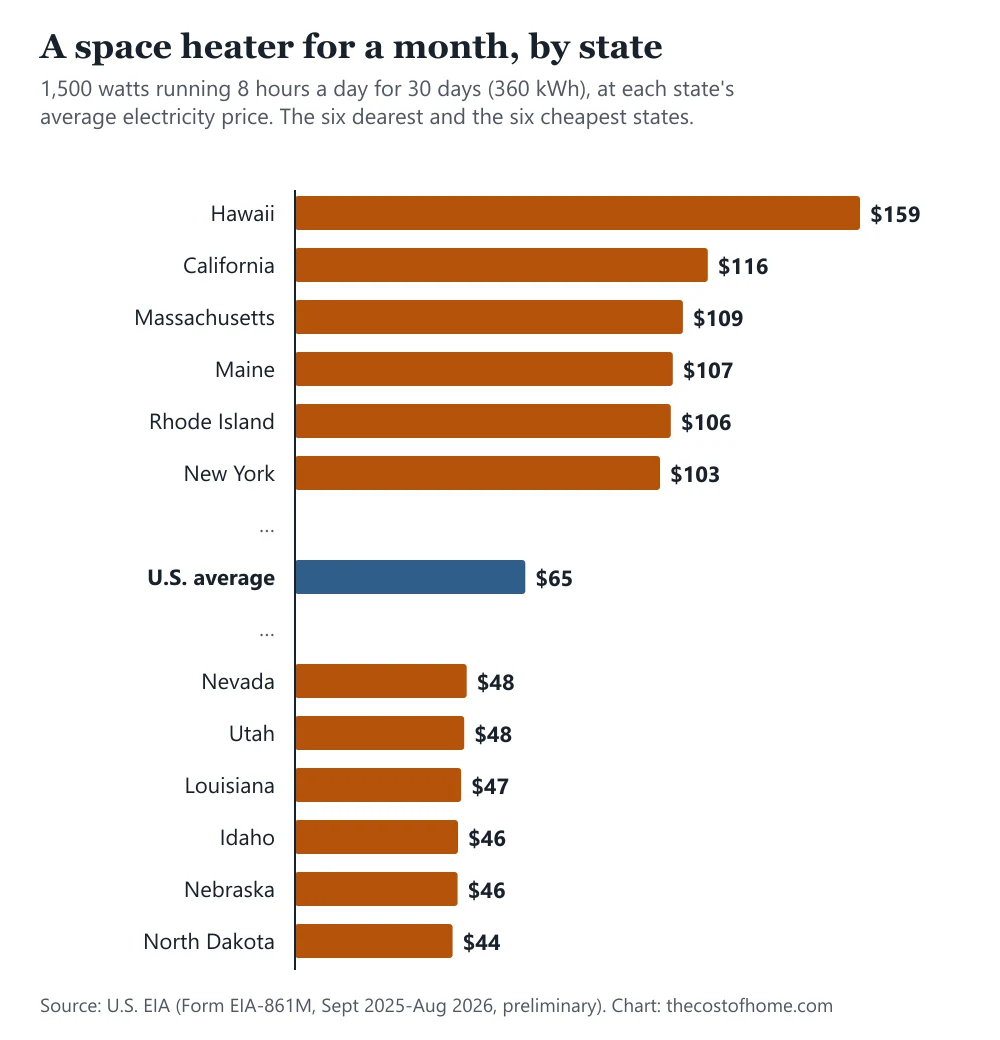
The heater is the same everywhere and the price per kWh is not. The same 1,500 W heater, running 8 hours a day for 30 days, costs about $51 a month in Washington, $58 in Texas, $66 in Ohio, $103 in New York and $116 in California. That is more than twice as much in California as in Washington for the same warmth.
| State | kWh price | Per hour | Per month | Per winter |
|---|---|---|---|---|
| U.S. average | 18.0¢ | $0.27 | $65 | $260 |
| Washington | 14.2¢ | $0.21 | $51 | $204 |
| Texas | 16.0¢ | $0.24 | $58 | $230 |
| Ohio | 18.4¢ | $0.28 | $66 | $265 |
| New York | 28.6¢ | $0.43 | $103 | $412 |
| California | 32.3¢ | $0.49 | $116 | $466 |
The same 1,500 W heater in five states with very different electricity prices. Prices are each state's average residential price per kWh, September 2025 to August 2026 (preliminary), from my electricity prices guide. Per month is 8 hours a day for 30 days; per winter is 120 days.
Across all the states, the monthly cost runs from $44 in North Dakota to $159 in Hawaii. California is next at $116, and after North Dakota the cheapest are Nebraska ($46) and Idaho ($46). 33 of the 51 places on my list are priced below the national average. Find your row in the table at the end of this guide; if your own bill shows a different price per kWh, use that one in the formula.
Is a space heater cheaper than running the furnace?
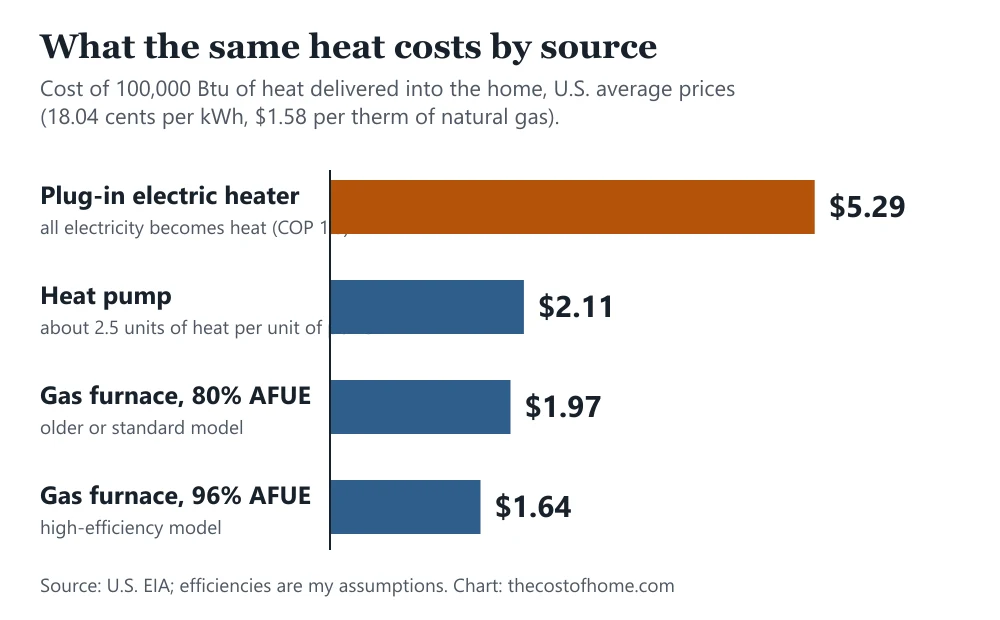
Per unit of heat, no. A space heater is simple: all the electricity it draws becomes heat in the room, so it is very good at turning power into warmth and no better than that. A gas furnace or a heat pump is the cheaper way to buy the same heat. At the U.S. average prices, 100,000 Btu of heat costs about $5.29 from a plug-in heater, $2.11 from a heat pump and $1.64 to $1.97 from a gas furnace.
| Heat source | Per 100,000 Btu | Compared with the heater |
|---|---|---|
| Plug-in heater | $5.29 | 1.0x |
| Heat pump | $2.11 | 0.40x |
| Gas furnace, 80% | $1.97 | 0.37x |
| Gas furnace, 96% | $1.64 | 0.31x |
What 100,000 Btu of heat costs by source at U.S. average prices (18.0 cents per kWh and $1.58 per therm of natural gas). A plug-in heater turns all its electricity into heat, which is a COP of 1.0. The heat pump uses a COP of 2.5 and the gas furnaces an AFUE of 96% and 80%; those efficiencies are my assumptions, as in my furnace and heat pump guides.
Here is what that looks like for one day of use. A 1,500 W heater gives off about 5,118 Btu an hour (1,500 W × 3,412 Btu per kWh ÷ 1,000), or about 40,944 Btu in 8 hours. That costs $2.16 in electricity. A 96% gas furnace would deliver the same heat for about $0.67 and a heat pump for about $0.87. In my math the heater costs roughly 3.2 times as much as the gas furnace for the same Btu, and 2.5 times as much as the heat pump. If you want the whole-house numbers, my guides on running a furnace and on a heat pump versus a gas furnace use the same prices.
When does a space heater save money?
When it lets you heat less of the house. The savings do not come from the heater being cheap; they come from heating one room and letting the rest of the house sit cooler. The Department of Energy (DOE) says room heaters can be an inexpensive way to provide zone heating when a central forced-air system is the main heat, and that electric room heaters can be cost-effective for infrequently used rooms. Its Energy Saver material calls space heaters supplemental heat for a specific room.
My rule of thumb comes straight from the price gap: the heater has to let the furnace cut back by about 3.2 units of heat for every one the heater makes, at today's average gas price, to come out ahead. In the example above that means the furnace has to save gas worth more than $2.16 over those hours. One small room you are using in the evening, a home office while the rest of the house is empty or a cold corner you use for a few hours are the cases where it can. Heating a large, open space to the same temperature as the rest of the house is the case where it cannot. In my opinion, a space heater earns its place as a way to turn the central thermostat down, and costs you money as a way to avoid thinking about it.
Two cautions on the other side of the trade. First, if your central heat is already electric (baseboards or an electric furnace), a heater costs the same per unit of heat, and the saving is only in the rooms you stop heating. Second, DOE's contractor guide for home energy upgrades says portable space heaters are not recommended because of their inefficiency and potential burn and tripping hazards, and that electric room heaters generally are not a cost-effective way to heat a whole average or large home with little insulation. That guide dates from 2011, and I use it for the principle, not its numbers. If your heating bill is the real problem, my winter heating costs guide shows what each fuel is expected to cost this season, and LIHEAP covers help paying for it.

What are the safety rules for running a space heater?
The Consumer Product Safety Commission (CPSC) gives these tips for electric space heaters: keep portable heaters at least three feet away from drapes, furniture, bedding and other combustible materials; plug them directly into a wall outlet, never into an extension cord or power strip; and turn them off when you are sleeping. That last one matters for this guide: the hours in my tables are hours when you are awake in the room, not a heater left on while you sleep. The CPSC estimates that portable heaters, including electric space heaters, caused an average of 1,600 fires a year and 70 deaths a year from 2020 to 2022. Read your heater's manual for anything specific to your model.
How can you cut what a space heater costs?
- Heat the person or the room, not the house. Close the door of the room you heat and turn the central thermostat down for the rest.
- Use the lowest setting that works. The cost is proportional to watts, so a 750 W setting costs half of 1,500 W for every hour.
- Use the thermostat or timer on the heater so it stops when the room is warm, and treat the tables above as a ceiling.
- Run it only when you are in the room. The hours are the biggest lever in the formula.
- Check your own price per kWh on the bill, since it moves the cost more than the heater model does. My smart thermostat guide covers the other half, how much turning the central heat down can save.
For the other half of the cold-weather bill, see my heat pump cost guide and the average electric bill by state. For more on the home heating and cooling costs I follow, see Heating & Cooling.
What does a space heater cost to run in all 50 states?
Here is the full list. Every row uses the same 1,500 W heater and the same 8 hours a day, so the only thing that changes is the price per kWh. The D.C. row is the District of Columbia. Treat the figures as arithmetic, a ceiling for a heater at full power, and not a count of what residents actually pay.
| State | kWh price | Per hour | Per 8 hours | Per month |
|---|---|---|---|---|
| U.S. average | 18.0¢ | $0.27 | $2.16 | $65 |
| Alabama | 16.4¢ | $0.25 | $1.97 | $59 |
| Alaska | 26.9¢ | $0.40 | $3.23 | $97 |
| Arizona | 15.4¢ | $0.23 | $1.85 | $55 |
| Arkansas | 13.6¢ | $0.20 | $1.63 | $49 |
| California | 32.3¢ | $0.49 | $3.88 | $116 |
| Colorado | 16.6¢ | $0.25 | $1.99 | $60 |
| Connecticut | 27.4¢ | $0.41 | $3.29 | $99 |
| Delaware | 18.0¢ | $0.27 | $2.16 | $65 |
| District of Columbia | 24.5¢ | $0.37 | $2.94 | $88 |
| Florida | 15.4¢ | $0.23 | $1.85 | $55 |
| Georgia | 15.2¢ | $0.23 | $1.82 | $55 |
| Hawaii | 44.3¢ | $0.66 | $5.31 | $159 |
| Idaho | 12.8¢ | $0.19 | $1.53 | $46 |
| Illinois | 18.9¢ | $0.28 | $2.27 | $68 |
| Indiana | 16.9¢ | $0.25 | $2.03 | $61 |
| Iowa | 14.2¢ | $0.21 | $1.70 | $51 |
| Kansas | 15.1¢ | $0.23 | $1.82 | $54 |
| Kentucky | 13.9¢ | $0.21 | $1.67 | $50 |
| Louisiana | 13.0¢ | $0.20 | $1.56 | $47 |
| Maine | 29.6¢ | $0.44 | $3.55 | $107 |
| Maryland | 21.2¢ | $0.32 | $2.54 | $76 |
| Massachusetts | 30.4¢ | $0.46 | $3.65 | $109 |
| Michigan | 21.3¢ | $0.32 | $2.55 | $77 |
| Minnesota | 16.3¢ | $0.24 | $1.95 | $59 |
| Mississippi | 14.8¢ | $0.22 | $1.78 | $53 |
| Missouri | 14.0¢ | $0.21 | $1.68 | $50 |
| Montana | 13.9¢ | $0.21 | $1.67 | $50 |
| Nebraska | 12.7¢ | $0.19 | $1.53 | $46 |
| Nevada | 13.4¢ | $0.20 | $1.61 | $48 |
| New Hampshire | 27.0¢ | $0.40 | $3.23 | $97 |
| New Jersey | 23.7¢ | $0.36 | $2.85 | $85 |
| New Mexico | 15.3¢ | $0.23 | $1.84 | $55 |
| New York | 28.6¢ | $0.43 | $3.43 | $103 |
| North Carolina | 14.8¢ | $0.22 | $1.77 | $53 |
| North Dakota | 12.3¢ | $0.19 | $1.48 | $44 |
| Ohio | 18.4¢ | $0.28 | $2.21 | $66 |
| Oklahoma | 13.8¢ | $0.21 | $1.66 | $50 |
| Oregon | 15.5¢ | $0.23 | $1.86 | $56 |
| Pennsylvania | 20.9¢ | $0.31 | $2.50 | $75 |
| Rhode Island | 29.4¢ | $0.44 | $3.53 | $106 |
| South Carolina | 15.8¢ | $0.24 | $1.89 | $57 |
| South Dakota | 14.3¢ | $0.21 | $1.71 | $51 |
| Tennessee | 13.6¢ | $0.20 | $1.63 | $49 |
| Texas | 16.0¢ | $0.24 | $1.92 | $58 |
| Utah | 13.3¢ | $0.20 | $1.59 | $48 |
| Vermont | 23.9¢ | $0.36 | $2.87 | $86 |
| Virginia | 16.6¢ | $0.25 | $2.00 | $60 |
| Washington | 14.2¢ | $0.21 | $1.70 | $51 |
| West Virginia | 15.5¢ | $0.23 | $1.86 | $56 |
| Wisconsin | 18.8¢ | $0.28 | $2.25 | $68 |
| Wyoming | 14.0¢ | $0.21 | $1.68 | $50 |
What a 1,500 W space heater costs in each state at its average residential electricity price (September 2025 to August 2026, preliminary, from my electricity prices guide). Per month is 8 hours a day for 30 days, which is 360 kWh. The heater is assumed to draw full power the whole time.
How was this calculated?
Each cost is watts divided by 1,000, times hours, times the price per kWh. The price per kWh for each state is residential revenue divided by kilowatt-hours sold, from the EIA's Form EIA-861M (preliminary), September 2025 to August 2026, the same figures as in my electricity prices guide: 18.0 cents for the U.S. The natural gas price is the EIA's residential price per 1,000 cubic feet for August 2025 to July 2026, converted at 1,037 Btu per cubic foot to $1.58 per therm, the same conversion as in my other heating guides. One kWh is 3,412 Btu of heat, and a plug-in heater turns all of it into heat. For the comparison, a gas furnace is priced at its efficiency (AFUE 96% and 80%) and a heat pump at a COP of 2.5. Those efficiencies are assumptions, the same ones I use in my furnace and heat pump guides, and a real home can do better or worse.
The hours (8 a day), the 30-day month and the 120-day winter are my assumptions, and the heater is assumed to draw its full rated power the whole time, which makes every figure a ceiling. The 1,500 W rating comes from EnergySage, and the safety tips from the CPSC. The DOE statements come from its Building America guide to HVAC upgrades for contractors (August 2011) and the Energy Saver home heating infographic. My sources and method are set out in how I research costs.
Frequently asked questions
How much does it cost to run a space heater per hour?
About 27 cents an hour for a 1,500 W heater at the U.S. average price of 18.0 cents per kWh. A 1,000 W heater costs about 18 cents an hour and a 750 W one about 14 cents. The formula is watts divided by 1,000, times your price per kWh.
How much does a space heater cost to run per month?
A 1,500 W heater running 8 hours a day for 30 days uses 360 kWh and costs about $65 at the U.S. average price. In a cheap-electricity state like North Dakota it is about $44 and in Hawaii about $159. A heater with a thermostat that cycles off costs less.
Is it cheaper to use a space heater or central heat?
Per unit of heat, central heat is cheaper: at U.S. average prices, 100,000 Btu costs about $5.29 from a plug-in heater and about $1.64 from a 96% gas furnace. A space heater saves money only when it lets you turn the central thermostat down and heat just the room you are using.
How many kWh does a space heater use?
A 1,500 W heater uses 1.5 kWh for every hour it runs at full power. Over 8 hours that is 12 kWh, and over a 30-day month of 8-hour days it is 360 kWh. A 750 W heater uses half as much.
Does a space heater use a lot of electricity?
A 1,500 W heater draws more power than most household appliances, so it adds up when it runs for many hours. At 8 hours a day it adds about $65 a month at the U.S. average price. For two hours an evening it adds about $16 a month.
Is it safe to leave a space heater on all night?
The Consumer Product Safety Commission says to turn space heaters off when you are sleeping, to keep them at least three feet from anything that can burn and to plug them directly into a wall outlet, not an extension cord or power strip.
Is a 750 W space heater cheaper to run than a 1,500 W one?
Per hour of running, yes: a 750 W heater costs half as much, about 14 cents an hour at the U.S. average price against 27 cents. It also puts out half the heat, so it suits a small room, and a larger room may need the bigger one to reach the same temperature.
Sources
- U.S. Energy Information Administration, Form EIA-861M: monthly sales, revenue and customers by state (September 2025 to August 2026, preliminary; used in my electricity prices guide)
- U.S. Energy Information Administration, Natural Gas Prices: residential price (August 2025 to July 2026, accessed October 17, 2026)
- U.S. Consumer Product Safety Commission, "Keep Warm and Safe This Winter: Tips for Using Generators, Furnaces and Space Heaters" (January 23, 2026; accessed November 9, 2026)
- U.S. Department of Energy, Building America Best Practices Series, Volume 14: Energy Renovations, HVAC (PNNL and ORNL, August 2011): room heaters and zoning (accessed November 9, 2026)
- U.S. Department of Energy, Energy Saver: home heating infographic, types of space heaters (accessed November 9, 2026)
- EnergySage, "How many watts does a space heater use?": average space heater power of 1,500 W (accessed November 9, 2026)

Founder and editor, The Cost of Home
I write and check every guide on this site myself, working from public data. The sources behind each number are listed at the end of the article, so you can check them too.