Heating & Cooling
Is a Heat Pump Worth It in a Cold Climate? What Winter Costs Show
Quick answer
Yes, if you now heat with propane or electric resistance, and usually not if you have natural gas. In 12 cold states, a heat pump with a seasonal COP of 2.5 cost less to run than a propane furnace in every one and about 60% less than electric heat, but more than a 96% gas furnace in all 12. It still works below zero, just less efficiently.
On this page
- Does a heat pump still work below zero?
- How much does it cost to heat with a heat pump in a cold state?
- Is a heat pump worth it if you heat with propane or electric heat?
- Is a heat pump worth it if you heat with natural gas?
- What can go wrong with a heat pump in a cold winter?
- How do you check the numbers for your own home?
- What does this comparison leave out?
- FAQ
- Sources
In a cold state, the doubt about a heat pump is simple: can it keep pulling heat out of the air when it is below zero, and does the bill still come out lower than what you pay now? The answer depends mostly on the fuel you use today.
I priced the same winter in 12 cold states: 60 million Btu of heat delivered to a home, an example size that you can scale to your own. The prices are residential averages from the Energy Information Administration (EIA) for November 2025 to March 2026. Heat pump prices to buy and install, and the incentives, are in my heat pump cost guide; this one is about what it costs to run and when that is worth it.
Does a heat pump still work below zero?
It does, with less efficiency and less heat output. NREL's 2022 report on cold-climate air-source heat pumps describes them as units designed to heat homes adequately at or below 5°F. It also says that as the outdoor temperature keeps falling, a heat pump eventually cannot pull enough heat from the air, and backup or supplemental heat takes over. That is why the NREL report says backup heat is required when you install one, and that an existing furnace can stay in place to do that job.
ENERGY STAR sets the bar for its cold-climate label. A qualifying unit must reach a COP of at least 1.75 at 5°F and keep at least 70% of its 47°F heating capacity at 5°F, and it must also meet a seasonal rating of at least 8.1 HSPF2 (ducted) or 8.5 (ductless). Those are lab ratings, so the field results matter more:
- Connecticut, Massachusetts and Vermont. A DOE Building America study, carried out by the research team CARB, monitored seven inverter-driven heat pumps in the winter of 2013-14. Measured monthly COPs ran between 1.1 and 3.1, and maximum heating capacity was generally in line with the manufacturers' claims as outdoor temperatures fell to -10°F. The team blamed the spread on low indoor airflow, poor outdoor unit placement and how the units were integrated with the old heating system.
- Minnesota. The Center for Energy and Environment monitored three homes during the 2015-16 heating season. When the heat pump itself was running, its weather-normalized COP over the year was 2.75, 2.78 and 2.51 at the three sites.
Those two studies are why I use 2.0 and 2.5 below: a hard winter pulls the average toward the low end of what was measured, and a normal cold one sits near the Minnesota results. Both studies are a few years old, and newer units may do better, so treat them as a floor.
How much does it cost to heat with a heat pump in a cold state?
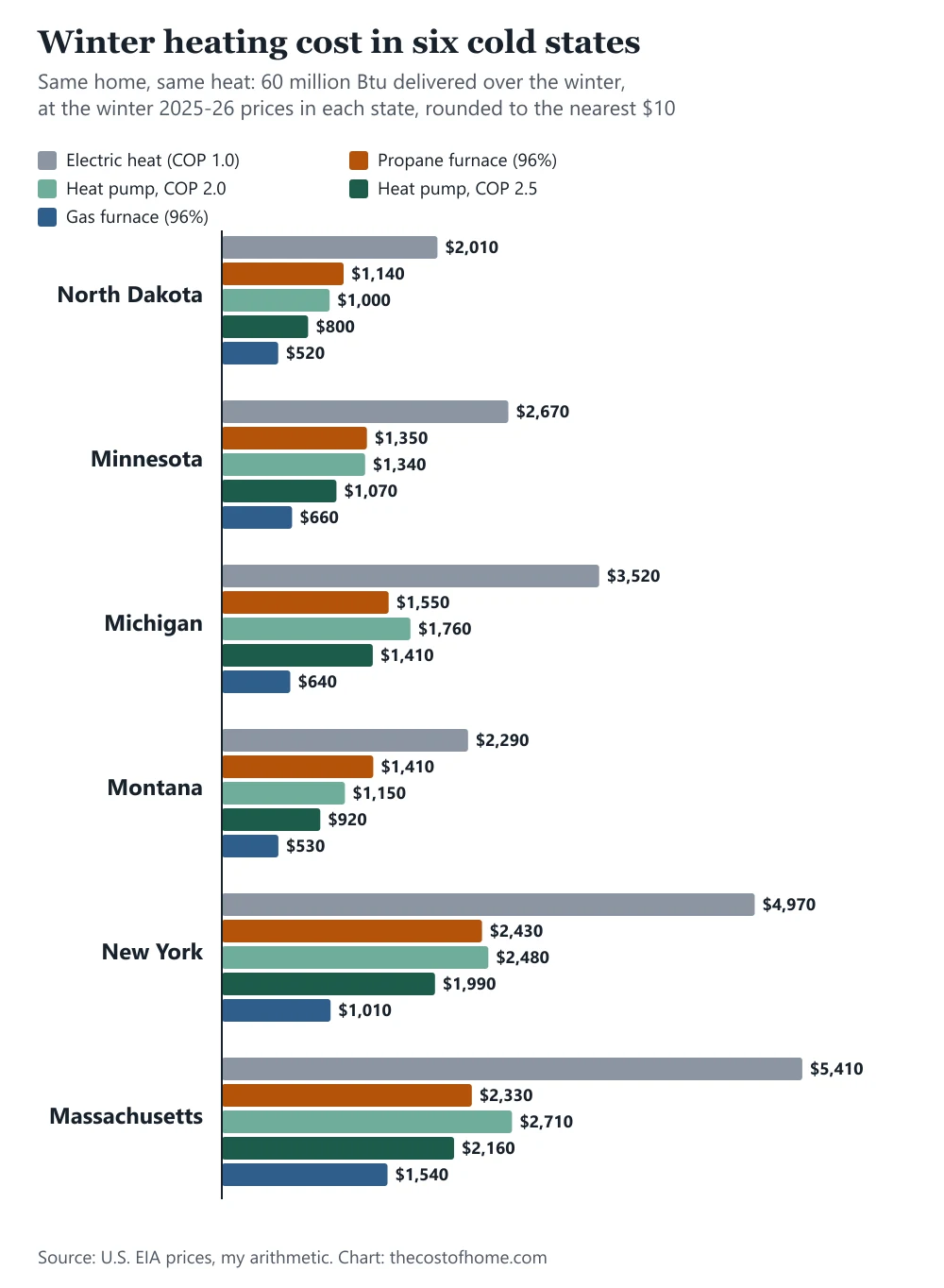
Take the same 60 million Btu of winter heat in each state and price it five ways. Electric resistance is the most expensive in all 12, at $2,010 in North Dakota and $5,410 in Massachusetts. A heat pump at COP 2.0 costs half of that by definition, and at COP 2.5 it costs 60% less.
| State | Gas | Propane | Electric | COP 2.0 | COP 2.5 |
|---|---|---|---|---|---|
| Colorado | $650 | $1,530 | $2,900 | $1,450 | $1,160 |
| Iowa | $610 | $1,100 | $2,280 | $1,140 | $910 |
| Massachusetts | $1,540 | $2,330 | $5,410 | $2,710 | $2,160 |
| Michigan | $640 | $1,550 | $3,520 | $1,760 | $1,410 |
| Minnesota | $660 | $1,350 | $2,670 | $1,340 | $1,070 |
| Montana | $530 | $1,410 | $2,290 | $1,150 | $920 |
| New Hampshire | $1,160 | $2,460 | $4,680 | $2,340 | $1,870 |
| New York | $1,010 | $2,430 | $4,970 | $2,480 | $1,990 |
| North Dakota | $520 | $1,140 | $2,010 | $1,000 | $800 |
| South Dakota | $590 | $1,250 | $2,370 | $1,180 | $950 |
| Vermont | $1,000 | $2,540 | $4,140 | $2,070 | $1,660 |
| Wisconsin | $690 | $1,330 | $3,230 | $1,610 | $1,290 |
Winter cost of 60 million Btu of heat, rounded to the nearest $10. Gas and propane furnaces at 96% AFUE; electric is plain resistance heat (COP 1.0); the two COP columns are a heat pump at a seasonal COP of 2.0 (a hard winter) and 2.5 (a normal cold winter). Prices are winter 2025-26 averages. Source: U.S. EIA prices, my arithmetic.
The heat pump at COP 2.5 was cheaper than the propane furnace in all 12 states. At COP 2.0 it was cheaper in 7 of 12: North Dakota, South Dakota, Minnesota, Montana, Colorado, Vermont and New Hampshire. Against the gas furnace, it was not cheaper in any of them, at either COP. The next table shows the prices behind those results.
| State | Electric | Gas | Propane | Break-even vs gas |
|---|---|---|---|---|
| Colorado | 16.5¢ | $1.04 | $2.24 | 4.4 |
| Iowa | 13.0¢ | $0.98 | $1.60 | 3.7 |
| Massachusetts | 30.8¢ | $2.47 | $3.41 | 3.5 |
| Michigan | 20.0¢ | $1.02 | $2.27 | 5.5 |
| Minnesota | 15.2¢ | $1.05 | $1.98 | 4.1 |
| Montana | 13.1¢ | $0.84 | $2.06 | 4.4 |
| New Hampshire | 26.6¢ | $1.86 | $3.60 | 4.0 |
| New York | 28.3¢ | $1.62 | $3.55 | 4.9 |
| North Dakota | 11.4¢ | $0.84 | $1.66 | 3.8 |
| South Dakota | 13.4¢ | $0.95 | $1.82 | 4.0 |
| Vermont | 23.6¢ | $1.60 | $3.71 | 4.1 |
| Wisconsin | 18.4¢ | $1.11 | $1.95 | 4.7 |
The prices behind the table above: electricity in cents per kWh, natural gas in dollars per therm and propane in dollars per gallon, winter 2025-26 averages. The last column is the seasonal COP at which a heat pump would cost the same as a 96% gas furnace. Source: U.S. EIA.
Is a heat pump worth it if you heat with propane or electric heat?
This is where the numbers are strongest. In my table, a COP 2.5 heat pump saves between $40 (Wisconsin) and $880 (Vermont) a winter against the propane furnace, and between $1,210 and $3,250 against electric heat. The break-even COP against propane, the efficiency at which the two cost the same, runs from 1.6 to 2.4 across the 12 states, which even a hard winter's COP of 2.0 clears in most of them.
Real homes agree, with smaller savings. In the Minnesota study, the three propane homes kept their furnaces as backup and still cut propane use by 52% to 89%. After the researchers adjusted for the extra heat the heat pumps delivered, the three homes saved $191, $350 and $267 a year, 14% to 29% of their heating cost. In that study propane cost about $1.29 a gallon ($1,320 for 1,022 gallons at one site), well under the $1.60 to $3.71 in my table, so the same homes would save more at today's propane prices. That part is my inference, not a result of the study.
The Building America study projected savings for a 100 million Btu load at New England rates: $2,374 a year against electric resistance, $2,101 against propane and $681 against oil, at an installed cost of $2,500 to $4,500 per ton. NREL's 2022 report adds that a Boston community action agency study found a savings-to-investment ratio above 1 for heat pump installations when replacing electric resistance or propane, and below 1 when replacing natural gas. That is the same split my table shows.
Is a heat pump worth it if you heat with natural gas?
Usually not for the running cost alone. At these prices a 96% gas furnace was cheaper than a heat pump in all 12 states, and the break-even COP ran from 3.5 to 5.5, well above the 1.1 to 3.1 the field studies measured. Gas is cheap in the northern states: North Dakota paid $0.84 per therm while its electricity cost 11.4¢ per kWh.
Two things can still change the answer. A heat pump also cools, so if your central air conditioner is near the end of its life, one machine can replace the air conditioner and part of the furnace's work. And if the existing furnace stays as backup, the heat pump only has to carry the mild and moderate days. NREL notes that analyses of full replacement leave out how the total bill changes when the old system is kept as backup, and calls for more research on it. My table does not model that mix, so I cannot say what it would save.
In my opinion, a gas home in a cold state should treat a heat pump as a replacement for the air conditioner, not as a way to lower the winter bill. My heat pump vs gas furnace guide compares the two in every state, and furnace replacement cost covers what a new gas furnace costs.
What can go wrong with a heat pump in a cold winter?
Most of the disappointing results in the studies came from the installation, not from the cold:
- Size. NREL says the heat pump should not be too small, or it will not keep the house warm on the coldest day, and not too big, or it will cycle on and off and waste energy. The sizing starts with a load calculation of your home (Manual J).
- Airflow and placement. In the CARB study, measured airflow was only 50% to 80% of the listed rate, and the outdoor units' placement hurt some of them. NREL also says the spot for the outdoor unit should be checked so that snowfall does not cover it.
- Controls and the old furnace. In the Minnesota homes, the controls used the backup furnace more than they needed to, and the authors say better integration would raise the savings. NREL also reports integration problems when a ducted heat pump is paired with an old furnace.
- The load itself. NREL says to finish insulation and air sealing before sizing the heat pump, because they change how much heat the house needs. My attic insulation cost guide covers the usual first step.
- Upkeep. NREL cites industry estimates of about $300 a year for maintenance and a life of 15 to 20 years.
The price tag also varies a lot. NREL's weatherization programs reported $4,000 to $8,000 for the equipment and $2,000 to $4,000 for labor, and $7,000 to $20,000 for a whole project once the supporting work was included. That range predates today's quotes, so use my heat pump cost guide for current prices.
How do you check the numbers for your own home?
Two quick rules use the prices on your bills, with a COP 2.5 heat pump and a 96% furnace:
- Against propane: the heat pump costs less to run when a gallon of propane costs more than about 10.3 times the price of a kWh in dollars. At 15¢ per kWh, that is $1.54 a gallon.
- Against natural gas: the heat pump costs less when a therm of gas costs more than about 11.3 times the price of a kWh in dollars. At 15¢ per kWh, that is $1.69 a therm.
Your gas bill shows the price per therm, and the electric bill the price per kWh; my guide to how to read your electric bill shows where to find it. For a rough check of what each fuel costs where you live, the propane vs natural gas guide and the winter heating cost forecast have the state numbers.
What does this comparison leave out?
- The purchase price and incentives. They decide the payback. A saving of a few hundred dollars a year against propane pays back slowly on a $15,000 project and much faster when the heat pump also replaces an air conditioner you needed anyway.
- Backup heat. On the coldest days a furnace, baseboard or electric element may run, at a higher cost per unit of heat than the heat pump. My two COP values average that in roughly, and a very cold home may do worse.
- Your rate plan. Time-of-use or tiered electric rates, and a utility's special heat pump rate, can move the result either way.
- Delivery and taxes. The EIA propane price is the residential price before taxes, and a delivered fuel has its own contract and delivery terms.
- Oil. I did not price heating oil, so the only oil figures here are the Building America projections above.
- Next winter's prices. These are last winter's averages. They change every year, and the ranking against gas can shift when gas gets more expensive.
The steps I take with every number are on the how I research costs page. For other guides on keeping a home warm, browse the Heating & Cooling section.
Frequently asked questions
Is a cold-climate heat pump worth it?
It is worth it against propane or electric resistance heat. At winter 2025-26 prices, a COP 2.5 heat pump cost less to run than a propane furnace in all 12 cold states and 60% less than electric heat. Against a 96% gas furnace it cost more in all 12, so for gas homes the case rests on replacing the air conditioner.
Do heat pumps work below zero degrees?
Yes, with less heat and lower efficiency. A DOE Building America study found maximum heating capacity generally in line with manufacturers' claims down to -10°F, and NREL says backup or supplemental heat takes over when the unit can no longer pull enough heat from the outdoor air.
What COP can a heat pump average in a cold winter?
Field studies measured a wide range. Seven heat pumps in Connecticut, Massachusetts and Vermont had monthly COPs between 1.1 and 3.1, and three Minnesota units averaged 2.51 to 2.78 when running. I use 2.0 for a hard winter and 2.5 for a normal cold one.
Is a heat pump cheaper than propane?
In my 12-state table, yes at COP 2.5 in every state, and at COP 2.0 in 7 of 12. In Minnesota homes with a furnace as backup, heat pumps cut propane use by 52% to 89% and heating costs by 14% to 29%, at propane prices lower than today's.
Is a heat pump cheaper than natural gas in a cold climate?
Not on running cost in these 12 states. The break-even COP against a 96% gas furnace was 3.5 to 5.5, which is above what the field studies measured. A Boston study cited by NREL found a savings-to-investment ratio below 1 when a heat pump replaced natural gas.
Do I need a backup heat source with a cold-climate heat pump?
NREL says backup or supplemental heat is required, and that an existing furnace can serve as the backup when a heat pump is added to an existing home. Some heat pumps use electric resistance elements for that job.
How long does a cold-climate heat pump last?
NREL cites industry estimates of 15 to 20 years, and about $300 a year for maintenance.
Sources
- National Renewable Energy Laboratory (U.S. Department of Energy), "Cold Climate Air Source Heat Pumps (ccASHPs) Technology," NREL/TP-7A40-83290, July 2022 (read November 9, 2026)
- U.S. Department of Energy Building America, "Field Performance of Inverter-Driven Heat Pumps in Cold Climates," case study with the Consortium for Advanced Residential Buildings, DOE/GO-102015-4643, September 2015 (read November 9, 2026)
- Schoenbauer, Kessler, Bohac and Kushler, "Field Assessment of Cold Climate Air Source Heat Pumps," 2016 ACEEE Summer Study on Energy Efficiency in Buildings, Center for Energy and Environment (read November 9, 2026)
- ENERGY STAR, Heat Pump Equipment Key Product Criteria: cold-climate requirements (read November 9, 2026)
- U.S. Energy Information Administration, Weekly Heating Oil and Propane Prices: residential propane by state, winter 2025-26 (via my propane guide, accessed November 1, 2026)
- U.S. Energy Information Administration, Natural Gas Prices: average residential price by state, monthly
- U.S. Energy Information Administration, Electricity Data Browser: residential average price by state, monthly
- U.S. Energy Information Administration, British thermal units (Btu): 1 kilowatthour = 3,412 Btu; 1 therm = 100,000 Btu

Founder and editor, The Cost of Home
I write and check every guide on this site myself, working from public data. The sources behind each number are listed at the end of the article, so you can check them too.