Home Repairs & Appliances
Is It Worth Replacing an Old Refrigerator?
Quick answer
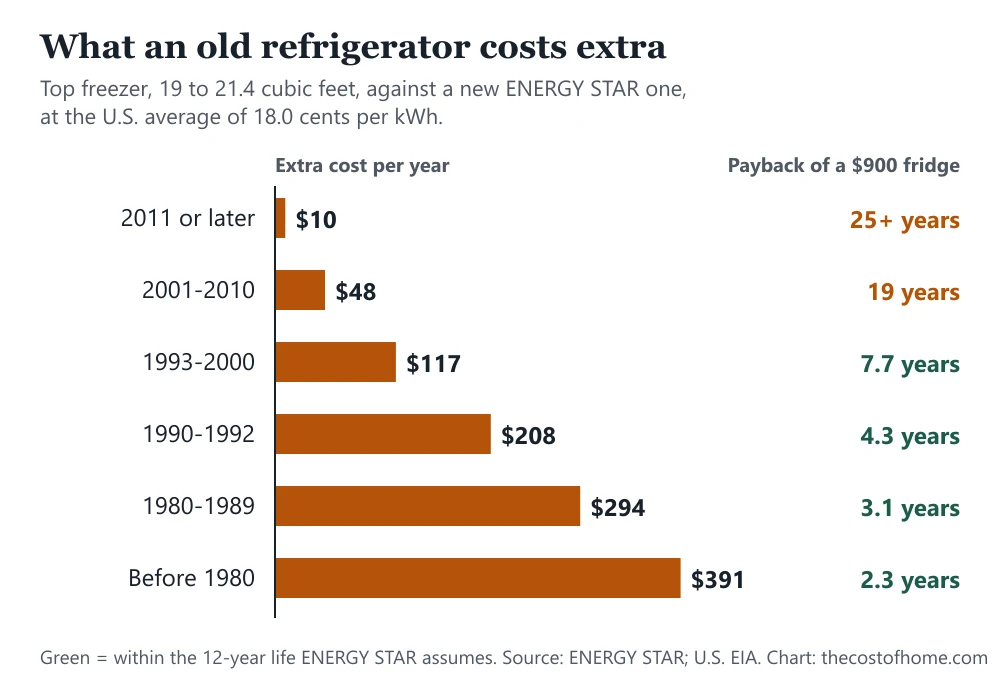
Usually not for the electric bill alone, unless it is from the 1990s or older. A 2001-2010 top freezer costs about $48 a year more than a new ENERGY STAR one, so a $900 replacement takes about 19 years to pay back, longer than the 12-year life ENERGY STAR assumes. One from 1993 to 2000 costs about $117 more and pays back in about 8 years.

On this page
- How much extra does an old refrigerator cost each year?
- How many years until a new refrigerator pays for itself?
- How much does your old refrigerator have to use to be worth replacing?
- Does where you live change the answer?
- Is it worth replacing a second refrigerator in the garage?
- When does replacing an old refrigerator make sense?
- How was this calculated?
- FAQ
- Sources
ENERGY STAR says a refrigerator over 15 years old could cost about $95 more a year to run than a new one, and that replacing an old refrigerator and recycling it saves about $150 over the new one's 12-year life. Those are broad averages. The real saving depends on the year your refrigerator was made, and for a refrigerator from the 2000s it is much smaller than $95.
The agency's own Flip Your Fridge calculator has the numbers behind it: the yearly use of an old refrigerator by model year, size and style, and of a new ENERGY STAR model of the same size. I took them out of the calculator, priced them at the U.S. average cost of electricity and worked out how long a new refrigerator takes to pay for itself. The prices are the 12-month averages I use in my guide to what a refrigerator costs to run.
How much extra does an old refrigerator cost each year?
It depends almost entirely on the model year, because the federal limits on refrigerator energy use have tightened in steps. For a standard top-mount refrigerator-freezer, the maximum allowed was 1,068 kWh a year in 1990, 773 in 1993, 540 in 2001 and 403 in 2014, according to a 2012 paper for the American Council for an Energy-Efficient Economy (ACEEE). The table shows what each generation means in dollars for a top freezer of 19.0 to 21.4 cubic feet.
| Model year | Age | Use per year | Per year | Extra vs new |
|---|---|---|---|---|
| 2011 or later | up to 15 | 438 kWh | $79 | $10 |
| 2001-2010 | 16-25 | 651 kWh | $117 | $48 |
| 1993-2000 | 26-33 | 1,031 kWh | $185 | $117 |
| 1990-1992 | 34-36 | 1,539 kWh | $277 | $208 |
| 1980-1989 | 37-46 | 2,018 kWh | $363 | $294 |
| Before 1980 | 47+ | 2,556 kWh | $460 | $391 |
| New ENERGY STAR | 0 | 383 kWh | $69 | – |
What an old top-freezer refrigerator of 19.0 to 21.4 cubic feet uses and costs a year, by model year, from the ENERGY STAR calculator's figures, which allow for wear with age, at 18.0 cents per kWh. The last row is a new ENERGY STAR model of the same size. "Age" is how old a refrigerator of that model year is in 2026.
The row that matters most for people asking this question in 2026 is the shaded one. A refrigerator made from 2001 to 2010 is between 16 and 25 years old, and the calculator puts it at 651 kWh a year, or $117. A new ENERGY STAR top freezer of the same size uses 383 kWh, so the extra is 268 kWh, about $48 a year. That is half of the $95 that ENERGY STAR gives for a refrigerator over 15 years old, which fits: its figure has to cover refrigerators from the 1990s and earlier too, and those cost $117 to $391 more.
The other styles land close by. A side-by-side from 2001 to 2010 uses 854 kWh and a bottom freezer 762 kWh, against 590 and 472 for new ENERGY STAR models, a gap of 264 and 290 kWh. From 1993 to 2000 the gap is 739 kWh for the side-by-side and 638 kWh for the bottom freezer. These are modeled estimates, not measurements of your refrigerator. They assume it is in working order, so a worn door seal or dirty coils would make it worse.
How many years until a new refrigerator pays for itself?
Simple payback is the price of the new refrigerator divided by what it saves each year. The price you pay depends on the model: Synchrony, a retail lender, puts the average new refrigerator at about $1,500, with top-freezer models running from $400 to $3,000, so the table uses four examples from $600 to $1,500. They are my examples, not a quote. Count what you actually pay, with delivery, and take off any rebate. Synchrony notes that most retailers will haul away your old refrigerator when the new one is delivered, though some charge for it.
| Old model year | $600 | $900 | $1,200 | $1,500 |
|---|---|---|---|---|
| 2011 or later | 25+ | 25+ | 25+ | 25+ |
| 2001-2010 | 12 | 19 | 25 | 25+ |
| 1993-2000 | 5.1 | 7.7 | 10 | 13 |
| 1990-1992 | 2.9 | 4.3 | 5.8 | 7.2 |
| 1980-1989 | 2.0 | 3.1 | 4.1 | 5.1 |
| Before 1980 | 1.5 | 2.3 | 3.1 | 3.8 |
Years for a new refrigerator to pay for itself in electricity alone, by the model year of the old top freezer (19.0 to 21.4 cubic feet) and what you pay for the new one after delivery and haul-away, at 18.0 cents per kWh. Shaded cells pay back within 12 years, the life ENERGY STAR assumes.
Read across the row for your model year. A 2001-2010 top freezer needs 12 years to repay a $600 replacement and 19 years to repay a $900 one, both longer than the 12-year life ENERGY STAR uses. A refrigerator from 1993 to 2000 pays back a $900 model in about 8 years, and anything from 1992 or earlier pays back in under 8 years even at $1,500. A refrigerator from 2011 or later saves about $10 a year, so replacing it for the electric bill never pays.
The calculation leaves out three things. It ignores interest and the rise in electricity prices, which cancel out somewhat. It assumes you buy the same size and style, and a bigger refrigerator or one with an ice maker uses more, which cuts the saving. It also counts nothing for the repairs you avoid or the food you do not lose, and for an old refrigerator that is close to failing those can matter more than the electricity. For the repair side, see my guide on whether to repair or replace an appliance. The timing helps a little: the Bureau of Labor Statistics' September index for major appliances sat about 2% below its September 2025 level, while the index for all items rose about 4%.
How much does your old refrigerator have to use to be worth replacing?
If you do not know your refrigerator's year, or you doubt that it matches the average, work backward from the price. A new top freezer uses about 383 kWh, so the old one has to use that much plus the new refrigerator's price spread over 12 years at your electricity rate. The table gives the answer in kWh a year.
| New fridge price | 13.0¢ | 18.0¢ | 25.0¢ | 33.0¢ |
|---|---|---|---|---|
| $600 | 768 kWh | 661 kWh | 583 kWh | 535 kWh |
| $900 | 960 kWh | 800 kWh | 683 kWh | 610 kWh |
| $1,200 | 1,152 kWh | 939 kWh | 783 kWh | 686 kWh |
| $1,500 | 1,345 kWh | 1,078 kWh | 883 kWh | 762 kWh |
The yearly use, in kWh, that an old refrigerator needs to have for a new top freezer (383 kWh a year) to pay for itself within 12 years, by the price of the new one and your price per kWh. The column headed 18.0¢ is the U.S. average over the last 12 months.
At the U.S. average of 18.0 cents, a $900 refrigerator is worth it for the electric bill only if the old one uses about 800 kWh a year or more. For comparison, the U.S. Energy Information Administration (EIA) puts the average most-used refrigerator in a U.S. home at about 620 kWh a year, counting refrigerators of every age. At 33 cents per kWh, the same $900 refrigerator is worth it at 610 kWh or more, and at 13 cents it needs 960 kWh.
To find your refrigerator's real use, I would plug it into an inexpensive electricity usage meter for a day or two and multiply the kWh by 365. A refrigerator cycles on and off, so a few hours would mislead, and a hot kitchen in summer will read higher than a cool one in winter. This is my suggestion, not a method from ENERGY STAR.
Does where you live change the answer?
A lot, because the saving is kWh times your price. For a $900 replacement of a 2001-2010 top freezer, the extra cost is about $117 a year in Hawaii (43.5 cents per kWh), which pays back in about 7.7 years, and $88 in California (33.0 cents), about 10 years. In Arkansas (13.4 cents) it is $36 a year and about 25+ years, and in North Dakota (12.3 cents) about 25+ years. A refrigerator from 1993 to 2000 pays back that $900 model in about 4.2 years in California and 10 in Arkansas. The state prices are in my guide to electricity prices by state, and your own rate is on your bill, as I explain in how to read your electric bill.
Is it worth replacing a second refrigerator in the garage?
This is the case where the math is easiest. ENERGY STAR's calculator has a separate scenario for removing an extra refrigerator, and there the whole yearly use counts as saved, because you buy nothing. A 2001-2010 top freezer of the same size uses 651 kWh, about $117 a year, and one from 1993 to 2000 uses 1,031 kWh, about $185. ENERGY STAR's fact sheet says an extra refrigerator in a basement or garage could waste about $80 a year.
The question for a second refrigerator is whether you need it all year. If it holds drinks and overflow a few weeks a year, unplugging it saves money from the first month. If you do need one year-round, ENERGY STAR advises replacing the old one with a certified model. My guide to what a refrigerator costs to run counts how many homes have one and where it usually sits.
When does replacing an old refrigerator make sense?
In my opinion, the electric bill alone justifies replacing a refrigerator in three cases: it is from 1992 or earlier, it is a second refrigerator you cannot give up, or you pay a high rate such as California's or Hawaii's and it is from the 1990s. Outside those, a working refrigerator from the 2000s is cheaper to keep, and the better time to replace it is when it breaks or a repair quote runs past half of a new one's price.

If you do decide to replace, three steps raise the saving. Pick the right size, because ENERGY STAR says the most efficient models are typically 16 to 20 cubic feet and that a larger one uses more. Consider a top freezer, which it says tends to use the least energy, and skip the ice maker if you can, which my refrigerator cost guide shows adds roughly 90 kWh a year in the typical top freezer. Then recycle the old one: ENERGY STAR links to a recycling program finder and a rebate finder, and utilities in many areas pay for pickup.
The rest of your electricity matters too. If the bill is the real problem, a refrigerator is usually not the biggest item, and my guide to why your electric bill is so high covers where the bigger ones are.
How was this calculated?
Use of an old refrigerator and of a new ENERGY STAR refrigerator comes from the table inside ENERGY STAR's Flip Your Fridge Calculator, which I read on November 12, 2026. For each style (top freezer, side-by-side, bottom freezer), size range and model-year range it gives the yearly kWh of an existing refrigerator and of a certified new one of the same size. ENERGY STAR says its assumptions combine historical data, adjusted for the wear of an older refrigerator, with the calculations in its specification. I used the 19.0 to 21.4 cubic foot size, the most common full-size range, and the difference between the two numbers as the extra use. Savings of 55 kWh for 2011 or later is the difference as the table gives it; the calculator's own savings column differs by 1 kWh because of rounding.
Cost is kWh times the U.S. average of 18.0 cents per kWh for the 12 months from August 2025 to July 2026 (EIA Form EIA-861M, preliminary), the same price as in my refrigerator cost guide. Payback is the price divided by the yearly saving, without interest or price changes, and the break-even table adds the new refrigerator's price over 12 years to its use. The prices of the new refrigerator are examples. Where the data comes from, and how I handle it, is in how I research costs, and more guides are in the Home Repairs & Appliances section.
Frequently asked questions
Is it worth replacing a 15-year-old refrigerator?
Usually not for the electric bill alone. ENERGY STAR's calculator puts a 2001-2010 top freezer about $48 a year above a new ENERGY STAR one at the U.S. average price, so a $900 refrigerator takes about 19 years to pay back. A repair quote above half the price of a new one changes that.
How much more electricity does an old refrigerator use?
For a top freezer of 19 to 21.4 cubic feet, ENERGY STAR's calculator gives 651 kWh a year for 2001-2010, 1,031 kWh for 1993-2000 and 1,539 kWh for 1990-1992, against 383 kWh for a new ENERGY STAR model.
How long does a new refrigerator take to pay for itself?
Divide its price by the yearly saving. At 18.0 cents per kWh, a $900 refrigerator takes about 8 years to repay replacing a 1993-2000 top freezer, and about 19 years for a 2001-2010 one.
Does ENERGY STAR really say an old refrigerator costs $95 more a year?
Its refrigerators page says refrigerators over 15 years old could cost about $95 more a year to run. The calculator's figures suggest that is closer to $117 for a 1993-2000 top freezer and $48 for a 2001-2010 one, so the $95 is an average over several generations.
Should I unplug my second refrigerator?
If you do not need it year-round, yes. A 2001-2010 top freezer uses about 651 kWh, or $117 a year at the U.S. average, and ENERGY STAR says an extra refrigerator in a basement or garage could waste about $80 a year.
How do I find out how much my refrigerator uses?
Use ENERGY STAR's Flip Your Fridge calculator with its style, size and model year, or plug it into an electricity usage meter for a day or two and multiply the kWh by 365. The meter is more accurate, because a refrigerator cycles on and off.
What should I do with my old refrigerator?
Recycle it. ENERGY STAR says to recycle the old refrigerator when you buy a new one, and many appliance retailers will pick it up at delivery. ENERGY STAR also lists a recycling program finder and a rebate finder by area.
Sources
- ENERGY STAR, Flip Your Fridge Calculator: yearly use of existing and new ENERGY STAR refrigerators by style, size and model year (data table in the calculator script, accessed November 12, 2026)
- ENERGY STAR, Refrigerators: buying advice, old refrigerators over 15 years, recycling and the $150 saving over 12 years (accessed November 12, 2026)
- ENERGY STAR, Flip Your Fridge and Save! fact sheet (February 16, 2021; extra refrigerator in a basement or garage; accessed November 12, 2026)
- James E. McMahon, "Energy Efficiency is a Renewable Resource," ACEEE Summer Study on Energy Efficiency in Buildings (2012): federal refrigerator-freezer standard levels of 1990, 1993, 2001 and 2014 (accessed November 12, 2026)
- Synchrony, "How Much Do Refrigerators Cost?": average price, price by style and removal of the old refrigerator (accessed November 12, 2026)
- U.S. Energy Information Administration, Form EIA-861M: monthly sales, revenue and customers by state (August 2025 to July 2026, accessed October 15, 2026)
- U.S. Energy Information Administration, 2020 Residential Energy Consumption Survey, table CE5.3b: detailed household electricity end-use consumption, averages (accessed October 23, 2026)
- U.S. Bureau of Labor Statistics, Consumer Price Index, major appliances (series CUUR0000SEHK01) and all items (CUUR0000SA0), September 2025 and 2026 (accessed November 9, 2026)

Founder and editor, The Cost of Home
I write and check every guide on this site myself, working from public data. The sources behind each number are listed at the end of the article, so you can check them too.