Home Repairs & Appliances
Air Fryer vs Oven: Which Costs Less to Cook With?
Quick answer
For small meals, an air fryer usually costs less to run than an electric oven. In a UK lab test by Which?, it used about a third to half the electricity for a chicken, chips, a potato and a cake. At the U.S. average price that is roughly 4 to 10 cents a meal against 13 to 21 cents. For big batches or long cooks, the oven can come out ahead.
On this page
- Is an air fryer cheaper to run than an oven?
- How do you work out the cost for your own air fryer and oven?
- When does the oven cost less than an air fryer?
- How much do an air fryer and an oven cost over a year?
- What does cooking Thanksgiving dinner cost in an oven and an air fryer?
- What about gas ovens, toaster ovens and microwaves?
- How can you cut what you spend cooking?
- What does a year of cooking cost in all 50 states?
- How was this calculated?
- FAQ
- Sources
The air fryer is sold as the cheap way to cook, and the oven as the costly one. It is a fair guess, since a full-size oven has to heat a large box before it heats your food. But two labs that measured it reached different answers, so the honest reply is "usually, for small meals". The size of the meal and the length of the cook decide it.
Below I put the lab figures at U.S. prices, show how to check your own kitchen, say when the oven wins, and work out a year of cooking and the Thanksgiving turkey. For electricity prices I use the figures in my electricity prices by state guide.
Is an air fryer cheaper to run than an oven?
In the most detailed test I found, yes. Which?, the UK consumer group, cooked a roast chicken, chips, a jacket potato and a cake in an air fryer and in a built-in electric oven, and measured the electricity each used, preheating included. The air fryer used between 31% and 47% of what the oven did, which means the oven used 2.1 to 3.2 times as much. At the U.S. average of 18.0 cents per kilowatt-hour (kWh), that is 4 to 10 cents a meal in the air fryer and 13 to 21 cents in the oven.
| Food | Air fryer kWh | Oven kWh | Air fryer cost | Oven cost |
|---|---|---|---|---|
| Roast chicken | 0.54 | 1.157 | 10¢ | 21¢ |
| Chips (fries) | 0.287 | 0.863 | 5¢ | 16¢ |
| Jacket potato | 0.392 | 1.084 | 7¢ | 20¢ |
| Cake | 0.223 | 0.71 | 4¢ | 13¢ |
What Which? measured in its UK lab for the same food in an air fryer and in a built-in electric oven, and what that electricity would cost at the U.S. average price of 18.0 cents per kWh. The kWh include preheating. The air fryer cake was smaller than the oven cake. Costs are my arithmetic: kWh times the U.S. price.
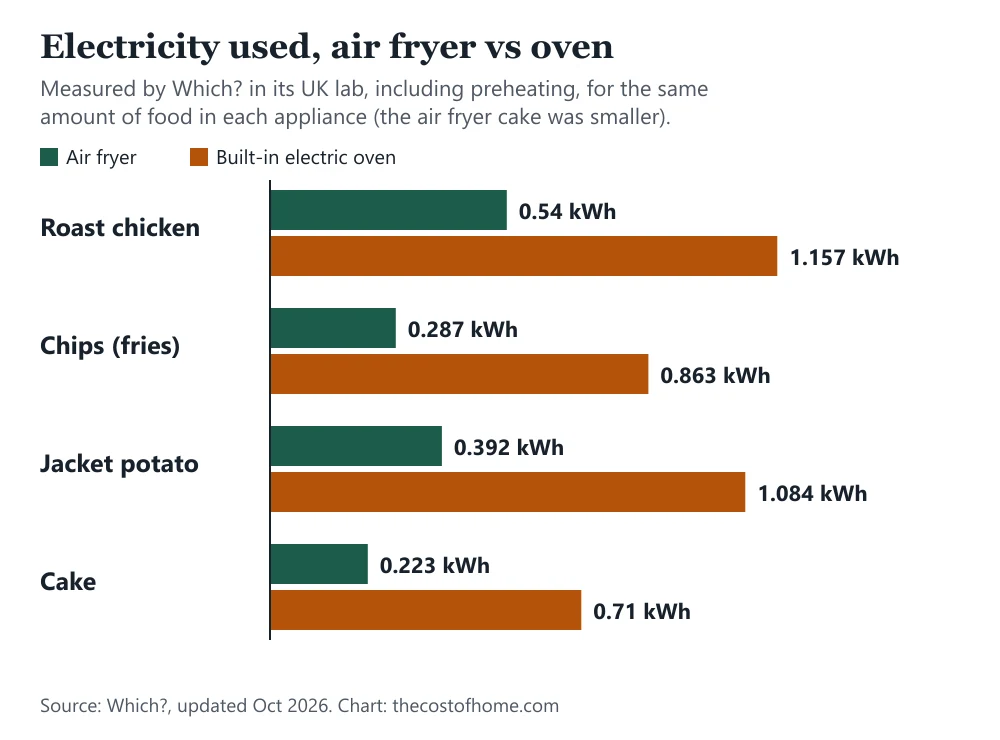
These are UK measurements on one air fryer and one oven, so I treat them as a pattern, not a promise for your kitchen. Which? also says the air fryer basket limited how much it could cook: the chicken was small, about 1.3 kg, the chips were half a basket, and the air fryer cake was smaller than the oven cake. The savings are for the portion an air fryer holds.
How do you work out the cost for your own air fryer and oven?
The rating on the label is the most power the appliance can draw. Convert it to kilowatts, multiply by the time it is on, and then by what your utility charges for a kWh. A 1,500-watt air fryer on for half an hour uses 0.75 kWh, which at 18.0 cents is 13 cents. An oven rated at 2,800 watts, the figure EnergySage uses for a typical oven (it says ovens range from 2,000 to 5,000 watts), is 1.4 kWh in the same half hour, or 25 cents.
That formula assumes the appliance draws its full rating the whole time, so it gives a ceiling. Neither one does. Which? says the same about its own formula, which is why it measured the real use. Its figures, divided by the time each cook took, show how much power the two drew on average:
| Food | Air fryer time | Oven time | Air fryer average | Oven average |
|---|---|---|---|---|
| Roast chicken | 53 min | 76 min | 0.61 kW | 0.91 kW |
| Chips (fries) | 23 min | 33 min | 0.75 kW | 1.57 kW |
| Jacket potato | 48 min | 68 min | 0.49 kW | 0.96 kW |
| Cake | 33 min | 56 min | 0.41 kW | 0.76 kW |
The cooking times Which? recorded for the same four foods, including preheating, and the average power each appliance drew over that time (kWh divided by hours). A typical air fryer is rated near 1,500 W and an oven near 2,800 W, so both ran well below their rating on average.
The air fryer averaged 0.41 to 0.75 kW and the oven 0.76 to 1.57 kW. The oven's thermostat switches the heating element off when the box is hot, and the air fryer's smaller space means it spends less time heating up. I do not know the rated wattage of the Which? models, so the 1,500 W and 2,800 W above are examples, not their specifications. For your own numbers, a plug-in energy monitor between the wall and the air fryer shows what one cook really uses. My guide on how to read your electric bill shows where your rate is printed.
When does the oven cost less than an air fryer?
When the food is a lot or the cook is long. Consumer NZ, the New Zealand consumer group, measured seven air fryers and three ovens in its lab (reported in January 2024) at 200 °C (390 °F) for 30 minutes. It found that using an air fryer for 30 minutes three times a week cost more, on average, than using an oven. Its explanation is that ovens are better insulated and sealed and their thermostat cycles the element on and off, while an air fryer keeps its fan and element working. It adds that for short cooks of 30 minutes or less with no preheat, and for small amounts of food, an air fryer is likely to be cheaper, and that if you add ten minutes of preheating to the oven the oven's average rises above the air fryer's.
The two tests are not in conflict. They measured different things, and together they give a rule I find useful:
- Small amounts, short cook: air fryer. Two portions of chips, one potato, a few chicken pieces or a small cake are the cases where it won in the Which? test.
- Big amounts, long cook: oven. If the air fryer needs two rounds to cook what the oven does in one, the savings shrink. Which? makes the same point: a full roast dinner may be cheaper in the oven because you can use the other shelves for other dishes.
- Several dishes at once: oven. Once the oven is hot, a tray of vegetables beside the chicken adds little to the bill.
In my opinion, the choice should follow the size of the meal. If you cook for one or two and use the oven mostly for a few pieces at a time, the air fryer is the cheaper tool. If you feed a family or roast a big tray, the oven is a fair choice, and buying an air fryer to save electricity on those meals will not pay for itself.
How much do an air fryer and an oven cost over a year?
Cooking one of each of the Which? foods a week for a year, one chicken, one batch of chips, one potato and one cake, uses 1.44 kWh a week in the air fryer and 3.81 kWh in the oven. At the U.S. average price that is about $13 a year in the air fryer and $36 in the oven, a gap of about $22. That is small next to a heating or cooling bill. If you want to know where the money does go, start with my electric bill breakdown.
The state you live in changes the gap more than the appliance does. The same cooking costs $11 a year in the air fryer and $28 in the oven in Washington, and $25 against $65 in California. Across all the places on my list the oven costs $15 more than the air fryer in North Dakota, where electricity is cheapest, and $54 more in Hawaii, where it is dearest. 33 of the 51 places are priced below the national average.
| State | kWh price | Air fryer a year | Oven a year | Gap |
|---|---|---|---|---|
| U.S. average | 18.0¢ | $13 | $36 | $22 |
| Washington | 14.1¢ | $11 | $28 | $17 |
| Texas | 16.0¢ | $12 | $32 | $20 |
| Ohio | 18.3¢ | $14 | $36 | $23 |
| New York | 28.4¢ | $21 | $56 | $35 |
| California | 33.0¢ | $25 | $65 | $41 |
A year of the same four foods (one of each a week for 52 weeks) in five states with very different electricity prices. The price is each state's average residential rate from my electricity prices guide (September 2025 to August 2026, preliminary), and the kWh come from the Which? lab test.
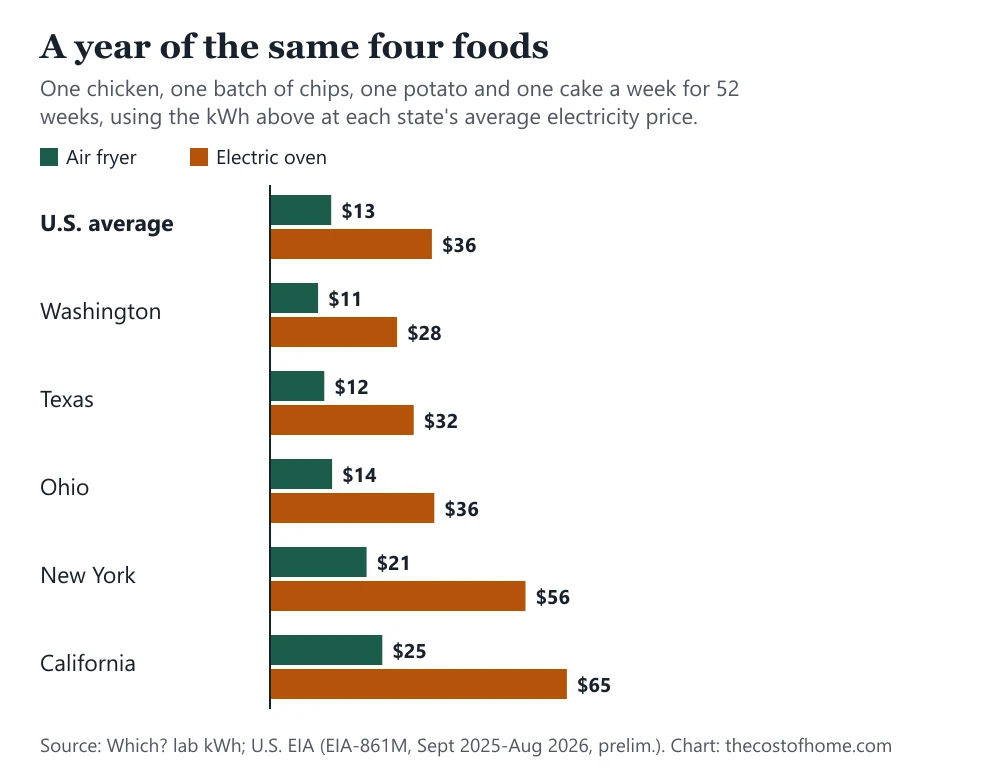
Your state is in the full table at the end. If your utility charges something else, plug in your own rate.
What does cooking Thanksgiving dinner cost in an oven and an air fryer?
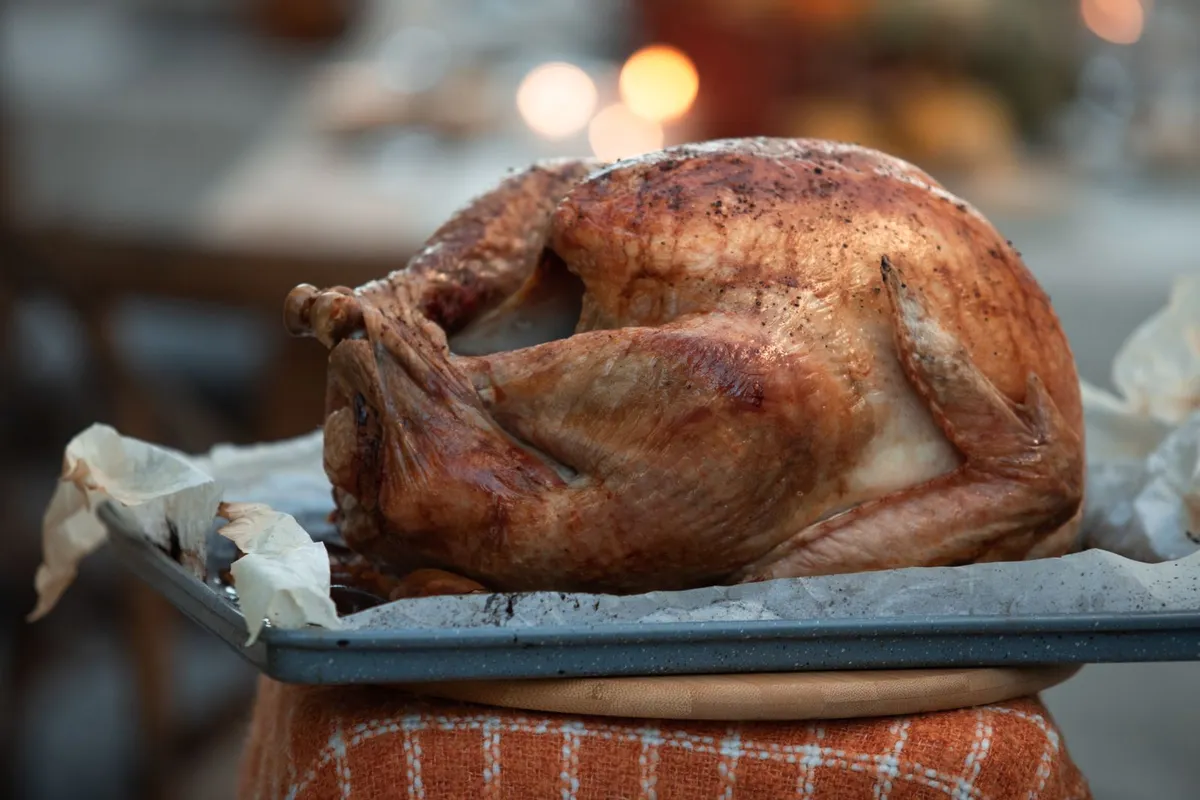
Less than most people expect. A turkey is an oven job: it does not fit in an air fryer. The USDA's roasting table, as published by University of Illinois Extension, gives 2¾ to 3 hours at about 160 °C (325 °F) for an unstuffed 8 to 12 pound bird. If the oven drew what it averaged for the Which? chicken, about 0.91 kW, a 3-hour turkey would use about 2.7 kWh. That is about $0.49 at the U.S. average price, and about $0.90 in California. It is my estimate, because I did not find a lab measurement of a turkey, and a bigger bird, a stuffed one or an older oven would use more.
The air fryer earns its place on the days after. Warming leftovers for 20 minutes at the average power of the Which? tests costs about 3 cents in the air fryer and about 6 cents in the oven. Both are pennies, so the real saving is the time you do not spend heating a large oven for one plate. The one trap is on the day itself: if the oven is already hot for the turkey, a dish that goes into it adds very little, and running the air fryer beside it adds its own kWh. Use the air fryer for the extra side only when the oven is full or already off.
For the rest of the holiday bill, my guide on gas versus electric stove cost shows what a whole year of cooking costs, and the clothes dryer guide covers the other appliance that works harder when guests come.
What about gas ovens, toaster ovens and microwaves?
The lab figures above are for electric ovens. A gas oven burns natural gas, which costs less per unit of heat than electricity in most states, so the comparison there is closer. I did not find a lab measurement of a gas oven against an air fryer, so I do not put a number on it. My guide on gas versus electric stoves has the fuel prices and the break-even rule, and the same logic applies.
The Department of Energy (DOE) does not rank them by cost, but its Energy Saver guide says to use small appliances such as air fryers, multicookers, slow cookers, toaster ovens, electric pressure cookers, microwave ovens or convection ovens for small meals instead of the large stove or oven. It says they save energy and can cut summer cooling costs because they give off less heat. An air fryer is one of that group, not a special case. If your meal is small enough for one of them, any of them is likely to cost less than heating the full oven.
How can you cut what you spend cooking?
- Match the appliance to the meal. Use the air fryer for a portion or two and the oven for a tray or a family meal.
- Skip the preheat when you can. Many air fryer recipes do not need it, and Consumer NZ says the oven loses its edge once about ten minutes of preheating are counted.
- Fill the oven when it is on. Cook a second tray at the same time, since the heat is already paid for.
- Do not open the door more than needed. Each opening lets heat out and the element has to make it up.
- Look up the rate you pay. It moves the result more than the choice of appliance does. My refrigerator guide shows an appliance that costs far more over a year than either of these.
An air fryer is not a reason to replace a working oven, and a broken oven is a decision about repair costs, not cooking costs: see my repair or replace guide. For more on what appliances cost to run, see the Home Repairs & Appliances section.
What does a year of cooking cost in all 50 states?
Here is the full list for the 50 states and the District of Columbia. Every row uses the same 1.44 kWh and 3.81 kWh a week from the Which? test, so only the price of electricity differs from row to row. Treat the figures as arithmetic for one pattern of cooking, not what residents actually pay.
| State | kWh price | Air fryer a year | Oven a year | Gap |
|---|---|---|---|---|
| U.S. average | 18.0¢ | $13 | $36 | $22 |
| Alabama | 16.4¢ | $12 | $33 | $20 |
| Alaska | 26.9¢ | $20 | $53 | $33 |
| Arizona | 15.4¢ | $12 | $31 | $19 |
| Arkansas | 13.4¢ | $10 | $27 | $17 |
| California | 33.0¢ | $25 | $65 | $41 |
| Colorado | 16.6¢ | $12 | $33 | $20 |
| Connecticut | 28.0¢ | $21 | $56 | $35 |
| Delaware | 17.8¢ | $13 | $35 | $22 |
| District of Columbia | 24.2¢ | $18 | $48 | $30 |
| Florida | 15.4¢ | $12 | $31 | $19 |
| Georgia | 15.1¢ | $11 | $30 | $19 |
| Hawaii | 43.5¢ | $33 | $86 | $54 |
| Idaho | 12.7¢ | $9 | $25 | $16 |
| Illinois | 18.8¢ | $14 | $37 | $23 |
| Indiana | 16.9¢ | $13 | $34 | $21 |
| Iowa | 14.1¢ | $11 | $28 | $17 |
| Kansas | 15.1¢ | $11 | $30 | $19 |
| Kentucky | 13.9¢ | $10 | $28 | $17 |
| Louisiana | 13.0¢ | $10 | $26 | $16 |
| Maine | 29.3¢ | $22 | $58 | $36 |
| Maryland | 21.0¢ | $16 | $42 | $26 |
| Massachusetts | 30.4¢ | $23 | $60 | $38 |
| Michigan | 21.1¢ | $16 | $42 | $26 |
| Minnesota | 16.2¢ | $12 | $32 | $20 |
| Mississippi | 14.8¢ | $11 | $29 | $18 |
| Missouri | 13.9¢ | $10 | $28 | $17 |
| Montana | 13.8¢ | $10 | $27 | $17 |
| Nebraska | 12.9¢ | $10 | $26 | $16 |
| Nevada | 13.4¢ | $10 | $26 | $16 |
| New Hampshire | 26.7¢ | $20 | $53 | $33 |
| New Jersey | 23.8¢ | $18 | $47 | $29 |
| New Mexico | 15.3¢ | $11 | $30 | $19 |
| New York | 28.4¢ | $21 | $56 | $35 |
| North Carolina | 14.8¢ | $11 | $29 | $18 |
| North Dakota | 12.3¢ | $9 | $24 | $15 |
| Ohio | 18.3¢ | $14 | $36 | $23 |
| Oklahoma | 13.7¢ | $10 | $27 | $17 |
| Oregon | 15.5¢ | $12 | $31 | $19 |
| Pennsylvania | 20.7¢ | $16 | $41 | $26 |
| Rhode Island | 29.3¢ | $22 | $58 | $36 |
| South Carolina | 15.6¢ | $12 | $31 | $19 |
| South Dakota | 14.2¢ | $11 | $28 | $18 |
| Tennessee | 13.6¢ | $10 | $27 | $17 |
| Texas | 16.0¢ | $12 | $32 | $20 |
| Utah | 13.3¢ | $10 | $26 | $16 |
| Vermont | 23.8¢ | $18 | $47 | $29 |
| Virginia | 16.5¢ | $12 | $33 | $20 |
| Washington | 14.1¢ | $11 | $28 | $17 |
| West Virginia | 15.5¢ | $12 | $31 | $19 |
| Wisconsin | 18.7¢ | $14 | $37 | $23 |
| Wyoming | 14.0¢ | $11 | $28 | $17 |
A year of the same four foods in each state (a roast chicken, a batch of chips, a jacket potato and a cake, once a week for 52 weeks), at the state's average residential electricity rate (the figures in my electricity prices guide, September 2025 to August 2026, preliminary). The kWh are the Which? lab figures: 1.44 kWh a week in the air fryer and 3.81 kWh in the oven. The D.C. row is the District of Columbia.
How was this calculated?
The kWh for each food come from the Which? article "Air fryer vs oven: energy usage, costs and cooking results compared" (updated October 23, 2026). Which? says it measured the energy each appliance used in its test lab, and that the cooking times and energy figures include preheating where needed. It used one air fryer and one built-in electric oven, and the same quantities of food in both, except the cake, which was smaller in the air fryer. I multiplied its kWh by U.S. and state electricity prices, which are residential revenue divided by kWh sold in the EIA's Form EIA-861M (preliminary data for September 2025 to August 2026). They match my electricity prices guide, and the U.S. average is 18.0 cents. Which? also gave costs in pence, which I did not use.
The average power in the second table is each appliance's kWh divided by its cooking time. The 1,500 W air fryer is my example, and the 2,800 W oven and the 2,000 to 5,000 W range come from EnergySage's guide to electric ovens and stoves. The turkey time is the USDA's 325 °F table as published by University of Illinois Extension, and the turkey's electricity is my estimate: the average power of the Which? chicken roast times the table's 3 hours. The yearly figures assume one of each food a week for 52 weeks, which is my assumption. The Consumer NZ result is from its lab test of seven air fryers and three ovens, and the DOE statement is from its Energy Saver Guide (2022). My sources and method are set out in how I research costs.
Frequently asked questions
Is an air fryer cheaper to run than an oven?
For small meals, usually. In a lab test by Which?, an air fryer used between 31% and 47% of the electricity of an electric oven for a chicken, chips, a potato and a cake. Consumer NZ found the oven cheaper in a 30-minute test, so for large batches or long cooks the oven can win.
How much does it cost to run an air fryer?
A 1,500 W air fryer at full power for 30 minutes uses 0.75 kWh, which costs about 13 cents at the U.S. average price of 18.0 cents per kWh. In the Which? tests the air fryers drew less than their rating on average, and a whole meal cost 4 to 10 cents.
How much does it cost to run an electric oven for an hour?
A typical 2,800 W oven at full power for an hour uses 2.8 kWh, about $0.50 at the U.S. average price. An oven cycles its element on and off, so the real figure is lower. In the Which? tests the oven averaged about 0.8 to 1.6 kW while cooking.
How many watts does an air fryer use?
Check the label: the rating is printed on the appliance or in its manual. I use 1,500 W as an example, and a 1,500 W air fryer uses 1.5 kWh for an hour at full power. In the Which? tests the air fryer averaged 0.41 to 0.75 kW over a cook.
Is it cheaper to cook a turkey in an oven or an air fryer?
A whole turkey does not fit in most air fryers, so it is an oven job. By my estimate a 3-hour roast uses about 2.7 kWh, about $0.49 at the U.S. average price. The air fryer is more useful for warming leftovers or cooking a small side.
Does an air fryer save money on the electric bill?
A little. The same four foods once a week for a year cost about $13 in an air fryer and $36 in an electric oven at the U.S. average price, a gap near $22. Heating, cooling and the water heater are far larger lines on a bill.
Is a gas oven cheaper than an air fryer?
It depends on your gas and electricity prices, and I did not find a lab measurement that compares them. Gas costs less per unit of heat than electricity in most states. My gas versus electric stove guide has the prices and the break-even rule.
Sources
- Which?, "Air fryer vs oven: energy usage, costs and cooking results compared" (updated October 23, 2026; accessed November 11, 2026)
- Consumer NZ, "Air fryer vs oven: do air fryers really save you money?" (January 2024; accessed November 11, 2026)
- EnergySage, "How many watts does an electric oven use?": oven power range and typical wattage (updated November 22, 2024; accessed November 11, 2026)
- U.S. Department of Energy, Energy Saver Guide 2022: kitchen and cooking tips, small appliances (accessed November 11, 2026)
- University of Illinois Extension, "Traditional Roast Turkey": USDA roasting timetable for fresh or thawed turkey at 325 °F (accessed November 11, 2026)
- U.S. Energy Information Administration, Form EIA-861M: monthly sales, revenue and customers by state (September 2025 to August 2026, preliminary; used in my electricity prices guide)

Founder and editor, The Cost of Home
I write and check every guide on this site myself, working from public data. The sources behind each number are listed at the end of the article, so you can check them too.