Home Repairs & Appliances
Repair or Replace? When an Old Appliance Is Worth Fixing
Quick answer
Fix an appliance when the repair costs less than half of what a new one would, and the machine is not already past its typical life of about 10 to 14 years. Replace it when the quote is near that halfway line or the appliance is old. Most repairs pass the test, since they run roughly $120 to $400, while a compressor, motor or control board on an old machine usually does not.
On this page
- What is the 50% rule for appliances?
- How much does an appliance repair cost?
- How old is too old to repair an appliance?
- What does a repair cost per year of life it buys?
- Does an old appliance cost more to run?
- Which repairs are usually worth it, and which are not?
- Should a Black Friday sale change my mind?
- What should I do before I decide?
- How did I put this together?
- FAQ
- Sources
A dead dishwasher or a fridge that will not get cold forces a decision in the same hour: pay a technician, or start shopping. Everyone has a rule for it, and most of the rules are old. The best known, the 50% rule, comes from Consumer Reports and still works as a first test. It just leaves out two things that change the answer, how old the machine is and what a new one actually costs this month.
Below I go through the rule, what repairs cost, how long each appliance lasts, what an old refrigerator wastes in electricity and how a sale changes the math. The prices come from published 2026 cost guides. Where I add my own arithmetic, I say so.
What is the 50% rule for appliances?
The rule says not to spend more than half of the price of a new product to repair an old one. Consumer Reports put it in a 2014 release based on a survey of 29,281 subscribers: no matter who does the repair, it advised, do not spend more than 50 percent of the cost of a new product on repairing an old one. If a new refrigerator would cost $1,000, the line is $500. A quote of $350 is under it; a quote of $650 is over it.
| New price | 50% line | New, 20% off | 50% line |
|---|---|---|---|
| $600 | $300 | $480 | $240 |
| $1,000 | $500 | $800 | $400 |
| $1,500 | $750 | $1,200 | $600 |
| $2,500 | $1,250 | $2,000 | $1,000 |
Where the 50% line falls for a few example prices of a new appliance. The prices are round examples, not quotes. The last two columns show the same line if the new one is on sale at 20% off, because the line follows the price you would actually pay.
The rule is a starting point, not a verdict. NerdWallet reported in 2023 that Consumer Reports has since refined its advice using member feedback on 528,000 products bought from 2012 through 2022. Its interactive repair-or-replace tool now looks at the appliance's price, its age and the cost of the repair, and builds in an estimate of how much life a typical appliance in that category has left. In general, NerdWallet says, the more you spent on the appliance in the first place, the more likely the tool is to say repair; and a costly repair on a cheaper appliance can still be worth it if it buys several more years. I did not open the tool itself, so I am relying on that description.
That is why I treat the 50% rule as the first of three questions. The other two are how old the machine is and what the repair works out to per year of life it buys. The next sections give the numbers for each.
How much does an appliance repair cost?
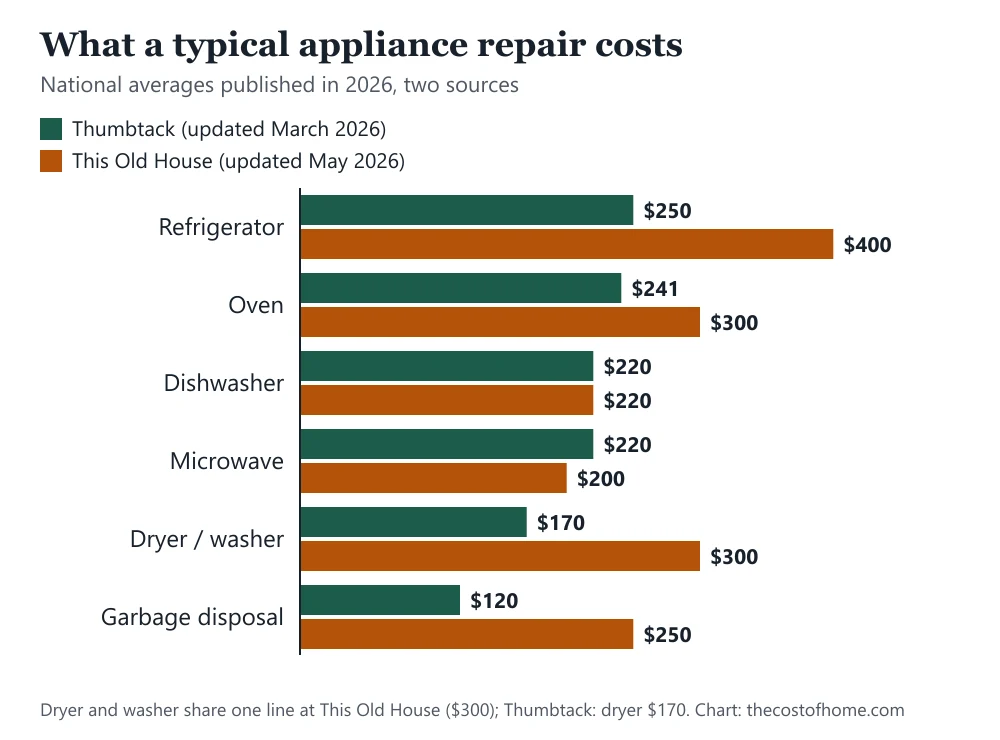
Most repairs land between about $120 and $400. Thumbtack's national average for minor appliance repairs is about $206 (range $129 to $329), with a refrigerator at $250 on average, a dishwasher at $220, a dryer at $170 and a washer at $224. This Old House puts the overall range at $50 to $500, with a refrigerator averaging $400, an oven $300 and a dishwasher $220. The two sources disagree on some lines, so I show both. Labor is a big part of it: Thumbtack gives $75 an hour as the national average, with a range of $40 to $110.
| Appliance | Thumbtack | This Old House | Typical range |
|---|---|---|---|
| Refrigerator | $250 | $400 | $200-$500 |
| Washer or dryer | – | $300 | $100-$650 |
| Oven | $241 | $300 | $100-$400 |
| Dishwasher | $220 | $220 | $100-$300 |
| Microwave | $220 | $200 | $50-$400 |
| Garbage disposal | $120 | $250 | $70-$400 |
What a typical repair costs, as published in 2026. Thumbtack's figures are national averages (updated March 31, 2026); This Old House lists an average and a typical range (updated May 6, 2026). This Old House gives one line for washers and dryers; Thumbtack prices them separately (washer $224, dryer $170).
Watch the service call. This Old House surveyed 2,000 homeowners with home warranties and found service call fees that run from under $40 to over $200, with $75 the most common. Ask whether that fee is credited toward the repair, and whether the quote you get includes the parts and the labor. The price depends on what broke. Thumbtack points out that replacing a knob on an oven costs far less than putting a new motor in a dishwasher, and This Old House says a refrigerator's control board or compressor can cost hundreds of dollars.
How old is too old to repair an appliance?
Older than the average life of that appliance, in my opinion, unless the repair is trivial. The National Association of Home Builders (NAHB) published the standard reference in 2007, from a 2006 telephone survey of manufacturers, trade associations and researchers: refrigerators and dryers last about 13 years, washers 10, dishwashers and microwaves 9, electric ranges 13 and gas ranges 15. The appliance makers' trade group, AHAM, was a bit more optimistic in 2019: 14 years for a top-freezer refrigerator, 11.1 for a side-by-side, 13.4 for a dryer, 11.2 for a top-load washer, 9.1 for a front-load, and 12 for a dishwasher.
| Appliance | NAHB 2007 | AHAM 2019 |
|---|---|---|
| Refrigerator | 13 | 14 (top-freezer), 11.1 (side-by-side) |
| Washer | 10 | 11.2 (top-load), 9.1 (front-load) |
| Dryer | 13 | 13.4 |
| Dishwasher | 9 | 12 |
| Electric range | 13 | 11.6 |
| Gas range | 15 | 14.2 |
| Microwave | 9 | – |
| Garbage disposal | 12 | – |
| Water heater, gas | 10 | – |
| Water heater, electric | 11 | – |
| Furnace, gas | 18 | – |
How many years each appliance typically lasts, in years. NAHB is the National Association of Home Builders' 2007 study of life expectancy, based on a 2006 survey. AHAM is the Association of Home Appliance Manufacturers' 2019 estimate of average useful life, as reported by NerdWallet in 2023. Both are averages, not promises.
These are averages, and the NAHB itself says its report is a general guideline only: the life of an appliance depends a great deal on how it is used, and many are replaced long before they wear out because newer ones look better or have new features. Consumer Reports adds a modern wrinkle. Appliances have more electronics than they used to, so there are more parts that can fail and the fixes can need specialized knowledge, and it says most people now expect a typical appliance to last about 10 years.
My simple version, which is mine and not Consumer Reports': a repair is worth considering when two things are true at once. The quote is under half the price of a new one, and the appliance is younger than its typical life in the table. If one of the two fails, I would shop around before paying. If both fail, I would replace it.
What does a repair cost per year of life it buys?
This is the check I find most useful, because it puts a repair and a new appliance on the same footing. Divide the quote by the number of extra years you reasonably expect. A $300 fix that gives you four more years costs $75 a year; a $300 fix on a machine that will probably quit in a year or two costs $150 to $300 a year. Compare that with the new appliance's price spread over its life, which for a $1,000 refrigerator lasting 13 years is about $77 a year.
| Repair | 2 years | 4 years | 6 years |
|---|---|---|---|
| $150 | $75 a year | $38 a year | $25 a year |
| $300 | $150 a year | $75 a year | $50 a year |
| $500 | $250 a year | $125 a year | $83 a year |
| $800 | $400 a year | $200 a year | $133 a year |
What a repair costs for each year of life it buys. For comparison, a new $1,000 appliance that lasts 13 years costs about $77 a year; the new price and the years are examples, so use your own quote and your own price. A repair does not make the rest of the machine new, so I count only the years I would expect it to keep working.
The shaded cells are the ones at or below the $77-a-year cost of the new example, which means the repair is the cheaper way to keep a working appliance. A $500 repair that buys six years beats the new one; the same $500 for two years does not. The honest unknown is how many years a repair really buys, and a technician can tell you more than a table can. NerdWallet's author described paying less than $200 to fix a 17-year-old refrigerator that was still running eight years later, which is the best case. I would not budget for it.
Two things are left out of this arithmetic. A new appliance also brings its own installation or delivery cost, and an old one that fails again after the repair brings a second repair bill. The first pushes toward repair, the second toward replacing.
Does an old appliance cost more to run?
For a refrigerator, yes, and it is the one case where the electric bill can tip the decision. ENERGY STAR's refrigerator page says a refrigerator over 15 years old could cost you about $95 more a year to run, and that an old one uses roughly 20% more energy than a certified model. Its estimate for swapping an old unit for a certified one, and recycling the old one, is about $150 saved across the new unit's 12-year life. Over five years that extra running cost is more than $450, which is real money next to a repair quote of $400. My refrigerator cost guide has the full numbers and how many homes still run a refrigerator that old.
Other appliances matter less. For a dryer, my dryer guide finds that swapping like for like saves little on the bill, so the repair math above decides it. A washer's yearly running cost is mostly hot water and the water bill, which I broke down in my washing machine guide. A water heater and a furnace are different: they are big purchases where efficiency can change the picture, so I cover them separately in the water heater replacement and furnace replacement guides.
Which repairs are usually worth it, and which are not?
The cheap fixes on younger machines are the easy yeses. This Old House and Thumbtack both list the kind of problem that suggests a repair: a clogged vent or broken belt on a dryer under 13 years old, a coil cleaning or thermostat on a refrigerator under 13, a drain problem or a door latch on a dishwasher, a worn door seal on a refrigerator. Those are small parts and short labor. This Old House also notes that high-quality dishwashers are some of the least expensive kitchen appliances to repair.
The costly parts are the ones that move the quote toward the 50% line: a compressor, a motor, a control board. On an old machine, I would usually let those push me to replace. The small ones that rarely justify a technician are the cheap appliances themselves. This Old House says a garbage disposal costs so little to buy that a new unit may be cheaper than getting the old one fixed, and Thumbtack says the same about some microwaves.
One safety point: This Old House says ovens and stovetops should usually be repaired by a professional, since electric units can electrocute and gas units can leak carbon monoxide.
Should a Black Friday sale change my mind?
It changes one side of the math, not both. Black Friday falls on November 27, 2026, the day after Thanksgiving. A sale lowers the price of the new appliance, so it lowers your 50% line along with it: at 20% off, the line for a $1,000 appliance drops from $500 to $400. The repair quote does not go on sale. That makes a repair that was just under the line before the sale a worse deal during it.
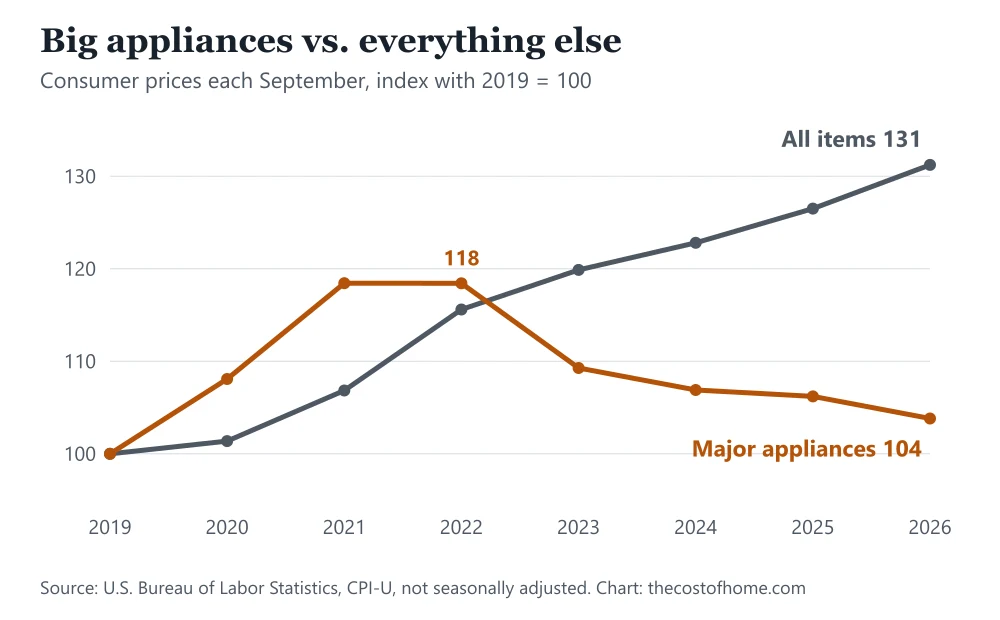
The price trend helps a little. In the Bureau of Labor Statistics' consumer price index, major appliances cost 2.3% less in September 2026 than a year earlier, while prices overall were up 3.7%. They are about 12% below the peak of 2021 and 2022, and only 3.8% above 2019, when everything else is up 31%. In my opinion that is a reason not to panic-buy: a new appliance is cheaper in real terms than it was a few years ago, so there is no need to buy a bad deal or to repair a bad machine just to avoid shopping.
If your appliance has already died, the sale can help; if it still works, do not let a doorbuster decide for you. Get the repair quote first, run the three checks, and then compare it with the sale price. I would check the new price you would really pay, including delivery, installation and haul-away of the old one, since the 50% line works only if you compare like with like.
What should I do before I decide?
- Get a written quote with parts, labor and the service fee, and ask whether the fee is credited if you go ahead.
- Price a comparable new one, with delivery and haul-away, and compute the quote as a share of it.
- Check the age against the typical life in the table above.
- Divide the quote by the years it should buy and compare with the new price spread over its life.
- For a refrigerator, add the extra electricity if it is more than 15 years old.
- Ask about a warranty on the repair. Consumer Reports found in 2014 that people who used independent repair shops were more satisfied than those who used the manufacturer's service, and that service contracts and extended warranties did not make people any happier with their repairs.
For the other costs that come with owning a home, see my guide to home maintenance cost per year and the rest of Home Repairs & Appliances.
How did I put this together?
Repair prices are the national averages published by Thumbtack (updated March 31, 2026) and This Old House (updated May 6, 2026); both are home-services businesses, so I treat them as estimates and show both. Appliance life comes from the NAHB's 2007 study and the AHAM's 2019 estimates as reported by NerdWallet in 2023. The 50% rule comes from a Consumer Reports release of January 9, 2014, and the description of its newer tool from NerdWallet. The refrigerator energy figures are ENERGY STAR's. The price trend uses the Bureau of Labor Statistics' consumer price index for major appliances and for all items, not seasonally adjusted, for each September from 2019 to 2026.
The examples with a $1,000 appliance, the 20% sale and the years a repair buys are my illustrations, not data, and the three-question test is my own simplification. I did not find a source that measures how many years a given repair buys. How I check a source before using it is explained in how I research costs.
Frequently asked questions
What is the 50% rule for appliance repair?
It says not to spend more than half the price of a new product to repair an old one. Consumer Reports stated it in a 2014 release. If a new refrigerator costs $1,000, a repair over $500 is not worth it by this rule.
How old is too old to repair an appliance?
Past its typical life, in my view. The NAHB's 2007 study puts refrigerators and dryers at about 13 years, washers at 10, dishwashers and microwaves at 9 and gas ranges at 15. The appliance makers' trade group, AHAM, estimated 9.1 to 14 years in 2019, depending on the type.
How much does it cost to repair an appliance?
Typically about $120 to $400. Thumbtack's 2026 average is about $206 for minor repairs, $250 for a refrigerator and $220 for a dishwasher, and This Old House gives $400 for a refrigerator and $300 for an oven. Expect a service fee of around $75 on top if you are not covered by a warranty.
Is it worth repairing a 15-year-old refrigerator?
Rarely, unless the fix is small. ENERGY STAR says a refrigerator over 15 years old could cost about $95 more a year to run, and 15 years is past the typical life of 13 to 14 years. A cheap repair like a door seal or thermostat can still make sense.
Is it worth repairing a washing machine?
If it is under about 10 years old and the quote is a small part, such as a hose, valve or belt, yes. A motor or control board on an older machine pushes toward the 50% line, so compare the quote with the price of a new one.
Should I wait for Black Friday to replace an appliance?
Only if the old one is still working. A sale lowers the price of a new appliance, and so lowers the 50% line, but the repair quote does not change. If it has died, compare the sale price, including delivery and haul-away, with the quote.
Do extended warranties make repairs better?
Not according to Consumer Reports' 2014 survey, which found that people with a service contract or extended warranty were no happier with their repairs than people without one. It also found that independent repair shops satisfied customers more than factory service.
Sources
- Consumer Reports, "Consumer Reports Offers Insights on When to Repair and When to Replace" (January 9, 2014; accessed November 9, 2026)
- NerdWallet (with The Associated Press), "When to Repair or Replace Your Appliances" (updated August 10, 2023; accessed November 9, 2026): Consumer Reports repair tool and AHAM 2019 useful-life estimates
- National Association of Home Builders and Bank of America Home Equity, "Study of Life Expectancy of Home Components" (2007, 2006 survey; accessed November 9, 2026)
- Thumbtack, "How much do appliance repairs cost?" (updated March 31, 2026; accessed November 9, 2026)
- This Old House, "How Much Does Appliance Repair Cost?" (updated May 6, 2026; accessed November 9, 2026)
- ENERGY STAR, Refrigerators: energy use of old refrigerators (accessed November 9, 2026)
- U.S. Bureau of Labor Statistics, Consumer Price Index, major appliances (series CUUR0000SEHK01) and all items (CUUR0000SA0), September 2019 to September 2026 (accessed November 9, 2026)

Founder and editor, The Cost of Home
I write and check every guide on this site myself, working from public data. The sources behind each number are listed at the end of the article, so you can check them too.