Home Repairs & Appliances
How Much Does It Cost to Run a Washing Machine?
Quick answer
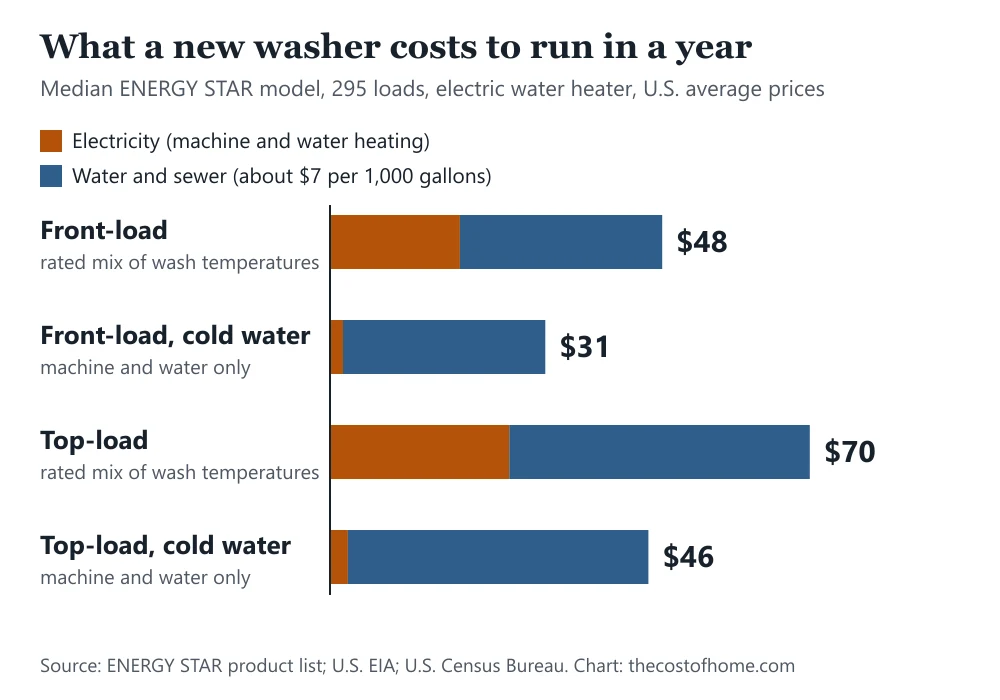
A new ENERGY STAR front-load washer costs about $48 a year to run, or 16 cents a load, once you count electricity, hot water and the water and sewer bill. A top-load costs about $70, or 24 cents a load. The water bill is more than half of it. Heating the water is the biggest energy cost, so a cold wash can cut the electricity part by up to about 90%.
On this page
- How much does it cost to run a washing machine per load, month and year?
- Is it the electricity, the hot water or the water bill that costs the most?
- Does washing in cold water save money?
- Does it matter if my water heater runs on gas or electricity?
- How do loads per week change the yearly cost?
- How much does it cost to run a washing machine in each state?
- Is a front-load washer cheaper to run than a top-load?
- Is it worth replacing a washer to save on the bill?
- Which habits cut the cost of washing clothes?
- How was this calculated?
- FAQ
- Sources
A washing machine has three costs. The first is the electricity that turns the drum, the second is the energy that heats the water, and the third is the water and sewer bill for the gallons that go through. The yellow EnergyGuide label counts the first two. The third is on a different bill, and by my yardstick it is the biggest.
Here I put a price on all three for the washers on sale today, load by load and year by year, and then look at what moves it: cold water, the fuel behind your water heater, how many loads you run and where you live. For electricity I used the same EIA prices as in my state-by-state electric bill guide, and the water rate builds on my water and sewer bill guide. The U.S. Energy Information Administration (EIA) surveys 104.0 million homes with a clothes washer, 74.8 million of them top-loading and 29.1 million front-loading.
How much does it cost to run a washing machine per load, month and year?
Every certified washer has its yearly energy and water use on the ENERGY STAR list. I kept the full-size models sold in the U.S. (more than 2.5 cubic feet, where ENERGY STAR splits its criteria), sorted them into front-load and top-load, and took each group's median. The list's yearly numbers assume 295 loads, about 5.7 a week, which is the figure the Department of Energy (DOE) builds into its washer test. ENERGY STAR itself puts the average American family at about 300 loads a year.
| Type of washer | Models | Energy a year | Water a year | Per load | Per year |
|---|---|---|---|---|---|
| Front-load | 147 | 105 kWh | 4,235 gal | $0.16 | $48 |
| Top-load | 117 | 145 kWh | 6,292 gal | $0.24 | $70 |
Yearly cost of a new full-size washer by type, using the median ENERGY STAR model sold in the U.S. (list of November 6, 2026) at 295 loads. Per load and per year combine electricity, with the water heated by an electric water heater at 18.0 cents per kWh, and water and sewer at about $7 per 1,000 gallons.
A typical new front-load washer uses 0.36 kWh and 14.4 gallons a load. That is 6.4 cents of electricity and 10.0 cents of water and sewer, 16 cents in all, or about $4.03 a month. A typical top-load uses 0.49 kWh and 21.3 gallons a load, which comes to 24 cents, or about $5.82 a month.
Is it the electricity, the hot water or the water bill that costs the most?
For a front-load washer, it is the water bill: $29 a year against $19 for all the electricity. The water figure is a yardstick, not a rate. I divided the average water and sewer bill of homes that pay one by the EPA's figure of 300 gallons a day for a family, which gives about $7 per 1,000 gallons for water and sewer together. Your utility may charge a good deal more or less, so read your own bill; the machine's 4,235 gallons a year is the part that does not change. It is a lot of water: 14.4 gallons a load for a front-load, 21.3 for a top-load.
Inside the electricity figure, almost all of it is hot water. ENERGY STAR says water heating consumes about 90% of the energy it takes to operate a clothes washer, so the drum, the pump and the controls are a small part. The DOE's test shows why: it counts every gallon of hot water as heated by 75 °F (about 42 °C), and that takes 0.18 kWh a gallon. On my split, the machine's own motor and controls come to less than a cent a load.
Does washing in cold water save money?
It saves the biggest slice of the energy cost, though not the water. Take away the hot water and what is left is the machine itself. I split each model's yearly kWh using ENERGY STAR's 90% water-heating share, which is an approximation and not a measurement of any one washer. On that basis a front-load on cold water uses about $2 of electricity a year instead of $19, and a top-load $3 instead of $26. That is a saving of about $17 a year for the front-load and $23 for the top-load, as an upper limit: the rated figure is already a mix of cold, warm and hot loads, so a home that mostly washes warm saves less.
| Water used | Front-load | Top-load |
|---|---|---|
| Electric water heater | $19 | $26 |
| Gas water heater | $9 | $12 |
| Cold water only | $2 | $3 |
Yearly energy cost of the median new washer by how the water is heated, at 295 loads. Water and sewer are not included. Prices used: 18.0 cents per kWh and $1.58 per therm of natural gas, the U.S. averages.
ENERGY STAR gives the practical version: switching the setting from hot to warm can cut the energy use in half, and the cold cycle cuts it more. Unless you are dealing with oily stains, it says, washing in cold water will generally do a good job of cleaning. Most households already lean that way. In the EIA's 2020 survey, 42.1 million homes (41%) said cold is their usual wash setting, 53.1 million (51%) said warm and 8.7 million (8%) said hot. ENERGY STAR also warns about the sanitary cycle, a super-hot cycle on some models that increases energy use significantly, so it is worth saving for when it is needed.
Does it matter if my water heater runs on gas or electricity?
Yes, a lot. The EnergyGuide label gives two figures for the same reason, one for an electric water heater and one for a gas one, and the list I used carries only the electric figure. To price a gas-heated washer I followed the DOE's own formula: the machine's electricity stays in kWh, and the hot-water energy is divided by the 0.75 efficiency the test assumes for a gas or oil water heater, converted to therms and priced as gas. At the national average prices that makes the median front-load about $9 a year in energy instead of $19, and the median top-load $12 instead of $26.
The gas figure is a floor, as in my dryer guide. It follows the DOE's test efficiency, and a real water heater loses some heat in the tank and pipes. If you are not sure which fuel yours uses, look at the label on the tank or at the line coming into it. My water heater guide covers how the two types compare, and the gas side of the bill is in my natural gas bill guide.
How do loads per week change the yearly cost?
A load costs roughly the same whenever you run it, which makes the number of loads your main lever. The EIA's survey shows how far homes differ: 70.3 million of the 104.0 million homes with a washer (68%) wash 1 to 4 loads a week, 25.7 million (25%) wash 5 to 9, and 6.8 million (7%) wash 10 or more. Pick your row to see the yearly cost.
| Loads a week | Loads a year | Front-load | Top-load | Front-load and dryer |
|---|---|---|---|---|
| 3 | 156 | $26 | $37 | $86 |
| 5 | 260 | $43 | $62 | $143 |
| 7 | 364 | $60 | $86 | $200 |
| 10 | 520 | $85 | $123 | $286 |
Yearly cost of a new washer by how many loads you wash a week: electricity (electric water heater) plus water and sewer, at the U.S. average prices. The last column adds the electric dryer, at 39 cents a load, from my dryer guide. The 295-load test figure is about 5.7 loads a week.
A household that washes 3 loads a week spends $26 a year with a front-load washer, and one that washes 10 spends $85. Add the dryer and the laundry bill climbs: at 7 loads a week a front-load washer and an electric dryer cost $200 a year together, and the dryer is 70% of it. My dryer guide has the gas and heat pump versions. ENERGY STAR notes that, unlike dryers, washers use about the same amount of energy regardless of the size of the load, so the cheapest load is a full one.
How much does it cost to run a washing machine in each state?
Energy prices differ widely from state to state, so one washer has a different yearly cost depending on the address. The table runs the median new washer, with an electric and a gas water heater, through each state's own 12-month prices. I left water and sewer out, because those rates change from town to town, as my water bill guide shows. Look up your state below.
| State | kWh price | Therm price | Electric heater | Gas heater |
|---|---|---|---|---|
| U.S. average | 18.0¢ | $1.58 | $21.59 | $9.90 |
| Alabama | 16.4¢ | $1.78 | $19.73 | $10.70 |
| Alaska | 26.9¢ | $1.31 | $32.22 | $9.68 |
| Arizona | 15.4¢ | $1.95 | $18.48 | $11.40 |
| Arkansas | 13.4¢ | $2.19 | $16.12 | $12.35 |
| California* | 33.0¢ | $2.12 | $39.59 | $14.39 |
| Colorado | 16.6¢ | $1.12 | $19.90 | $7.50 |
| Connecticut* | 28.0¢ | $1.63 | $33.59 | $11.36 |
| Delaware | 17.8¢ | $1.77 | $21.35 | $10.85 |
| District of Columbia | 24.2¢ | $1.71 | $29.04 | $11.29 |
| Florida* | 15.4¢ | $2.46 | $18.47 | $13.92 |
| Georgia | 15.1¢ | $2.13 | $18.14 | $12.29 |
| Hawaii* | 43.5¢ | $5.05 | $52.21 | $30.04 |
| Idaho | 12.7¢ | $0.77 | $15.18 | $5.31 |
| Illinois | 18.8¢ | $1.15 | $22.55 | $7.90 |
| Indiana | 16.9¢ | $1.18 | $20.33 | $7.81 |
| Iowa | 14.1¢ | $1.12 | $16.96 | $7.18 |
| Kansas* | 15.1¢ | $1.43 | $18.11 | $8.83 |
| Kentucky | 13.9¢ | $1.58 | $16.70 | $9.42 |
| Louisiana* | 13.0¢ | $1.68 | $15.59 | $9.80 |
| Maine* | 29.3¢ | $1.93 | $35.17 | $12.99 |
| Maryland* | 21.0¢ | $1.63 | $25.24 | $10.51 |
| Massachusetts | 30.4¢ | $2.54 | $36.52 | $16.13 |
| Michigan | 21.1¢ | $1.11 | $25.26 | $7.97 |
| Minnesota | 16.2¢ | $1.09 | $19.46 | $7.29 |
| Mississippi | 14.8¢ | $1.70 | $17.72 | $10.12 |
| Missouri | 13.9¢ | $1.64 | $16.74 | $9.73 |
| Montana | 13.8¢ | $0.89 | $16.61 | $6.04 |
| Nebraska | 12.9¢ | $1.25 | $15.43 | $7.67 |
| Nevada | 13.4¢ | $1.08 | $16.03 | $6.93 |
| New Hampshire* | 26.7¢ | $1.79 | $32.00 | $12.02 |
| New Jersey | 23.8¢ | $1.43 | $28.54 | $9.86 |
| New Mexico* | 15.3¢ | $0.95 | $18.38 | $6.50 |
| New York | 28.4¢ | $1.81 | $34.07 | $12.28 |
| North Carolina* | 14.8¢ | $1.76 | $17.72 | $10.41 |
| North Dakota | 12.3¢ | $0.98 | $14.78 | $6.30 |
| Ohio* | 18.3¢ | $1.34 | $21.90 | $8.75 |
| Oklahoma* | 13.7¢ | $1.39 | $16.44 | $8.46 |
| Oregon | 15.5¢ | $1.68 | $18.60 | $10.11 |
| Pennsylvania | 20.7¢ | $1.54 | $24.84 | $10.05 |
| Rhode Island* | 29.3¢ | $2.08 | $35.12 | $13.71 |
| South Carolina* | 15.6¢ | $1.65 | $18.77 | $9.97 |
| South Dakota | 14.2¢ | $1.02 | $17.04 | $6.74 |
| Tennessee | 13.6¢ | $1.29 | $16.27 | $7.96 |
| Texas | 16.0¢ | $2.19 | $19.15 | $12.68 |
| Utah | 13.3¢ | $1.07 | $15.98 | $6.84 |
| Vermont | 23.8¢ | $1.77 | $28.56 | $11.55 |
| Virginia | 16.5¢ | $1.73 | $19.78 | $10.50 |
| Washington* | 14.1¢ | $1.70 | $16.94 | $10.04 |
| West Virginia* | 15.5¢ | $1.33 | $18.58 | $8.40 |
| Wisconsin* | 18.7¢ | $1.04 | $22.49 | $7.34 |
| Wyoming | 14.0¢ | $1.26 | $16.81 | $7.86 |
Estimated yearly energy cost of a new washer (the median ENERGY STAR model, 120 kWh a year at 295 loads) by state, with an electric or a gas water heater. Water and sewer are not included. Electricity is each state's average residential price over the 12 months from August 2025 to July 2026 (preliminary). Gas is the 12-month state price, and * marks states where the EIA's monthly series has gaps, so the 2025 calendar-year price stands in.
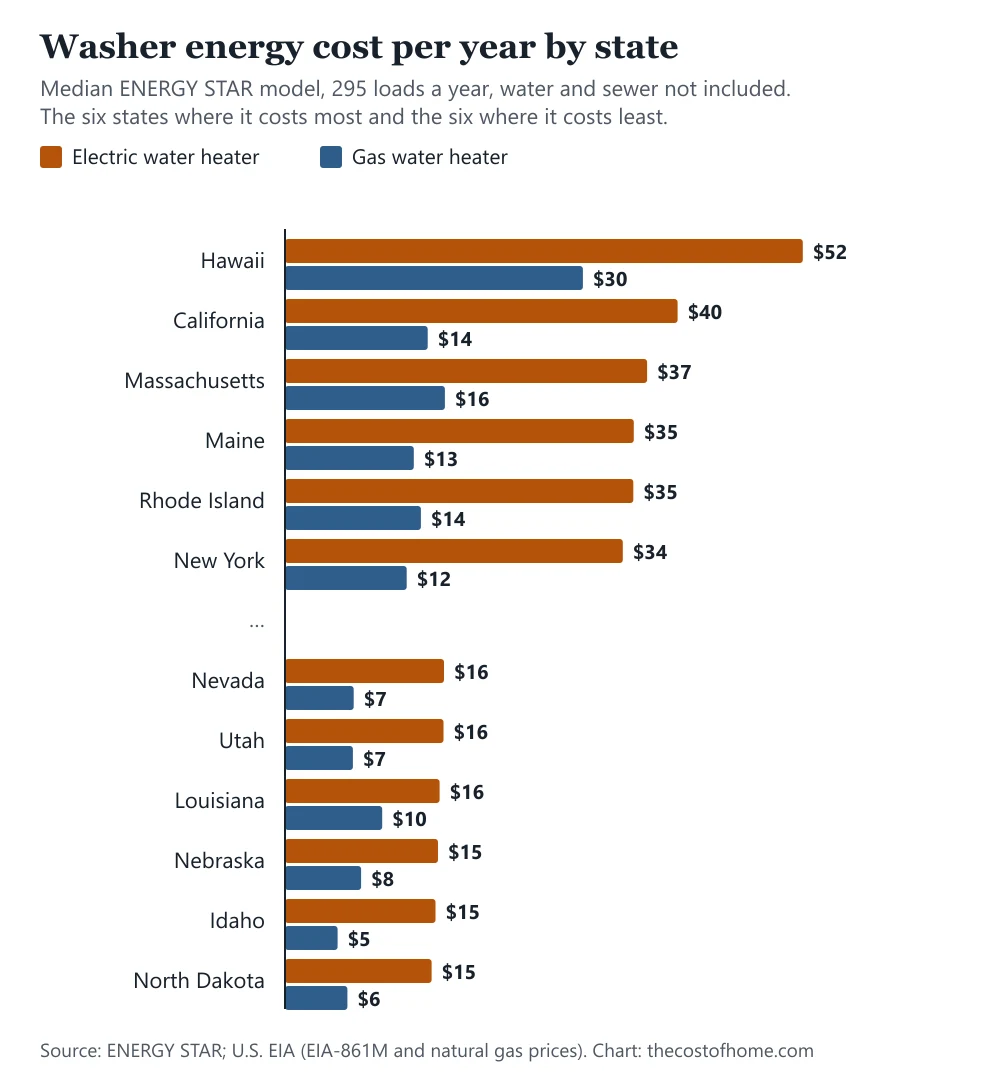
With an electric water heater, the energy runs from $15 a year in North Dakota to $52 in Hawaii. California is next at $40, and after North Dakota the lowest are Idaho ($15) and Nebraska ($15). A gas water heater costs from $5 in Idaho to $30 in Hawaii. A gas-heated wash is cheaper than an electric one in every one of the 51 places, D.C. included; the gap is narrowest in Arkansas ($4 a year) and widest in California ($25). Treat these as arithmetic, not a count of what residents actually pay: the machine is identical in every row and only the price changes.
Is a front-load washer cheaper to run than a top-load?
Yes, on both bills. The median front-load on the list uses 105 kWh and 4,235 gallons a year, against 145 kWh and 6,292 gallons for the median top-load, which is 28% less energy and 33% less water. At the average prices that is $21 a year. ENERGY STAR puts the gap at about 25% against a top-load impeller washer (the kind with a low cone or disc instead of an agitator) and about 50% against an agitator washer. The median certified top-load sits right at the program's floor: its integrated modified energy factor is 2.06 and its integrated water factor 4.3, the same as the minimum for top-loaders, while the median front-load is 2.92 against a minimum of 2.76. Only 24 of the 147 front-load models meet ENERGY STAR's Most Efficient criteria on the list, and none of the top-loads do.
A top-load can still be the right choice, and the gap is not large in dollars. I would buy for capacity, reliability and what fits the space, then use the energy figures to pick among the models that fit. The yearly kWh and gallons are on the list for every certified model, and the EnergyGuide label on the floor shows the energy cost.
Is it worth replacing a washer to save on the bill?
Seldom, if the bill is the only reason. The gap between the median front-load and the median top-load is about $21 a year at today's prices, and a replacement has a purchase price to cover. ENERGY STAR says certified washers use about 20% less energy and about 30% less water than regular washers, and that over the life of the product a certified model can save about $530 in energy costs. That is the program's own estimate over a washer's life, and I did not rebuild it, because the list covers only certified models. 25.8 million homes (25%) in the EIA's survey have a washer at least 10 years old, and those are the cases where the savings are more likely to count. If your washer is failing, put these figures into the choice of its replacement. If yours still works, I would start with the habits below.
Which habits cut the cost of washing clothes?
These ENERGY STAR tips cost nothing to follow:
- Wash in cold water whenever the load allows it. Water heating is about 90% of the energy a washer uses, and warm instead of hot already halves it.
- Fill it up. Washers use about the same energy regardless of the size of the load, so run full loads whenever possible.
- Skip the sanitary cycle unless you need it, because the extra-hot water increases energy use significantly.
- Use the high spin speed or the extended spin option when it suits the load. It leaves less moisture in the clothes, which shortens the time in the dryer.
- Put what you can on a drying rack or a line, which also helps clothes last longer.
- Leave the door ajar for an hour or two after a front-load cycle so the seal can dry and mold has less chance to grow. Keep children from climbing into an open machine.
In the store, check the ENERGY STAR label, then compare the yearly kWh and gallons on the list for the models you are weighing. For the rest of your electric bill, start with why your electric bill is so high; the two other big appliances in the laundry and kitchen are the dryer and the refrigerator. What you pay per kWh depends on your state, and my electricity prices by state guide shows how much.
How was this calculated?
Each yearly cost multiplies the energy by its price and adds the water multiplied by its rate. The new-model figures come from the ENERGY STAR certified residential clothes washer list (downloaded November 6, 2026; 421 listings, of which 329 are stand-alone washers sold in the U.S., from 41 brands) for full-size washers, more than 2.5 cubic feet, and took the median of 147 front-load and 117 top-load models. I left out the 65 compact models, laundry centers, combination washer-dryers and models sold only in Canada. The list's yearly energy is the DOE's figure for an electrically heated water supply: 295 cycles times the per-cycle energy of the machine, the water heating and the standby mode. The DOE test heats each gallon of hot water by 75 °F (about 42 °C), and its figure for a gas or oil water heater divides the hot-water energy by 0.75. The yearly water on the list is the integrated water factor times the capacity times 295 cycles.
The list does not split the energy between the machine and the water heating. I used ENERGY STAR's statement that water heating is about 90% of the energy a washer uses, so the gas and cold-water figures are estimates built on that share. The list's "integrated modified energy factor" also counts the energy to dry the clothes, so I did not use it to price a load; the yearly kWh on the list leaves drying out, and the dryer has its own guide.
The power price is residential revenue divided by kilowatt-hours sold in the EIA's Form EIA-861M (preliminary), August 2025 to July 2026, which comes to 18.0 cents for the U.S. Natural gas uses the EIA's residential price per 1,000 cubic feet over the same 12 months, converted at 1,037 Btu per cubic foot to $1.58 per therm. 18 states have gaps in the monthly series, so I used their 2025 calendar-year price and marked it with an asterisk. The water and sewer rate is my own yardstick: $6.95 per 1,000 gallons, the average yearly water and sewer bill of homeowners who pay one (Census Bureau American Community Survey, 2024) divided by the EPA's 300 gallons a day. It is a rough national figure and not a utility rate.
The home figures are from table HC3.1 of the EIA's 2020 Residential Energy Consumption Survey (homes with a washer by type, age, loads per week and usual wash temperature). Washers bought since 2020 may use less than the ones it counted. With rooftop solar, part of the washer's electricity comes from your own panels, so the grid bill rises by less than these figures show. My sources and method are set out in how I research costs; for more on appliances and repairs, see Home Repairs & Appliances.
Frequently asked questions
How much does it cost to run a washing machine per load?
About 16 cents for a new front-load washer and 24 cents for a top-load, counting electricity at 18.0 cents per kWh with an electric water heater and water and sewer at about $7 per 1,000 gallons. Electricity alone is about 6 cents a load for the front-load.
How much does it cost to run a washing machine per month?
A new front-load washer costs about $4.03 a month and a top-load about $5.82, at about 5.7 loads a week. Of the front-load's total, about $1.57 is electricity and $2.45 is water and sewer.
How many kWh does a washing machine use per year?
The median new front-load on the ENERGY STAR list uses 105 kWh a year and the median top-load 145 kWh, at 295 loads with an electric water heater. Most of that is heating the water. In the EIA's 2020 survey, clothes washers' own electricity totaled 7.1 billion kWh across U.S. homes, against 55.9 billion for dryers.
Does washing clothes in cold water save money?
Yes, on the electricity. ENERGY STAR says water heating is about 90% of a washer's energy and that switching from hot to warm can cut energy use in half, with cold cutting more. On my estimate, a front-load saves up to about $17 a year in electricity by washing every load in cold water. The water bill does not change.
Is it cheaper to run a washer with a gas water heater?
Yes, in all 51 places I priced. With gas, the median front-load's energy costs about $9 a year at U.S. average prices, against $19 with an electric water heater. I used the DOE's test efficiency of 0.75 for a gas water heater, so a real tank may cost a little more.
Is a front-load or top-load washer cheaper to run?
Front-load. The median front-load on the ENERGY STAR list costs about $48 a year with water counted and the median top-load about $70, a difference of $21. The front-load uses 28% less energy and 33% less water.
How much water does a washing machine use per load?
The median new front-load uses about 14 gallons a load and the median top-load about 21, according to the yearly water on the ENERGY STAR list at 295 loads. ENERGY STAR says certified washers use about 30% less water than regular ones.
Does a washing machine use more electricity than a dryer?
No. My dryer guide puts a new electric dryer at about $109 a year, against about $19 in electricity for a front-load washer: a dryer has to heat a large flow of air, while a washer mostly moves water. The washer is the bigger water user.
Sources
- ENERGY STAR, Certified Residential Clothes Washers: product list with annual energy use, annual water use, integrated modified energy factor and integrated water factor by model (downloaded November 6, 2026)
- ENERGY STAR, Clothes Washers: buying guidance, savings tips and energy and water savings (accessed November 6, 2026)
- ENERGY STAR, Clothes Washers key product criteria: IMEF and IWF requirements by size and type (accessed November 6, 2026)
- U.S. Department of Energy, 10 CFR 430.23(j): estimated annual operating cost and water consumption of clothes washers, 295 cycles per year (accessed November 6, 2026)
- U.S. Department of Energy, 10 CFR 430, Subpart B, Appendix J2: uniform test method for clothes washers (75 °F temperature rise, 0.75 gas water heater efficiency; accessed November 6, 2026)
- U.S. Energy Information Administration, 2020 Residential Energy Consumption Survey, table HC3.1: appliances in U.S. homes (clothes washer type, age, loads per week and usual wash temperature; accessed November 6, 2026)
- U.S. Energy Information Administration, 2020 Residential Energy Consumption Survey, table CE5.1a: household electricity end-use consumption, totals (accessed October 21, 2026)
- U.S. Energy Information Administration, Form EIA-861M: monthly sales, revenue and customers by state (August 2025 to July 2026, accessed October 15, 2026)
- U.S. Energy Information Administration, Natural Gas Prices: residential price by state (accessed October 17, 2026)
- U.S. Environmental Protection Agency, WaterSense, "How We Use Water": more than 300 gallons a day per family at home (accessed November 2, 2026)
- U.S. Census Bureau, American Community Survey 2024 1-year Public Use Microdata Sample (PUMS), housing records: yearly water and sewer cost of homeowners who pay one (variable WATP; used in my water and sewer bill guide; accessed November 2, 2026)

Founder and editor, The Cost of Home
I write and check every guide on this site myself, working from public data. The sources behind each number are listed at the end of the article, so you can check them too.