Home Repairs & Appliances
How Much Does It Cost to Replace Windows?
Quick answer
Replacing a window costs about $450 to $1,200, with an average near $800, and a whole house runs $8,000 to $24,000, according to Fixr's 2026 guide. HomeAdvisor puts the average installation project at $7,347. Frame, glass, size and the number of windows set the price. ENERGY STAR models save about $253 to $568 a year, so the payback can take many years.

On this page
- How much does it cost to replace windows in 2026?
- How much does it cost to replace all the windows in a house?
- What does a window cost by frame, glass and style?
- What else can make a window quote go up?
- Why does Cost vs. Value price ten windows at $22,073?
- How much of the cost comes back when you sell?
- How much do new windows save on energy bills?
- Do new windows pay for themselves?
- Is there a tax credit for new windows in 2026?
- When does it make sense to replace windows?
- How do you compare window quotes?
- What should you keep in mind about these numbers?
- FAQ
- Sources
Windows are one of the repairs where two quotes for the same house can differ by thousands of dollars. Most of the gap comes from a few choices: how many windows you replace, what the frame is made of, how many panes of glass each one has, and what the installer counts as part of the job.
The prices below come from two cost guides updated in 2026, Fixr and HomeAdvisor, and from the Remodeling Cost vs. Value report, which prices one specific job by region and asks Realtors what it adds at sale. The savings come from ENERGY STAR. These are national averages, not quotes, and the sources do not always agree, so each table says where its numbers come from.
How much does it cost to replace windows in 2026?
About $800 per window, and between $8,000 and $24,000 for a whole house. Fixr says most replacement windows cost $450 to $1,200 each and gives $800 as the average. HomeAdvisor puts the average window project at $7,347, with most homeowners paying $3,436 to $11,836.
| Source | What it prices | Typical range | Average |
|---|---|---|---|
| Fixr | One replacement window | $450 to $1,200 | $800 |
| Fixr | Single-story house, 10 to 15 windows | $8,000 to $12,000 | – |
| Fixr | Two-story house, 15 to 30 windows | $12,000 to $24,000 | – |
| HomeAdvisor | Window installation project | $3,436 to $11,836 | $7,347 |
| HomeAdvisor | One replacement window, bought and installed | $300 to $1,650 | – |
What replacing windows costs, by source. Both are national cost guides run by home-services companies, not quotes. Sources: Fixr, January 21, 2026; HomeAdvisor, June 17, 2026.
HomeAdvisor's project figure is lower than Fixr's house figure because the two count different jobs: HomeAdvisor's table is built on projects of six to 25 windows, and many houses have more windows than the average project. Count your own windows first, since the total moves with that number more than with anything else.
How much does it cost to replace all the windows in a house?
Fixr says a single-story home with 10 to 15 windows is likely to cost $8,000 to $12,000, and a two-story home with 15 to 30 windows $12,000 to $24,000. HomeAdvisor's own table runs from $4,500 for six to eight windows to $18,000 to $20,000 for 25.
| Windows | Fixr | HomeAdvisor |
|---|---|---|
| 1 | $450 to $1,200 | – |
| 5 to 10 | $2,250 to $12,000 | – |
| 6 to 8 | – | $4,500 to $6,000 |
| 8 to 12 | – | $6,000 to $9,000 |
| 11 to 20 | $4,950 to $24,000 | – |
| 12 to 16 | – | $9,000 to $12,000 |
| 16 to 20 | – | $12,000 to $15,000 |
| 20 to 24 | – | $15,000 to $18,000 |
| 21 to 25 | $9,450 to $30,000 | – |
| 25 | – | $18,000 to $20,000 |
Window replacement cost by number of windows. The two guides price the same job differently, and Fixr's ranges are wider. Sources: Fixr, January 21, 2026; HomeAdvisor, June 17, 2026.
Both guides say the price per window can fall a little on a bigger order. Fixr says installers may discount labor when they know a larger job is secured, and manufacturers sometimes offer bulk discounts. Those discounts vary, so ask for them in writing.
What does a window cost by frame, glass and style?
Frame material is the first choice. Fixr calls vinyl the standard because it balances upfront cost, durability and insulation, at $350 to $800 per window. Aluminum is the cheapest, at $200 to $800, but Fixr says it insulates less than vinyl and can dent. Fiberglass and composite are the most energy efficient in Fixr's view, and wood has the longest lifespan and is the easiest to repair.
| Frame | Per window |
|---|---|
| Aluminum | $200 to $800 |
| Vinyl | $350 to $800 |
| Composite | $300 to $2,500 |
| Fiberglass | $400 to $1,500 |
| Wood | $600 to $2,000 |
Price per window by frame material. Fixr's own text lists wood at both $400 to $2,000 and $600 to $2,000; the table shows its summary figure. Source: Fixr, January 21, 2026.
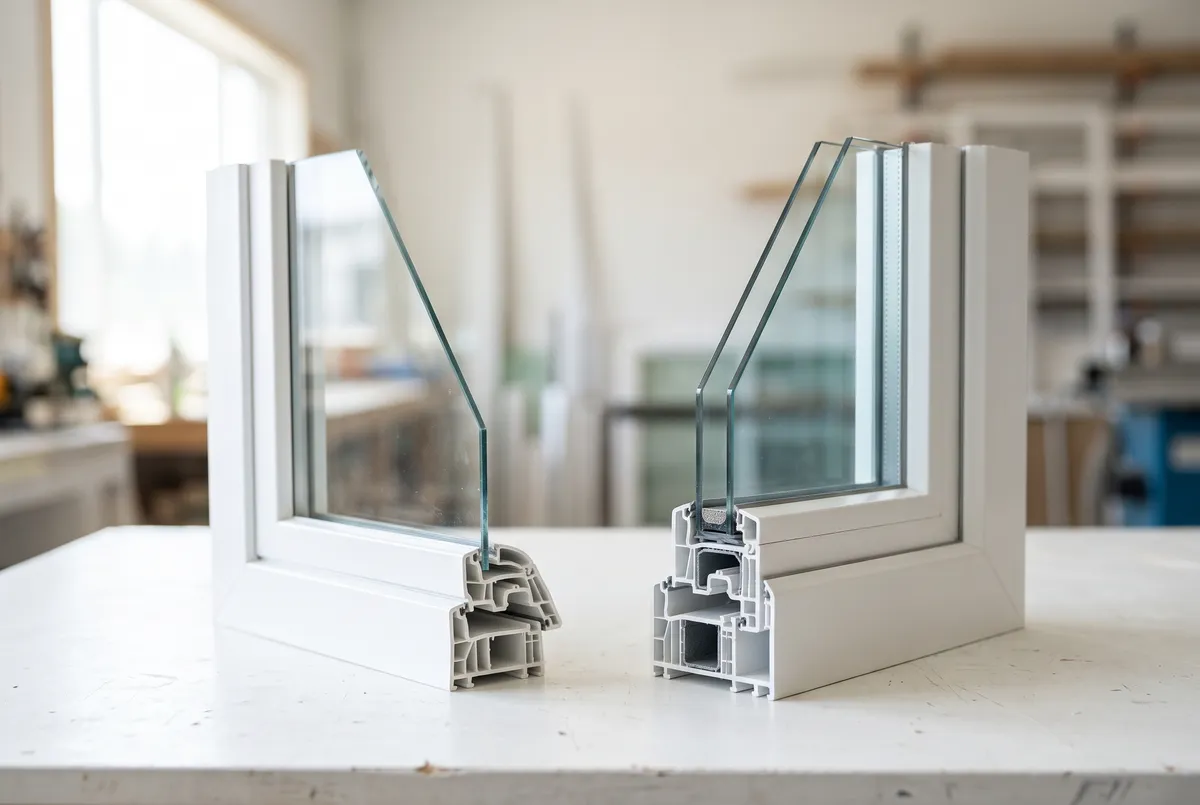
Glass is the second. A single pane is the cheapest and the least insulating. A double pane has two layers of glass with a sealed layer of gas between them, and a triple pane has three. HomeAdvisor says that more panes mean a higher price per window, and the same goes for coatings and gas fills.
| Glass | Fixr | HomeAdvisor |
|---|---|---|
| Single-pane | $200 to $650 | $150 to $450 |
| Double-pane | $450 to $2,000 | $450 to $1,000 |
| Triple-pane | $1,000 to $4,000 | $500 to $2,000 |
| Low-E | $300 to $1,100 | $600 to $3,100 |
Price per window by glass type. The two guides overlap but do not match. Sources: Fixr, January 21, 2026; HomeAdvisor, June 17, 2026.
Then comes the style. Fixr says simpler designs such as picture windows or single-hung windows cost less in materials than windows with a more complex opening, such as casement or double-hung. Custom sizes cost more, which is common in older homes with non-standard openings.
| Style | Fixr range | HomeAdvisor average |
|---|---|---|
| Single-hung | $250 to $700 | $400 |
| Double-hung | $300 to $1,000 | $700 |
| Casement | $400 to $1,200 | $900 |
| Picture | $300 to $1,600 | $900 |
| Sliding | $700 to $1,500 | $1,000 |
| Egress | $300 to $1,500 | $2,300 |
| Bay | $900 to $4,500 | $2,500 |
| Bow | $1,500 to $8,000 | $2,500 |
Price per window by style. Fixr gives a range; HomeAdvisor gives an average. Sources: Fixr, January 21, 2026; HomeAdvisor, June 17, 2026.
What else can make a window quote go up?
Labor is the smaller part of the bill, 15% in HomeAdvisor's figures and 30% in Fixr's. Five things push it up most often:
- Size. HomeAdvisor says small windows (2 by 3 feet or smaller) cost $100 to $400, medium ones (3 by 4 to 4 by 6 feet) $200 to $800, and larger ones $700 to $3,000.
- Hidden damage. Fixr says that when the old window comes out, installers may find water damage or shifting in the frame, and fixing it can cost a few hundred dollars or thousands.
- Height. Fixr says second-story windows almost always cost more, and a large one can need a crane.
- Permits. Fixr says some municipalities require a permit for any replacement, and most do when the work is structural. Fees average $50 to $300.
- Disposal. Many installers include hauling the old windows away, but Fixr says others charge separately.
| Item | Typical cost | Source |
|---|---|---|
| Labor | $150 to $300 per small window, up to $800 for a large bay or bow; about 30% of the total | Fixr |
| Labor | $100 to $400 per window, about 15% of the project | HomeAdvisor |
| Glass upgrades | $100 to $800 per window for tempered or laminated glass | Fixr |
| Permit | $50 to $300 for the permit and inspection | Fixr |
| Hidden damage | Water damage or frame repair found behind the old window: a few hundred dollars to thousands | Fixr |
| Haul-away | Old windows: often in the quote, sometimes charged separately | Fixr |
| New opening | A window where there was none: up to $5,000 per window | HomeAdvisor |
Costs that can sit outside the price of the window. Sources: Fixr, January 21, 2026; HomeAdvisor, June 17, 2026.
Fixr's advice on doing it yourself is to leave it to a professional. It says most manufacturers void the warranty if you do not have a professional install the window, and that mistakes can cause water or air leaks and mold. If the frame is in good condition, an insert, or pocket, replacement swaps only the sashes and costs less.
Why does Cost vs. Value price ten windows at $22,073?
Because it prices one specific, finished job, not the cheapest one. The Remodeling Cost vs. Value 2025 report replaces ten existing 3-by-5-foot double-hung windows with insulated vinyl replacement windows, and wraps the existing exterior trim as required to match, without disturbing the interior trim. That job cost $22,073 nationally, about $2,207 a window by my arithmetic, well above the guide averages.
The wood version is the same ten windows in insulated wood replacement windows with the exterior clad in vinyl or aluminum, at $26,781. Treat both figures as the price of a complete, detailed job; the guide prices above describe an ordinary one. The report also warns that small differences in scope or finishes can change a price a great deal.
How much of the cost comes back when you sell?
Nationally, Cost vs. Value says vinyl windows recover about 76% of their cost at resale: $16,657 of value against a $22,073 job. Wood windows recover about 70%, $18,764 against $26,781. In dollars, the vinyl job leaves you $5,416 short of its cost and the wood one $8,017.
Where you live changes it. Vinyl recovered 85.3% in the Pacific region and 64.1% in the Middle Atlantic region. Wood ranged from 87.3% in the Pacific region to 60.5% in the Middle Atlantic region. The job cost most in the Middle Atlantic region, at $23,986.
| Region | Vinyl cost | Vinyl recouped | Wood recouped |
|---|---|---|---|
| National | $22,073 | 75.5% | 70.1% |
| New England | $21,922 | 71.2% | 69.7% |
| Middle Atlantic | $23,986 | 64.1% | 60.5% |
| South Atlantic | $21,629 | 82.6% | 71.5% |
| East South Central | $20,328 | 70.4% | 62.6% |
| West South Central | $20,171 | 70.6% | 70.5% |
| East North Central | $22,054 | 81.3% | 70.1% |
| West North Central | $22,781 | 69.9% | 68.4% |
| Mountain | $21,165 | 79.6% | 72.2% |
| Pacific | $23,819 | 85.3% | 87.3% |
Vinyl window cost and share recouped, and wood window share recouped, by region, 2025. Each job replaces ten windows; the national wood job costs $26,781. "Recouped" is the resale value Realtors surveyed said the work would add, as a share of the job cost; the dollar values are in the chart below. The national row shows 75.5% and 70.1%, which the report rounds to 76% and 70%. States by region: New England, CT, ME, MA, NH, RI, VT; Middle Atlantic, NJ, NY, PA; South Atlantic, DE, DC, FL, GA, MD, NC, SC, VA, WV; East South Central, AL, KY, MS, TN; West South Central, AR, LA, OK, TX; East North Central, IL, IN, MI, OH, WI; West North Central, IA, KS, MN, MO, NE, ND, SD; Mountain, AZ, CO, ID, MT, NV, NM, UT, WY; Pacific, AK, CA, HI, OR, WA. Source: Remodeling Cost vs. Value 2025, JLC and Zonda.
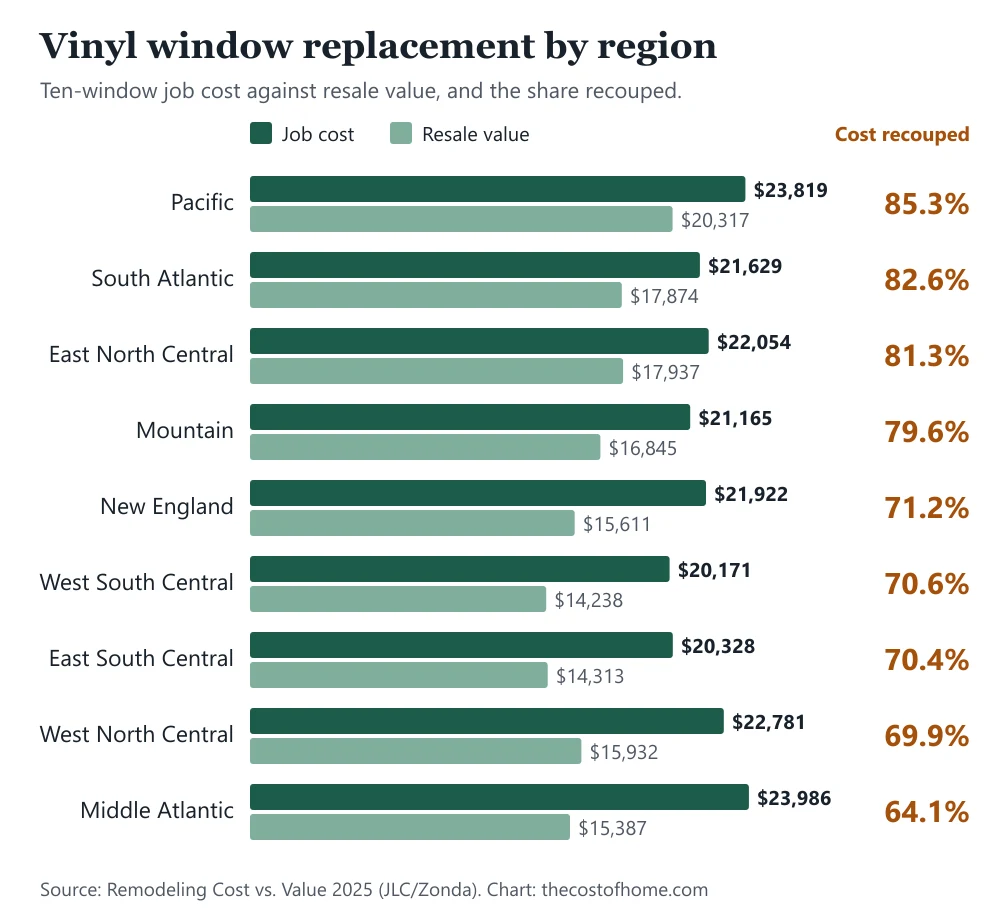
The resale side is what Realtors expect, not a recorded sale price. Fixr gives a wider range, saying new windows return 60% to 85% depending on materials, and HomeAdvisor says up to 85%. None of them promises a dollar return.
How much do new windows save on energy bills?
ENERGY STAR's 2023 analysis puts the average at $253 to $568 a year, depending on climate zone and what you replace. That is 6% to 12% of a typical home's utility bill. The biggest savings come from replacing single-pane windows, at $493 to $568 in every zone.
| Zone | Replacing single-pane | Replacing double-pane |
|---|---|---|
| Northern | $568 (12%) | $282 (6%) |
| North-Central | $493 (11%) | $253 (6%) |
| South-Central | $547 (12%) | $336 (7%) |
| Southern | $563 (12%) | $373 (8%) |
Average yearly energy savings from replacing every window with ENERGY STAR certified ones, by climate zone, and the share of a typical home's utility bill. The model home is 2,376 square feet and two stories, in 132 U.S. cities. Source: ENERGY STAR, October 2023 (D+R International).
Replacing double-pane windows saves about half as much, at $253 to $373 a year, because clear double-pane glass already insulates better than a single pane. ENERGY STAR's 2025 fact sheet gives a broader figure, about 13% a year, for replacing poor-performing windows with certified models. It also says windows are about 8% of a home's surface area but account for almost half of the heat lost or gained.
These are modeled savings for a typical 2,376-square-foot two-story house, using each state's average gas and electricity prices from the EIA, and ENERGY STAR itself says actual savings vary with local climate, utility rates and the home. The Department of Energy's consumer guide gives 7% to 15% or more on annual energy bills, depending on location and the window being replaced. Both put the savings in the same range. How fast they cover the cost is the question.
A new window is not the only way to cut the bill. For the heating and cooling cost itself, see what a furnace costs to run per month and what central air costs to run.
Do new windows pay for themselves?
Rarely in a short time. The DOE guide says replacing old windows is a significant investment, and ENERGY STAR's savings numbers are small next to the price of a whole house. Divide the price by the yearly savings and the gap shows.
| Job price | Saves $253 | Saves $373 | Saves $493 | Saves $568 |
|---|---|---|---|---|
| $8,000 | 32 years | 21 years | 16 years | 14 years |
| $12,000 | 47 years | 32 years | 24 years | 21 years |
| $24,000 | 95 years | 64 years | 49 years | 42 years |
Years to earn back the price of the windows from energy savings alone, in my arithmetic: price divided by yearly savings. The columns are ENERGY STAR's yearly savings for double-pane windows in the North-Central and Southern zones, then single-pane in the North-Central and Northern zones. Prices are Fixr's ranges for a house, and the savings are ENERGY STAR's modeled figures. The two sources describe different homes, so read the table as a rough size of the gap, not a forecast.
The best case in the table, an $8,000 job on single-pane windows in the Northern zone, earns the money back in about 14 years. A $24,000 job that replaces double-pane windows in the North-Central zone takes about 95. Most real jobs sit between those, and a window that is rotting, leaking or painted shut is a different decision from one that is merely old, because it is a repair as much as an upgrade.
In my opinion, the number to check before you sign is the gap between a single-pane house and a double-pane one. ENERGY STAR's figures put single-pane savings at about 1.5 to 2 times the double-pane ones, so a house that still has single-pane glass has the strongest case for replacement, and a house with newer double-pane windows has the weakest one. The DOE guide also says to insulate and air seal the house before replacing windows, and it points to its guides on insulation and air sealing. For the insulation side, see attic insulation cost.
Is there a tax credit for new windows in 2026?
Not under the federal credit. The IRS says you can claim the Energy Efficient Home Improvement Credit for improvements made through December 31, 2025. That credit covered exterior windows and skylights that met ENERGY STAR Most Efficient requirements, with a $600 limit. Some pages still describe it as available. ENERGY STAR's January 2025 fact sheet says it runs through December 31, 2032, and HomeAdvisor's June 2026 page still mentions it, but the IRS page, last reviewed April 28, 2026, is the one that applies to your tax return.
ENERGY STAR and the DOE both point to local help. Utility rebates for windows may exist, and ENERGY STAR's Home Savings tool lets you enter a zip code to see what is available near you. Check before you buy, not after.
When does it make sense to replace windows?
When the windows are failing, not just old. ENERGY STAR lists three signs: single-pane glass, air leaks or drafts and degraded sills and sashes, and windows that do not open or are painted shut. Fixr adds condensation between the panes, which means a broken seal, and water damage or soft, rotting frames around a window.
Fixr also says drafts may be fixed with a repair, and that if the frame is in good condition, an insert replacement can cost less than a full one. A repair is the first thing to price against replacing the whole window.
How do you compare window quotes?
Fixr's advice is to get at least three estimates. A few lines decide whether two quotes are comparable:
- Window specs. Frame material, number of panes, low-E coating and the ENERGY STAR climate zone label. ENERGY STAR says to look for the label and the zone map when ordering.
- Full-frame or insert. Fixr says an insert replacement swaps only the sashes and costs less, but it needs a frame in good condition.
- Trim and finish. Cost vs. Value's job wraps the exterior trim and leaves the interior trim alone, so ask what happens to both.
- Disposal and permit. Ask whether hauling and the permit fee are included.
- Damage found behind the old window. Ask what the installer charges to repair it.
- Timing. Fixr says window companies are busiest in spring and summer, so you may find discounted labor in fall or winter.
What should you keep in mind about these numbers?
- These are not quotes or official surveys. Fixr and HomeAdvisor are cost guides run by home-services companies, and Cost vs. Value is a magazine report built on estimates and a Realtor survey.
- The sources disagree. Fixr gives a typical range of $450 to $1,200 per window and HomeAdvisor gives $300 to $1,650 for a replacement. Fixr's own text lists wood windows at two different ranges. I show each source with its date instead of choosing one.
- Cost vs. Value is the 2025 edition. Prices have likely moved since it was published, so treat the figures as a benchmark, not a forecast.
- The payback table is my arithmetic. It divides Fixr's house prices by ENERGY STAR's modeled savings, from different sources and different homes, and it ignores comfort, noise and any rebate.
- Not covered: storm windows, window film, skylights, hurricane-rated glass, historic-home rules and financing.
Windows are one of several big repairs this blog tracks. For the others, see what a roof costs to replace, what a water heater costs to replace and heat pump cost. To plan the whole house, read what home maintenance costs per year. More repair guides are in the Home Repairs & Appliances section.
Frequently asked questions
How much does it cost to replace a window?
Fixr says most replacement windows cost $450 to $1,200 each, with an average of $800. HomeAdvisor says $300 to $1,650 for a replacement window, bought and installed. Frame, glass, size and style move the price, and large bay or bow windows can pass $3,000.
How much does it cost to replace all the windows in a house?
Fixr says a single-story home with 10 to 15 windows is likely to cost $8,000 to $12,000, and a two-story home with 15 to 30 windows $12,000 to $24,000. HomeAdvisor puts the average project at $7,347, with most between $3,436 and $11,836.
Are vinyl windows cheaper than wood?
Yes. Fixr puts vinyl at $350 to $800 per window and wood at $600 to $2,000. In Cost vs. Value 2025, ten vinyl windows cost $22,073 and ten wood windows $26,781, and the vinyl job recovered more of its cost at resale, 76% against 70%.
How much do double-pane windows cost?
Fixr puts double-pane windows at $450 to $2,000 each, and HomeAdvisor at $450 to $1,000. Triple-pane costs more, at $1,000 to $4,000 in Fixr's guide and $500 to $2,000 in HomeAdvisor's.
Do new windows save money on energy bills?
ENERGY STAR says replacing every window with certified models saves about $253 to $568 a year, or 6% to 12% of a typical bill, depending on the zone and the old windows. The savings are largest when you replace single-pane glass.
How long does it take for new windows to pay for themselves?
Usually many years. At ENERGY STAR's modeled savings, my arithmetic gives about 14 years for an $8,000 job that replaces single-pane windows in the Northern zone, and about 95 years for a $24,000 job that replaces double-pane windows in the North-Central zone.
Do new windows increase home value?
Realtors surveyed for Cost vs. Value 2025 said vinyl windows add about 76% of their cost, and the figure runs from 64.1% to 85.3% by region. Fixr says 60% to 85%. These are opinions, not sale prices.
Is there a federal tax credit for new windows in 2026?
The IRS says you can claim the Energy Efficient Home Improvement Credit for improvements made through December 31, 2025. Some pages still say it runs longer, but the IRS page controls. Utility rebates may still exist, so ask before you buy.
Should I replace windows myself?
Fixr recommends a professional. It says most manufacturers void the warranty if a professional does not install the window, and that mistakes can lead to water or air leaks and mold.
Sources
- Fixr, "How Much Does Window Replacement Cost?" by Dan Simms: per-window range, cost by number, frame, style, glass, labor, extras and return on investment (updated January 21, 2026; accessed November 16, 2026)
- HomeAdvisor, "What Is the Average Cost to Install Windows?": project range and average, size, count, glass type, labor and style (updated June 17, 2026; accessed November 16, 2026)
- Journal of Light Construction / Zonda, Remodeling Cost vs. Value Report 2025: national and regional figures for window replacement in vinyl and wood (accessed November 16, 2026)
- Journal of Light Construction, Cost vs. Value, "Window Replacement | Vinyl | Midrange": project description (June 20, 2025; accessed November 16, 2026)
- Journal of Light Construction, Cost vs. Value, "Window Replacement | Wood | Midrange": project description (June 20, 2025; accessed November 16, 2026)
- ENERGY STAR, "Average annual energy savings when replacing single pane clear or double pane clear" by climate zone (D+R International, October 2023; accessed November 16, 2026)
- ENERGY STAR, windows fact sheet: signs to replace, 13% average savings, climate zones and rebates (January 2025; accessed November 16, 2026)
- U.S. Department of Energy and ENERGY STAR, "Consumer Guide to Energy-Efficient Windows" (DOE/EE-2468, August 2021; accessed November 16, 2026)
- Internal Revenue Service, Energy Efficient Home Improvement Credit (page last reviewed April 28, 2026; accessed November 16, 2026)

Founder and editor, The Cost of Home
I write and check every guide on this site myself, working from public data. The sources behind each number are listed at the end of the article, so you can check them too.