Energy Bills
Average Electric Bill for an Apartment vs a House
Quick answer
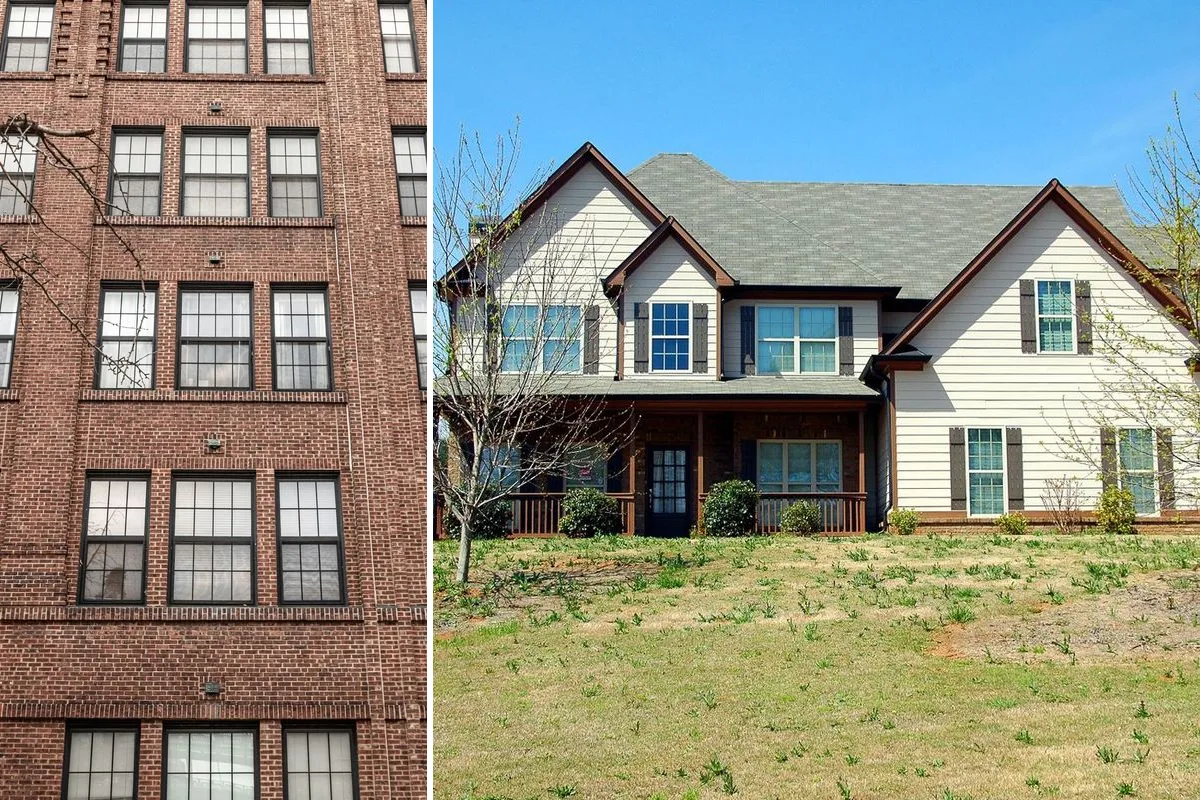
At today's average price of about 18 cents per kWh, a typical apartment uses about $94 of electricity a month and a typical detached house about $186, roughly double. The house is about 2.4 times larger and uses about twice the kWh, while the apartment uses more per square foot. These are my estimates from federal energy-use data, not a published bill average.
On this page
- What is the average electric bill for an apartment and for a house?
- Why does a house use about twice as much electricity?
- Do apartments cost more per square foot?
- Is the bill different for renters, or when electricity is included in the rent?
- How much does your state change the answer?
- What should you budget when you move?
- How was this calculated?
- FAQ
- Sources
People who move from an apartment to a house, or the other way, are often surprised by the electric bill in one direction or the other. The rule of thumb that a house costs about twice as much turns out to be close to right, but the reasons are more interesting than the ratio, and a few of them work against the apartment.
This guide uses the Energy Information Administration's 2020 Residential Energy Consumption Survey to compare the electricity use of apartments, houses, townhouses and mobile homes, and prices it at today's average rate. It also shows where the difference comes from, what changes for renters, and how much your state's price moves the answer. For the national picture by state, see my guide to the average electric bill by state.
What is the average electric bill for an apartment and for a house?
At the average residential price of 17.99 cents per kWh, an apartment in a building of five or more units uses about 6,093 kWh a year, or about $91 a month. A detached house uses 12,402 kWh, about $186 a month. Counting apartments of every building size together, the typical apartment is about $94 a month, 50% of the house figure.
| Home | Homes | kWh a year | A month | In 2020 |
|---|---|---|---|---|
| Detached house | 62% | 12,402 | $186 | $132 |
| Mobile home | 6% | 12,456 | $187 | $125 |
| Townhouse | 6% | 8,443 | $127 | $99 |
| Apartment, 2-4 units | 8% | 6,665 | $100 | $83 |
| Apartment, 5+ units | 18% | 6,093 | $91 | $74 |
Typical electric use and bill by type of home. "Homes" is the share of U.S. homes. "A month" is my calculation: the kWh a year from the 2020 federal survey, times 17.99 cents per kWh, divided by 12. "In 2020" is the monthly electric bill the survey itself reports, at 2020 prices.
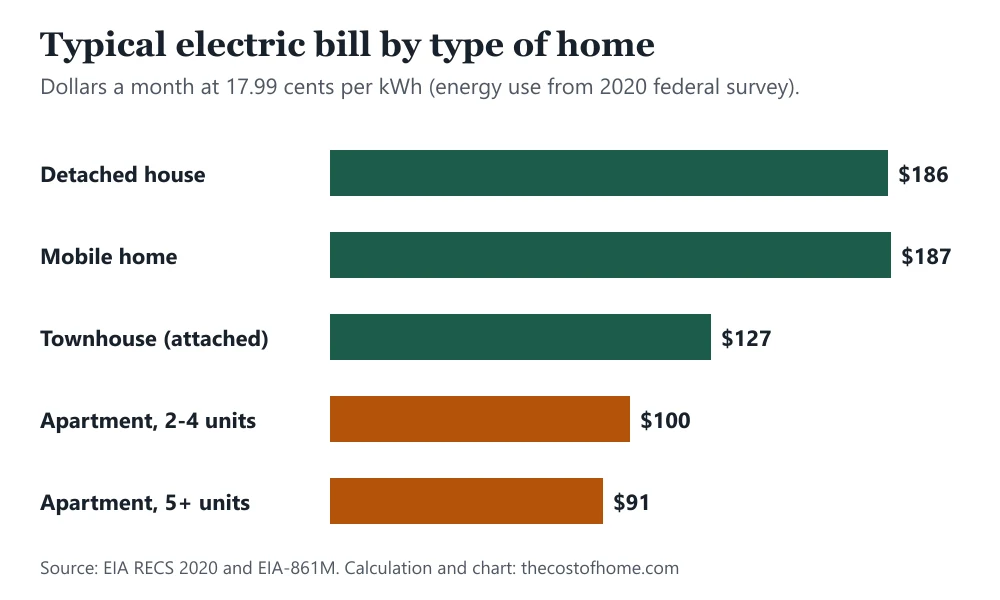
Two things to know about these numbers. First, they are my calculation: the survey measures how many kWh homes use, and I multiplied by the current national price, so they are an estimate of a current bill, not a published average. As a check, the same method applied to all homes gives about 10,580 kWh a year, or about $159 a month, close to the $156 a month the EIA's utility data shows for the average residential customer over the last 12 months. Second, the last column shows the bills the survey itself reported for 2020, which were lower because electricity cost less then. In 2020 the apartment bill was a little more than half the house bill, because apartments paid slightly more per kWh: by my arithmetic about 14 to 15 cents, against about 13 for detached houses. That means my current-price estimates for apartments may run a little low.
The mobile home is the quiet surprise. It uses nearly as much electricity as a detached house, 12,456 kWh a year, even though it is about half the size. The survey shows why: the average mobile home uses 2,360 kWh a year for heating and 2,532 for water heating, against 1,434 and 1,243 for the average house.
Why does a house use about twice as much electricity?
Mostly because it is bigger and has more to run. The average detached house in the survey has about 2,264 square feet, against about 905 in a building of five or more units. That is 2.5 times the space for about 2.0 times the electricity. The end-use breakdown shows where the extra kWh go.
| Use | House | Apartment |
|---|---|---|
| Air conditioning | 2,510 | 1,047 |
| Space heating | 1,434 | 829 |
| Water heating | 1,243 | 1,120 |
| Refrigerator | 973 | 547 |
| Everything else | 6,244 | 2,714 |
| Total | 12,402 | 6,259 |
Electricity used each year by the average home of each type, in kWh, from the 2020 federal survey. "Everything else" is the end uses the table does not list separately, such as lighting, electronics, cooking and laundry. A home that heats with gas shows little in the heating row, because that energy is not electricity.
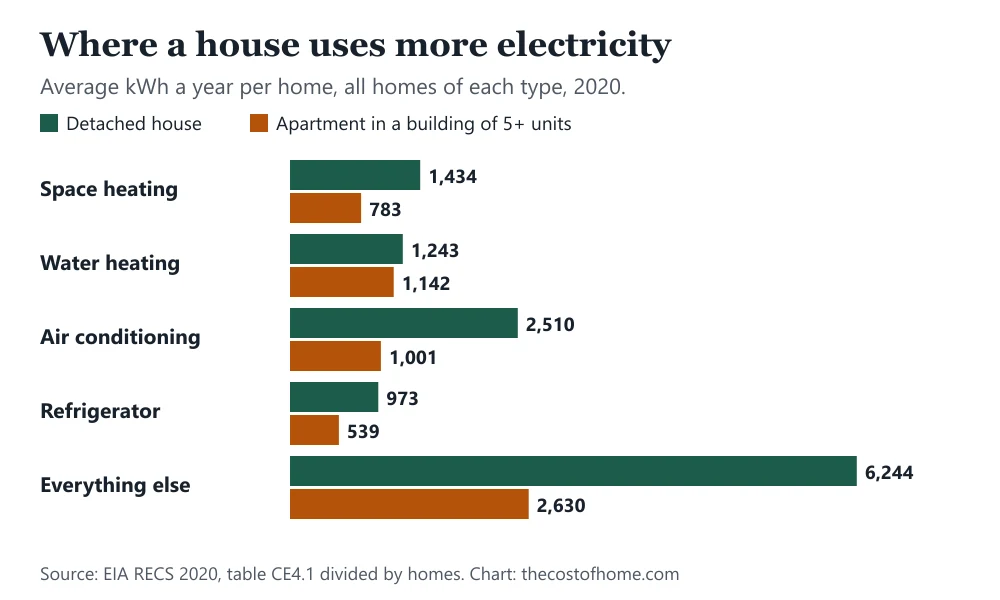
Air conditioning is the largest gap, with the house using about 2.5 times the kWh of an apartment in a large building. That fits what you would expect: more rooms to cool and more outside wall and roof. My central air conditioning guide prices that line by state. The heading "everything else" is the other large gap, 6,244 kWh against 2,714, which covers the lighting, electronics, cooking and laundry that grow with the number of rooms and people.
Water heating is where the two are closest, 1,243 kWh in the house and 1,120 in the average apartment, which I read as a sign that hot water follows the people in a home more than its floor area. If your water is heated with electricity, my guides to the clothes dryer and the washing machine show how laundry adds to it.
One caution on the heating row. It counts only electric heat. About 12% of a house's electricity goes to heating on average, but many houses and apartments heat with natural gas, propane or oil, and their heating shows up on a different bill. The survey shows the same direction for all energy together: the average apartment in a building of five or more units spent $1,107 a year on energy in 2020, against $2,205 for the average detached house. My numbers here are electricity only.
Do apartments cost more per square foot?
Yes, a little. An apartment in a building of five or more units uses about 6.7 kWh per square foot a year, and a detached house about 5.5, so the apartment uses about 23% more for each square foot. A townhouse is slightly below the house, at 5.2. I have left the mobile home out of this comparison because its square footage is reported by the household and its heating and cooling lean on electricity in a way that makes it a different case.
The survey does not explain the gap, so what follows is my reading. A small home still needs a refrigerator, a water heater, cooking and lighting, and those costs do not shrink in proportion to the floor area. A 900 square foot apartment has most of the fixed costs of a 2,300 square foot house with only a part of the space. In my opinion, that is the better way to think about it: the apartment is cheaper in total because it is smaller, not because each foot is cheaper to run. The refrigerator row fits this: the average apartment uses 547 kWh a year on it against 973 in the average house. That is 44% less, while the apartment has 59% less floor area.
Two limits apply to the comparison. The floor area in the survey is reported by the people who live in the home, not measured, so each square footage figure is approximate. And the per-square-foot numbers count electricity only: if houses and apartments use natural gas, propane or oil in different shares, part of the gap could come from that, and I did not separate it.

Is the bill different for renters, or when electricity is included in the rent?
Not much in an apartment, and more in a house. In the survey, apartment owners use about 6,345 kWh a year and apartment renters about 6,246, nearly the same. Among single-family homes, owners use about 12,246 kWh and renters about 10,802, about 12% less.
| Home | Owners | Renters |
|---|---|---|
| Apartment | 6,345 | 6,246 |
| Single-family house | 12,246 | 10,802 |
Electricity used each year by the average owner and renter household, in kWh, 2020. Renters include households that live in their home without paying rent.
A bigger difference is who pays. In the survey, 4.3 million homes, about 4% of all U.S. homes, have all of their energy bills included in the rent or condo fee, and another 6.3 million, about 5%, have some of them included. Those figures are for energy as a whole, not electricity alone, but they show why some apartment tenants never see an electric bill. If yours is included, the cost is still there, folded into the rent. When you compare listings, ask whether electricity is included, and at what monthly amount, and compare the total with a similar place where you pay it yourself.
How much does your state change the answer?
A lot, because the price per kWh runs from 12.3 cents in North Dakota to 44.3 cents in Hawaii. Pricing the same national usage at those rates gives the table below.
| Price of | Per kWh | Apartment | House |
|---|---|---|---|
| North Dakota | 12.3¢ | $64 | $128 |
| U.S. average | 18.0¢ | $94 | $186 |
| California | 32.3¢ | $169 | $334 |
| Hawaii | 44.3¢ | $231 | $458 |
The same use at different prices. The kWh are the national averages from the table above, for a detached house and for apartments of all sizes together, priced at each state's average residential rate for the 12 months ending August 2026. A real home in these states would use a different number of kWh, because climate differs.
Read it as the effect of price alone. The apartment is cheaper than the house in every row, but the size of the saving in dollars changes with the rate: about $92 a month at the national price, and about $227 a month at Hawaii's. Climate also changes the kWh, in both directions, and my guide to winter and summer electric bills by state shows how much. The electricity prices by state guide has the rate for every state.
What should you budget when you move?
- Ask for the last 12 months of usage. Many utilities will give the kWh for an address, and that is better than any average, mine included.
- Check what runs on electricity. Electric heat, an electric water heater, an electric dryer and central air each add a block of kWh from the table above. My guide to reading your electric bill shows where those appear.
- Look at the rate plan. Some utilities charge more at peak hours, which matters if you work from home. See my guide to time-of-use rates.
- Add the rest of the monthly cost. The house may also bring water, maintenance and association fees that an apartment does not. See the guides to water and sewer bills and HOA fees.
If you have a bill that looks high for your home type, my guide on why an electric bill is so high walks through the usual causes.
How was this calculated?
Annual kWh per home come from the EIA's 2020 Residential Energy Consumption Survey (RECS), table CE2.1, average electricity use by type of home. The end-use rows come from table CE4.1, which gives total electricity by end use for all homes of each type; I divided by the number of homes to get the average for each home, and converted Btu to kWh at 3,412 Btu per kWh. Square footage is from table HC10.1, total square feet divided by the number of homes, which is my arithmetic. The 2020 bills are from table CE2.6. The apartment figure combines the 2-4 unit and 5+ unit groups by number of homes.
The price is 17.99 cents per kWh, the average residential price from the EIA's monthly utility data for August 2025 through July 2026, the same one I use in my other electric bill guides. State prices are the 12-month averages through August 2026. These data are preliminary. The RECS data are from 2020, so they describe how homes used electricity then; prices have risen since, and usage can change with new appliances and weather. I used the most recent consumption tables available.
Frequently asked questions
What is the average electric bill for an apartment?
At today's average price of about 18 cents per kWh, a typical apartment uses about 6,259 kWh a year, which is about $94 a month. For an apartment in a building of five or more units it is about $91. This is my estimate from the EIA's 2020 survey, not a published bill average.
How much is the average electric bill for a house?
A detached house uses about 12,402 kWh a year, about $186 a month at today's national average price. A townhouse is lower, about $127 a month.
Is electricity cheaper in an apartment than in a house?
The bill is lower, about half, but the price per kWh is the same. An apartment uses less because it is smaller. Per square foot, apartments use about 23% more electricity than detached houses in the survey.
Why is my apartment electric bill high?
The usual causes are electric heat, an electric water heater, air conditioning in a hot climate, and a high rate in your state. Compare your kWh with about 522 kWh a month for the typical apartment. My guide on why an electric bill is so high covers the causes in order.
Is electricity included in rent?
Sometimes. In the 2020 survey, about 4% of U.S. homes had all their energy bills included in the rent or condo fee, and about 5% had some included. Ask the landlord, and compare the total with a place where you pay it yourself.
Why does a mobile home use as much electricity as a house?
In the survey, mobile homes use about 12,456 kWh a year, nearly the same as a detached house, though they are about half the size. The survey shows more electricity going to heating and water heating than in the average house.
Sources
- U.S. Energy Information Administration, Residential Energy Consumption Survey 2020, table CE2.1: annual household site fuel consumption, totals and averages, by type of home and ownership (accessed November 17, 2026)
- U.S. Energy Information Administration, RECS 2020, table CE1.1: summary annual household site consumption and energy expenditures, by type of home (accessed November 17, 2026)
- U.S. Energy Information Administration, RECS 2020, table CE2.6: annual household fuel expenditures, totals and averages (accessed November 17, 2026)
- U.S. Energy Information Administration, RECS 2020, table CE4.1: annual household site end-use consumption by fuel, totals (accessed November 17, 2026)
- U.S. Energy Information Administration, RECS 2020, table HC10.1: total square footage of U.S. homes (accessed November 17, 2026)
- U.S. Energy Information Administration, Electric Power Monthly and Form EIA-861M: residential sales, revenue and customers by state, August 2025 to August 2026 (preliminary; accessed November 17, 2026)

Founder and editor, The Cost of Home
I write and check every guide on this site myself, working from public data. The sources behind each number are listed at the end of the article, so you can check them too.