Energy Bills
Average Utility Bills per Month: Electric, Gas, Water and Sewer
Quick answer
The average U.S. home pays about $156 a month for electricity and about $60 for water and sewer, which is $216. A home that also buys natural gas adds about $84, for $300. Across all homes, the three together come to about $263 a month, because only about 56% of homes use gas. The total is highest in winter and lowest in spring. These sums are my own, built from federal data.

On this page
There is no single published number for what a household pays for utilities, because each bill comes from a different source and half the country does not have all three. What I can do is add the ones my guides already measure: electricity, natural gas, and water and sewer. This page puts those sums in one place, shows how they move through the year, and tells you where the totals are least reliable.
I left out trash, phone and internet, and heating oil and propane, which I cover in separate guides. Each bill below links to the full guide on that line. For the costs of owning a house beyond the bills, see my guide to the cost of owning a home per month.
What is the average utility bill per month?
For electricity, water and sewer together, about $216 a month. That is $156 for electricity, from the Energy Information Administration's utility data for August 2025 through July 2026, and $60 for water and sewer, from the Census Bureau's 2024 American Community Survey. Homes that also buy natural gas add about $84 a month, using the EIA's 2025 gas data, which brings those homes to about $300.
| Bill | A month | A year | Who pays it |
|---|---|---|---|
| Electricity | $156 | $1,878 | Nearly every home |
| Water and sewer | $60 | $720 | 70% of homes |
| Natural gas | $84 | $1,008 | About 56% of homes |
| Electric and water | $216 | $2,592 | Homes without gas |
| All three | $300 | $3,600 | Homes with gas |
The three bills for the typical U.S. home, in dollars a month. Electricity is the average of all residential customers. Gas is the average for homes that buy it from a gas utility. Water and sewer is the average for homes that pay a separate bill, one twelfth of the yearly amount.
The "average home" is a number to handle with care. Only about 56% of homes use gas, by my count of the EIA's residential gas customers against the Census household count, so the average across every home is $216 plus 56% of the gas bill, or about $263. No home pays that exact amount: yours is closer to $216 or to $300, depending on whether you have gas. If you heat with electricity, expect the electric line to be well above $156 in winter, which my guide to monthly heating bills by state covers.
How do these numbers compare with a household survey?
Closely, for two of the three. The Bureau of Labor Statistics runs the Consumer Expenditure Survey, which asks households what they spend, and its 2025 averages for all households are $157 a month for electricity, $47 for natural gas and $74 for water. The electricity figure matches the EIA's $156 almost to the dollar. The gas figure matches my $47 ($84 times 56%), which I did not tune to fit. That agreement tells me the way I count gas homes is about right.
| Line | All | Owners | Renters |
|---|---|---|---|
| Electricity | $157 | $183 | $110 |
| Natural gas | $47 | $58 | $26 |
| Water | $74 | $97 | $30 |
| Trash | $23 | $31 | $7 |
| All utilities | $411 | $491 | $265 |
What the Bureau of Labor Statistics survey found households spent in 2025, in dollars a month (yearly average divided by 12). Each figure averages every household in the group, including those that do not use the service, so gas and water look lower than a bill actually paid. The groups do not add to the total, which also covers items not shown.
Water is where the two sources differ. The BLS gives $74 a month, against my $60. The Census's American Housing Survey for 2023 puts the average at $71 for homes that pay a separate bill, which sits between them. I did not find out why the surveys differ, so I treat $60 as the low end of the range and the BLS and AHS figures as the high end. My guide to the average water and sewer bill shows both surveys side by side.
The same table is useful for a second reason: it shows owners and renters. Owners spend about $183 a month on electricity, renters about $110. The gap is bigger for water, $97 against $30, partly because many renters never get a water bill, since it comes with the rent. In the Census survey, 40% of renting households have water included, against 3% of owners.
How do the bills change from month to month?
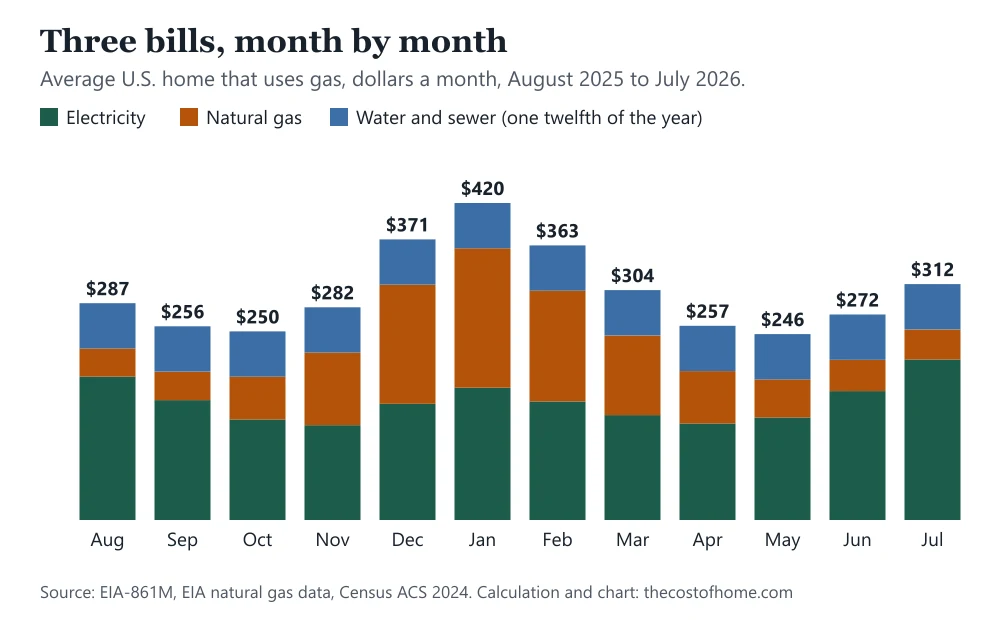
For a home with gas, the total runs from about $246 in May to about $420 in January, a swing of $174. Gas drives most of it, from $37 in August to $184 in January. Electricity has a smaller, two-peaked shape: about $212 in July, $125 at the bottom in November, and a second rise in winter.
| Month | Electric | Gas | Water | Total |
|---|---|---|---|---|
| Aug 2025 | $190 | $37 | $60 | $287 |
| Sep 2025 | $159 | $38 | $60 | $256 |
| Oct 2025 | $133 | $57 | $60 | $250 |
| Nov 2025 | $125 | $96 | $60 | $282 |
| Dec 2025 | $154 | $158 | $60 | $371 |
| Jan 2026 | $175 | $184 | $60 | $420 |
| Feb 2026 | $157 | $147 | $60 | $363 |
| Mar 2026 | $139 | $105 | $60 | $304 |
| Apr 2026 | $128 | $69 | $60 | $257 |
| May 2026 | $136 | $50 | $60 | $246 |
| Jun 2026 | $171 | $41 | $60 | $272 |
| Jul 2026 | $212 | $40 | $60 | $312 |
The same three bills for a home that uses gas, month by month. Electricity and gas are the national averages for that month. Water and sewer is the yearly average spread evenly, because I have no monthly water data.
Two cautions. The water line is flat because my source gives only a yearly amount, and real water bills rise in summer in many places, so the summer totals here are probably a little low. And the bills are national averages: a home in Florida and one in Minnesota do not follow the same curve. My guides to winter and summer electric bills and the natural gas bill by state give the shape for each state.
How much do utility bills change by state?
A lot, mostly through the electric line. Of the states and D.C., New Mexico has the lowest electricity-plus-water total, about $154 a month, and Hawaii the highest, about $316. That is a spread of $162 a month before gas. Gas widens it again where homes burn a lot of it.
| State | Electric | Water | No gas | Gas | With gas |
|---|---|---|---|---|---|
| New Mexico | $99 | $55 | $154 | $48 | $202 |
| Utah | $104 | $61 | $164 | $52 | $216 |
| Florida | $169 | $62 | $231 | $47 | $278 |
| Texas | $176 | $69 | $245 | $68 | $313 |
| Illinois | $132 | $62 | $194 | $93 | $287 |
| California | $161 | $87 | $248 | $66 | $313 |
| New York | $167 | $55 | $222 | $143 | $365 |
| Massachusetts | $182 | $69 | $251 | $162 | $413 |
| Hawaii | $224 | $93 | $316 | $90 | $407 |
Utility bills in nine states, in dollars a month. "No gas" is electricity plus water and sewer. "Gas" is the average bill of the homes that use it, and "With gas" adds it. Gas serves few homes in Florida and Hawaii, so the last column applies to a small share there.
Read the gas column as the bill of a home that has gas, not the average of all homes in the state. In New York and Massachusetts, where many homes heat with gas, the three bills together come to about $365 and $413, against $202 in New Mexico. In my opinion, the way to use this table is to find your state, then decide whether you are a "gas" or "no gas" home and read only that column. Gas figures for a few states are approximate, for the reasons given in the gas guide. The state-by-state rates behind the electric column are in my electricity prices by state guide.
What do owners and renters pay?
Owners pay more on every line in the Bureau of Labor Statistics survey, $491 a month for all utilities against $265 for renters. The survey does not say why, but in my opinion much of it is size, since owners tend to live in bigger homes, plus the bills that renters never see because they are rolled into the rent. It does not mean the same home costs more to own than to rent. If you are comparing a rental with a house, my guide to the electric bill for an apartment and a house separates the two for electricity, and the guide to HOA fees covers what a condo or association may bundle.

How do you work out your own total?
- Pull the last 12 months of each bill. Add them and divide by 12. A single winter or summer bill misleads, as the table above shows.
- Add the lines I left out. The BLS survey has trash at about $23 a month for all households and $31 for owners, and your phone and internet are on top of that.
- Compare each line with the table, not the total. A high total can hide one line that is out of range. My guides on reading an electric bill and reading a natural gas bill show what each charge means.
- Start with the line that moves most. For most homes that is gas in winter or electricity in summer. If the electric bill is the one that looks high, see why an electric bill is so high.
- Check whether you qualify for help. A winter bill that you cannot pay is what LIHEAP heating bill assistance exists for.
How was this calculated?
Electricity is the average residential bill from the EIA's monthly utility data (Form EIA-861M): residential revenue divided by residential customers, averaged over August 2025 through July 2026, preliminary. Natural gas is the EIA's residential price times residential volume, divided by residential customers, for calendar year 2025, and for the month-by-month figures the same calculation for August 2025 through July 2026. Water and sewer is the mean yearly cost reported by households that pay a separate bill in the Census Bureau's 2024 American Community Survey public-use microdata, divided by 12. All of these are from my own guides, where the methods are explained in full.
The share of homes with gas is the EIA's count of residential gas customers for 2024, 73.7 million, divided by the ACS count of 132.7 million households. A utility customer is not the same as a household, since a building can share one account, so I use the figure only for the national average and do not apply it to states. The sums, the three-bill totals and the shares are my arithmetic. The Bureau of Labor Statistics figures are annual means per household for 2025, read from the BLS public data API on November 17, 2026, for all households, homeowners and renters (series for electricity, natural gas, water, trash and all utilities). My page on how I research costs explains how I pick and check sources.
Frequently asked questions
What is the average utility bill per month?
About $216 a month for electricity, water and sewer, and about $300 for a home that also buys natural gas. Across all homes, since only about 56% use gas, the three bills come to about $263. These are my sums from EIA and Census data.
What is the average electric bill per month?
About $156, from the EIA's utility data for August 2025 through July 2026. The Bureau of Labor Statistics survey for 2025 gives $157 for all households, which agrees closely.
What is the average gas bill per month?
About $84 for homes that buy natural gas from a utility, in the EIA's 2025 data. It swings from about $37 in August to about $184 in January. Because many homes use no gas, the average across all households is closer to $47.
What is the average water and sewer bill per month?
About $60 in the Census Bureau's 2024 American Community Survey, for homes that pay a separate bill. Other surveys run higher: the American Housing Survey gives about $71, and the Bureau of Labor Statistics about $74 across all households.
Which month has the highest utility bills?
For a home that uses gas, January, at about $420 for the three bills together, driven by gas for heating. The lowest is May, at about $246. For a home without gas, summer is the high point, because of air conditioning.
Do utilities include internet, phone and trash?
Not in my totals. I count only electricity, natural gas, and water and sewer. In the Bureau of Labor Statistics survey, trash alone averages about $23 a month, and phone and internet are separate again.
Are utilities included in rent?
Often for water, less so for electricity. In the Census survey, about 40% of renting households have water and sewer included in the rent, against about 3% of owners. Ask the landlord what is included before you compare listings.
Sources
- U.S. Energy Information Administration, Electric Power Monthly and Form EIA-861M: residential sales, revenue and customers by state, August 2025 to July 2026 (preliminary; accessed November 17, 2026)
- U.S. Energy Information Administration, Natural Gas Consumption by End Use: residential volume, price and customers, 2025 and August 2025 to July 2026 (accessed November 17, 2026)
- U.S. Census Bureau, American Community Survey 2024 1-year Public Use Microdata Sample, housing records: yearly cost of water and sewer (accessed November 17, 2026)
- U.S. Census Bureau and HUD, American Housing Survey 2023: water and sewer paid separately, mean $71 a month (accessed November 17, 2026)
- U.S. Bureau of Labor Statistics, Consumer Expenditure Surveys, 2025 annual means for all households, homeowners and renters: electricity, natural gas, water, trash and utilities (read from the public data API on November 17, 2026)

Founder and editor, The Cost of Home
I write and check every guide on this site myself, working from public data. The sources behind each number are listed at the end of the article, so you can check them too.